Quenching vs Tempering vs Annealing vs Normalizing: Steel Heat Treatment
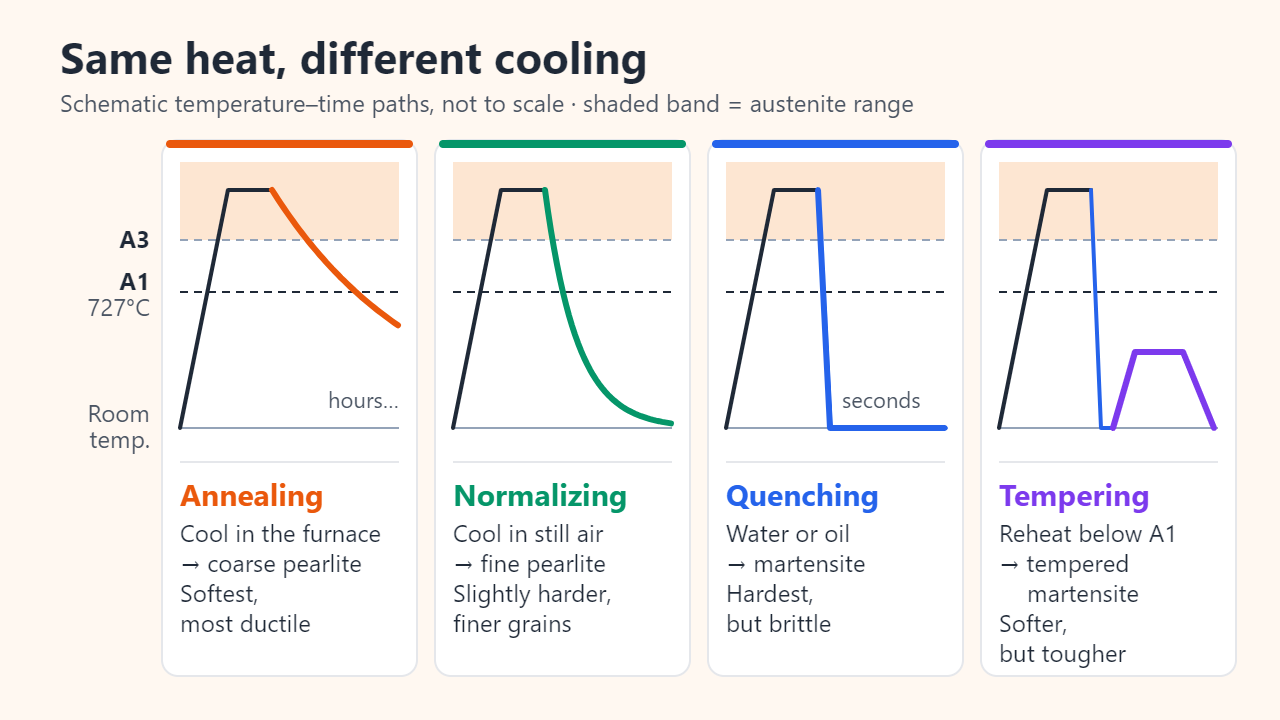
Annealing, normalizing, quenching and tempering all change steel with heat, and what mainly separates them is how the steel cools afterward. The first three heat the steel until it turns into austenite: annealing then cools it slowly inside the furnace for the softest result, normalizing cools it in still air for a slightly harder, finer structure, and quenching plunges it into water or oil to create hard but brittle martensite. Tempering is the follow-up to quenching: the steel is reheated below 727°C to trade some of that hardness for toughness.
Why heat changes steel: austenite and the 727°C line
Steel is iron with a small amount of carbon. Iron's crystal structure changes with temperature, and the high-temperature form can hold far more carbon than the room-temperature form. Every heat treatment exploits that mismatch. The structures to know:
- Ferrite (α): body-centered cubic iron, stable at room temperature, dissolving at most about 0.022 wt% carbon. Soft and ductile.
- Austenite (γ): face-centered cubic iron, stable when hot, dissolving up to 2.14 wt% carbon.
- Cementite (Fe3C): a hard, brittle iron carbide containing about 6.7 wt% carbon.
- Pearlite: not a single phase but alternating thin plates of ferrite and cementite, formed when austenite cools slowly.
- Martensite: a non-equilibrium structure that appears when austenite cools too fast for its carbon to escape.
On the iron–carbon phase diagram, the line that matters most is A1 at 727°C, the eutectoid temperature (alloying elements shift it somewhat). A steel with 0.76 wt% carbon, the eutectoid composition (some references give 0.77 or 0.8 wt%), turns completely into pearlite when it cools slowly through this line. Steels with less carbon, which covers most structural and machine steels, become fully austenitic only above a second line, A3. A3 falls from 912°C for pure iron to 727°C at 0.76 wt% C; for higher-carbon steels the matching boundary, Acm, climbs to 1148°C at 2.14 wt% C.
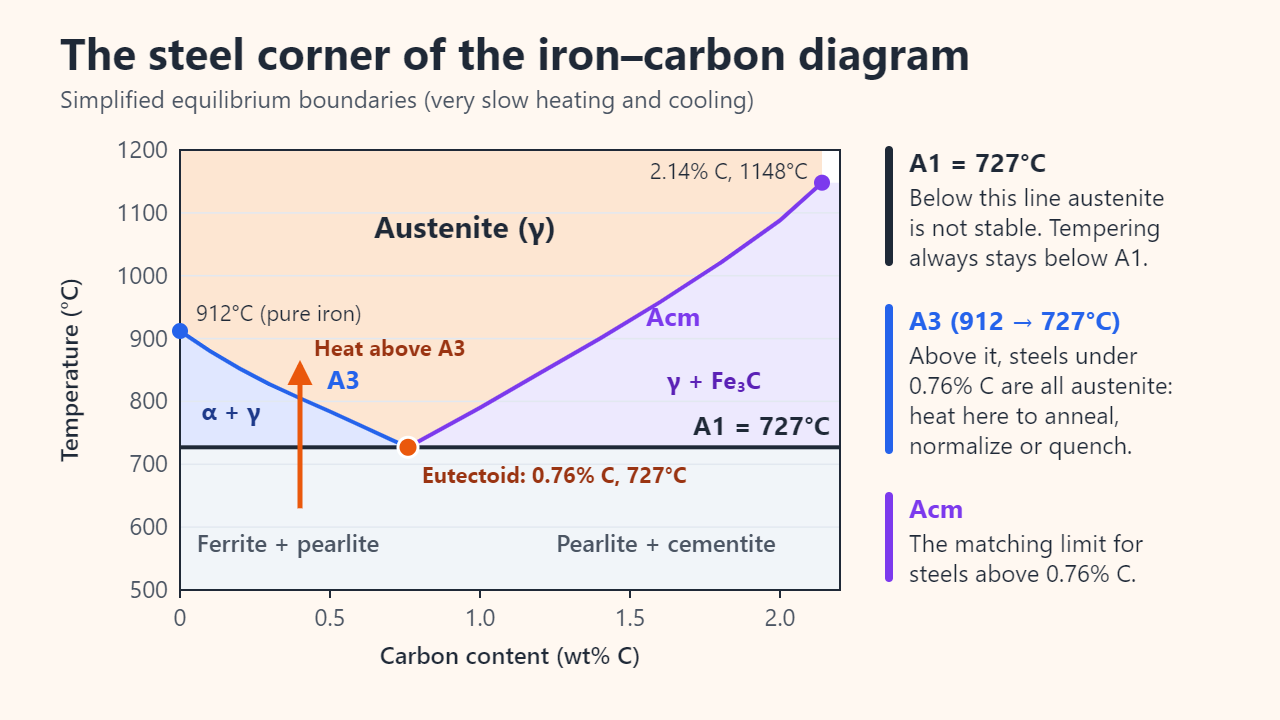
Every treatment comes down to two choices: how hot to heat the steel and how fast to cool it.
Quenching: trapping carbon in martensite
Quenching, also called hardening, first soaks the steel in the austenite range until its structure is uniform, then cools it faster than the steel's critical cooling rate, typically in water, brine or oil. At that speed the carbon atoms cannot diffuse out to form pearlite. Instead, the iron lattice changes structure in a diffusionless transformation, producing martensite: a body-centered tetragonal iron crystal supersaturated with trapped carbon.
Martensite is the hardest, strongest condition a given steel can reach, but as-quenched it is brittle and loaded with internal stress. Severe quenches, abrupt section changes and sharp corners invite distortion and quench cracks, so quenched parts are almost never used untempered. The quenchant must match the steel's hardenability: plain carbon steels usually need a drastic water or brine quench, while many alloy steels harden in gentler oil.
Tempering: trading hardness for toughness
Tempering reheats quenched steel to a temperature below A1, holds it there, and cools it again. Because the steel never returns to the austenite range, the hardening is not erased. Instead, the trapped carbon precipitates as fine carbides, internal stresses relax and the structure gradually recovers. In plain carbon steels, hardness falls steadily as the tempering temperature rises while toughness generally improves. Steels containing strong carbide formers such as chromium, molybdenum or vanadium can regain hardness at higher temperatures as alloy carbides precipitate, an effect called secondary hardening.
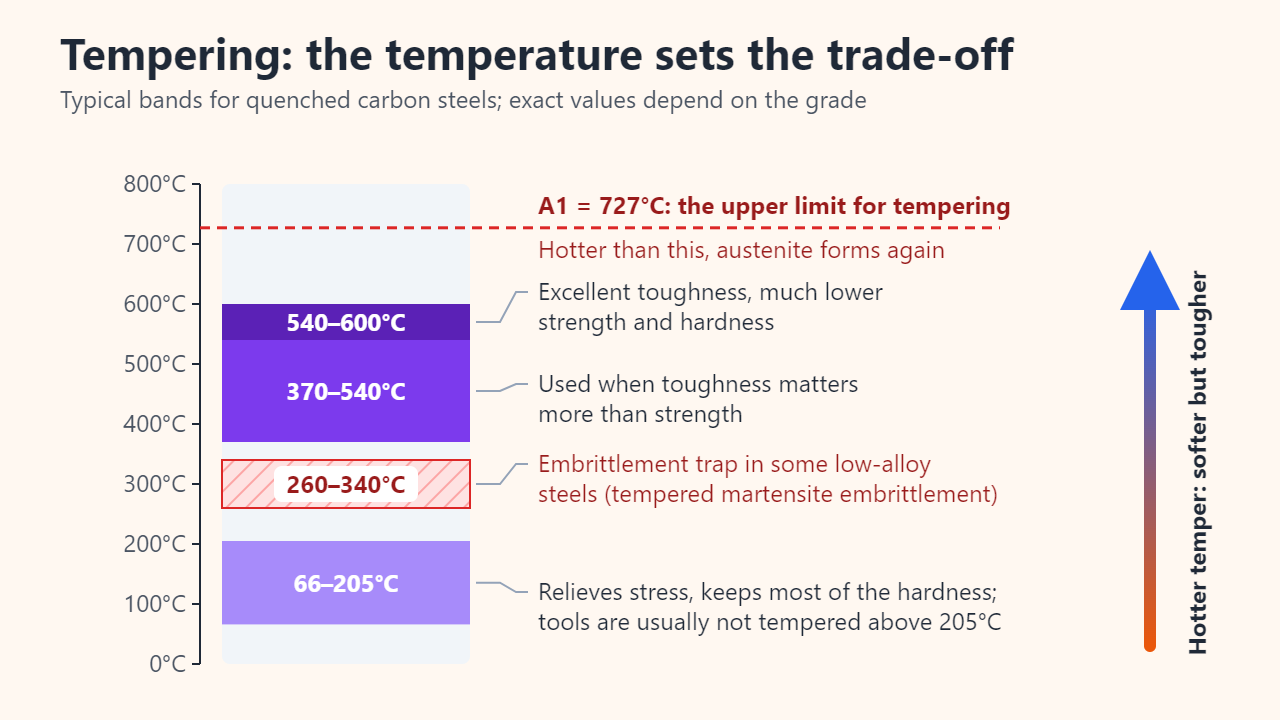
Typical bands for quenched carbon steels:
- About 66–205°C: relieves stress while keeping most of the hardness. Tools that need strength more than toughness are usually not tempered above 205°C.
- About 260–340°C: avoided for some low-alloy steels, which lose ductility in this range (tempered martensite embrittlement).
- 370–540°C: chosen when toughness matters more than strength.
- 540–600°C: excellent toughness, but substantially lower strength and hardness.
Annealing vs normalizing: same heat, different cooling
Annealing and normalizing both austenitize the steel and let it transform back into pearlite (with some ferrite or cementite), so in ordinary carbon steels neither one creates martensite. The real difference is how fast the heat leaves.
Full annealing cools the steel very slowly, usually inside the switched-off furnace or buried in hot sand. The austenite becomes coarse pearlite, leaving the steel soft and ductile, ideal for machining or cold forming. Normalizing takes the hot part out of the furnace to cool in still air. The faster cooling produces finer pearlite and a more uniform structure throughout the part, so normalized steel ends up slightly harder and stronger. Normalizing is also cheaper than annealing, and the result is often still adequate for machining.
“Annealing” is also an umbrella term: process and stress-relief annealing stay below A1 to soften cold-worked steel or relax residual stress, and spheroidizing uses long holds near A1 to turn cementite into small globules, an even softer structure that makes high-carbon steel easier to machine.
Side-by-side comparison
| Treatment | Heating | Cooling | Resulting structure | Effect | Typical purpose |
|---|---|---|---|---|---|
| Full annealing | Into the austenite range (above A3 for steels under 0.76% C) | Very slow, in the furnace | Coarse pearlite (plus ferrite or cementite) | Softest, most ductile | Machining, cold forming |
| Normalizing | Into the austenite range | Still air | Fine pearlite, uniform grains | Slightly harder and stronger than annealed | Refining the structure of forged or rolled parts |
| Quenching (hardening) | Into the austenite range | Faster than the critical cooling rate: water, brine or oil | Martensite | Hardest, but brittle | First step of hardening |
| Tempering | Below A1 (727°C) | Usually in air | Tempered martensite | Some hardness lost, toughness regained | Making quenched parts usable |
Worked example: four treatments on AISI 1040 steel
A teaching lab from Purdue University, published on NASA's Technical Reports Server, runs all four treatments on AISI 1040, a plain carbon steel with about 0.40% carbon:
- Heat every sample to 1650°F (about 899°C), above this steel's A3, and hold for about an hour.
- Annealing: switch off the furnace and let the sample cool inside it.
- Normalizing: take the sample out and let it cool in still air on a metal grating.
- Quenching: plunge the sample into cold water and agitate it so steam bubbles do not insulate the surface.
- Tempering: reheat a quenched sample to 900°F (about 482°C, within the 370–540°C band) for one hour, then let it cool in air.
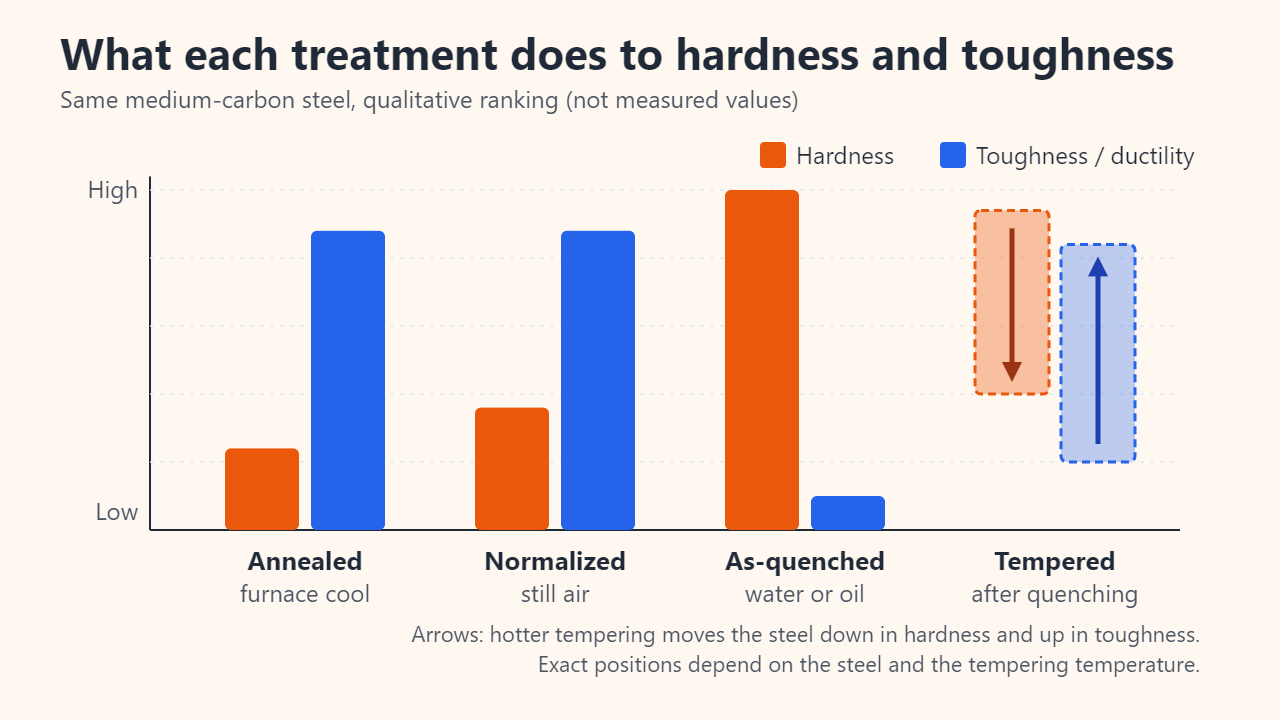
The handout lists no results, but expect the ranking in Figure 4: annealed softest, normalized slightly harder, as-quenched hardest, tempered somewhere below as-quenched.
FAQ
Is tempering the same as annealing?
No. Tempering is applied to quenched steel and stays below A1, so it keeps much of the hardness gained by quenching. Full annealing re-forms austenite and cools slowly, erasing earlier hardening and leaving the steel soft.
Why not use steel straight from the quench?
As-quenched martensite is hard but brittle and full of internal stress, so parts can crack in service or even on the bench. Quenched parts are normally tempered promptly, even if only at a low temperature.
Is normalized steel harder than annealed steel?
Slightly. Air cooling produces finer pearlite, so normalized steel is a bit harder and stronger, but it remains far softer than quenched steel.
Can air cooling ever harden steel?
For plain carbon steels, air cooling is normalizing, not hardening. Air-hardening tool steels are the exception: their alloying slows the transformation so much that still air is fast enough to form martensite.
Sources: University of Washington MSE 170 lecture notes on the Fe–C system; E. L. Widener (Purdue University), “Heat-Treating of Materials,” NASA Technical Reports Server; H. K. D. H. Bhadeshia, “Tempered Martensite,” University of Cambridge; Wikipedia: Tempering (metallurgy).
Related reading
Original illustrations created to help explain this article.