Reading Carbon-Steel Designations: Carbon Content and Heat-Treatment Conditions
This article was translated from its source language with AI assistance. Please check technical terms and equations against the original.
A steel-grade name in a component's material field can make it seem that every mechanical property is determined. However, composition ranges, actual delivery condition, product dimensions, and test conditions need separate confirmation. Even sources using the same name can lead to different judgments depending on the conditions associated with their numbers.
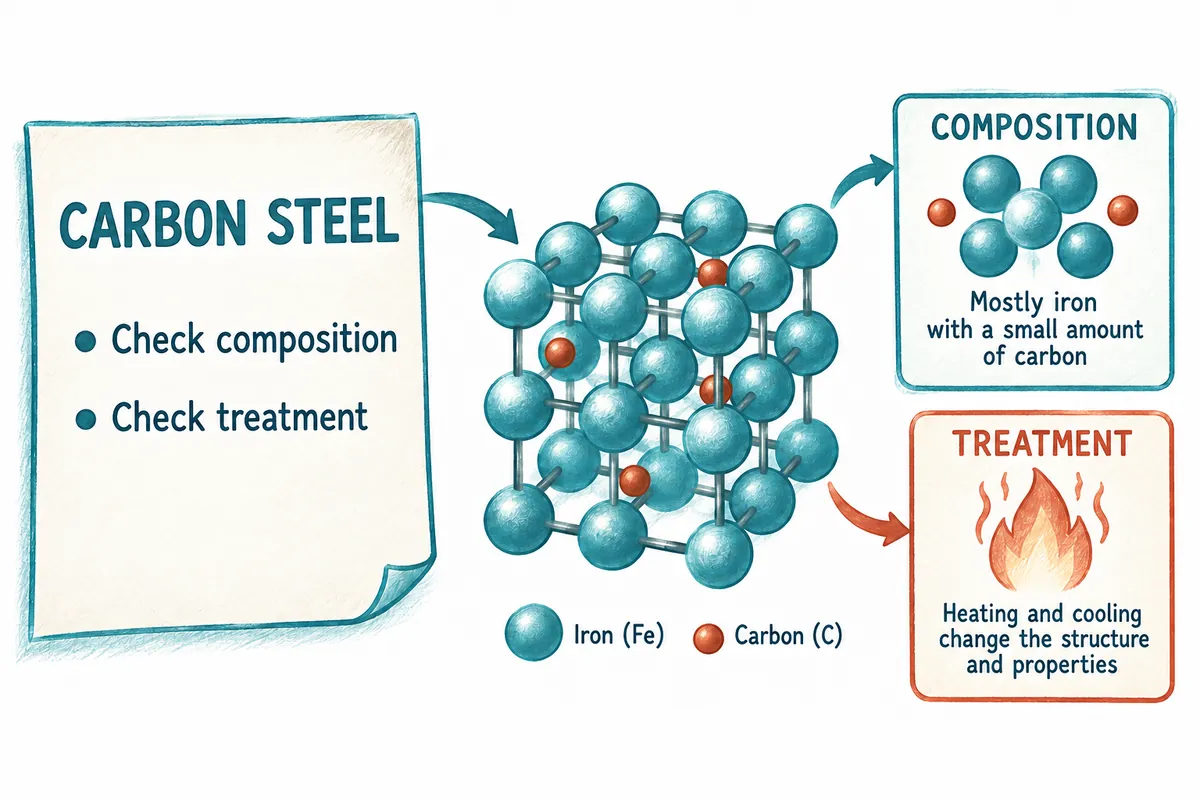
This article uses manufacturer information for C45 to explain reading material designations. It does not approve substitute materials for specific components or prescribe heat-treatment processes. Hypothetical orders and carbon-mass calculations are illustrative, not results of analyzing purchased materials or performing tensile or hardness tests.
The sequence for reading carbon-steel data at a glance
Explanatory illustration — not an actual screen or test result.
1. Identify grade, standard, and manufacturer's product entry
2. Distinguish composition ranges, typical values, and measurements
3. Check delivery condition, such as as-rolled, normalized, or quenched and tempered
4. Compare dimensions, tests, and property conditions in the same row
5. Record connections between order requirements and inspection evidence
1. Add standard and product information to the grade name
First record the material name, standard and edition, manufacturer, product shape, and dimensions. Read which product the datasheet covers. Similar names for bars and sheets do not automatically extend one product's test values to delivered material of another form.
Ovako introduces C45 as a medium-carbon steel and lists several manufacturer variants separately. Thus, a shared broad grade name still leaves specific variants and composition ranges to examine. Before selecting a table row, identify which product entry you are reading.
| Information to check | Illustrative record | Why it is needed |
| Steel grade | C45 | Starting point for the material family |
| Standard | Standard and edition specified in the order | Connection to requirements |
| Product | Bar and actual dimensions | Applicability of the property table |
| Manufacturer variant | Actual supplied product entry | Distinguishing composition and processing conditions |
| Delivery condition | As-rolled, normalized, quenched and tempered, etc. | Conditions attached to properties |
A similar-material table across standards does not establish delivery substitution. Compare actual permissible ranges and test requirements for the order. A renamed correspondence table alone cannot prove identical composition, heat treatment, and guaranteed properties.
2. Carbon content can be a range, not one number
The same Ovako information lists carbon ranges of 0.42–0.50% for SB1672 and 0.46–0.49% for SB8673. These values belong to those manufacturer entries, not a universal range for every C45 product. They demonstrate why actual row minima and maxima matter beyond the designation.
Read typical composition, permitted range, and actual analysis separately. A typical value may describe the product's usual composition; a range gives condition boundaries. Verify the supplied batch's composition using inspection information linked to that material. A typical value does not make every delivered material's measured value identical.
If a hypothetical inspection record states 0.45% carbon and the order specifies a separate permitted range, compare against that range. Do not read the number in the grade name directly as a measurement. If the analysis target or units are missing, establish what was analyzed before applying the result.
3. Understand mass percent through calculation
Assume an illustrative 50 kg material contains 0.45% carbon by mass. Carbon mass is 50 kg × 0.0045 = 0.225 kg, or 225 g. 0.45% is not 45%, nor a multiplier of 0.45. Conversion from percentage to decimal is needed.
| Illustrative conditions | Calculation | Carbon mass |
| 50 kg, 0.45 mass% | 50 × 0.0045kg | 0.225kg = 225g |
| 10 kg, same proportion | 10 × 0.0045kg | 0.045kg = 45g |
This illustrates the relationship between total mass and proportion. It cannot establish the structures containing that carbon or the component's hardness and tensile strength. Do not automatically attach test values to a composition calculation.
Check composition-table units as well. Mass fraction and atomic fraction cannot be read as the same number. This example explicitly assumes mass%, so an actual table requires checking its units and target before use in calculations.
4. Distinguish as-rolled, normalized, and quenched-and-tempered conditions
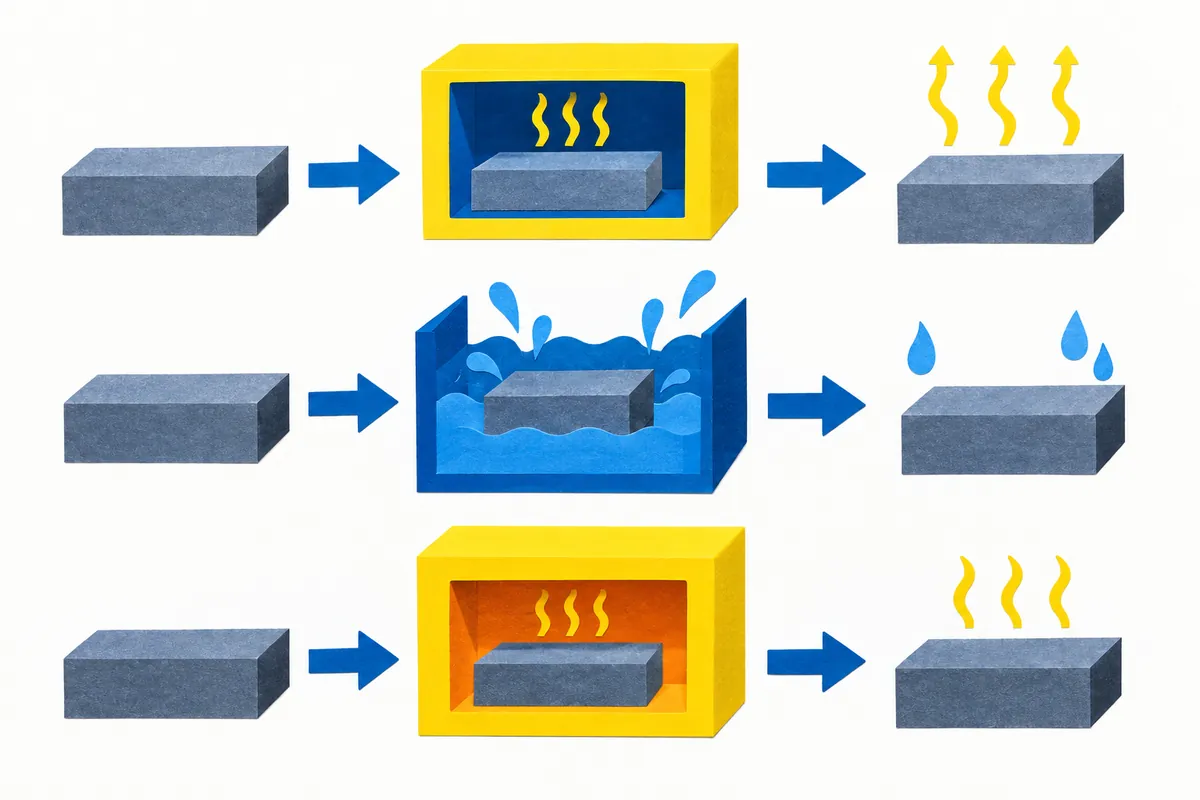
Ovako identifies +AR as as-rolled, +N as normalized, and +QT as quenched and tempered. Read condition symbols with the explanation on that page. Similar symbols in another manufacturer's table still require checking its legend.
Suppose hypothetical delivery document A states C45 as-rolled and B states C45 quenched and tempered. Matching grade names can still require different rows of property data. Values associated with B's condition do not establish that A guarantees those properties.
Knowing one heat-treatment temperature does not determine the final condition. Reviewing a process requires heating, holding, cooling, subsequent treatment, and product conditions. If your purpose is understanding a datasheet, begin by connecting process names to the states in which numerical values apply.
5. Read dimensions and test conditions in the same property-table row
Tensile strength, yield strength, and hardness are different properties. Once you find a number, check its column heading, units, and row's shape, dimensions, and condition. Do not change a hardness scale or transcribe a hardness value as guaranteed tensile strength.
If hypothetical comparison sources show different strengths for C45, first list heat-treatment condition, product size, and test type side by side. Different numbers alone do not establish an erroneous source. If differences remain after matching conditions, check detailed manufacturer or standard requirements.
Minimum, range, and typical values serve different purposes. Arbitrarily choosing a range's midpoint as a guarantee changes requirements. If an order requires minimum properties, link that demand to actual inspection and guarantee evidence. Leave absent values unverified.
6. Recheck the starting condition after processing
A material designation may identify the starting material. Subsequent heat treatment or welding may require further process and inspection information to describe the final component. Do not confuse delivered raw-material conditions with the whole finished component's state.
Nippon Steel's welding Q&A explains that rapid welding heating and cooling in machinery structural materials such as S45C can harden the heat-affected zone and cause cracking problems. This shows why a carbon-steel name alone cannot determine arbitrary welding conditions. This article does not transfer the source's temperature table into component-specific work instructions.
If hypothetical component B undergoes joining, connect its original material state, joined region and performance requirements, process used, and necessary verification results. Do not report unmeasured heat-affected-zone hardness as whole-component hardness. Material and final-state tables must describe matching targets for comparison.
7. Identify missing fields specifically when questioning suppliers
For a drawing listing only a material name, ask more specifically than “Is this material good?” Ask about the applicable standard, composition range, delivery condition, size-dependent properties, and links to inspection data. Application requirements must match design and review documents.
| Missing information | Example question |
| Standard edition | Which standard applies to this delivery? |
| Manufacturer variant | Which product entry is this? |
| Delivery condition | In what condition is it supplied? |
| Property conditions | What guarantees apply to these dimensions and condition? |
| Inspection linkage | What inspection information is linked to this material? |
Connect actual drawing or order requirements to inquiries. Do not present invented conditions from a hypothetical table as actual order requirements. If information has not arrived, mark it “unverified” so follow-up checks can identify what needs filling.
8. Build a one-page material summary
Include grade, standard, product, composition, delivery condition, property conditions, and inspection evidence in order. Label composition as typical, a range, or measured; place units and test conditions beside property values. This is easier to compare with the original than a detached name and number.
C45 figures here are confined to checked manufacturer entries, while the 50 kg calculation is a separate hypothetical mass-ratio example. Manufacturer model graphs are not described as measurements of the reader's component. Distinguishing actual inspection from explanatory material preserves the summary's meaning.
The material name is the starting point for finding information. Reading the nature of carbon values and connecting heat treatment, product, and test conditions in the same row clarifies which properties can actually be compared. The illustrations show this reading sequence, not a particular material's micrograph or experimental results.
Official sources and writing standards
- Ovako: C45 material data sheet — Chemical composition and condition codes
- Nippon Steel Welding: Q058 — Welding S45C and machine structural steels
References checked: 2026-10-07. This explanation was written with AI assistance based on official sources actually opened. Separately marked calculations, code, and checking examples are illustrative, not results from directly testing or measuring the user environment. Recheck changes to features and references on the publication date.
Original illustrations created to help explain this article.
Original on Tistory ↗