What Is Brittleness? Differences from Toughness and Ductility, and Interpreting Charpy Tests
This article was translated from its source language with AI assistance. Please check technical terms and equations against the original.
Brittleness means little plastic deformation before fracture; toughness is the ability to absorb energy until fracture. Ductility is the capacity to deform before fracture. This article explains their differences and how to read Charpy impact tests.
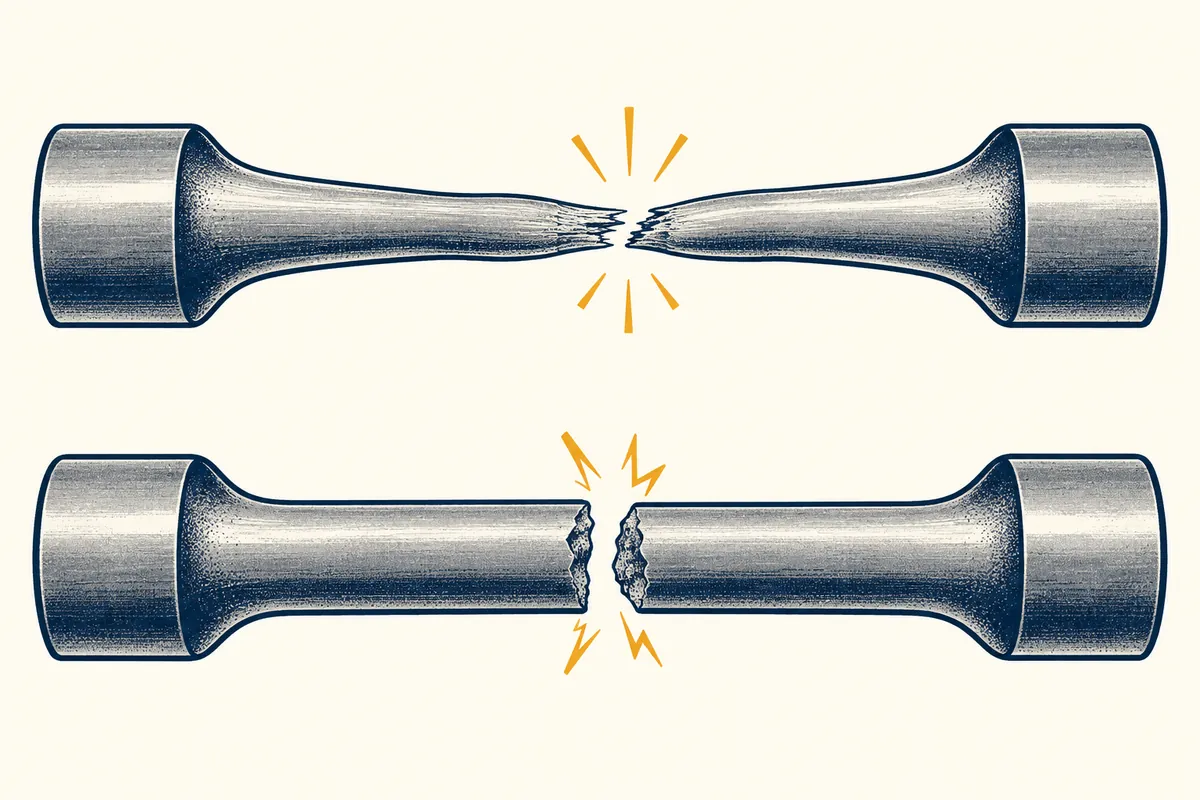
If strength and hardness are also confusing, read the strength–hardness comparison and, for basic curve terms, the stress–strain curve explanation together.
1. Basic Concepts of Toughness and Brittleness
1.1 What Is Toughness?
Toughness is a material's ability to absorb energy until fracture. The area under a tensile stress–strain curve up to fracture represents absorbed energy per unit volume. Toughness reflects both strength and deformation capacity, so elongation alone cannot determine it.
- Characteristics:
- High ductility: Highly ductile materials stretch or bend readily under external loads; this is common in metals such as carbon steel.
- Combination of strength and deformation capacity: Even large deformation may absorb little energy before fracture if strength is very low.
- Check evaluation conditions: Tensile toughness, impact-test absorbed energy, and fracture toughness measured with cracked specimens are different quantities. Distinguish test methods and conditions.
- Toughness evaluation factors:
- Elongation and reduction of area
- Resistance to impact loading
- Analysis of crack initiation and propagation
- Representative materials:
- Metals: Stainless steel and low-carbon (mild) steel
- Nonmetals: Polymers and composites
- Applications: Vehicle bodies, structural steel, and aircraft fuselages
1.2 What Is Brittleness?
Brittleness means little plastic deformation before fracture. Elastic deformation may still occur before brittle fracture, so it does not mean “no deformation at all.” Brittleness must not be equated with high or low strength.
- Characteristics:
- Fracture after little plastic deformation: Compared with ductile fracture, deformation is small and failure may occur without obvious deformation warning.
- Check absorbed energy: Low energy under identical test conditions can suggest brittle behavior, but specimen size, notch, and temperature must also be checked.
- Strength and brittleness are separate: High strength alone does not establish impact resistance; examine deformation capacity before fracture too.
- Brittleness evaluation factors:
- Ductile-to-brittle transition temperature (DBTT)
- Charpy and Izod impact-test results
- Microcrack analysis and fracture-mode observations
- Representative materials:
- Metals: Cast iron and high-carbon steel
- Nonmetals: Ceramics, glass, and concrete
- Applications: Building materials, semiconductor components, and pottery
2. Differences Between Toughness and Brittleness
This table summarizes concepts, not universal judgments of test values for every material.
| Category | Toughness | Brittleness |
| Deformation behavior | Ductile and able to deform | Fractures with almost no deformation |
| Impact resistance | Can absorb high energy | Low energy absorption |
| Fracture mode | Ductile fracture | Brittle fracture |
| Main applications | Vehicle bodies and aircraft structures | Ceramics, glass, and concrete |
3. Measuring Toughness and Brittleness
Various tests evaluate these properties. Common methods follow.
3.1 Impact Testing
Impact testing is a representative method for evaluating toughness and brittleness. Common tests include Charpy and Izod tests.
- Charpy Impact Test
- A central V-notch is made in the specimen; a hammer released from a set height strikes it to measure fracture energy.
- Highly brittle specimens break suddenly at the notch, while tougher specimens deform to some extent before fracture.
- Izod Impact Test
- Impact is applied to a vertically clamped specimen.
- Mainly used to evaluate brittleness in plastics and composites.
Measurement criteria:
- Impact resistance energy in joules
- Test temperature and environmental effects
3.2 Tensile Testing
Tensile tests measure deformation capacity and strength under tension and can evaluate brittle behavior.
- Ultimate tensile strength (UTS)
- Yield strength
- Elongation
4. Interpreting Impact-Test Results
Impact results are important indicators of toughness and brittleness. They analyze behavior under external impact and assess stability in particular environments. Identifying ductile-to-brittle transition temperatures is especially useful for predicting low-temperature performance.
4.1 Interpreting Charpy Results
Charpy tests measure energy absorbed by steel alloys at various temperatures to analyze behavior.
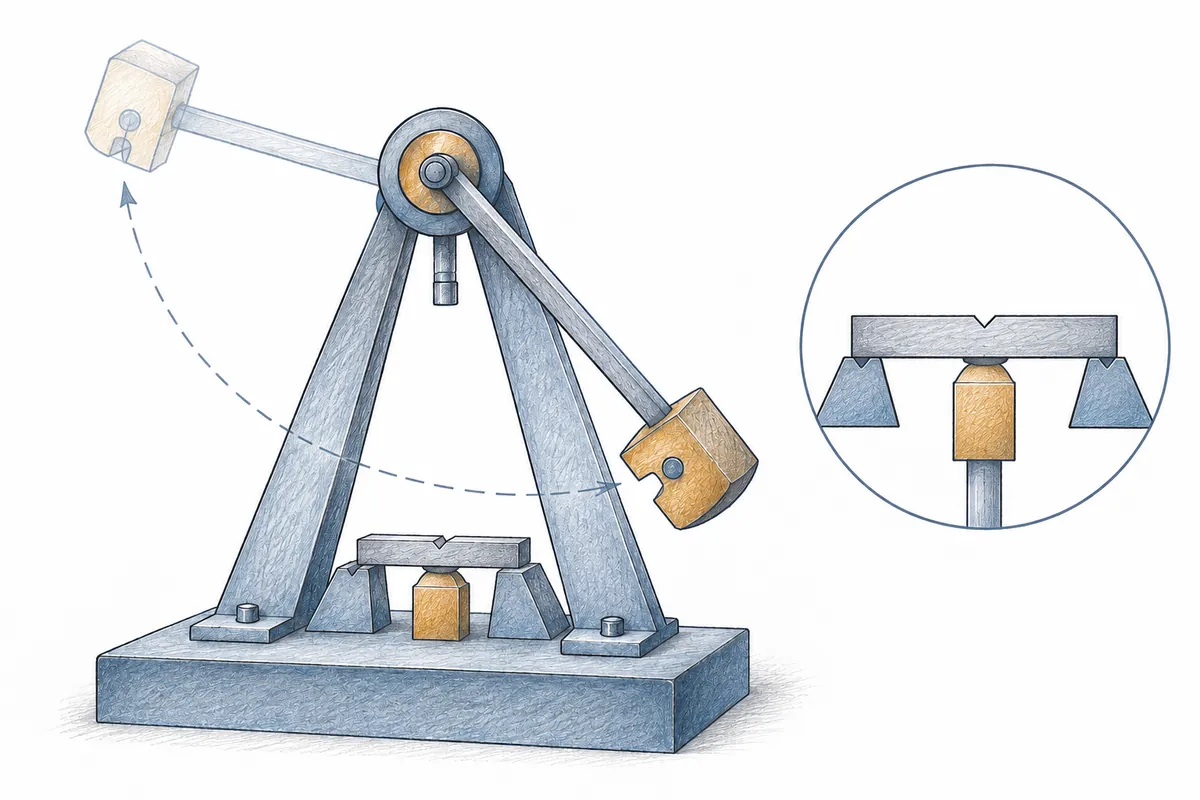
The table below shows conceptual trends, not actual measurements. Energy–temperature relationships vary by steel and conditions. Numbers without sources and specimen details cannot establish a particular steel's transition temperature.
| Region | Absorbed-energy trend | Fracture behavior |
| Lower-temperature side | Lower shelf: relatively low | Brittle behavior may dominate |
| Transition region | Large temperature dependence and scatter | Ductile and brittle fracture may coexist |
| Higher-temperature side | Upper shelf: relatively high | Ductile behavior may dominate |
- DBTT is defined using a chosen criterion such as absorbed energy or fracture-surface shear percentage. It means fracture behavior changes with temperature, not necessarily that a phase transformation or microstructural change occurs there.
- Some ferritic steels show transitions with pronounced low-temperature brittle behavior. The same transition temperature or curve cannot apply to every metal and steel.
- Such tests are essential for quality control of materials potentially exposed to low temperatures, including aircraft, building structures, and automotive components.
4.2 Interpreting Tensile Results
Test item Ductile material Brittle material
| Test item | Ductile behavior | Brittle behavior |
| Yield strength | Cannot infer from ductility alone | Cannot infer from brittleness alone |
| Elongation | High | Low |
| Fracture characteristics | Progressive deformation | Sudden fracture |
- Ductile materials deform progressively under load and substantially before fracture.
- Materials showing brittle behavior may have little plastic deformation before fracture. Fracture timing is not determined simply by exceeding an elastic limit.
- Results inform material-design selection for the environmental conditions under load.
5. Toughness and Brittleness in Different Industries
5.1 Automotive Industry
Balancing toughness and brittleness matters greatly for vehicle safety and durability.
- Vehicle bodies:
- Bodies must absorb crash energy to protect occupants. Tough materials such as aluminum alloys and high-strength sheet steel are used. Deformation distributes impact and maintains structural integrity.
- Examples: Major manufacturers such as Hyundai and Tesla use tough materials in body design to improve crash-test performance.
- Engine blocks:
- Blocks need stable performance at high temperature and pressure. Brittle materials such as cast iron are commonly used. Cast iron has high compressive strength but low toughness and may be vulnerable to sudden impact.
- Examples: Widely used in diesel and heavy-truck engines.
5.2 Construction and Civil Engineering
Appropriate combinations of toughness and brittleness are essential for safety and durability.
- Reinforced concrete:
- Steel reinforcement is tough and ductile, while concrete supplies high compressive strength but is brittle. Combining them complements their properties to improve strength and earthquake resistance.
- Examples: High-rise buildings, bridges, and tunnels.
- Windows:
- Glass is hard but brittle and readily broken by impact. Buildings use tempered glass or laminated glass to improve safety.
- Examples: Commercial buildings, vehicle windows, and solar panels.
5.3 Aerospace Industry
Selecting high strength-to-weight materials retaining performance in extreme environments is important in aerospace.
- Aircraft wings:
- Wings must withstand flight loads and resist deformation. Carbon fiber reinforced polymer (CFRP) supports lightweight structures, but performance depends on layup direction and loading. Do not declare it optimal by directly equating its behavior with metal ductility.
- Examples: Boeing 787 Dreamliner and Airbus A350.
- Engine turbine blades:
- Blades use nickel-base superalloys for high-temperature strength and creep resistance. Describing them merely as “alloys used because they are brittle” is inaccurate. Deformation and fracture depend on composition, microstructure, and temperature.
- Examples: Jet engines and rocket propulsion systems.
6. Conclusions and Material-Selection Guide
Correct understanding of toughness and brittleness matters in selection. Some applications prioritize ductility and toughness, while high-strength brittle materials may suit some environments.
Selection tips:
- Choose tough materials where high impact resistance is required.
- For high loads, examine fracture behavior, defects, service temperature, and structural conditions alongside strength.
- Balance both characteristics through composite-material combinations.
Related references:
- ASTM E23 – Impact-testing standard
- [Materials Science and Engineering: An Introduction - Callister]
If this article helped, please comment and share!
Related Articles and Supporting Materials
- Strength and hardness: Different material properties
- Understanding stress–strain curves
- MIT 3.032 laboratory material: Toughness, strength, and ductility
- NIST: Charpy testing and impact toughness
- NIST TN 2158: Charpy transition curves and transition temperatures
- Cambridge: Nickel-base superalloys
- Pilkington: Laminated-glass structure
Original illustrations created to help explain this article.
Original on Tistory ↗