Simple vs Compound Interest: Formulas, Worked Examples and the Rule of 72
Simple interest is calculated only on the original principal, so the balance grows by the same amount every year: A = P(1 + rt). Compound interest adds each period’s interest to the balance, so later interest is also earned on earlier interest: A = P(1 + r/n)nt. At 5% a year, 1,000 becomes 1,500.00 after 10 years with simple interest but 1,628.89 with annual compounding, and the rule of 72 estimates that compounded money doubles in about 72 ÷ 5 = 14.4 years.
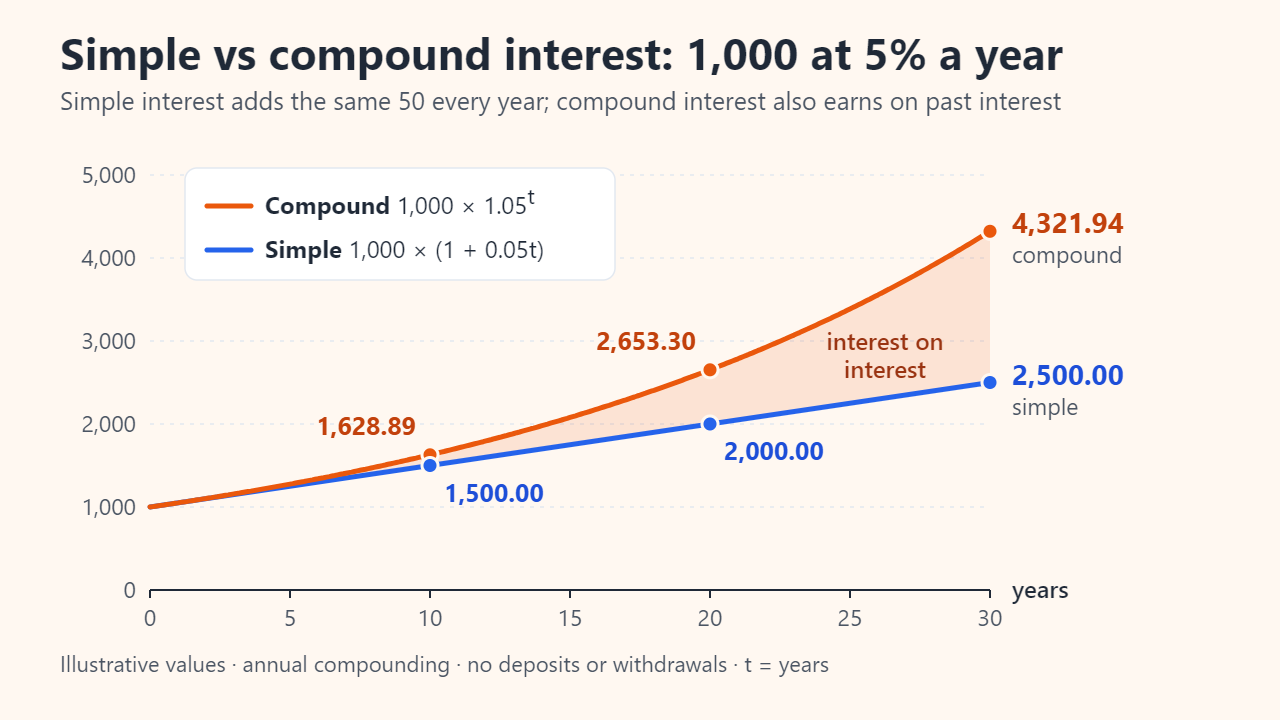
The simple and compound interest formulas side by side
Both formulas use the same inputs. The only difference is what the rate is applied to: the original amount every time, or the growing balance.
- Simple interest: I = P × r × t, so the ending amount is A = P(1 + rt). Each year’s interest is always P × r.
- Compound interest: A = P(1 + r/n)nt. Interest is added to the balance n times a year, and every addition earns interest from then on. With yearly compounding (n = 1) this shortens to A = P(1 + r)t.
- Continuous compounding: A = Pert, the limit as n grows without bound (e ≈ 2.71828).
Here P is the principal, r the nominal annual rate written as a decimal (5% = 0.05), t the time in years and n the number of compounding periods per year. Total interest is A − P in every case.
Worked example: 1,000 at 5% for 30 years
Illustrative numbers: 1,000 deposited at 5% a year, with no deposits or withdrawals along the way.
| Years | Simple: 1,000(1 + 0.05t) | Compound: 1,000 × 1.05t | Difference |
|---|---|---|---|
| 1 | 1,050.00 | 1,050.00 | 0.00 |
| 5 | 1,250.00 | 1,276.28 | 26.28 |
| 10 | 1,500.00 | 1,628.89 | 128.89 |
| 20 | 2,000.00 | 2,653.30 | 653.30 |
| 30 | 2,500.00 | 4,321.94 | 1,821.94 |
After one year the two are identical, because there is no earlier interest to earn on yet. After that the gap widens faster every year. In year 30 alone the compound balance earns 205.81 (5% of 4,116.14), more than four times the flat 50 that simple interest adds each year. Simple interest needs 20 years to double the money (100 ÷ 5); compound interest gets there between years 14 and 15 (1,979.93 and 2,078.93).
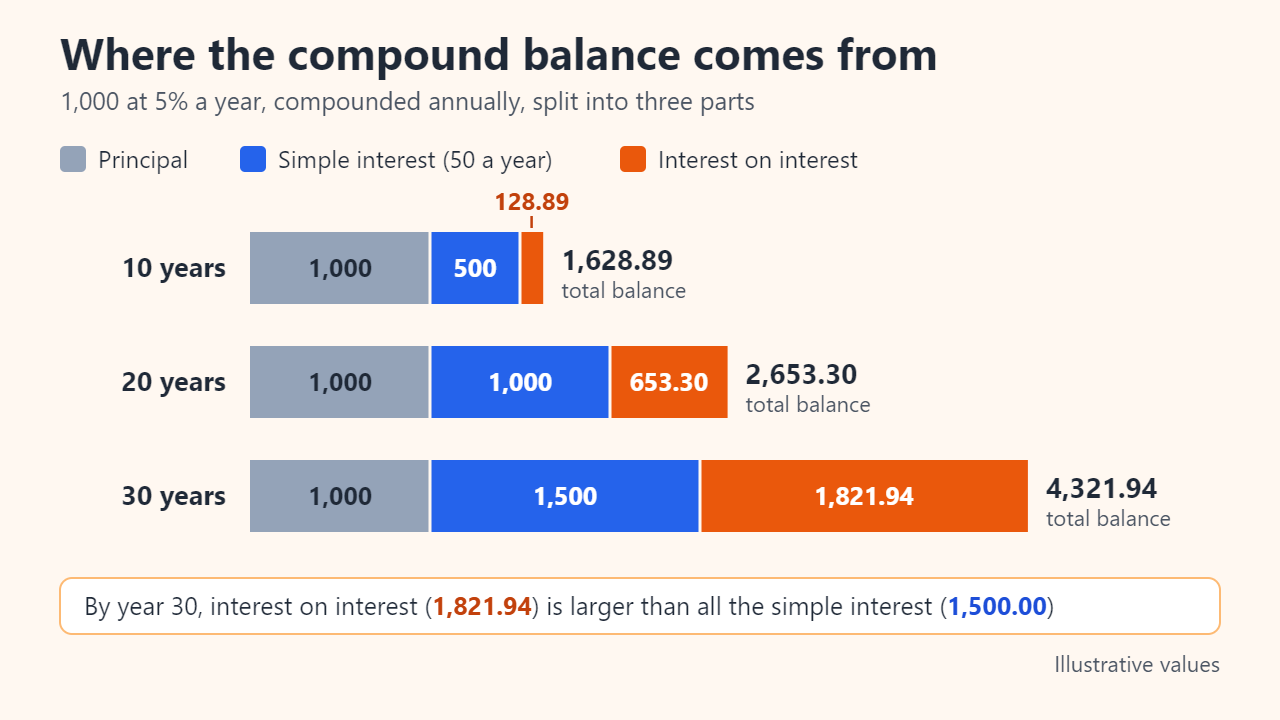
The difference column is, quite literally, interest on interest. Once the compound balance is split into its three parts, you can see that by year 30 the interest-on-interest part (1,821.94) is larger than all the simple interest combined (1,500.00).
How compounding frequency changes the result
Rates are normally quoted as a nominal annual rate, but interest may be added yearly, monthly or daily. At the same nominal rate, more frequent compounding pays a little more because interest starts earning sooner. The growth you actually get over one year is the effective annual rate (EAR): (1 + r/n)n − 1, or er − 1 for continuous compounding. US savings accounts disclose a comparable figure as the annual percentage yield (APY).
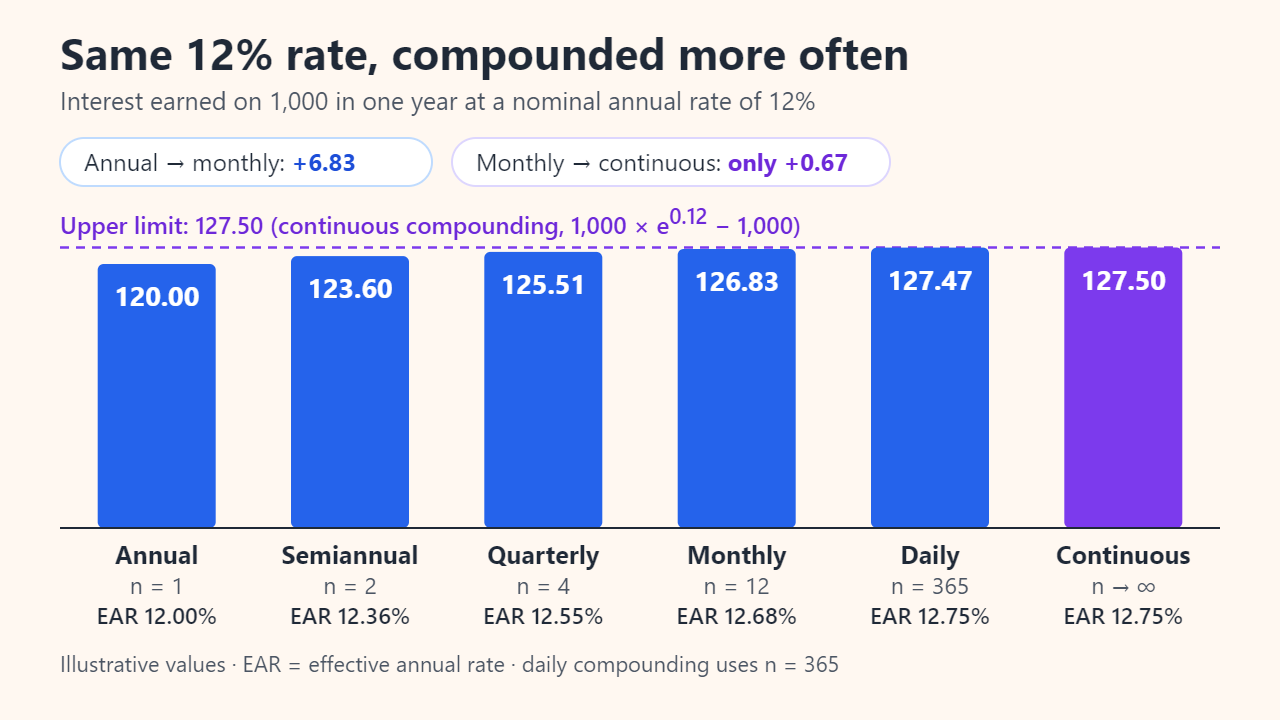
At an illustrative 12% nominal rate, 1,000 earns 120.00 in a year with annual compounding, 126.83 with monthly compounding (EAR 12.68%), 127.47 with daily compounding and 127.50 with continuous compounding. The gains shrink fast: moving from annual to monthly adds 6.83, but moving from monthly all the way to continuous adds only 0.67. This is the same limit that defines e. OpenStax’s algebra text shows 1 at 100% interest growing to 2.613035 with monthly compounding and 2.714567 with daily compounding, closing in on e ≈ 2.718282.
The rule of 72: estimating doubling time
The rule of 72 is a mental shortcut for compound growth. Use it like this:
- Write the annual rate as a plain percentage number: 6% becomes 6.
- Divide 72 by it: 72 ÷ 6 = 12, so money doubles in about 12 years.
- To work backward, divide 72 by the years instead: doubling in 9 years needs about 72 ÷ 9 = 8% a year.
The exact answer comes from solving (1 + r)t = 2, which gives t = ln 2 ÷ ln(1 + r). At 6% that is 0.6931 ÷ 0.05827 = 11.90 years, so the rule is off by only about 0.1 year.
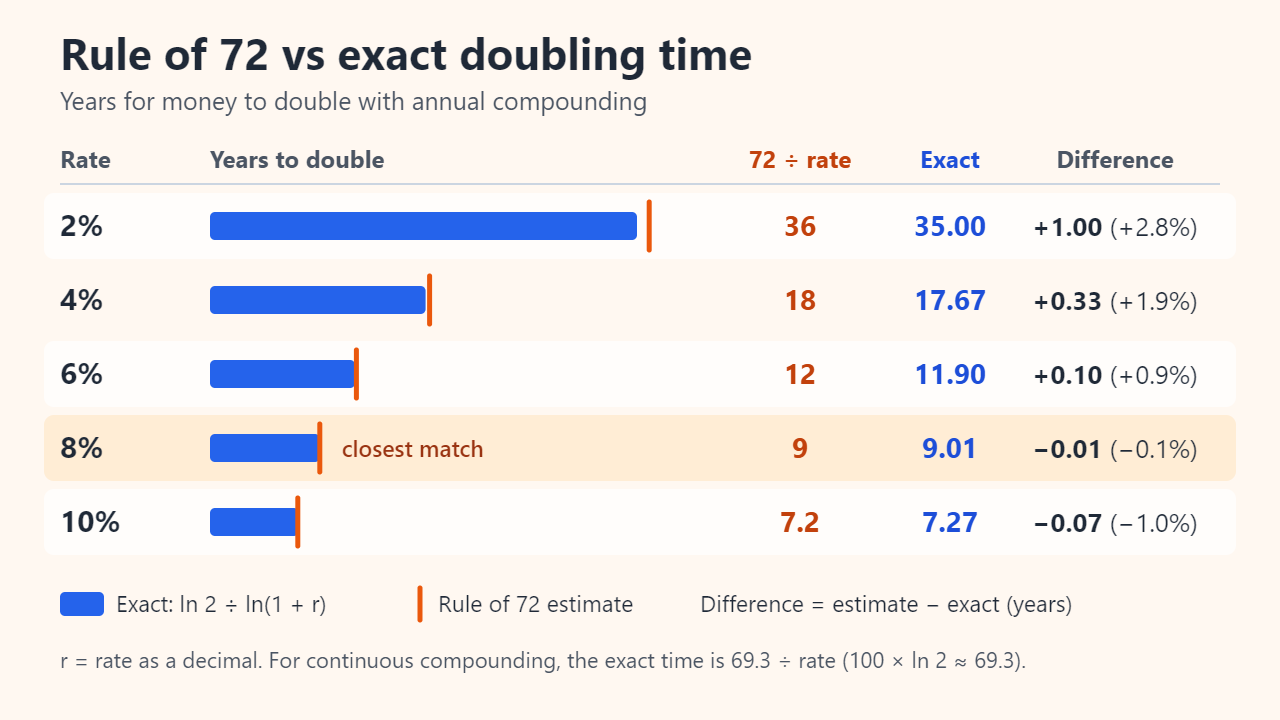
Why 72? With continuous compounding the exact doubling time is ln 2 ÷ r, which works out to 69.3 ÷ the rate in percent. With yearly compounding, ln(1 + r) is slightly smaller than r, so the ideal constant creeps upward: about 70.0 at 2%, 71.4 at 6%, 72.0 at 8% and 72.7 at 10%. The number 72 sits in the middle of that common range and divides evenly by 2, 3, 4, 6, 8, 9 and 12. From 2% to 12% it stays within 3% of the exact answer; at 20% it gives 3.6 years against an exact 3.80, about 5% short.
The same math works against you: debt, inflation and fees
Compounding is repeated multiplication, so it also describes amounts that grow against you. Illustrative examples:
- Unpaid debt: at 24% a year charged as 2% a month and added to the balance with no payments, the balance doubles in 35 months (about 2.92 years). The rule of 72 gives 72 ÷ 2 = 36 months.
- Inflation: at 3% a year, prices double in about 23.4 years (rule of 72: 24), so the same amount of cash buys roughly half as much.
- Fees and drag: if costs cut yearly growth on 1,000 from 6% to 5%, the 30-year result falls from 5,743.49 to 4,321.94, a loss of 1,421.55, or about a quarter.
Common calculation mistakes
- Using 5 instead of 0.05. The formulas need the decimal rate; only the rule of 72 uses the percentage number.
- Mixing periods. With monthly compounding the rate per period is r/12 and the number of periods is 12t.
- Comparing nominal rates with different compounding. Compare effective annual rates instead.
- Applying the rule of 72 to simple interest. Simple interest doubles in 100 ÷ rate years.
FAQ
Is compound interest always better than simple interest?
At the same rate, compounding gives a saver at least as much and more after the first period, while a borrower pays more. This article explains the arithmetic only; it is not financial advice.
Does the rule of 72 work with monthly compounding?
Roughly. Monthly compounding behaves almost like continuous compounding, where 69.3 is the right constant, so 72 runs slightly long: at 6% compounded monthly, money doubles in 11.58 years rather than 12.
What is the continuous compounding formula?
A = Pert. For example, 1,000 at 5% for 20 years gives 1,000 × e1 = 2,718.28.
Sources: OpenStax, College Algebra 2e, 6.1 Exponential Functions (compound interest and e); OpenStax, College Algebra 2e, 6.7 Exponential and Logarithmic Models (doubling time); OpenStax, Contemporary Mathematics, 6.4 Compound Interest; U.S. SEC Investor.gov, What is compound interest? (rule of 72).
Related reading
Original illustrations created to help explain this article.