mAh vs Wh: Power Bank Capacity Math and the 100 Wh Flight Limit
mAh (milliamp-hours) measures electric charge, while Wh (watt-hours) measures energy, and voltage links the two: Wh = mAh × V ÷ 1,000. A 20,000 mAh power bank built from 3.7 V lithium-ion cells stores 20,000 × 3.7 ÷ 1,000 = 74 Wh. Airlines judge batteries by Wh, and the line that matters is 100 Wh, about 27,000 mAh at 3.7 V: a power bank at or below it can fly in your carry-on (never in checked baggage) without airline approval.
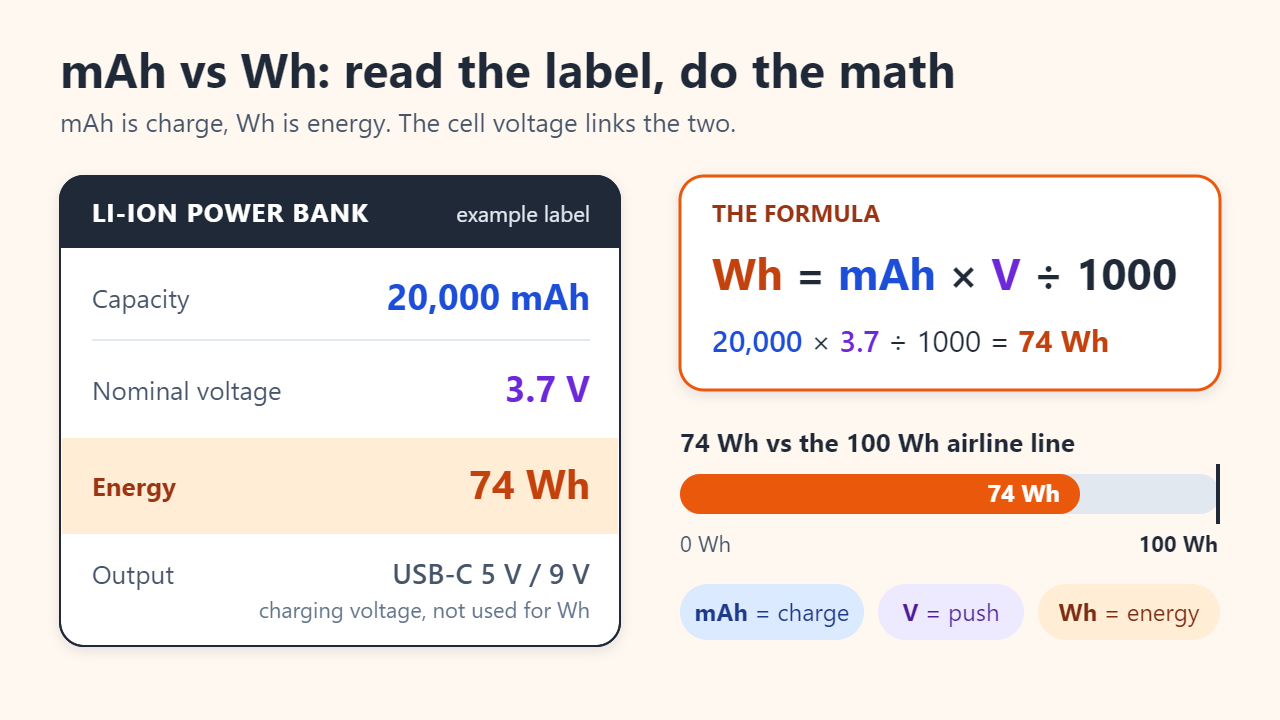
mAh measures charge, Wh measures energy
A milliamp-hour is an amount of electric charge: 1,000 mAh could deliver 1 amp for one hour, or 0.5 A for two hours. It says nothing about voltage, the “push” behind that charge, and energy is charge multiplied by voltage. That is why equal mAh figures can hide different amounts of energy: a 5,000 mAh battery holds 16 Wh at 3.2 V but about 19.3 Wh at 3.85 V.
Watt-hours fold the voltage in, so they compare any two batteries fairly. IATA's passenger guidance defines the rating as rated capacity in ampere-hours multiplied by nominal voltage, and says lithium-ion batteries must show their Wh rating on the case. Wh also describes how much energy a battery could release if it fails, so aviation rules are written in Wh rather than mAh. To convert a label yourself:
- Divide the capacity in mAh by 1,000 to get amp-hours (20,000 mAh = 20 Ah).
- Find the nominal cell voltage: usually 3.6 V or 3.7 V for lithium-ion, about 3.2–3.3 V for lithium iron phosphate (LiFePO4).
- Multiply: 20 Ah × 3.7 V = 74 Wh. To go the other way, use mAh = Wh × 1,000 ÷ V.
mAh to Wh conversion table
Battery University lists nominal voltages of 3.6 V and 3.7 V for the common lithium-ion chemistries, so the voltage you pick shifts the answer by about 3%. When your battery prints its own voltage, use that.
| Capacity | At 3.6 V | At 3.7 V | Within 100 Wh? |
|---|---|---|---|
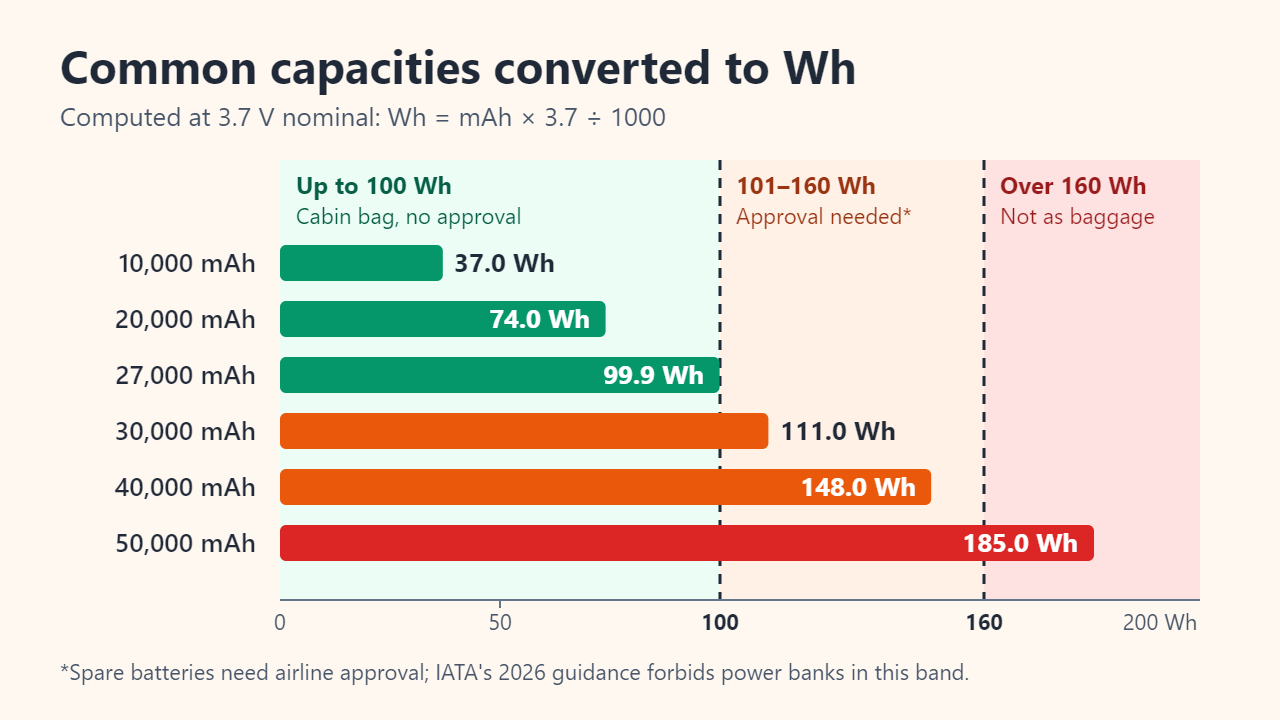
| 10,000 mAh | 36.0 Wh | 37.0 Wh | Yes |
| 20,000 mAh | 72.0 Wh | 74.0 Wh | Yes |
| 26,800 mAh | 96.5 Wh | 99.2 Wh | Yes |
| 27,000 mAh | 97.2 Wh | 99.9 Wh | Yes, just |
| 30,000 mAh | 108.0 Wh | 111.0 Wh | No |
| 40,000 mAh | 144.0 Wh | 148.0 Wh | No |
| 50,000 mAh | 180.0 Wh | 185.0 Wh | No, over 160 Wh |
Working backwards, 100 Wh equals 27,027 mAh at 3.7 V or 27,778 mAh at 3.6 V, so a capacity just under 27,000 mAh is the practical ceiling for a cabin-friendly power bank. The 160 Wh line falls at 43,243 mAh (3.7 V) or 44,444 mAh (3.6 V).
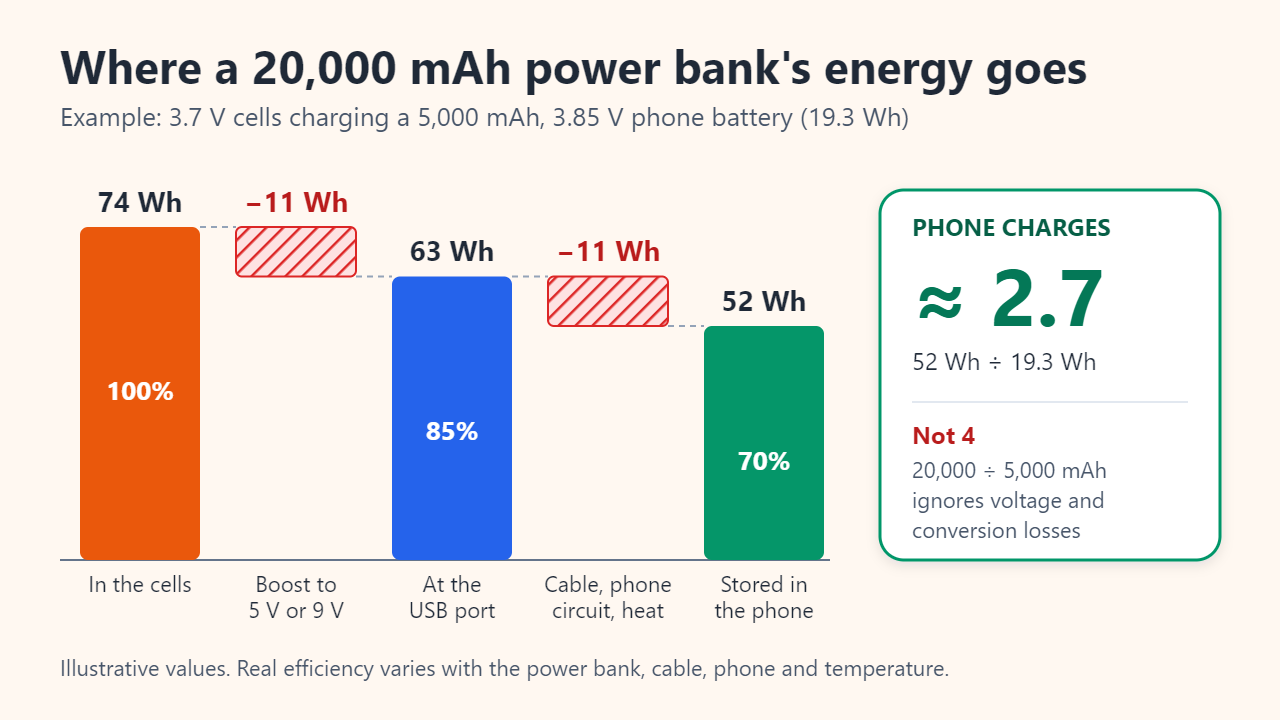
Why 20,000 mAh won't charge a phone four times
Dividing 20,000 mAh by a 5,000 mAh phone battery suggests four full charges. In practice you get noticeably fewer, for three reasons:
- Different voltages. Phone batteries are often rated around 3.85 V, above the 3.6–3.7 V used for power bank cells, so a 5,000 mAh phone battery holds about 19.3 Wh. Even a loss-free 74 Wh power bank would fill it only 3.8 times.
- Conversion losses. The power bank boosts its cell voltage to 5 V, or to 9 V and higher for fast charging, and the phone steps it back down to charge its battery. Each conversion turns some energy into heat.
- Everyday drains. Cable resistance, using the phone while it charges, cold temperatures and an aging power bank all cut what arrives.
With illustrative efficiencies of 85% inside the power bank and about 83% from the USB port into the phone's battery, 74 Wh becomes 63 Wh at the port and 52 Wh in the phone: roughly 70% of the label energy, or about 2.7 full charges.
Airline limits: 100 Wh, 160 Wh and the 2026 power bank rules
International rules come from ICAO's Technical Instructions for the Safe Transport of Dangerous Goods by Air, which airlines and national regulators apply. For lithium-ion batteries in passenger baggage, the tiers look like this:
| Battery energy | Spare battery (camera, laptop) | Power bank |
|---|---|---|
| 100 Wh or less | Carry-on only, no approval, up to 20 per person | Carry-on only, no approval, at most two per person |
| Over 100 Wh, up to 160 Wh | Carry-on only, airline approval, up to two per device | ICAO: airline approval. IATA 2026 guidance: forbidden |
| Over 160 Wh | Not allowed in passenger baggage | Not allowed in passenger baggage |
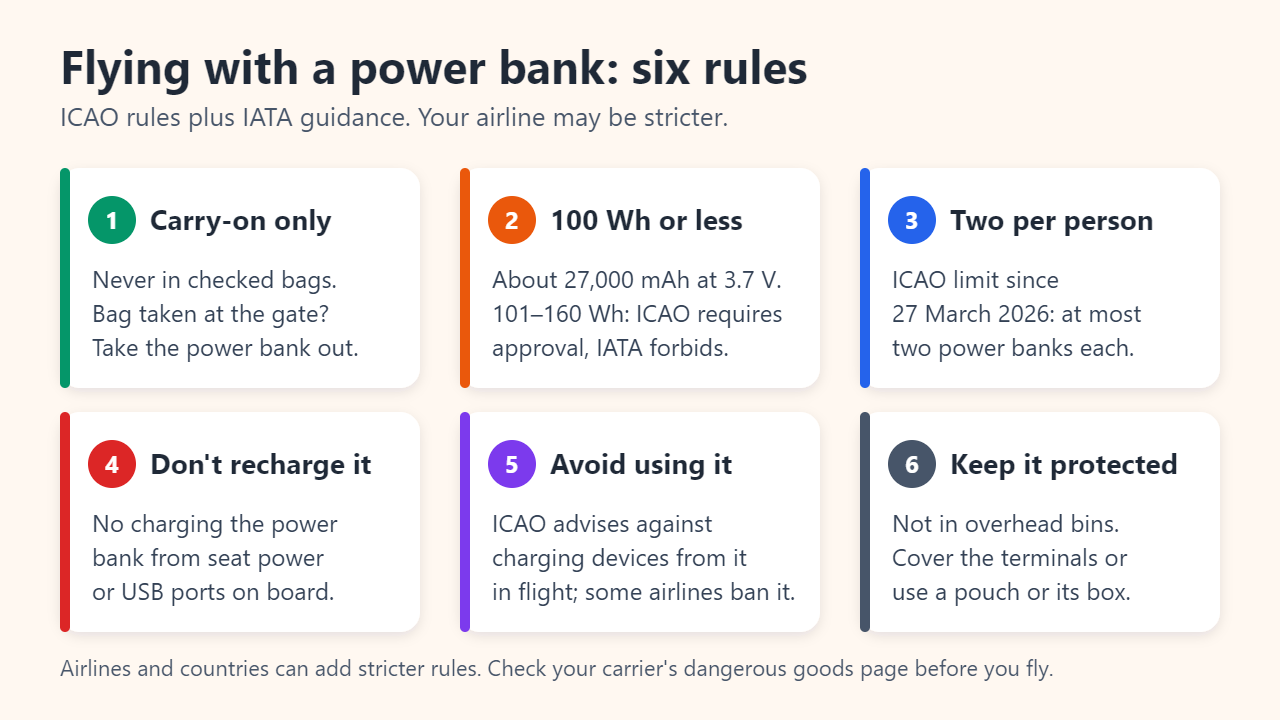
On 27 March 2026, ICAO's Council approved stricter power bank provisions, taking effect the same day: no more than two power banks per person, and no recharging of power banks on board. The UK Civil Aviation Authority's summary adds that passengers should not use a power bank to charge other devices during the flight, and that each one must be individually protected against short circuits. IATA's 2026 guidance goes further than ICAO: power banks over 100 Wh are forbidden, and power banks should stay out of overhead bins and not power devices during taxi, take-off or landing.
Two rules have not changed. Spare batteries and power banks never go in checked baggage, and if your cabin bag is taken at the gate for the hold, remove them first. Keep loose spares in their retail packaging, tape over the terminals or put each one in its own bag.
Check your airline before you fly
ICAO's tiers are a baseline, and IATA's guidance notes that airlines may impose stricter conditions. Common extras include:
- A ban on using power banks anywhere on board, or a limit of one per passenger.
- A legible capacity marking. IATA notes that if staff cannot verify the Wh rating from the battery or its documentation, the airline may refuse it.
- National rules, such as required safety certification marks on domestic flights in some countries.
- Different start dates, because countries and airlines adopted the 2026 changes on their own schedules.
The airline's “dangerous goods” or “restricted items” page is the authoritative answer for your flight; on a multi-airline trip, check each carrier.
How to read a power bank label
- Look for Wh first. If the label shows a Wh figure, that is the number the airline checks.
- Otherwise, pair mAh with the cell voltage. Use the nominal voltage printed next to the capacity (often 3.6 V or 3.7 V; sometimes 3.85 V, or 3.2 V for LiFePO4), not the 5 V, 9 V or 20 V output ratings.
- Don't be thrown by “rated capacity.” Some labels add a smaller mAh figure measured at the 5 V output after conversion losses. In the illustrative example above, 63 Wh ÷ 5 V = 12,600 mAh. It describes the same battery.
- Keep the label readable. A worn or missing marking can get the power bank refused.
The most common mistake is multiplying by the 5 V output. That turns 20,000 mAh into exactly 100 Wh and makes a 74 Wh power bank look borderline.
FAQ
How many mAh is 100 Wh?
About 27,000 mAh at 3.7 V (27,027 mAh exactly) or 27,778 mAh at 3.6 V, using mAh = Wh × 1,000 ÷ V.
Can I take a 20,000 mAh power bank on a plane?
Usually, yes. At 3.7 V it holds 74 Wh, so it can travel in carry-on baggage without approval, counting toward the two-power-bank limit, but never in checked baggage.
Can I charge my phone from a power bank during the flight?
The 2026 ICAO rules advise against it, and some airlines ban it outright. Recharging the power bank itself from seat power is not allowed under the 2026 rules.
Why can't power banks go in checked bags?
A lithium battery that overheats in the cabin can be noticed and handled by the crew; in the cargo hold, it cannot.
Sources: IATA: Passengers Travelling with Lithium Batteries (2026 guidance, PDF); ICAO: New power bank restrictions (27 March 2026); UK CAA: Changes to rules on lithium batteries and power banks; Battery University: Types of Lithium-ion
Related reading
Original illustrations created to help explain this article.