Battery Materials: Thermal Runaway, Its Causes, and Mechanisms
This article was translated from its source language with AI assistance. Please check technical terms and equations against the original.
Hello. In this post, we will examine thermal runaway, which has recently attracted attention as a safety issue for lithium-ion batteries used in electric vehicles and portable electronic devices. We will learn what thermal runaway is, what causes it, and how it can be prevented.
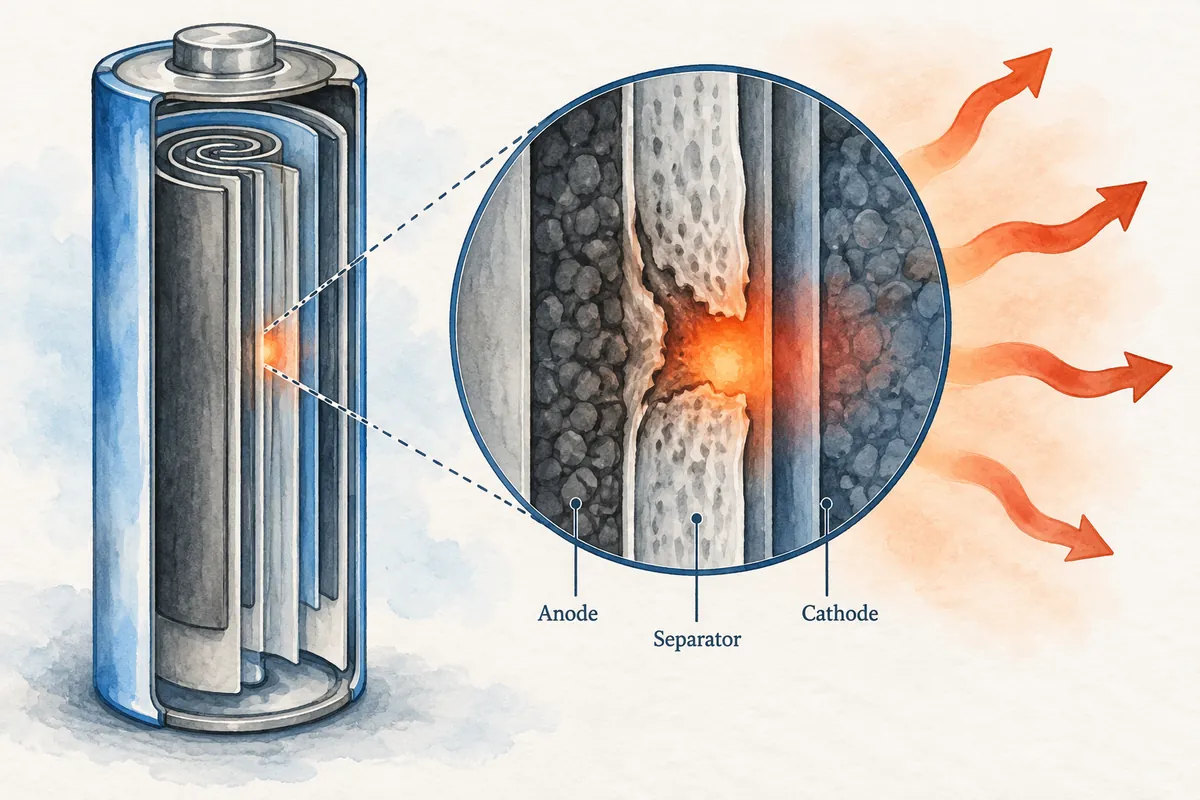
Definition of Thermal Runaway
Thermal runaway means that a cell loses control and ignites spontaneously. The UL9540A standard established by UL, a US international safety science and technology organization, addresses test methods for evaluating the propagation of fires caused by thermal runaway.
Causes of Thermal Runaway
Thermal runaway has various causes, including manufacturing and material defects, design abnormalities, careless use, and misuse.
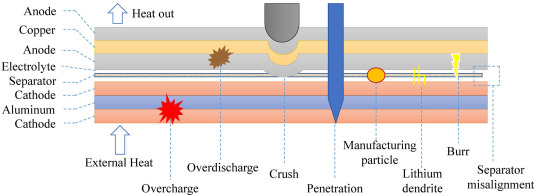
Generally, there are four abuse conditions:
mechanical abuse, electrical abuse, thermal abuse, and internal short circuits.
Types of Abuse Related to Thermal Runaway
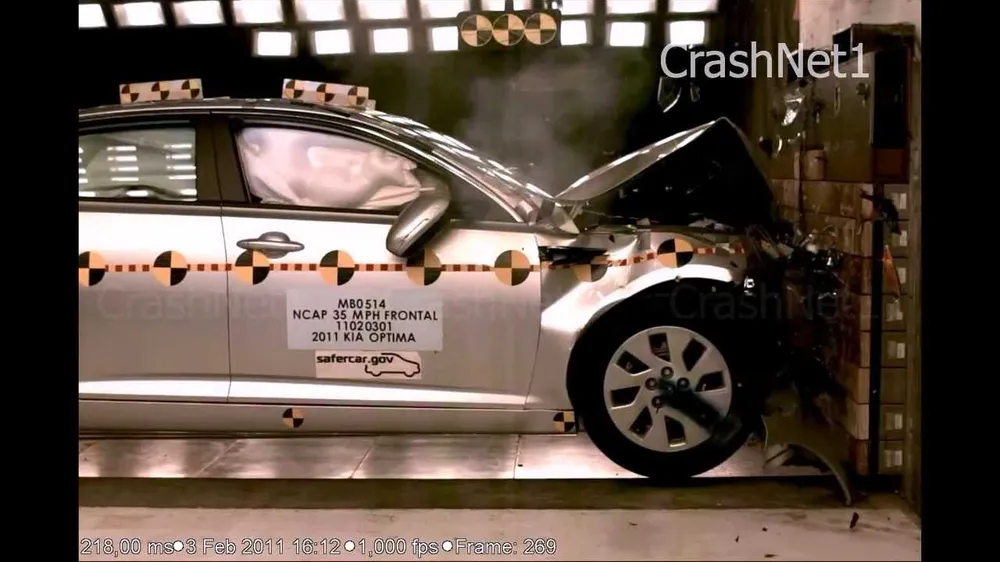
1. Mechanical abuse: This refers to battery damage and deformation caused by external forces.
For example, deformation of a battery pack in a collision while an electric vehicle is being driven can damage the separator inside a cell and cause an internal short circuit, leading to electrolyte leakage and fire. When a metallic object penetrates an entire cell, it can also cause a severe internal short circuit. The resulting increase in the cell's internal temperature comes from heat generated by that short circuit.
2. Electrical abuse: This includes external short circuits, overcharging, and overdischarging.
External short circuits can result from impact-related deformation and damage to a battery pack, immersion in water, contamination by external conductive materials, and electrical shocks. Cell overheating is mainly caused by resistive heating.
Overcharging is a form of electrical abuse involving charging at a high voltage. If a battery management system (BMS) malfunction or system error causes a cell to exceed its upper charging voltage limit, resistive heating and chemical side reactions rapidly increase its internal temperature.
Overdischarging refers to forced discharge. During overdischarge, changes in the shape of the cathode material prevent some lithium ions from being inserted and extracted, rapidly reducing battery capacity.
One consequence of such overcharging and overdischarging is the swelling seen in devices such as power banks, known as cell swelling. Excessive extraction of lithium ions accelerates decomposition of the SEI film. This produces CO or CO2 gas, and that gas causes the cell to swell.
If the battery is charged again in this state, new SEI impurities form on the anode surface. The resulting SEI significantly reduces electrochemical performance and safety.

3. Thermal abuse: This includes localized overheating and external fires.
Localized overheating mainly occurs when battery connectors become loose or when the bond between electrode materials and current collectors inside a cell weakens. Repeated charging and discharging generate heat at the loosened electrode material–current collector interface, potentially leading to thermal runaway. In an external fire, exposure to combustion and a high-temperature environment for a certain period can burn the electrolyte and cause thermal runaway.
4. Internal short circuits: Internal short circuits are directly correlated with mechanical, electrical, and thermal abuse of batteries and are a decisive factor in causing thermal runaway.
However, an important point is that not every internal short circuit necessarily leads to thermal runaway.
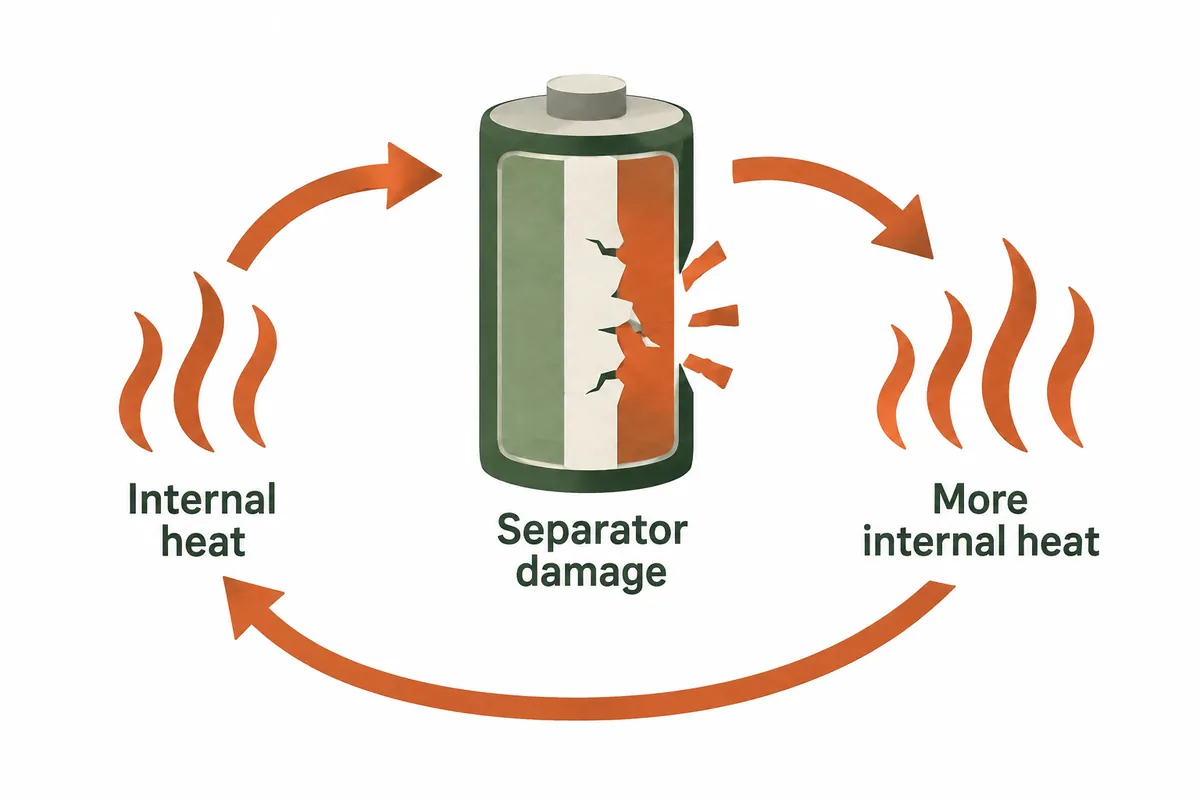
Internal short circuits can be divided into the following three levels.
1. LEVEL I: At this stage, the cell voltage decreases very slowly, self-discharge is very slight, and there is almost no temperature change. This is an early stage that does not greatly affect battery safety.
2. LEVEL II: At this stage, the voltage decreases very rapidly, and a noticeable temperature increase appears. This increase indicates heat generation. Battery safety is affected at this stage, and management is required.
3. LEVEL III: This is the most serious stage. Battery voltage reaches zero, and an enormous amount of heat is generated. This situation leads to immediate thermal runaway. Battery safety is severely threatened, and immediate action is necessary.
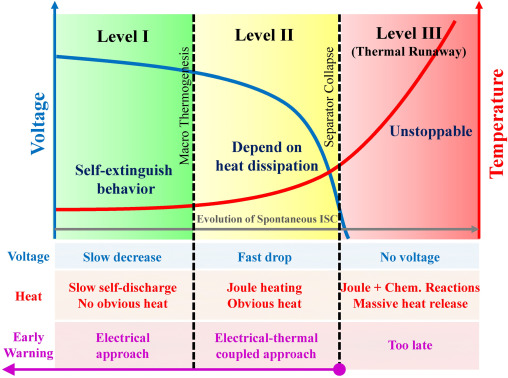
When using batteries, it is important to recognize these internal short-circuit stages and respond appropriately to each one. In particular, electrical, mechanical, and thermal abuse must be minimized to prevent progression to LEVEL III.
You may find the material in this post a little difficult. The following illustration summarizes it.
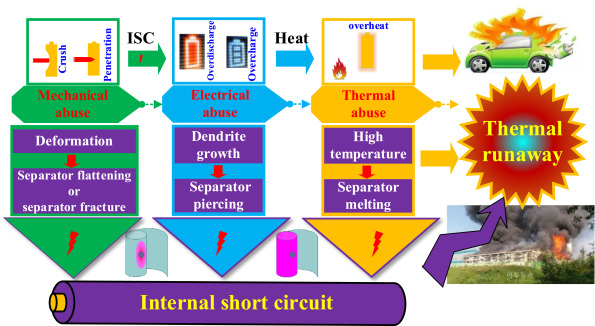
Today, we have examined the definition and causes of thermal runaway, along with the types of abuse associated with it.
Original illustrations created to help explain this article.
Original on Tistory ↗