Voltage, Current and Resistance Explained: Ohm’s Law (V = IR) Made Simple
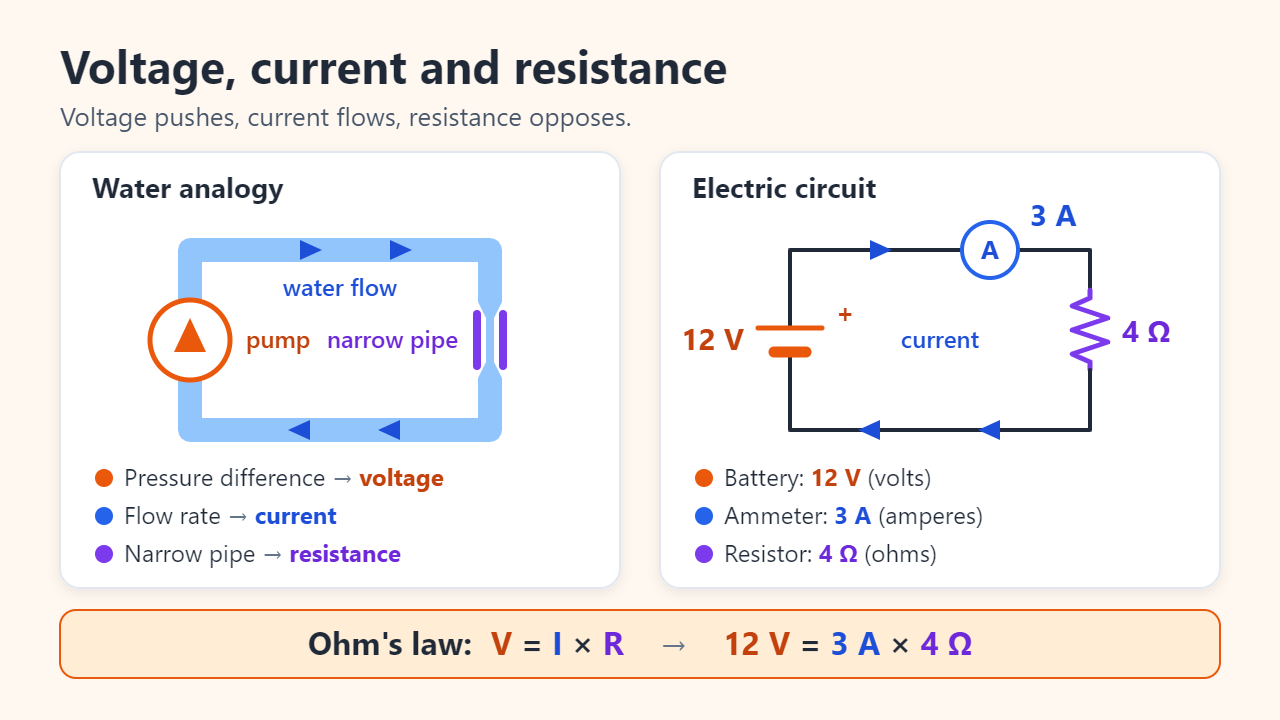
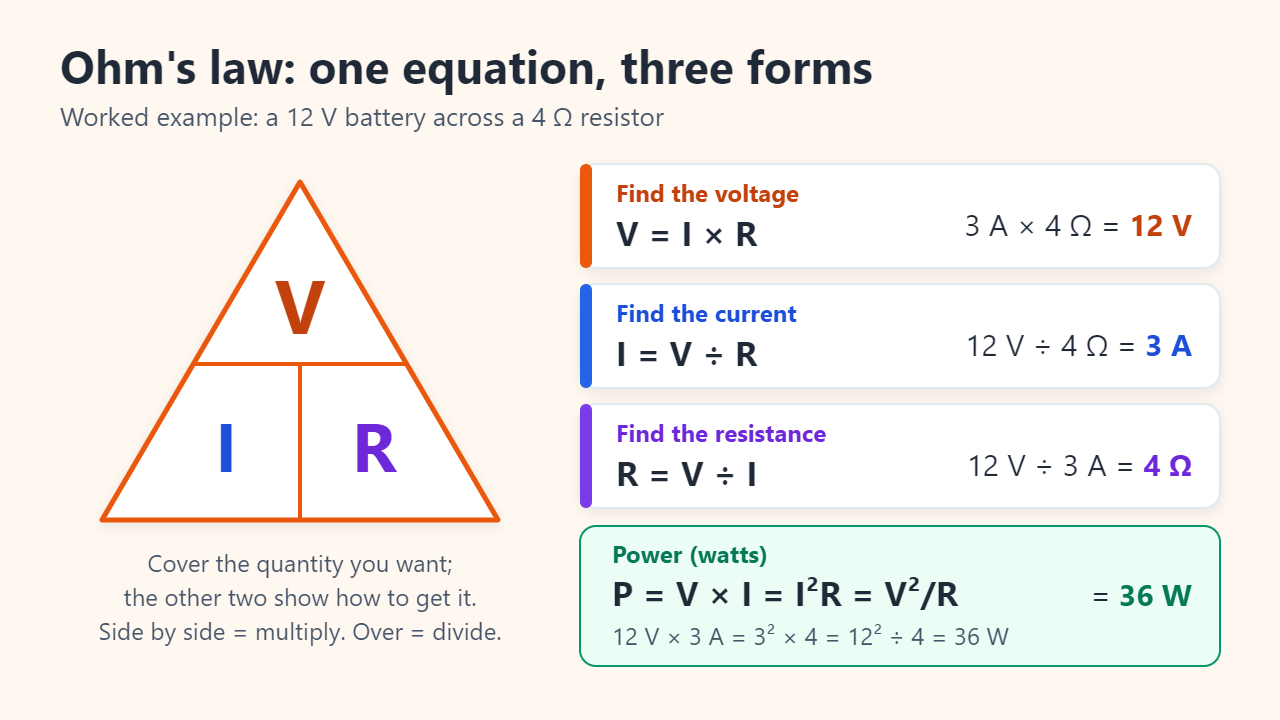
Voltage is the electrical push between two points, current is the amount of charge flowing past a point each second, and resistance is how strongly a component opposes that flow. Ohm’s law ties them together as V = I × R: 12 volts across a 4-ohm resistor drives 3 amperes. Multiply voltage by current and you get power, here 12 V × 3 A = 36 watts.
The water-pipe analogy, and where it breaks down
Picture a closed loop of pipe with a pump. The pump creates a pressure difference, water circulates, and a narrow section limits the flow. In a circuit, the battery is the pump, its voltage is the pressure difference, the current is the flow rate, and a resistor is the narrow pipe. More pressure means more flow; a narrower pipe means less.
| Quantity | Symbol | Unit | Water analogy | What it measures |
|---|---|---|---|---|
| Voltage (potential difference) | V | volt (V) | Pressure difference | Energy per unit charge: 1 V = 1 J/C |
| Current | I | ampere (A) | Flow rate | Charge per second: 1 A = 1 C/s |
| Resistance | R | ohm (Ω) | Narrowness of the pipe | Volts needed per ampere: 1 Ω = 1 V/A |
| Power | P | watt (W) | Work done by the flow each second | Energy per second: 1 W = 1 J/s = 1 V·A |
The analogy helps, but four details trip people up:
- Voltage is always between two points. “This wire is at 9 V” only means something relative to a reference, such as the negative terminal or ground.
- Current is not used up. The current entering a resistor equals the current leaving it; the resistor takes energy and turns it into heat.
- A cut wire does not leak. A broken pipe spills water, but a broken circuit simply stops the current, and the voltage appears across the gap.
- Direction is a convention. Conventional current runs from + to −, but in metal wires electrons carry the current, drifting the opposite way.
Units and worked Ohm’s law examples
The units are defined in terms of each other: NIST’s guide to the SI lists the volt as one watt per ampere and the ohm as one volt per ampere, and one ampere is one coulomb per second. So 4 ohms means it takes 4 volts to push 1 ampere through. Rearranging V = IR gives one form per unknown:
- Find the current, I = V ÷ R. A 12 V battery across 4 Ω drives 12 ÷ 4 = 3 A.
- Find the voltage, V = I × R. A current of 20 mA through 220 Ω drops 0.020 × 220 = 4.4 V.
- Find the resistance, R = V ÷ I. If a 9 V battery delivers 0.045 A, the circuit’s resistance is 9 ÷ 0.045 = 200 Ω.
The most common slip is mixing prefixes. Convert to amps and ohms first: 5 V across 2.2 kΩ gives 5 ÷ 2,200 = 0.00227 A, or 2.27 mA. A handy shortcut: milliamps times kilohms gives volts, so 2 mA × 4.7 kΩ = 9.4 V.
Electrical power: P = VI = I²R = V²/R
Voltage is energy per coulomb and current is coulombs per second, so their product is energy per second: P = V × I, in watts. Substituting Ohm’s law gives P = I²R when you know the current and P = V²/R when you know the voltage.
Take a 1,200 W space heater on a 120 V supply (illustrative numbers):
- Current: I = P ÷ V = 1,200 ÷ 120 = 10 A.
- Resistance of the hot element: R = V ÷ I = 120 ÷ 10 = 12 Ω.
- Check: I²R = 10² × 12 = 1,200 W, and V²/R = 120² ÷ 12 = 14,400 ÷ 12 = 1,200 W.
- Energy: two hours of use is 1.2 kW × 2 h = 2.4 kWh (1 kWh = 3.6 MJ).
The squares matter. Because P = V²/R, doubling the voltage quadruples the power: the same 12 Ω element on 240 V would try to draw 20 A and about 4,800 W, which is why appliances carry a voltage rating. And because wire losses grow with I², power grids transmit electricity at high voltage and low current.
Series vs parallel resistors
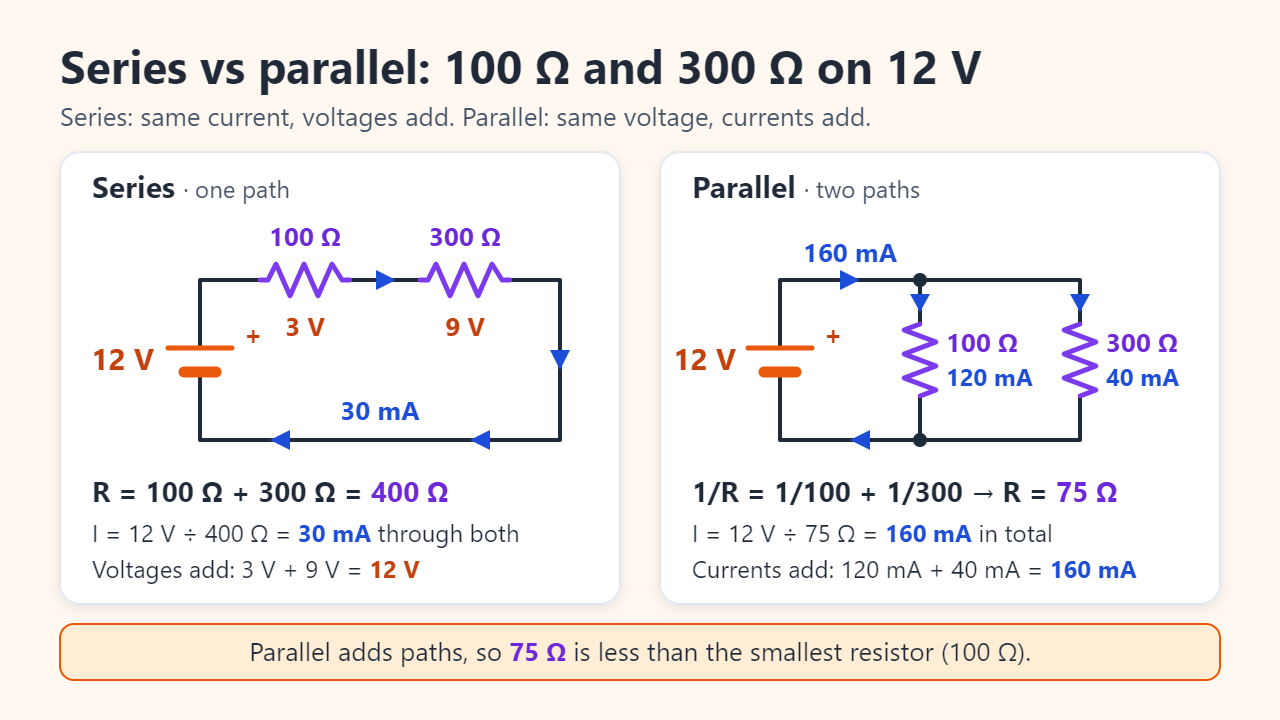
Resistors in series share one path, so the same current flows through each and their voltages add up to the supply voltage. Resistors in parallel each connect directly across the supply, so each sees the full voltage and the branch currents add up. That is why household outlets are wired in parallel: every appliance gets the full voltage and can be switched independently.
| Property | Series | Parallel |
|---|---|---|
| Equivalent resistance | R = R1 + R2 + … | 1/R = 1/R1 + 1/R2 + … |
| Same for every resistor | Current | Voltage |
| What adds up | Voltages | Currents |
| Result compared with the parts | Larger than the largest | Smaller than the smallest |
| 100 Ω and 300 Ω on 12 V | 400 Ω, 30 mA | 75 Ω, 160 mA |
Working through the last row: in series, R = 100 + 300 = 400 Ω, so I = 12 ÷ 400 = 0.03 A (30 mA), dropping 3 V across 100 Ω and 9 V across 300 Ω. In parallel, 1/R = 1/100 + 1/300 = 4/300, so R = 75 Ω; the branches carry 12 ÷ 100 = 120 mA and 12 ÷ 300 = 40 mA, 160 mA in total. For two resistors, product over sum gives the same result: (100 × 300) ÷ (100 + 300) = 75 Ω.
When Ohm’s law does not apply: non-ohmic devices
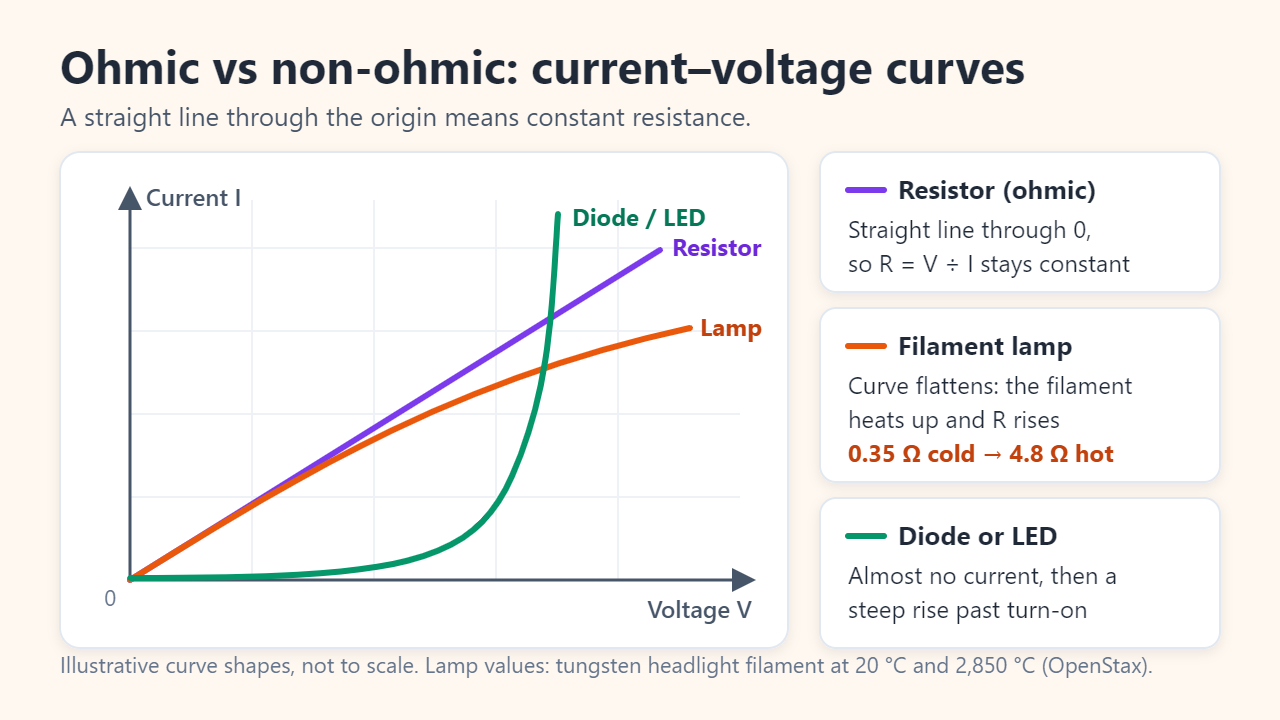
Ohm’s law is an empirical rule, not a law of nature. R = V ÷ I always gives a device’s resistance at one operating point, but the device is ohmic only if that ratio stays constant, giving a straight-line current–voltage (I–V) graph through the origin. Resistors and metal wires at a steady temperature qualify; lamps and diodes do not.
Filament lamps
A tungsten filament’s resistance rises steeply as it heats. In a worked example in OpenStax College Physics, a headlight filament of 0.350 Ω at 20 °C reaches about 4.8 Ω at its 2,850 °C operating temperature, roughly 14 times higher. So the lamp’s I–V curve flattens: doubling the voltage less than doubles the current. The low cold resistance also explains the brief current surge when a bulb is switched on.
Diodes and LEDs
A diode passes almost no current in reverse (until breakdown) and very little forward until its turn-on voltage. Past that point current climbs steeply while the voltage barely changes, staying near 0.7 V for a silicon diode. An LED is a diode, so it is normally driven through a series resistor that sets its current. With illustrative values of a 5 V supply, a 2 V LED drop and a 20 mA target, the resistor needs (5 − 2) ÷ 0.020 = 150 Ω.
FAQ
Does a battery supply a fixed current?
No. A battery tries to hold a roughly fixed voltage, and the current depends on what you connect, through I = V ÷ R. A 9 V battery pushes 9 mA through 1 kΩ but 90 mA through 100 Ω. Real batteries also have internal resistance, so their terminal voltage sags under heavy load.
Why do thicker wires have lower resistance?
Resistance depends on the material and the shape: R = ρL ÷ A, where ρ is the resistivity, L the length and A the cross-sectional area. Copper’s resistivity is 1.72 × 10⁻⁸ Ω·m, so 10 m of 1.5 mm² copper wire has about 0.11 Ω. Doubling the area halves the resistance; doubling the length doubles it.
Sources: NIST Guide to the SI (SP 811), Chapter 4; OpenStax University Physics: Ohm’s Law; OpenStax University Physics: Resistors in Series and Parallel; OpenStax College Physics: Resistance and Resistivity.
Related reading
Original illustrations created to help explain this article.