What Is a Decibel? How Much Louder Are +3, +6 and +10 dB?
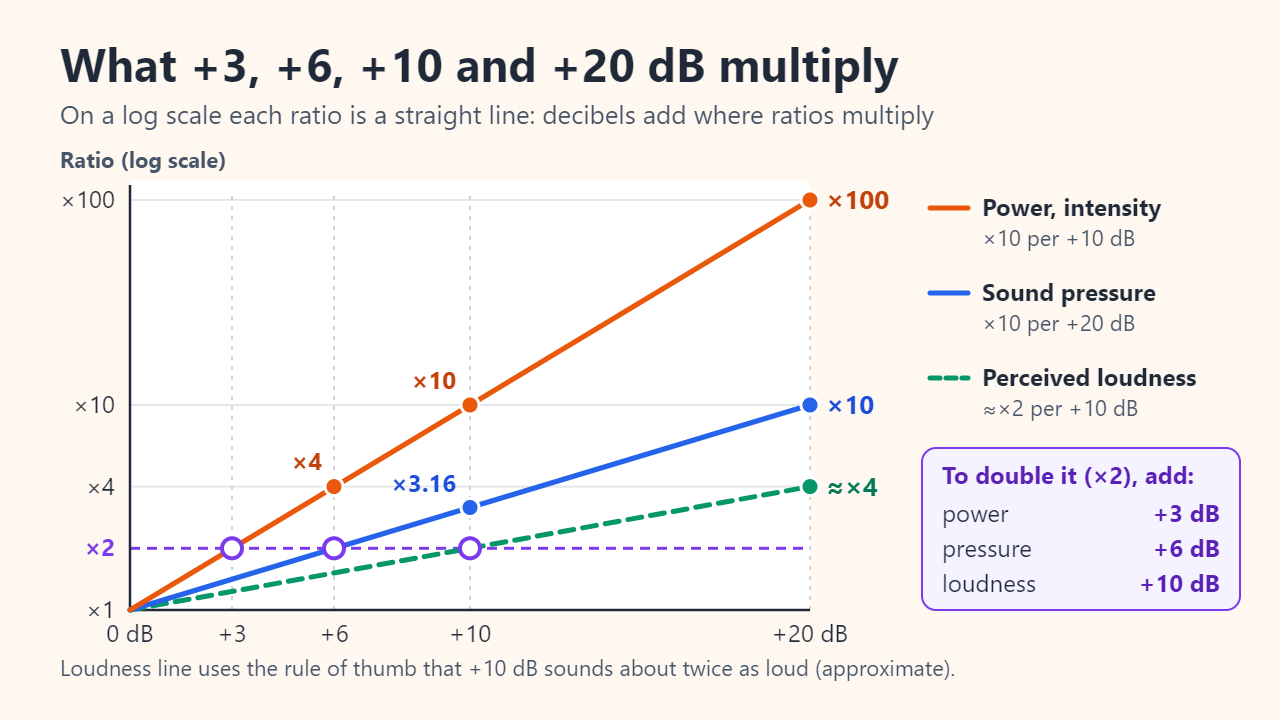
A decibel (dB) expresses a ratio on a logarithmic scale rather than an amount. For sound power or intensity, every +10 dB means 10 times more, +20 dB means 100 times, and +3 dB roughly doubles it, while +6 dB doubles the sound pressure. Your ears are far less dramatic: a sound 10 dB higher is usually judged only about twice as loud.
Why sound is measured on a logarithmic scale
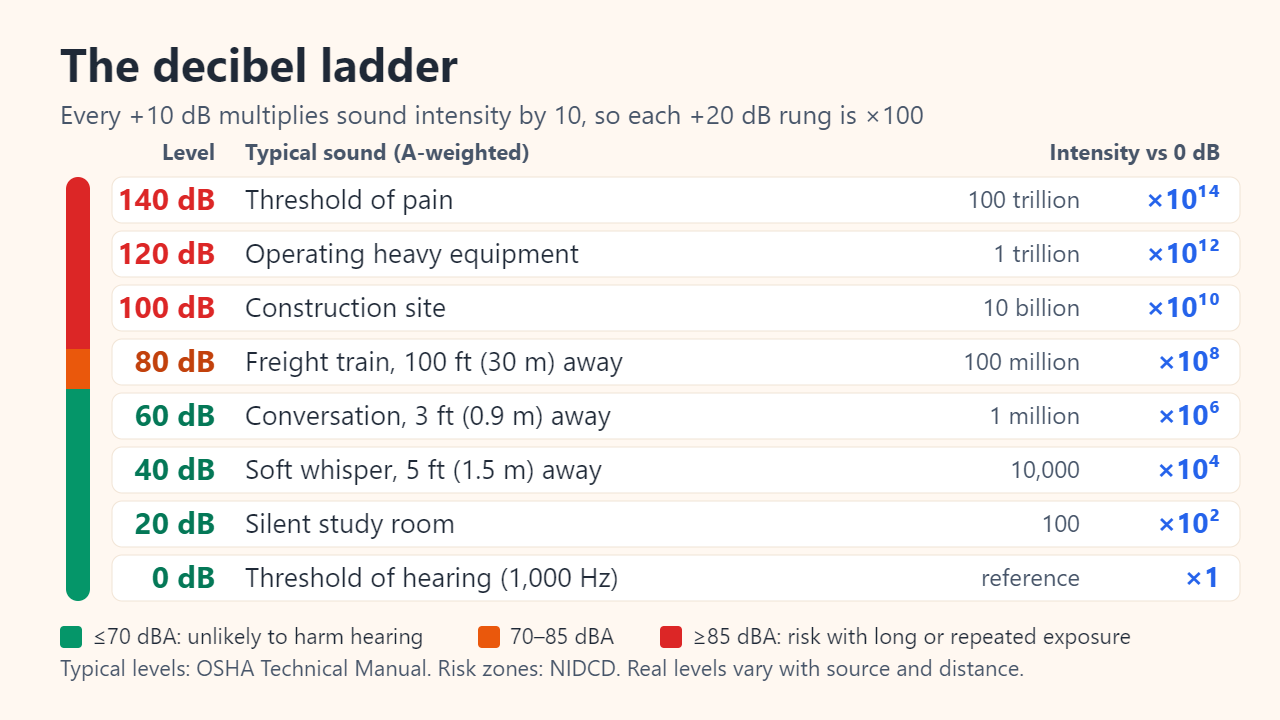
Human hearing spans an enormous range. The standard reference for 0 dB in air is a sound pressure of 20 micropascals (µPa), roughly the threshold of hearing at 1,000 Hz. The threshold of pain is placed somewhere between 120 and 140 dB depending on the source, which means 1012 to 1014 times more intensity. In watts per square meter, that runs from 0.000000000001 at the threshold of hearing to roughly 1 to 100 at the threshold of pain.
A logarithmic scale squeezes those numbers into 0 to 140 and turns multiplication into addition: each 10 dB step multiplies intensity by 10, whatever the starting point. It also fits perception better than a linear scale, because a tenfold jump in intensity sounds like a modest step, not a tenfold one. The unit is a tenth of a bel, named after Alexander Graham Bell, and 0 dB is not silence; it simply marks the reference level.
Decibel formulas: 10 log for power, 20 log for pressure
NIST's Guide to the SI defines a level as the logarithm of a ratio between a quantity and a reference value. There are two versions:
- Power quantities (power in watts, intensity in W/m²): L = 10 · log10(P / P0) dB
- Field or amplitude quantities (sound pressure, voltage): L = 20 · log10(F / F0) dB
The factor doubles because power is proportional to amplitude squared, and the logarithm of a square is twice the logarithm. Both formulas therefore agree on the same physical change: doubling the sound pressure quadruples the intensity, and either way the answer is +6 dB.
Worked example: sound pressure level
Sound pressure level (SPL) uses p0 = 20 µPa. The OSHA Technical Manual works through a pressure of 2 pascals: 20 · log10(2 / 0.00002) = 20 · log10(100,000) = 100 dB. Ten times that pressure, 20 Pa, gives 120 dB. For intensity the reference is 10−12 W/m², so 10−6 W/m² is 10 · log10(106) = 60 dB.
Always check the reference
NIST stresses that a level must state its reference. dB SPL means relative to 20 µPa in air; dBA is a sound level measured with A-weighting, which de-emphasizes low frequencies roughly as hearing does; dBm is power relative to 1 milliwatt. An amplifier with "+10 dB gain" states a ratio, while a "60 dB room" states a level.
+3, +6, +10 and +20 dB: what each change means
Because decibels are logarithms, the same change always means the same ratio. Going from 30 to 40 dB and from 90 to 100 dB are both tenfold increases in intensity. The table converts common steps:
| Change | Power / intensity | Sound pressure / voltage | Perceived loudness (rough) |
|---|---|---|---|
| +3 dB | ×2 | ×1.41 | ≈ ×1.2 |
| +6 dB | ×4 | ×2 | ≈ ×1.5 |
| +10 dB | ×10 | ×3.16 | ≈ ×2 |
| +20 dB | ×100 | ×10 | ≈ ×4 |
| −10 dB | ×0.1 | ×0.32 | ≈ ×0.5 |
The loudness column applies a rule of thumb from Georgia State University's HyperPhysics: a sound needs about ten times the intensity to seem twice as loud, so ten identical violins sound roughly twice as loud as one. It describes average listeners and steady, similar sounds, so treat ×1.2 and ×1.5 as rough estimates.
The same arithmetic explains several everyday surprises:
- Two equal sources add 3 dB. Two machines at 90 dB each measure about 93 dB together, not 180 dB, as OSHA's worked example shows. Ten equal sources add 10 dB.
- Loudness costs a lot of power. To sound twice as loud, an amplifier needs about ten times the power, for example 10 W instead of 1 W (illustrative numbers).
- −3 dB means half the power. That is why a filter's −3 dB cutoff frequency is also called its half-power point.
Typical sound levels and when they become risky
Real levels depend on the source and how far away you are, so health agencies publish ranges. The US National Institute on Deafness and Other Communication Disorders (NIDCD) lists these typical A-weighted levels:
- Normal conversation: 60–70 dBA
- Movie theater: 74–104 dBA
- Motorcycles and dirt bikes: 80–110 dBA
- Music through headphones at maximum volume, sporting events and concerts: 94–110 dBA
- Sirens: 110–129 dBA
- Fireworks show: 140–160 dBA
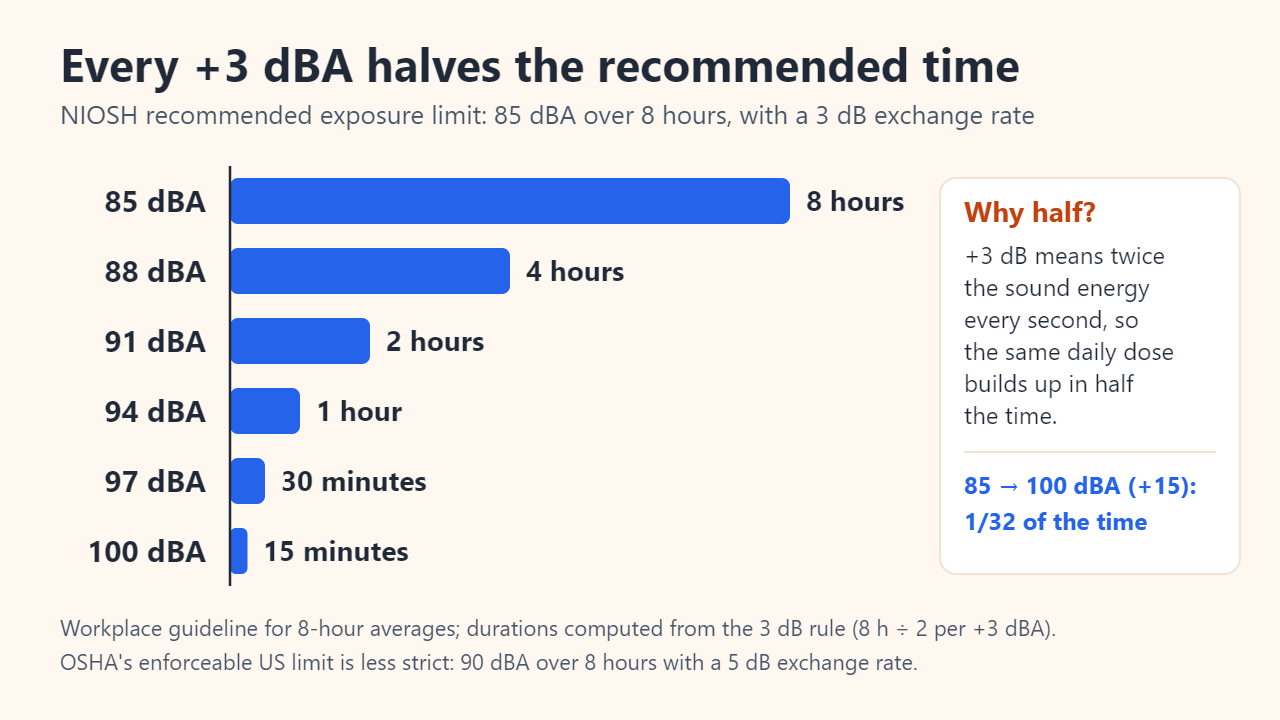
NIDCD notes that sounds at or below 70 dBA are unlikely to cause hearing loss even after long exposure, while long or repeated exposure at or above 85 dBA can. For workplaces, NIOSH recommends a limit of 85 dBA averaged over an eight-hour shift and halving the time for every 3 dBA increase. That 3 dB exchange rate is the +3 dB rule at work: twice the sound energy per second delivers the same dose in half the time. Step by step, 8 hours at 85 dBA becomes 4 hours at 88, 2 hours at 91, 1 hour at 94, 30 minutes at 97 and 15 minutes at 100 dBA. OSHA's enforceable US limit is less strict, at 90 dBA with a 5 dB exchange rate.
Distance: about −6 dB each time you double it
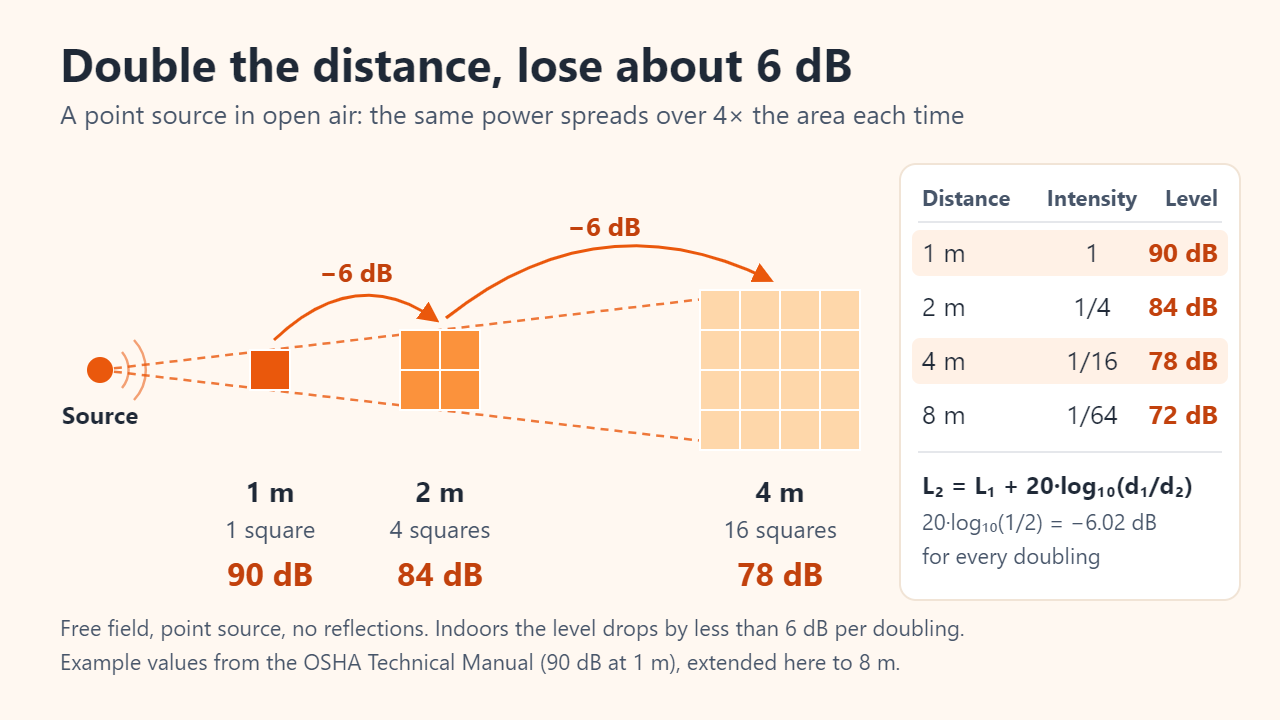
Sound from a small source in open air spreads over an ever larger sphere. The sphere's area grows with the square of the distance, so intensity falls with the square of the distance (the inverse-square law) and sound pressure falls in inverse proportion to it (1/r). In decibels, L2 = L1 + 20 · log10(d1 / d2), which comes to about −6 dB per doubling of distance.
OSHA's example: a point source producing 90 dB at 1 m gives 84 dB at 2 m and 78 dB at 4 m. At 8 m it would be 72 dB, with the intensity cut to 1/64. Keep three limits in mind:
- Free field only. The rule assumes no reflecting surfaces. Indoors, reflections keep levels higher, so the drop per doubling is less than 6 dB, and far from the source the reverberant sound dominates.
- Not too close. Right next to a large source, in the near field, measurements are unreliable and the rule breaks down.
- Power stays the same. A source's sound power does not depend on distance; only the level you measure does, so a dB figure without a distance is incomplete.
FAQ
Is 60 dB twice as loud as 30 dB?
No. A 30 dB difference is 10 × 10 × 10 = 1,000 times the intensity, and by the rule of thumb (2 × 2 × 2) about eight times as loud.
Is a 3 dB increase noticeable?
Usually, in a side-by-side comparison, but it is a modest step: double the power, yet only about 1.2 times as loud by the rule of thumb. That is why turning a speaker up by 3 dB rarely feels dramatic.
Can decibels be negative?
Yes. A negative value means below the reference: −10 dB is one tenth of the reference power, and a sound below 0 dB SPL has a pressure under 20 µPa. In gain figures, negative dB means attenuation.
Sources: NIST Guide to the SI, Section 8.7: level, neper and bel; OSHA Technical Manual, Section III Chapter 5: Noise; NIDCD: Noise-Induced Hearing Loss; HyperPhysics (Georgia State University): Loudness.
Related reading
Original illustrations created to help explain this article.