Echo and reverb: why the same voice sounds different in each room
This article was translated from its source language with AI assistance. Please check technical terms and equations against the original.
In an empty room, the end of a sentence seems to linger against the walls. In a furnished room with curtains, speech feels closer. The voice itself has not necessarily changed; the reflections following the direct sound have. Understanding that difference helps you identify recording problems before adding lots of effects.

A repeated sound versus a lingering sound
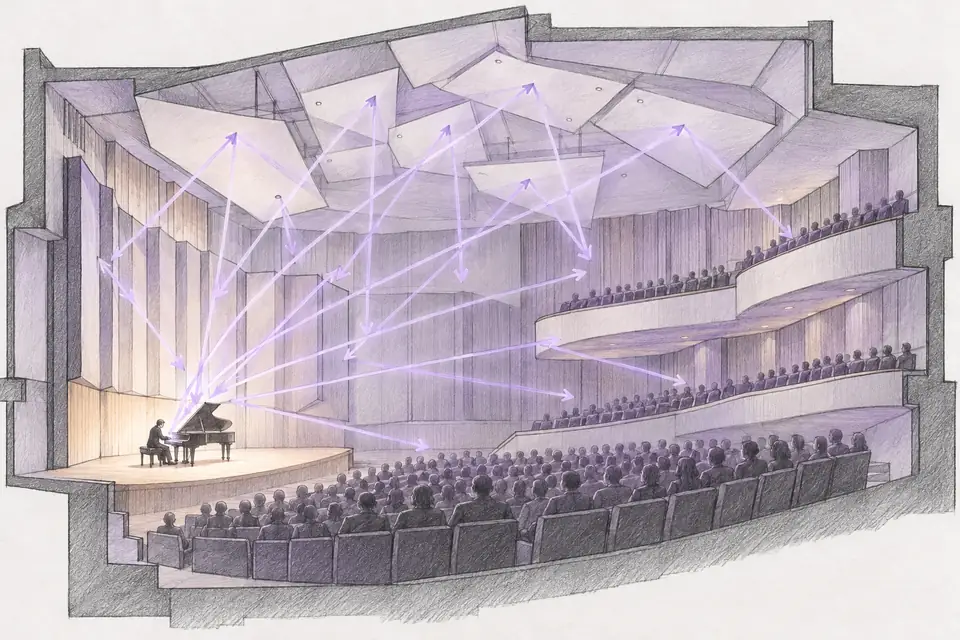
An echo is easiest to understand as a repeat distinguishable from the original sound. Reverberation is the sense of lingering space created by many overlapping reflections. Both can occur in the same real room. Reflections do not all return at identical intervals, so a room's sound is more complicated than a simple copy.
In audio effects, echo controls the timing and decay of repeats, while reverb creates ambience and a tail. The basic distinction is explained in Audacity's echo guide and reverb guide. Keep an effect's name separate from the physical behaviour of a room.
Compare rooms without buying equipment
Suppose you need a place to record an explanatory video. Compare a position facing a bare wall with one beside a bookcase, recording the same sentence at the same speaking volume. Keep the phone or microphone position and its distance from your mouth as similar as possible to make the room comparison useful.
Leave a brief silence after a short sentence and listen to how long the ending continues. Separately note whether consonants smear, words overlap, or steady noise such as a ventilation fan is present. A single clap can help you notice reflections, but it does not by itself constitute an accurate professional measurement of reverberation time.
Absorption and sound isolation solve different problems
Thick curtains and soft furnishings may reduce reflections. Their effectiveness depends on the material, covered area, and frequency; they are not a universal cure for bass problems. Reducing a room's internal ringing also does not necessarily reduce noise from the neighbouring room by the same amount.
Absorption concerns reflected energy inside a room. Sound isolation concerns transmission between spaces. If passing traffic is your main difficulty, recording at a quiet time or checking the situation around doors and windows may deserve attention before attaching small acoustic panels. This is a practical way to prioritise when comparing spaces.
Add effects sparingly and listen through the ending
For a video that communicates information, first check that the original speech is clear, then add spatial effects gradually. A louder processed version can misleadingly seem better, so compare the two at similar playback levels. A pleasing musical tail may be distracting on an explanatory voice track.
After adding repeats or reverb, leave time for the tail after the last word. Check that a tightly trimmed file does not cut the effect off abruptly, and listen again in the finished video. The aim is to choose a sense of space that lets listeners follow the sentence comfortably, rather than to erase the room completely.
Original illustrations created to help explain this article.