Why Is the Sky Blue and Sunsets Red? Rayleigh Scattering Explained
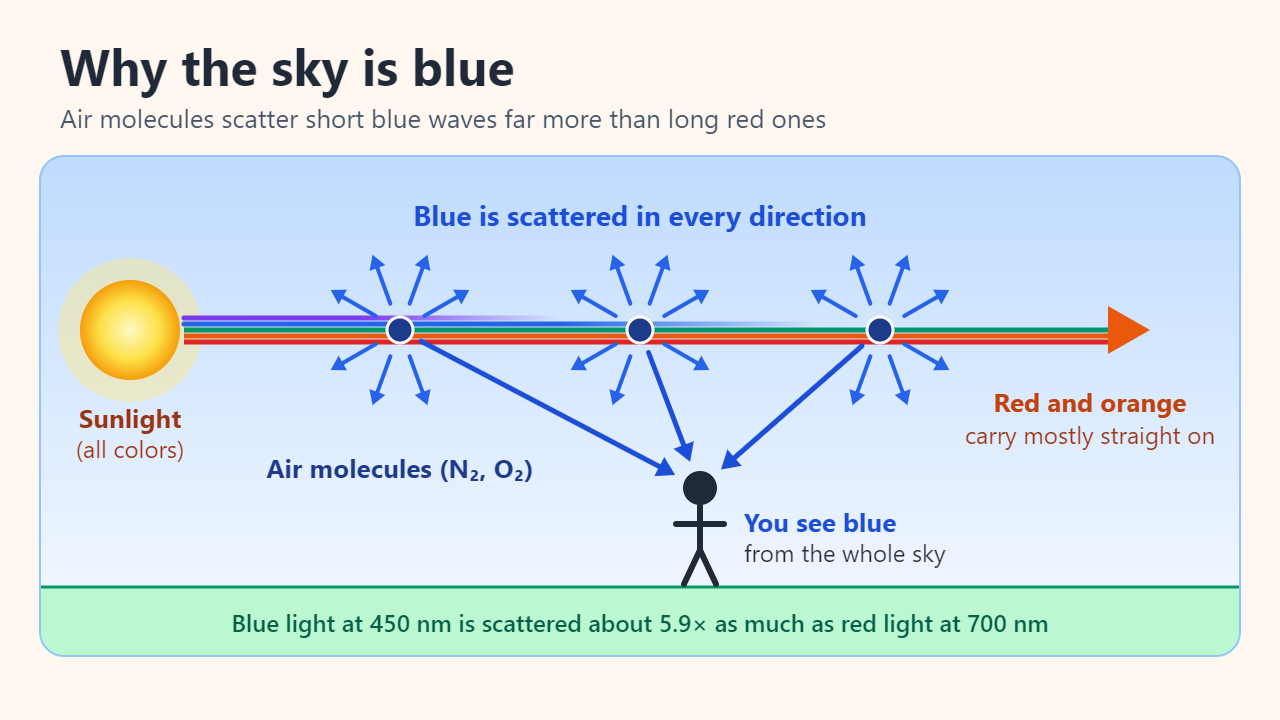
The sky is blue because the nitrogen and oxygen molecules in air scatter short-wavelength light far more strongly than long-wavelength light, a process called Rayleigh scattering. Its strength goes as 1/λ⁴, so blue light at 450 nm is scattered about 5.9 times as much as red light at 700 nm, and that scattered blue reaches your eyes from every direction of the sky. At sunset, sunlight crosses up to about 38 times as much air, so most of the blue is scattered out of the beam on the way, leaving orange and red.
Sunlight is a mix of every color
Sunlight looks white, but it is a blend of all the colors of the rainbow, each with its own wavelength. NASA gives the range the human eye can detect as roughly 380 to 700 nanometers (nm), and some references stretch the red end to about 750 nm. Violet sits at the short end, followed by blue, green, yellow and orange, with red at the long end.
A prism or a raindrop bends these colors apart. Clear air does something subtler: it redirects a small share of the light sideways, and how much it redirects depends very strongly on wavelength. That single fact explains the blue sky, the red sunset and, by contrast, the white cloud.
Rayleigh scattering: the 1/λ⁴ rule, worked out
When light meets a particle much smaller than its wavelength, the light's oscillating electric field makes the particle's electrons vibrate, and they re-radiate light in all directions. Nitrogen and oxygen molecules are well under a nanometer across, roughly a thousand times smaller than a wave of visible light, so they scatter in this regime, named after the 19th-century physicist Lord Rayleigh. The scattered intensity is proportional to 1/λ⁴, which is the same as saying it rises with the fourth power of frequency. Halve the wavelength and scattering grows 2⁴ = 16 times.
To compare blue (450 nm) with red (700 nm), divide the wavelengths and raise the result to the fourth power: 700 ÷ 450 = 1.556, and 1.556⁴ ≈ 5.86. Blue light is therefore scattered almost six times as strongly as red. The table repeats the calculation across the spectrum.
| Wavelength | Color | Calculation | Scattering relative to 700 nm |
|---|---|---|---|
| 400 nm | Violet | (700/400)⁴ | 9.38× |
| 450 nm | Blue | (700/450)⁴ | 5.86× |
| 550 nm | Green | (700/550)⁴ | 2.62× |
| 650 nm | Red | (700/650)⁴ | 1.35× |
| 700 nm | Deep red | (700/700)⁴ | 1.00× |
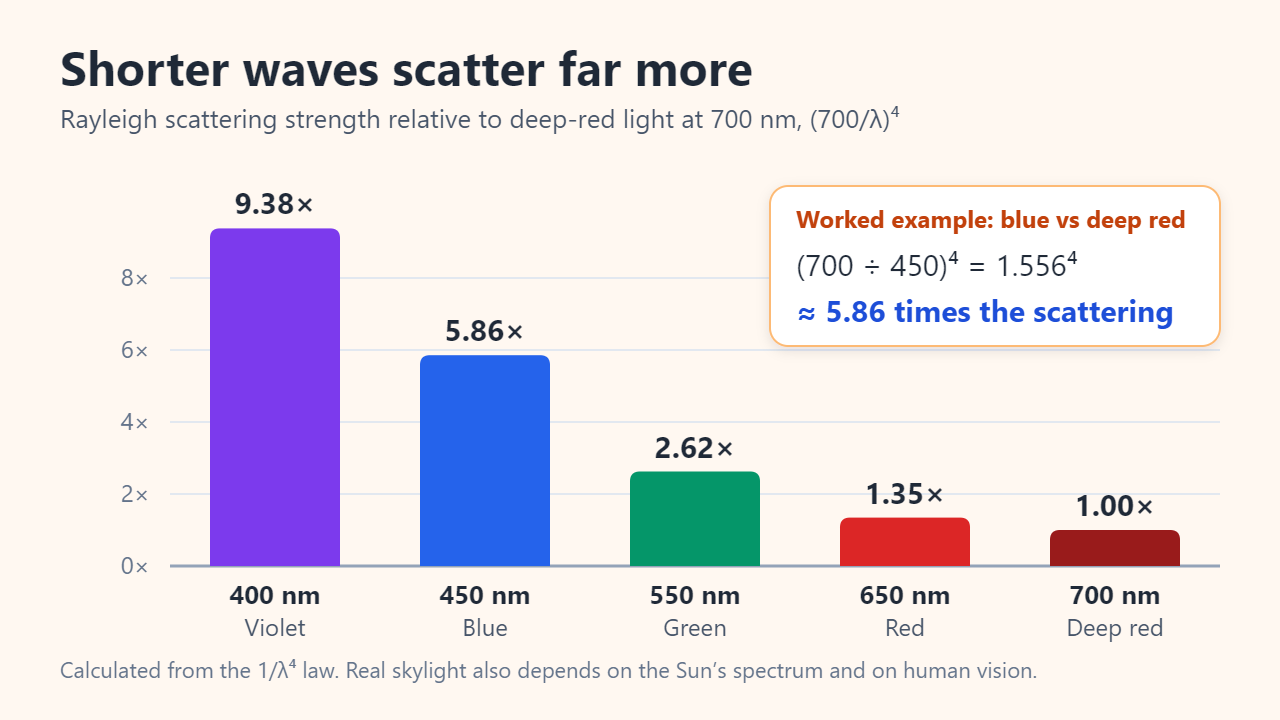
You will see other multiples quoted, because the answer depends on which wavelengths you call "blue" and "red." NOAA, for example, describes blue as scattering about four times more strongly than red, which matches roughly 460 nm against 650 nm. The rule is the same in every case; only the endpoints differ.
Why isn't the sky violet?
If scattering were the whole story, the sky would look violet: at 400 nm, violet is scattered (450 ÷ 400)⁴ ≈ 1.6 times as strongly as 450 nm blue. Three things tip the balance toward blue.
- Sunlight carries less violet than blue. The Sun does not emit an even mix of colors, and its output falls off toward the violet end before the light even reaches Earth.
- Violet is used up on the way down. Because violet scatters most, it is also stripped from the incoming sunbeam fastest, so less of it is left deep in the atmosphere to be scattered toward you.
- Your eyes are less sensitive to violet. The three types of color-sensing cone cells overlap and respond weakly at the violet end. The brain combines plenty of blue and violet with smaller amounts of green and red into a pale, whitish blue.
So skylight is not a single pure color. It is a broad mixture weighted toward short wavelengths, and human vision reports that mixture as "sky blue."
Why sunsets are red and orange
Sunset colors come from the same scattering, seen from the other end of the beam. Around midday, sunlight takes a short path down through the atmosphere. When the Sun is low, its light skims through far more air, and blue and violet are scattered out of the beam along the way. What survives the trip is weighted toward yellow, orange and red, and that light colors the Sun's disk and the undersides of clouds.
Astronomers and solar engineers describe this path with the air mass: the length of the light's path through the atmosphere divided by the path when the Sun is straight overhead. The values below come from the Kasten–Young formula, which allows for Earth's curvature.
| Sun's height above the horizon | Relative air mass |
|---|---|
| 90° (overhead) | 1 |
| 30° | 2.0 |
| 10° | 5.6 |
| 5° | 10.3 |
| 0° (on the horizon) | About 38 |
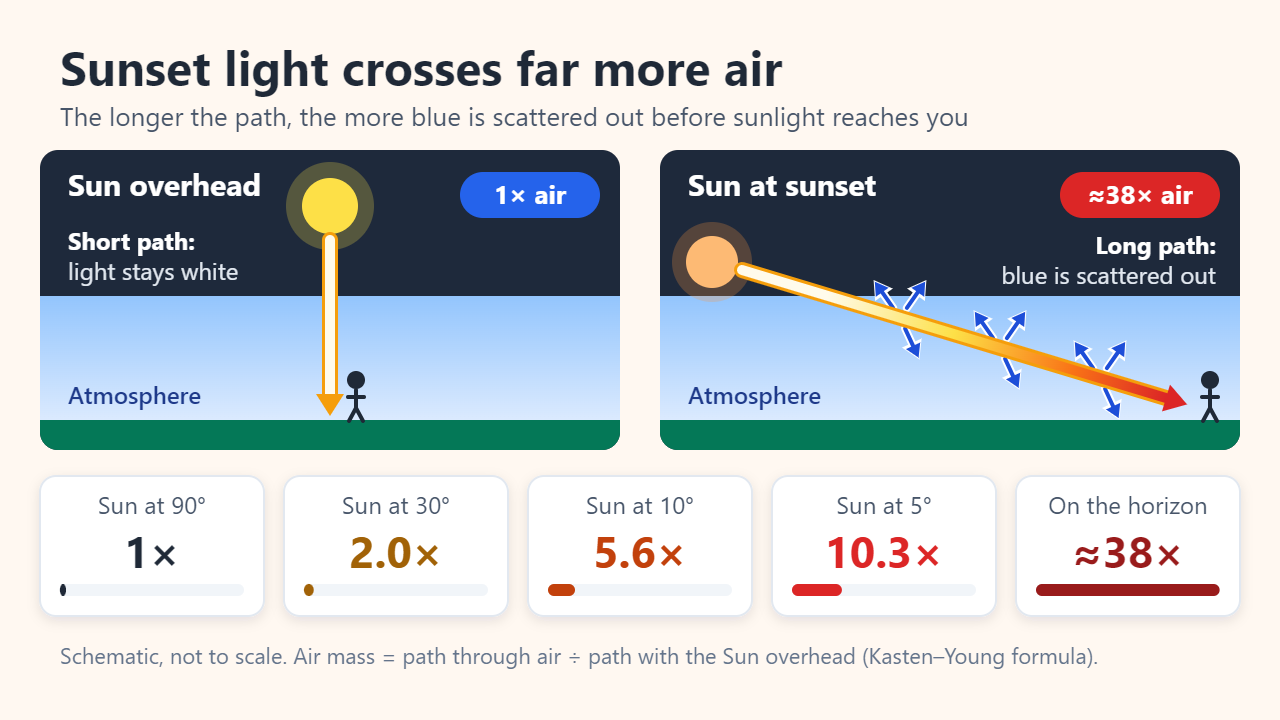
Each stretch of air removes another share of the blue, so a path 38 times longer strips it out almost completely. Dust, pollution and other aerosols scatter light too and can make sunsets redder still. The same effect explains why the sky near the horizon looks paler than the sky overhead: light reaching you from low angles has crossed so much air that its blue has been scattered and re-scattered into a whitish mix.
Clouds and Mars: when bigger particles change the color
Why clouds are white (or gray)
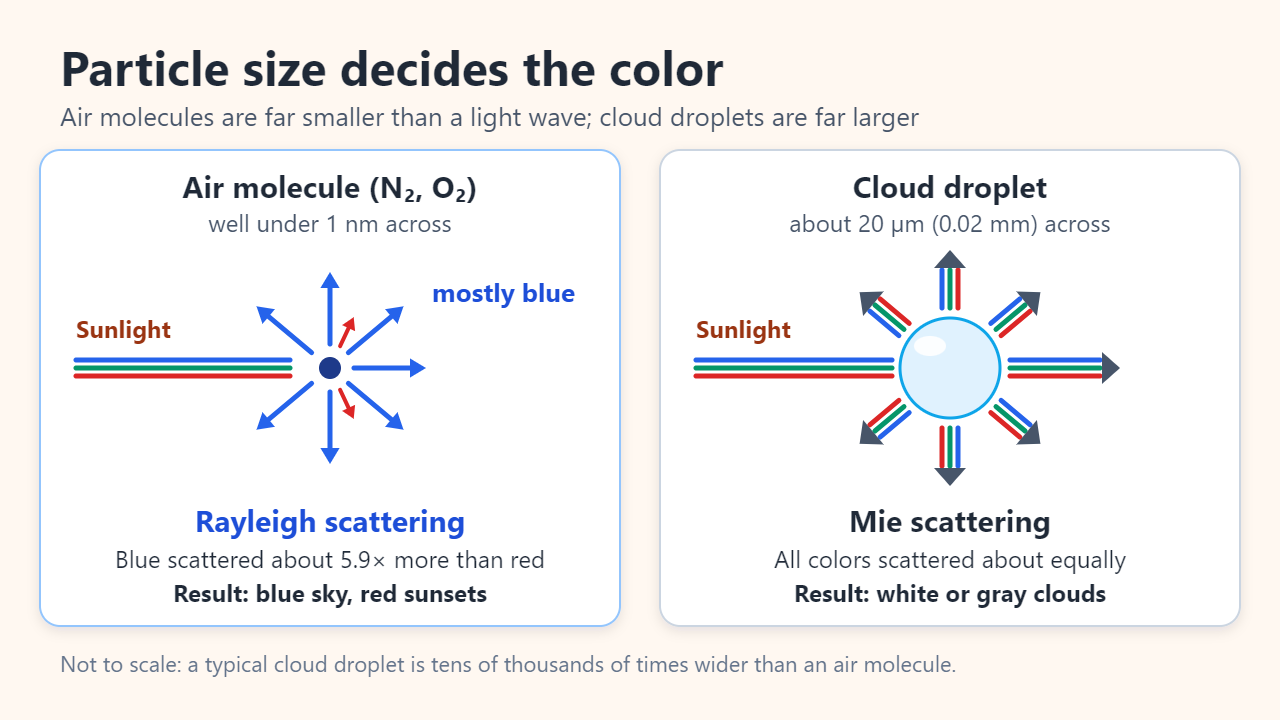
Cloud droplets are enormous compared with air molecules. A typical droplet is about 20 micrometers (0.02 mm) across, around 40 times the wavelength of green light. Particles of that size produce Mie scattering, which treats all visible wavelengths about equally. Light scattered by a cloud keeps its full mix of colors, so the cloud looks white. As a cloud thickens, less sunlight gets through, and its base turns gray.
- Air molecules (well under 1 nm): Rayleigh scattering, strongly favors blue, giving blue skies and red sunsets.
- Cloud droplets (about 2–50 micrometers): Mie scattering, nearly color-neutral, giving white or gray clouds.
Why Mars has blue sunsets
Mars shows how much the particles matter. Its atmosphere is very thin and mostly carbon dioxide, and fine dust suspended in it does most of the coloring, so the daytime sky looks orange to reddish. Near sunset the pattern flips: the dust lets blue light through slightly more efficiently, so a blue-gray glow gathers around the setting Sun. NASA's Curiosity rover photographed this in Gale Crater in 2015.
FAQ
Is the sky blue because it reflects the ocean?
No. The color is produced by the air itself, which is why the sky is just as blue over deserts and mountains far from the sea.
Why is the sky black in space or on the Moon?
Without air there is nothing to scatter sunlight toward you from directions away from the Sun. Above the atmosphere, or on the airless Moon, the sky stays black even in full daylight.
Why does the Moon turn red during a total lunar eclipse?
The only sunlight reaching the eclipsed Moon has been filtered through a thick slice of Earth's atmosphere, which removes blue just as it does at sunset. NASA describes it as if all the world's sunrises and sunsets were projected onto the Moon.
Sources: NASA Space Place: Why is the sky blue?; NOAA JetStream: The Color of Clouds; West Texas A&M University (Christopher S. Baird): Why is the sky blue?; PVEducation: Air Mass.
Related reading
Original illustrations created to help explain this article.