Is a Crescent Moon Earth's Shadow? Separating Phases from Lunar Eclipses
This article was translated from its source language with AI assistance. Please check technical terms and equations against the original.
When the Moon becomes thin and then round again, it is tempting to imagine something gradually covering it. Yet an ordinary crescent and a lunar eclipse have different causes. Rather than memorizing shapes first, sketch the positions of the Sun, the Moon, and the observer. Those three positions are also the key to explaining the Moon you see tonight.
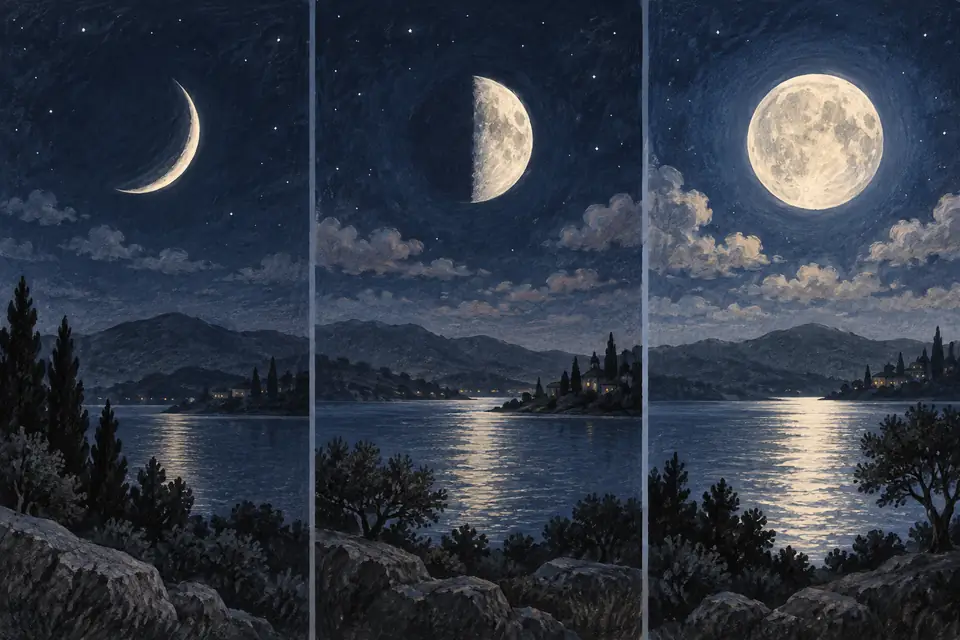
1. Separate the illuminated half from the visible portion
The Moon reflects sunlight rather than shining like a star. Normally, its Sun-facing half is illuminated. As it travels around Earth, we see different proportions of that illuminated half: its phases. A half Moon therefore does not mean that only half of the whole Moon receives sunlight; it means half of its apparent disk looks bright. NASA's explanation of Moon phases describes this distinction.
From new Moon to full Moon, the bright area we see grows; afterward it shrinks. The Moon is neither being cut apart nor growing back. Think of observing the same ball from different directions. In a phase diagram, separate arrows for the direction of sunlight and the line of sight from Earth to the Moon help prevent confusion.
2. A lunar eclipse involves Earth's shadow
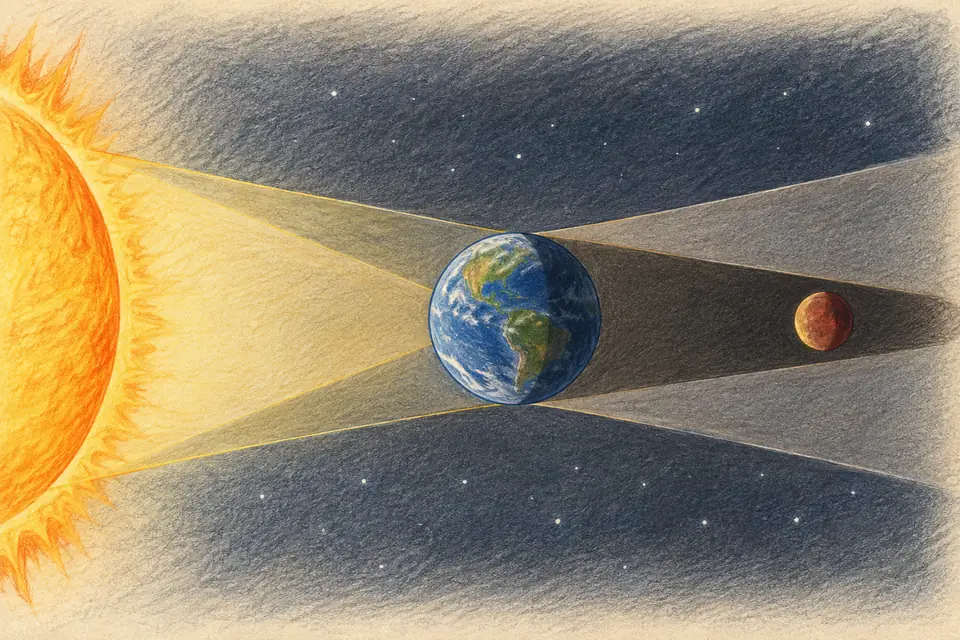
During a lunar eclipse, the Moon enters the shadow cast by Earth between it and the Sun. This can happen at full Moon. However, the lunar orbit is inclined to the plane of Earth's orbit around the Sun, so the required alignment does not happen every month. Full Moon alone does not guarantee an eclipse. NASA's eclipse guide illustrates the tilted orbit.
Two questions separate the phenomena. “From which direction do we see the sunlit portion?” concerns phases. “Does the Moon enter Earth's shadow?” concerns an eclipse. Calling the dark portion of a crescent Earth's shadow mixes these questions together. The boundary between light and dark on the lunar surface is not, by itself, the edge of Earth's shadow.
3. Test the geometry indoors
Let a lamp represent the Sun, a white ball the Moon, and your eyes the observer. Hold the ball near eye level and move it around your body, comparing the visible bright area. Look at the ball, not the lamp, and adjust positions so your body or hand does not shade it. The model separates illumination from viewing direction; it does not reproduce astronomical distances or sizes.
With the ball between the lamp and your eyes, mainly its dark side faces you. Move it sideways and you see both light and dark regions. Opposite the lamp, a broad bright face appears. If your head's shadow covers the ball there, you have mixed an eclipse situation into the phase model. Explaining why that shadow appeared makes the difference clearer.
4. Record direction as well as shape
Over a week, note the date, time, observing location, position in the sky, and approximate bright fraction whenever you see the Moon. Leave a gap when weather prevents a view. There is no need to fill missing photographs or invent unobserved shapes. Even a few entries show why looking in the same place at the same time does not always locate the Moon.
A rule such as “a bright right-hand side means waxing” depends on location and diagram orientation. Do not apply it unchanged to photographs from another hemisphere or to rotated images. Compare whether the illuminated portion grows or shrinks across dated observations, and consider the arrangement of light and sight lines. The shape reveals a relationship among three bodies, rather than the size of a missing piece.
Original illustrations created to help explain this article.