Is Earth Closer to the Sun in Summer? Two Changes Behind the Seasons
This article was translated from its source language with AI assistance. Please check technical terms and equations against the original.
Hot summer weather may suggest that Earth has moved closer to the Sun. But consider that Korea has summer while Australia has winter in the same month. Both hemispheres share Earth's distance from the Sun, yet their seasons are opposite. Distance alone cannot explain this. Understanding seasons requires both the angle of sunlight and the length of daylight.

1. Begin with the tilted rotation axis
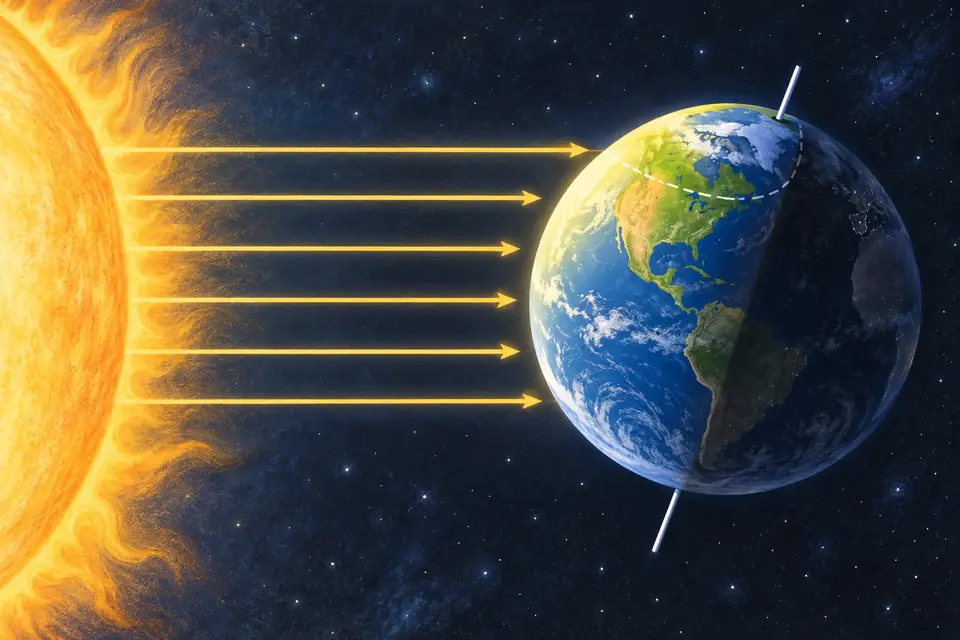
Earth's rotation axis is tilted about 23.4 degrees from the direction perpendicular to its orbital plane. As Earth circles the Sun, a hemisphere alternately tilts toward and away from it. NASA's seasons explanation identifies this tilt as the key cause. Around June the Northern Hemisphere tilts toward the Sun; around December the Southern Hemisphere does.
When drawing Earth in four seasons, do not point each rotation axis in an unrelated direction. In a simple model of one year, keep the axes nearly parallel while changing Earth's orbital position. Otherwise the picture can incorrectly suggest that Earth repeatedly turns its axis toward the Sun. Consistent geometry matters more than beautiful arrows.
2. Slanting light spreads over more area
A beam arriving nearly perpendicular to a surface covers a smaller area than a beam arriving obliquely. The same light is shared over a larger patch. This geometry explains why the incidence angle affects energy received per unit area; it is not a formula that immediately predicts actual air temperature.
Shine a flashlight onto paper from nearly perpendicular and tilted directions and compare the shapes of the illuminated patches. Keep the distance from flashlight to paper as constant as possible and focus on patch area rather than the impression of brightness. Changing distance mixes another variable into the angle comparison. This, too, is a simple model rather than a reproduction of the real Sun–Earth scale.
3. Longer days mean more time receiving sunlight
At middle latitudes, the summer Sun follows a higher path and daylight lasts longer; winter reverses this. Both the concentration of sunlight and the receiving time change. Comparing a near-noon shadow and daylight length at monthly intervals in one location can make seasons more concrete than a single calendar diagram.
Record the time and surface conditions. You need not assume clock noon is exactly the Sun's local meridian passage. Match comparison conditions where possible and note cloudy versus clear weather separately. Oceans, terrain, the atmosphere, and heat storage also influence local temperature, so do not expect the longest day necessarily to be the hottest day.
4. Distance changes, but is not the main cause
Earth's orbit is not a perfect circle. It is generally closest to the Sun in January and farthest in July. NASA's material shows that Northern Hemisphere winter and summer occur in the opposite order from the “closer means summer” explanation. That does not mean distance has absolutely no physical influence. Distinguish the existence of an effect from the principal cause of seasons.
To explain a season, first identify the hemisphere, then ask about sunlight angle and day length. Avoid applying Korea's four-season pattern unchanged to places near the equator. Besides asking where Earth is, consider how and for how long a particular region receives light. That lets one model explain two cities with opposite seasons.
Further reading
Original illustrations created to help explain this article.