What Is Specific Strength? Meaning, Formula, Units, Calculation Examples, and Its Difference from Specific Stiffness
This article was translated from its source language with AI assistance. Please check technical terms and equations against the original.
Specific strength is a material's strength divided by its density. It is used to compare how much load materials can withstand at the same weight. The basic formula isSpecific strength = strength σ / density ρ. Higher strength or lower density increases specific strength, but being lightweight alone does not mean a material has high specific strength.
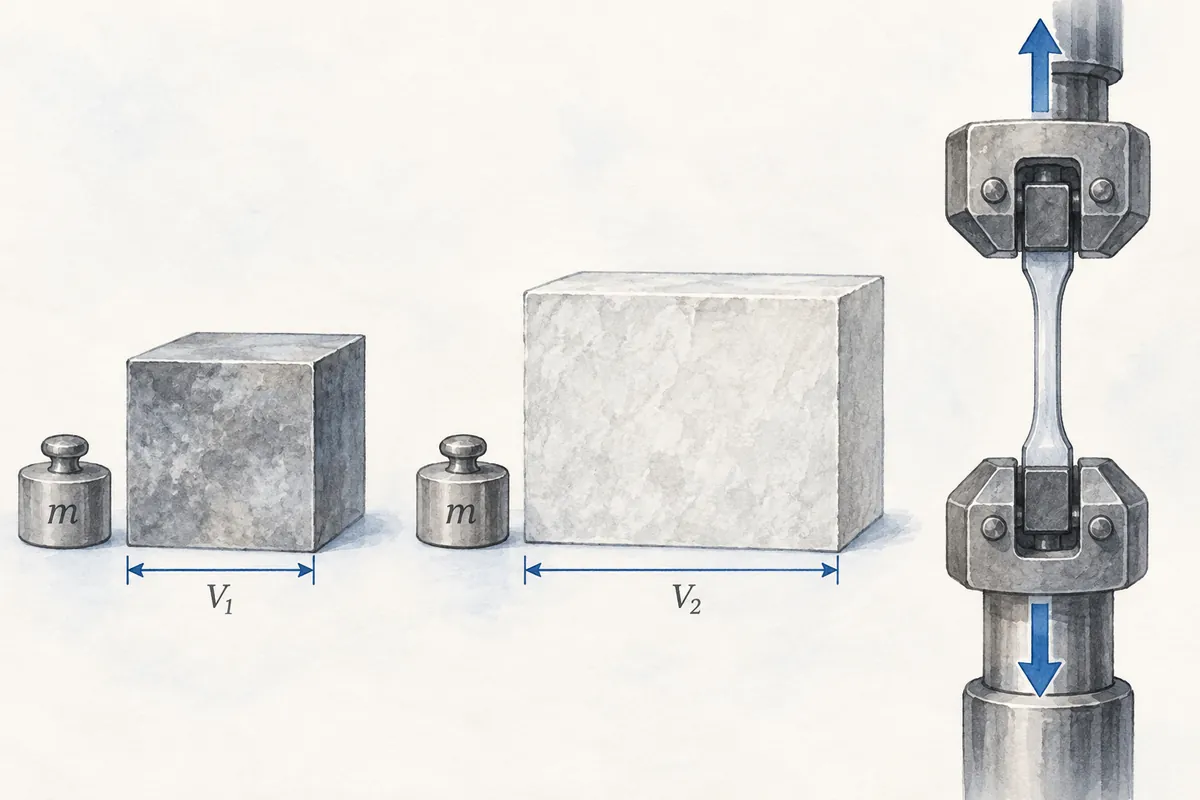
1. Meaning and Formula of Specific Strength
Specific strength is used to compare many kinds of materials, including composites as well as metals. First, check whether yield strength or tensile strength is being used. Combining the yield strength of one material with the tensile strength of another does not provide a comparison on the same basis.
σspecific = σ / ρ
σ: the strength used for comparison; ρ: material density
2. Units and Calculation Examples
If strength is entered in Pa and density in kg/m³, the unit is Pa·m³/kg, equivalent to N·m/kg or m²/s². For data given in MPa and g/cm³, convert the units before calculating.
- 1 MPa = 1,000,000 Pa
- 1 g/cm³ = 1,000 kg/m³
The following hypothetical materials illustrate the calculation method. These are not actual test values for any particular alloy.
| Hypothetical material | Strength on the same basis | Density | Specific strength |
| A | 300 MPa | 2.70 g/cm³ | Approximately 111,111 N·m/kg |
| B | 600 MPa | 7.80 g/cm³ | Approximately 76,923 N·m/kg |
For A, the calculation is 300,000,000 Pa ÷ 2,700 kg/m³. B has higher strength itself, but under these assumptions, the difference in density gives A a higher specific strength. When comparing actual materials, match the alloy grade, heat-treatment condition, test temperature, and loading direction as well.
3. Differences Between Strength, Specific Strength, and Specific Stiffness
| Property | Value being compared | Main question |
| Strength | Stress at yielding or failure | How much stress can it withstand? |
| Specific strength | Strength / density | Which material has the advantage when weight is considered? |
| Specific stiffness | Elastic modulus E / density | How well does it limit deformation relative to its weight? |
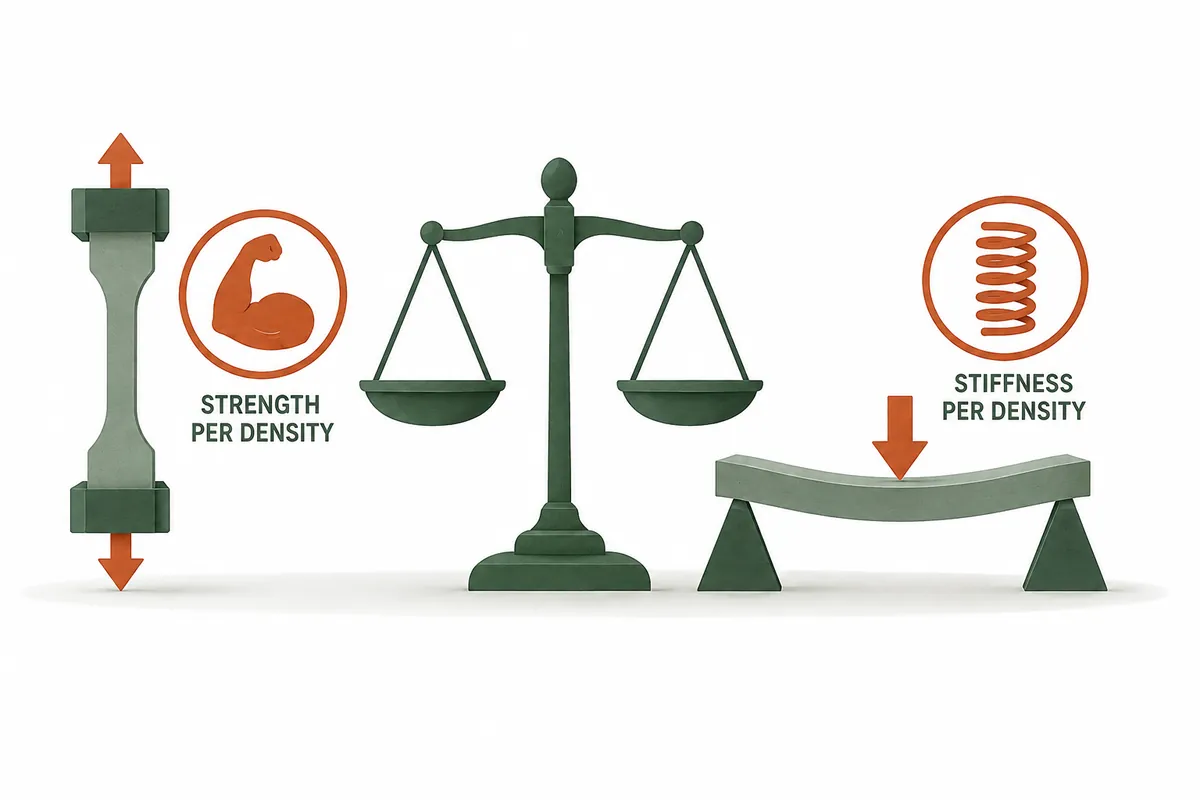
High specific strength does not always mean less bending. If deformation is the concern, examine the elastic modulus and geometry as well. Readingthe difference between strength and hardness, strength and elastic modulus on a stress–strain curve together helps distinguish these terms.
4. How to Read a Strength–Density Chart
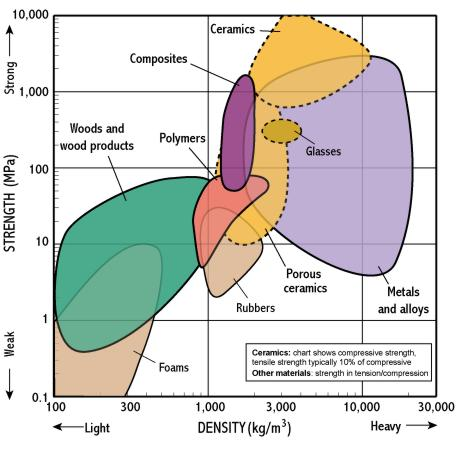
The horizontal axis represents density, and the vertical axis represents strength. At the same density, a higher position means higher specific strength; at the same strength, a position farther left means higher specific strength. However, do not simply subtract coordinates on a logarithmic chart or interpret distance from the origin as specific strength. Read the actual strength and density values and calculate σ/ρ.
5. Conditions to Check When Using Specific Strength
- Use it as an indicator to narrow down candidate materials for weight-limited components in aircraft, cars, bicycles, and similar applications.
- The selection criteria may differ between a simple member under tension and a member governed by bending or buckling.
- Also consider fatigue, corrosion, joining methods, temperature, cost, and manufacturability. Do not choose the optimal material based on specific strength alone.
6. Frequently Asked Questions
Does Lower Density Mean Higher Specific Strength?
If strength is equal, the lower-density material has higher specific strength. If strength also decreases, the result may differ, so calculate using both values.
Do Specific Strength and Tensile Strength Mean the Same Thing?
Tensile strength is a strength value obtained from a tensile test, whereas specific strength is the selected strength value divided by density. If tensile strength is used to calculate specific strength, state that basis alongside it.
Related Posts and References
Original illustrations created to help explain this article.
Original on Tistory ↗