Before Comparing Titanium and Stainless Steel: Reading Grade 2 and 316L Designations and Property Data
This article was translated from its source language with AI assistance. Please check technical terms and equations against the original.
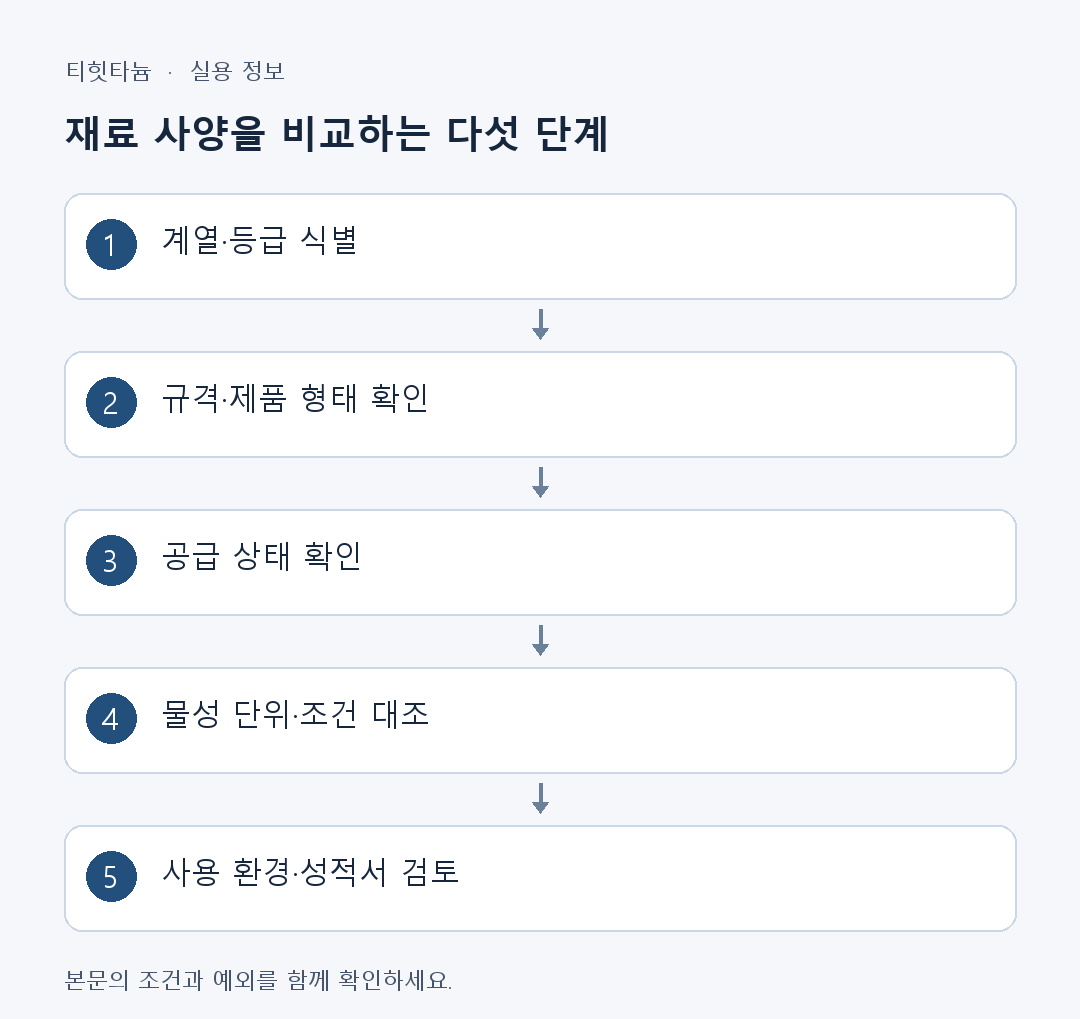
Descriptions such as “Titanium is light” or “Stainless steel does not rust” are insufficient for choosing a material. Titanium includes commercially pure grades and various alloys; stainless steel includes grades with different compositions and structures. When comparing products or experimental specimens, read the grade, specification, product form, and processing condition alongside the material name.
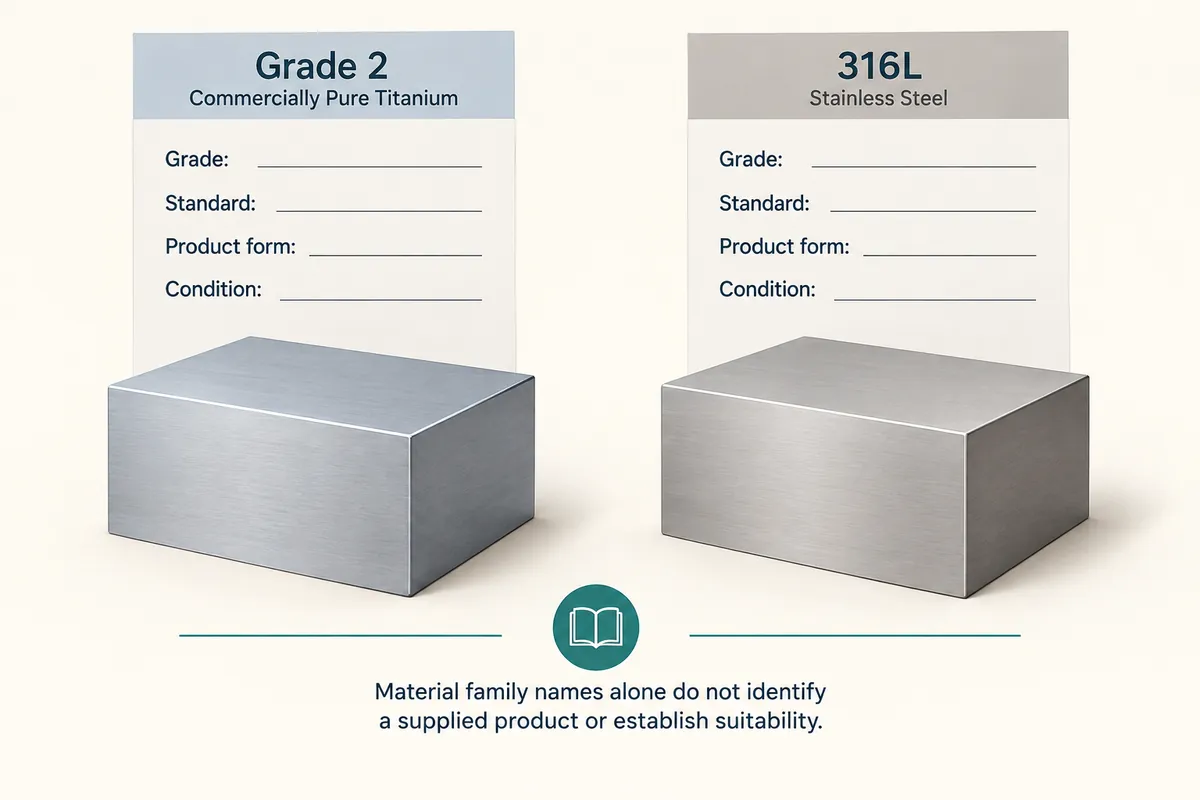
Rather than ranking titanium against stainless steel, this article explains identifying materials in manufacturer sources. It uses TIMET's Grade 2 equivalent product and Outokumpu's 316-series materials as examples without extending their conditions to every titanium or stainless steel. Calculations are hypothetical examples for understanding.
1. Separate material families from specific grades
“Titanium” is both an element name and a term for the wider titanium material family. Actual supply data requires checking grades such as Grade 2, alloy names, and manufacturer product names. TIMET describes TIMETAL 50A as commercially pure titanium corresponding to ASTM Grade 2. Do not read it as identical to titanium alloys of other grades.
Commercially pure titanium does not mean chemically 100% titanium atoms. Manufacturer data may list controlled constituents such as oxygen, iron, and nitrogen. Check the relevant specification and certificate for which elements are controlled and their ranges. Read entries such as “balance titanium” alongside the entire composition table.
Stainless steel is a family of many grades. Do not treat 304, 316, and 316L as one interchangeable name. Manufacturer product names may appear alongside EN numbers, ASTM types, and UNS numbers, so distinguish designation systems. Similar appearance or magnetic response alone cannot reliably establish a grade.
| Designation in the source | What to distinguish | How to read the example |
| Family name | Broad material group | Titanium, stainless steel |
| Grade or alloy name | Identification by composition and specification | Grade 2, Type 316L |
| Manufacturer product name | A particular manufacturer's supplied product | TIMETAL 50A, Supra 316L/4404 |
| Specification or identification number | Connect the applicable standard and grade | ASTM type, EN number, UNS number |
| Product form and condition | Sheet, bar, heat treatment, and processing conditions | Check comparison conditions even within the same grade |
2. Information to check in 316 and 316L designations
Outokumpu's Supra data describes the 316 series as austenitic stainless steel containing chromium, nickel, and molybdenum. Its 316L/4404 product is introduced as low-carbon. Rather than treating “L” like a number indicating a higher performance tier, read the source's explanation of low carbon and resistance to intergranular corrosion after welding.
Designations such as EN 1.4404, Type 316L, and UNS S31603 appearing together help identify corresponding products. However, one online equivalence table does not establish that every product requirement is identical. Standard editions, product forms, additional requirements, and certificates can matter in actual purchasing and inspection. For work requiring full specifications, compare manufacturer or supplier documents.
If a product description includes 316 but omits detailed specifications or manufacturing condition, request the necessary information. Corrosion resistance, strength, and weldability need consideration alongside environment and processing. An example application in a source does not guarantee suitability for your device's temperature, solution, and loading conditions.
3. Distinguish equal volume from equal function when comparing weight
Density helps compare masses at the same volume. TIMETAL 50A data lists 4.51 g/cm³. This is an example for that product, not an exact density for every titanium alloy. Check manufacturer density values for the stainless steel candidate using the same temperature and units.
For a hypothetical component volume of 10 cm³, the above density gives a calculated mass of 45.1 g. Assuming another candidate's density is an illustrative 8.0 g/cm³ gives 80.0 g at the same volume. The second density is an assumed calculation value, not a measurement of a particular 316 product. This shows mass differences for identical shapes but does not guarantee final mass of actual components performing the same function.
For equal load or deformation limits, different materials may require different thicknesses and shapes. The conclusion “Lower density means an equally capable component is lighter by that same ratio” therefore needs further assessment. Compare required properties and geometry, including strength, stiffness, fatigue, joints, and manufacturing conditions. Density comparison and design comparison are related but different tasks.
| Comparison question | Information needed | Problem from numbers alone |
| Is it lighter at the same volume? | Density in matching units | Ignoring product geometry and hollow construction |
| Does it withstand the same load? | Strength, cross-section, and joint conditions | Establishing strength from the family name alone |
| Does it resist bending? | Elastic modulus, geometry, and length | Using strength and stiffness as synonyms |
| Does it withstand the environment? | Solution, temperature, contact, and surface condition | Extending corrosion resistance into a guarantee for every environment |
| Are supply documents reliable? | Specifications, certificates, and product condition | Citing general promotion as an inspection result |
4. Strength, stiffness, and hardness answer different questions
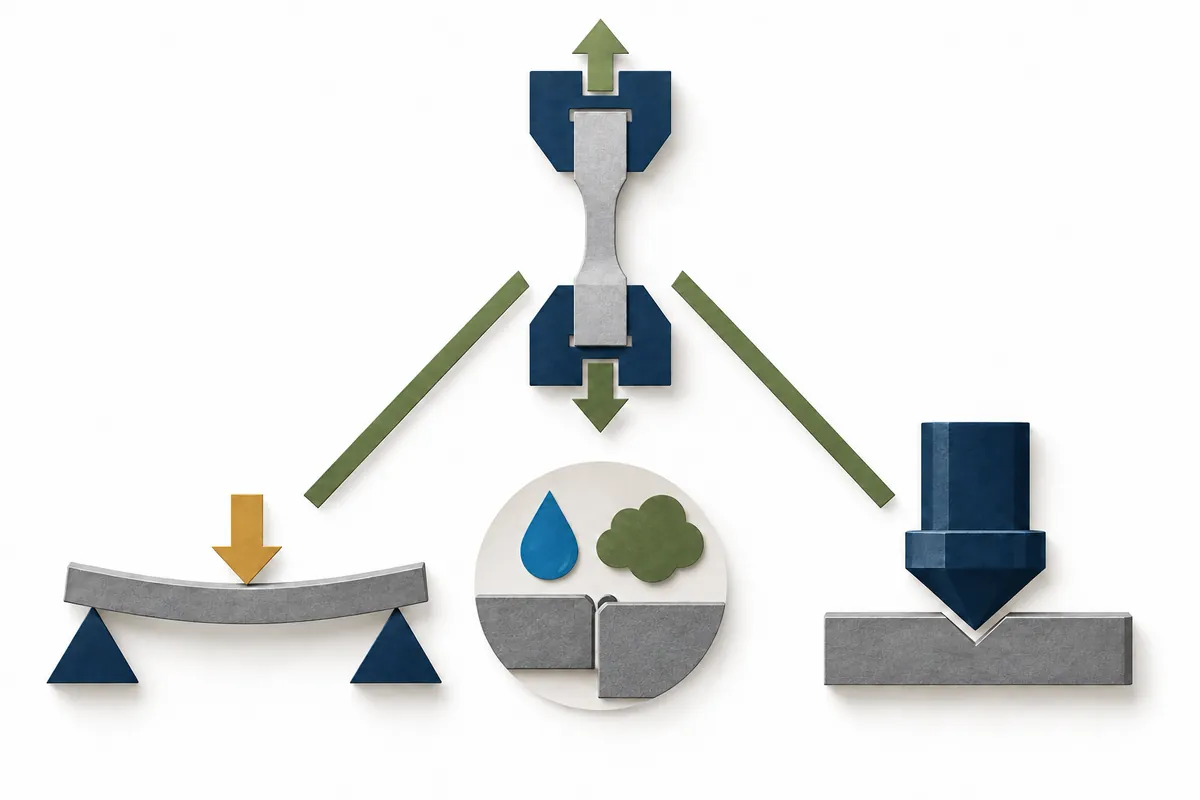
Strength relates to the stress level at which material deforms or fails. Stiffness matters for load-induced deformation in the elastic range and depends on elastic modulus and structural geometry. Hardness expresses resistance to indentation or similar action under defined test conditions. A high value in one does not establish high values in the other two.
Distinguish yield strength and tensile strength in manufacturer tables. A “minimum” can relate to a guaranteed boundary under specifications or supply conditions; a “typical” value may be representative data. Do not use typical values as guarantees for every delivered product. Table footnotes on test temperature, direction, heat treatment, and product form clarify numerical meanings.
Even in a hypothetical case where a component feels easier to bend after changing material, do not immediately conclude that strength is lower. Check whether deformation is elastic or permanent, whether geometry changed, and whether thickness and length match. Feel alone without testing cannot readily establish a grade or manufacturing defect. Actual decisions require appropriate inspection and criteria.
5. State the environment instead of saying “does not rust”
Explain corrosion resistance with the environment. Water composition, temperature, oxygen conditions, crevices, contact with other metals, and surface state can affect results. A manufacturer's application example is not a guarantee under every condition. Check the environment and method associated with corrosion findings.
Do not immediately determine a grade from staining on stainless steel, or assume titanium is safe in any chemical solely from its name. You can inspect surface contamination, material transferred from other metals, crevices, and contact conditions too. If needed, request manufacturer data and recommendations for the environment. This article does not newly determine suitability at specific chemical concentrations or temperatures.
Devices joining different metals may need more than each material's isolated properties. Overall conditions including contact and environment are necessary. Before replacing an existing component with another material, check joint, surface treatment, and usage requirements as well as dimensions. Documenting specific conditions is more useful than descriptions such as “premium material.”
6. Documents to request before purchasing or experiments
Organize material grade, applicable specification and edition, product form, dimensions and tolerances, supplied condition, and required certificates before contacting suppliers. For experimental specimens, processing direction, manufacturing history, and heat treatment may matter too. A receipt or packaging label stating only a material name provides different information from an actual property inspection certificate.
Include source and check date in comparison tables. If one material uses typical annealed sheet values and another guaranteed work-hardened wire values, mark the limitations of direct comparison. Leave missing comparable information unverified rather than forcing numbers into gaps. Matching comparison conditions matters more than the quantity of data.
An illustrative inquiry can say, “I need Grade 2 sheet. Please provide the applicable specification, thickness tolerances, supplied condition, and scope of available certificates.” For stainless steel, adding the actual needed product form and condition after “316L” also helps locate relevant data. Define final suitability conditions separately according to intended use.
Final check for reading material designations
Find family and grade in product names, then connect specifications, product form, and supplied condition in detailed sources. Next distinguish units, minimum values, and typical values for the properties being compared, and check test conditions and application environment. This changes a broad “titanium versus stainless steel” comparison into the practical question of comparing two candidate products under specific conditions.
Official sources and scope of verification
- TIMET: TIMETAL 50A, a Grade 2 equivalent product
- Outokumpu: Official Supra 316 and 316L series information
Sources checked: October 3, 2026. An informational guide written by AI after reviewing official materials. Hypothetical cases and calculation examples are not actual user records or experimental results. Screens, service conditions, and announcements can change.
Original illustrations created to help explain this article.
Original on Tistory ↗