Newton's Three Laws of Motion Explained: Inertia, F = ma, Action-Reaction
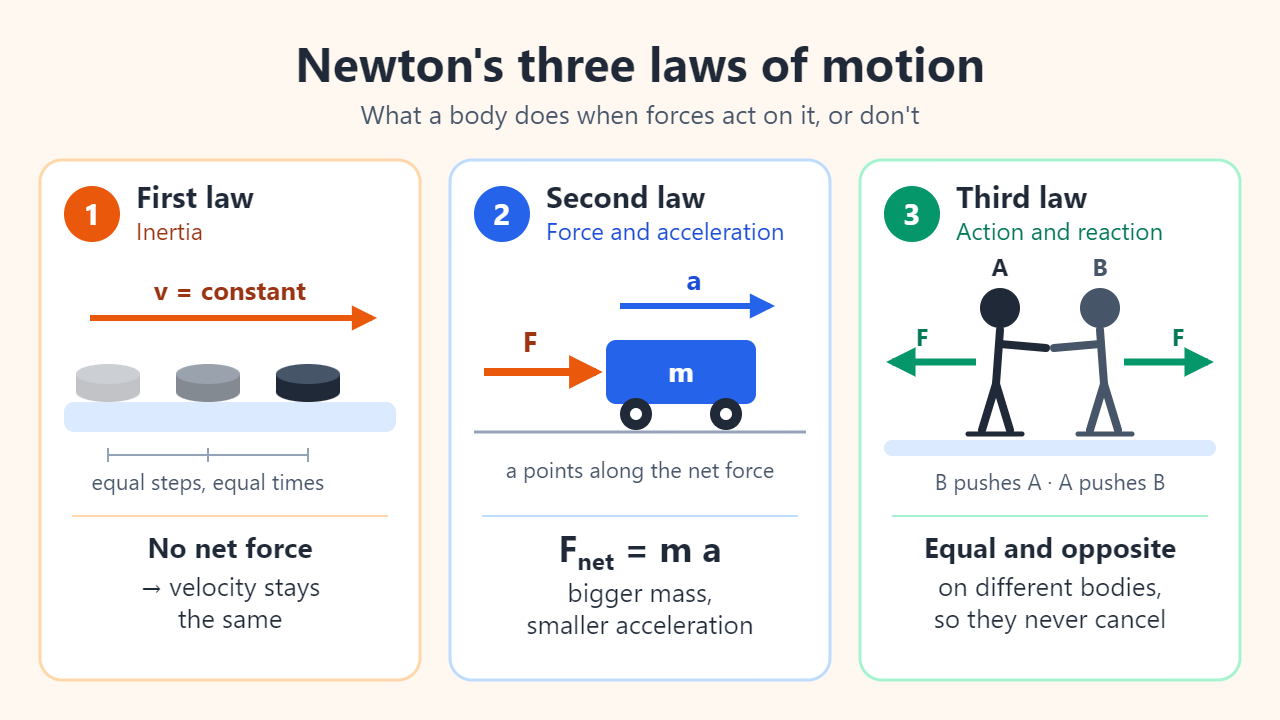
Newton's three laws of motion say that (1) an object keeps its velocity, staying at rest or moving in a straight line at constant speed, unless a net external force acts on it; (2) the net force equals mass times acceleration, Fnet = ma, so 1 newton gives 1 kg an acceleration of 1 m/s²; and (3) every force has an equal and opposite partner that acts on a different object. That last detail is why action and reaction never cancel each other out.
The first law: inertia and constant velocity
Newton published the three laws in the Principia in 1687; the first law refines an idea Galileo had developed earlier. It says a body at rest stays at rest, and a moving body keeps moving at constant velocity, unless a net external force acts on it. This resistance to changes in motion is called inertia, and mass is its measure: a loaded truck is far harder to start or stop than a bicycle.
Two details trip people up. First, "no net force" does not mean "no forces." A car cruising at a steady 100 km/h on a straight road has forces acting on it, but the road's forward push on the tires balances air drag and rolling resistance. Second, the law holds only in an inertial reference frame, one that is not accelerating. When a bus brakes, passengers lurch forward not because something shoves them, but because their bodies keep moving while the bus slows.
The second law: F = ma explained
When forces don't balance, the acceleration is proportional to the net external force, points in the same direction, and is inversely proportional to the mass: Fnet = ma, or a = Fnet ÷ m. Force and acceleration are vectors, so direction matters as much as size.
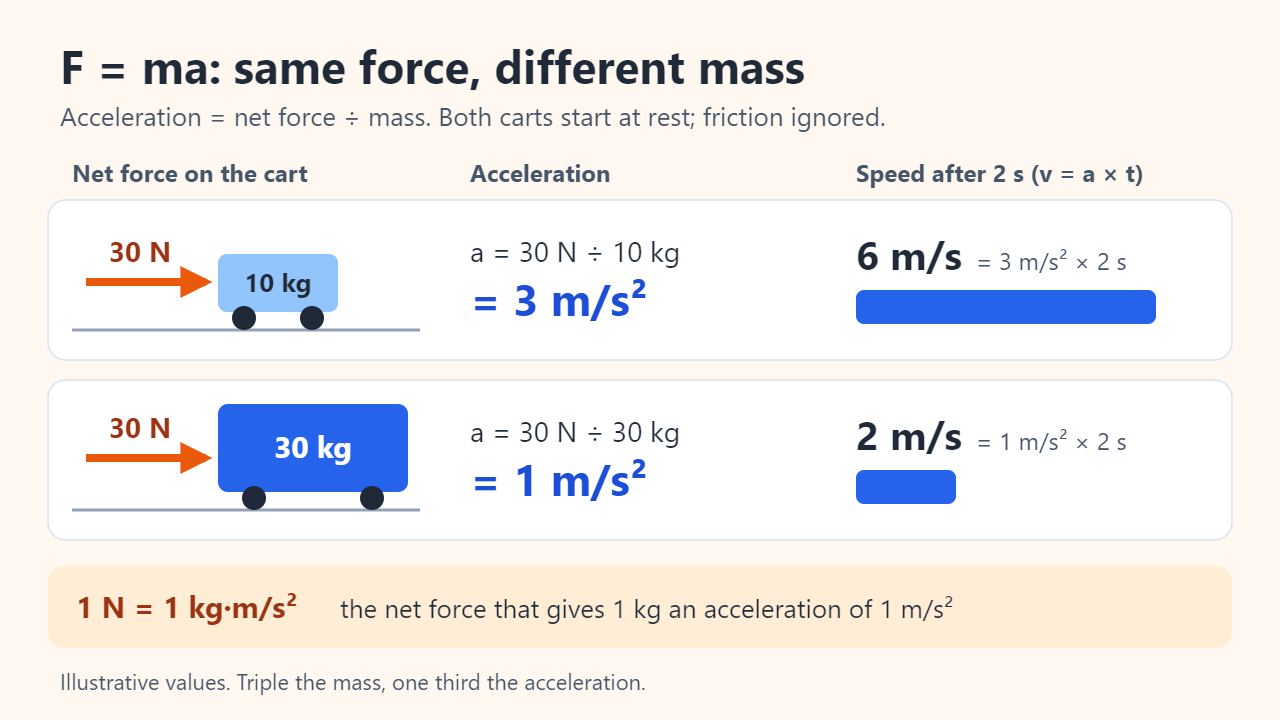
The SI unit of force comes straight from this equation. One newton (N) is the force that gives 1 kg an acceleration of 1 m/s², so 1 N = 1 kg·m/s² (NIST writes it in base units as m·kg·s⁻²). On Earth a 1 kg object weighs about 9.8 N, so 1 N is roughly the weight of a 100 g apple.
Worked example: the same push on two carts
Give two carts the same 30 N net force (illustrative numbers, friction ignored). The 10 kg cart accelerates at 30 ÷ 10 = 3 m/s², so after 2 seconds from rest it moves at 6 m/s. The 30 kg cart gets only 30 ÷ 30 = 1 m/s² and reaches 2 m/s. Triple the mass, one third the acceleration.
Worked example with friction
Push a 15 kg box with 50 N while friction resists with 20 N (illustrative):
- List the horizontal forces on the box: 50 N forward, 20 N backward.
- Add them as vectors: Fnet = 50 N − 20 N = 30 N forward.
- Divide by the mass: a = 30 N ÷ 15 kg = 2 m/s², forward.
- Check the units: N ÷ kg = (kg·m/s²) ÷ kg = m/s².
Putting the 50 N push straight into F = ma would give 3.3 m/s², a common slip. Only the net force sets the acceleration.
The third law: action and reaction examples
Whenever object A pushes or pulls on object B, B pushes or pulls on A with a force of the same size in the opposite direction. Forces come from interactions, so they always arrive in pairs:
- Walking: your foot pushes backward on the ground, and the ground pushes you forward.
- Driving: the drive wheels push backward on the road, and the road pushes the car forward.
- Rocket: the engine forces exhaust gas backward, and the gas pushes the rocket forward.
- Falling apple: Earth pulls the apple down, and the apple pulls Earth up just as hard; Earth's enormous mass makes its acceleration far too small to notice.
Equal forces do not mean equal effects. If a 40 kg skater and an 80 kg skater push off each other with 60 N (illustrative numbers), the lighter one accelerates at 1.5 m/s² and the heavier one at 0.75 m/s².
Why action and reaction forces don't cancel
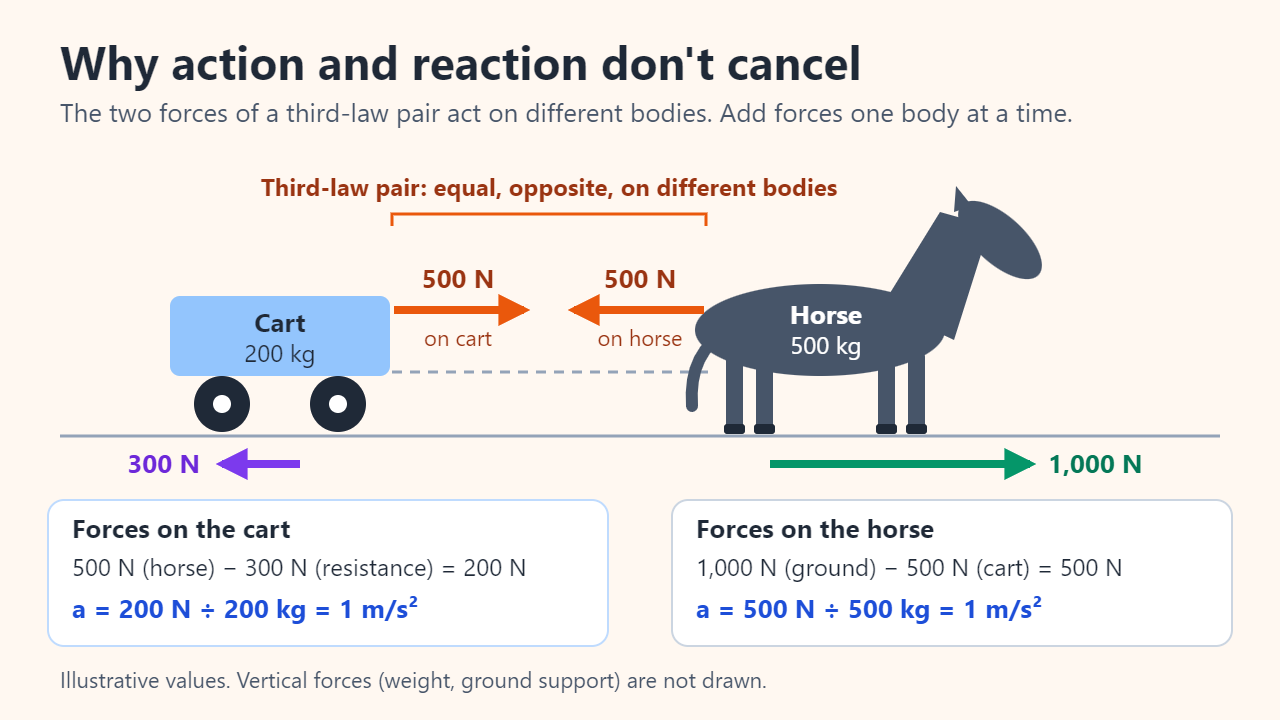
The classic puzzle: if a horse pulls a cart and the cart pulls back equally hard, how can either move? The two forces act on different bodies, so they never appear in the same force sum. To see whether the cart accelerates, add only the forces on the cart; for the horse, only the forces on the horse.
With illustrative numbers, the horse pulls the 200 kg cart forward with 500 N while 300 N of resistance holds it back: net 200 N, acceleration 1 m/s². The cart pulls the 500 kg horse back with 500 N, but the ground pushes the hooves forward with 1,000 N (the reaction to the hooves pushing back): net 500 N, again 1 m/s². Treated as one 700 kg system, the internal pull drops out: (1,000 N − 300 N) ÷ 700 kg = 1 m/s². The ground's push is what moves them.
Putting the laws together: free-body thinking
Most problems use all three laws at once, and a free-body diagram keeps them straight:
- Pick the object or system and draw it on its own.
- Draw every force acting on it from outside: gravity, normal force, friction, tension, pushes.
- Use the third law to pair forces between objects; the two members of a pair always sit on different diagrams.
- Add the forces as vectors. A zero sum means constant velocity (first law); otherwise a = Fnet ÷ m (second law).
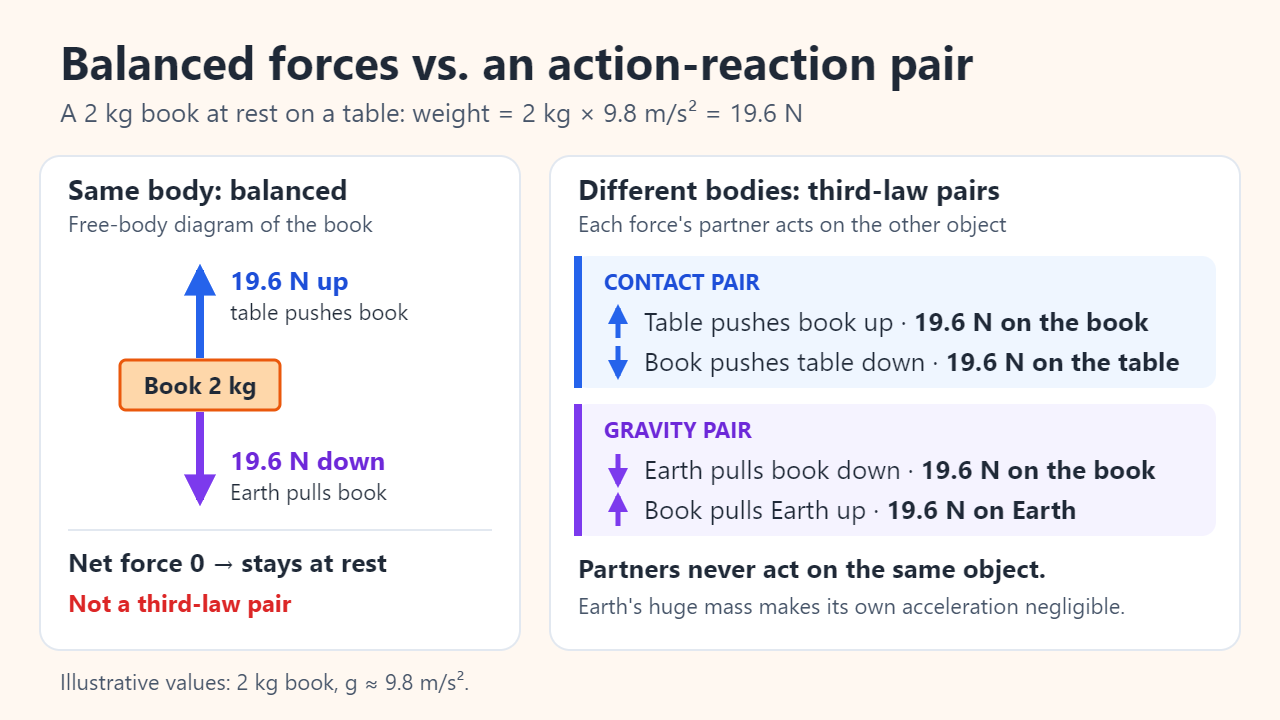
A book resting on a table is the standard test. Its weight and the table's upward push are equal and opposite, but both act on the book, so they are balanced forces, not an action-reaction pair. The partner of the book's weight is the book's own pull on Earth.
Common misconceptions about Newton's laws
| Misconception | What is actually true | Law |
|---|---|---|
| A moving object needs a steady force to keep moving | Force is needed only to change velocity; friction and drag are what slow things down | 1st |
| If nothing moves, no forces act | The forces balance, so the net force is zero | 1st |
| Acceleration points the way an object moves | It points along the net force; a braking car moves forward but accelerates backward | 2nd |
| Action and reaction cancel out | They act on different bodies | 3rd |
| Weight and normal force are an action-reaction pair | Both act on the same object | 3rd |
| In a truck-car crash, the truck hits harder | The forces are equal; the lighter car gets the larger acceleration | 3rd and 2nd |
FAQ
Is inertia a force?
No. Inertia is a property of matter, its resistance to changes in velocity, and mass measures it.
Does F = ma always work?
It holds for constant mass in an inertial frame. NASA's Glenn Research Center notes that Newton defined force as the rate of change of momentum (mass × velocity); when mass changes, as in a rocket burning fuel, use that general form. Near the speed of light, relativity takes over.
How can a rocket accelerate in space with nothing to push against?
It pushes on its own exhaust, and the exhaust pushes back. OpenStax points out that rockets perform even better in a vacuum, where exhaust escapes more freely.
Sources: NASA Glenn Research Center: Newton's Laws of Motion; OpenStax University Physics Volume 1, 5.5 Newton's Third Law; NIST Guide to the SI, Chapter 4: The Two Classes of SI Units and the SI Prefixes; Stanford Encyclopedia of Philosophy: Newton's Principia.
Related reading
Original illustrations created to help explain this article.