Mass, Weight, and Density: Sorting Out kg, N, and g/cm³ in Calculations
This article was translated from its source language with AI assistance. Please check technical terms and equations against the original.

“It weighs 2 kg,” “Its density is 8 g/cm³,” and “The load is 20 N” all express magnitudes, but not the same physical quantity. Everyday conversation can mix weight and mass, but calculations and material specifications need the distinction for consistent equations and identifiable errors. Treating mm as cm in density calculations or multiplying kg by gravitational acceleration twice can substantially alter results.
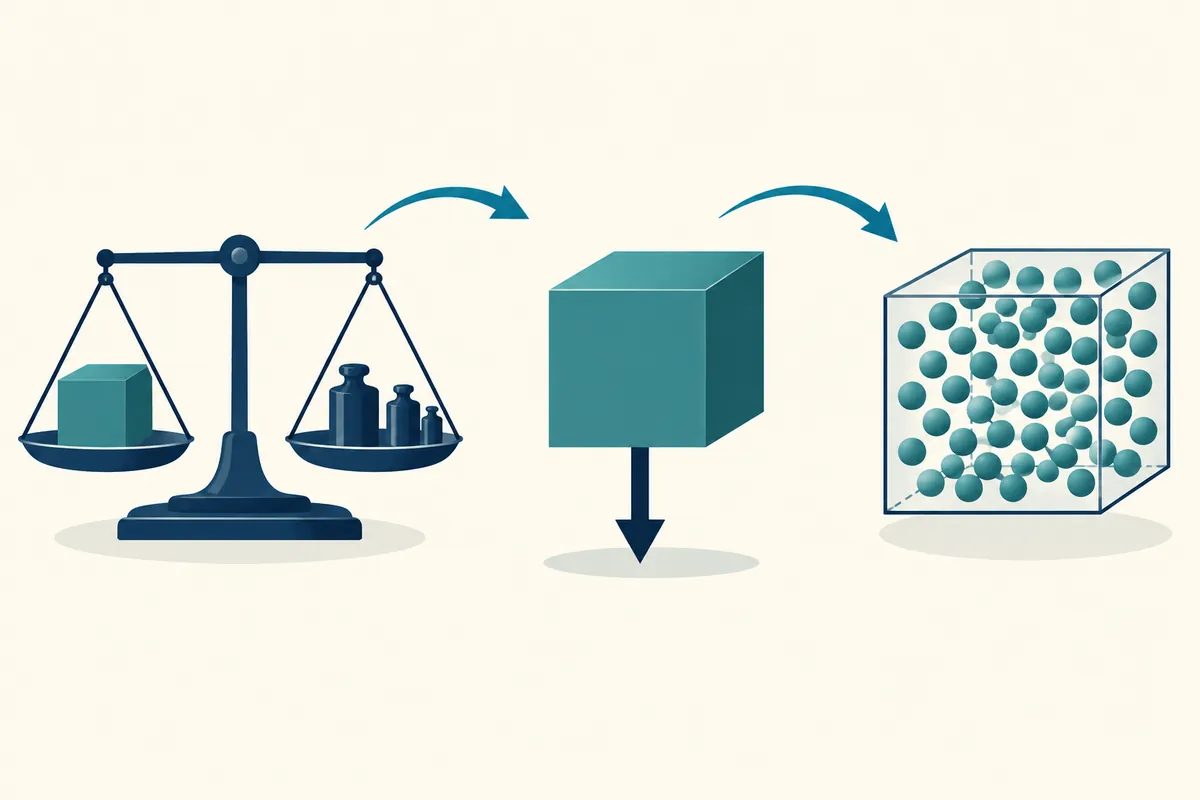
This article distinguishes mass, weight, and density and explains unit conversion order and simple calculations. Every numerical example is hypothetical. They are not actual alloy properties, weighing results, or structural design safety criteria.
1. Mass uses kg; weight as a force uses N
The SI base unit of mass is kilogram, symbol kg. When science and engineering treat weight as gravitational force, they use newtons, symbol N. Everyday expressions such as “body weight 60 kg” conventionally refer to mass. NIST's SI guidance also distinguishes everyday usage from scientific force. Stating the intended meaning in documents reduces confusion.
For an object of mass m under gravitational acceleration g, weight is W = mg. Here g depends on location conditions. With the explanatory approximation 9.81 m/s² and m = 2.00 kg, W ≈ 19.6 N. 2 kg and 19.6 N are different physical quantities linked by an equation, not one number rewritten in another unit.
Do not multiply a value already stated as “load 100 N” by 9.81 again. Conversely, calculating force from only “mass 10 kg” requires gravitational acceleration and application conditions. Contact forces during motion or sums of forces may differ from a stationary object's simple weight. Read the conditions and first name the force being calculated.
| Physical quantity | Meaning | Common units | Basic relationship |
| Mass m | Mass of an object | kg, g | Convert to matching units before calculation |
| Weight W | Force due to gravity | N | W = mg |
| Volume V | Amount of space occupied | m³, cm³, mm³ | Calculate using a formula appropriate to geometry |
| Mass density ρ | Mass per unit volume | kg/m³, g/cm³ | ρ = m/V |
2. Match mass and volume units before calculating density
Mass density is ρ = m/V. Using kg and m³ gives kg/m³; g and cm³ gives g/cm³. The same material may have different numerical representations, so do not compare numbers alone. 1 g/cm³ corresponds to 1,000 kg/m³. Convert before concluding different units mean different materials.
A hypothetical rectangular specimen with length 20 mm, width 10 mm, and thickness 5 mm has volume 1,000 mm³, equal to 1 cm³. Assuming mass 8.0 g gives density 8.0 g/cm³. The purpose is practicing conversion, not proving the specimen's metal identity or claiming an actual product has this density.
If formulas are unfamiliar, keep units beside numbers. Writing 8.0 g ÷ 1 cm³ = 8.0 g/cm³ shows what was calculated. Seeing only 0.008 from dividing 8 by 1,000 may seem incorrect, but that unit is g/mm³. 0.008 g/mm³ and 8.0 g/cm³ represent the same density in different volume units.
3. Do not apply a length conversion factor unchanged to volume
1 cm = 10 mm, but 1 cm³ = 10 mm × 10 mm × 10 mm = 1,000 mm³. Conversion factors apply once for length, twice for area, and three times for volume. Dividing mm³ by only 10 to obtain cm³ overestimates volume by a factor of 100. Since density divides by volume, the error propagates in the opposite direction.
Since 1 m = 1,000 mm, 1 m³ = 1,000,000,000 mm³. Small component volumes in m³ become tiny decimals. If these are easy to misread, calculate using understandable units such as mm and g, then convert the final result. Units must nevertheless remain consistent within each equation.
For cylindrical volume, distinguish diameter and radius. If diameter d is given, radius is d/2 and V = π(d/2)²L. Using diameter directly as radius quadruples volume. For a hollow component, subtract empty-space volume from external geometric volume. Incorrect geometry gives incorrect calculated density even with accurately measured mass.
| Conversion | Correct relationship | Common error |
| Length | 1 cm = 10 mm | Applying this factor only once to area and volume too |
| Area | 1 cm² = 100 mm² | Dividing mm² by only 10 |
| Volume | 1 cm³ = 1,000 mm³ | Converting mm³ like a length unit |
| Mass | 1 kg = 1,000 g | Mixing unchanged kg and g numbers within one equation |
| Density | 1 g/cm³ = 1,000 kg/m³ | Treating numbers alone as different material properties |
4. Distinguish containers and empty space in actual weighing
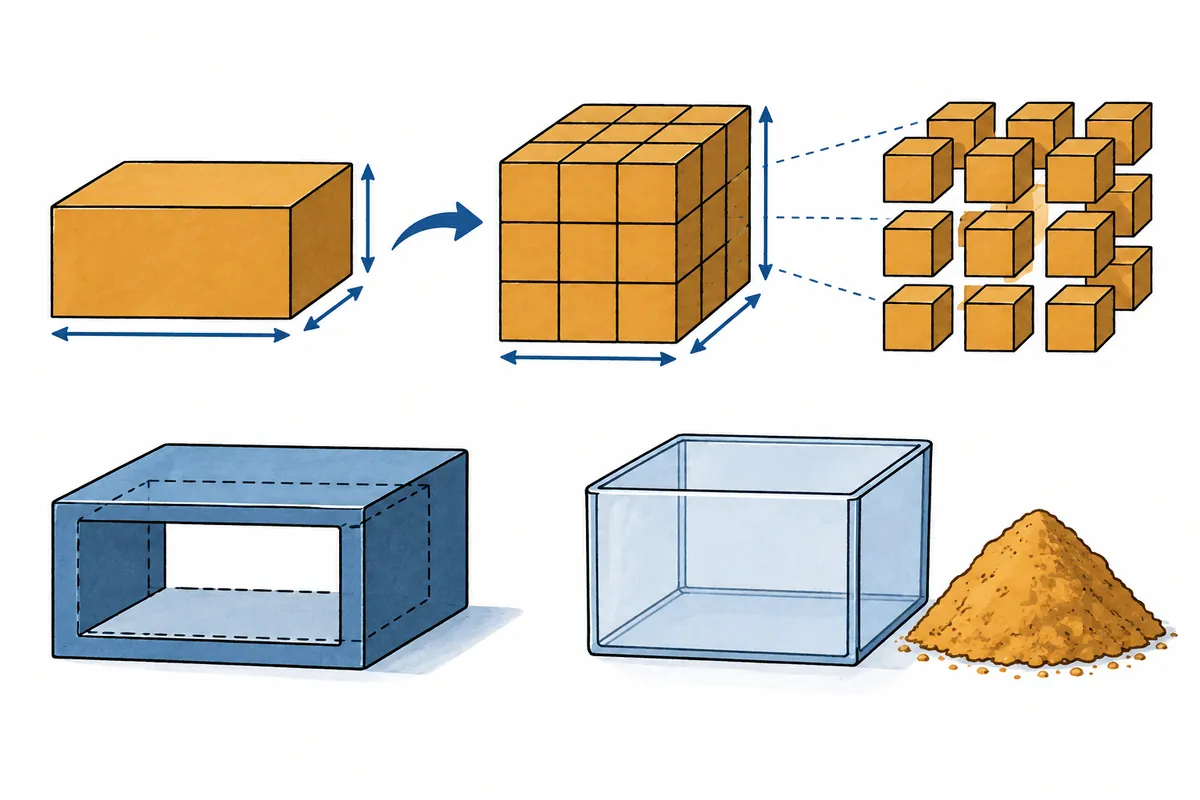
To find material mass in a container, subtract the container's mass. If a scale's zero or tare function was used, check whether it is already excluded. Subtracting twice or treating gross mass as material mass changes density. Clearly record whether a value is gross, container, or net mass.
Volume meaning is particularly important for powders and porous objects. Particle volume differs from volume including interparticle voids. Mass divided by a package's external volume is not the same as the material's intrinsic density. If sources use terms such as bulk or apparent density, check the measurement method and definition.
Water displacement does not suit every sample. Materials that absorb or react with water and geometries trapping air complicate interpretation. This article's simple equations do not establish a measurement method's validity. For material specification decisions, follow applicable standardized measurement procedures and equipment conditions.
5. A reliable input order for Excel or calculators
Record original inputs and units in a table, create converted inputs in the next column, then calculate volume and density. Avoid overwriting originals so you can return to them when results look unusual. Including units in names such as “Mass_g,” “Length_mm,” “Volume_mm3,” and “Density_g_cm3” also reduces mistakes.
For a rectangular block, use Volume_mm3 = Length_mm × Width_mm × Thickness_mm, then Volume_cm3 = Volume_mm3 / 1000, then Density_g_cm3 = Mass_g / Volume_cm3. If volume is 0 or blank, do not calculate density; flag the input for checking. Division by zero is impossible, and treating missing values as actual zero can misrepresent data.
Consider displayed digits relative to input precision. Reporting ten decimal places after roughly measured dimensions can imply equally precise measurement. A calculator's extra digits do not improve measurement accuracy. Educational examples retain intermediate values to show calculation; actual reports choose digits with measurement resolution and uncertainty in mind.
6. Five questions for unusual results
First check whether the target is mass, force, or density. Second, inspect mixed input units. Third, check area and volume conversion factors. Fourth, distinguish diameter and radius and external volume from actual material volume. Fifth, check whether container mass or an already applied correction was included again.
Try a simple reverse calculation before interpreting unusual results as special material properties. Multiplying calculated density by volume should return initial mass, as in the hypothetical 8.0 g/cm³ × 1 cm³ = 8.0 g. Dividing 19.6 N by the gravitational acceleration used should return approximately 2 kg. Reverse calculation helps find unit and input errors.
When sharing data, keep value, unit, equation, and input conditions together. “Density 8” is less verifiable than “Mass density 8.0 g/cm³ calculated from hypothetical specimen mass 8.0 g and geometric volume 1 cm³.” Records containing conditions support accurate comparisons and repeated calculations better than one number.
When inputs have no units
Do not arbitrarily assign kg or g to numbers without units. Check original headings or instrument displays and ask the provider. If the original cannot be found, exclude the value from calculation or mark its unit unverified. A plausible-looking result does not establish correct input units.
Official sources and scope of verification
Sources checked: October 3, 2026. An informational guide written by AI after reviewing official materials. Hypothetical cases and calculation examples are not actual user records or experimental results. Screens, service conditions, and announcements can change.
Original illustrations created to help explain this article.
Original on Tistory ↗