N versus kgf: Conditions to Check When Converting Force Units
This article was translated from its source language with AI assistance. Please check technical terms and equations against the original.
Expressing the same force in two units
| 1 kgf | 9.80665 N |
| 50 kgf | 490.3325 N |
| 1,000 N | Approximately 101.97 kgf |
| 2.5 kN | Approximately 254.93 kgf |
This explanatory diagram organizes the reading sequence. It is not an actual program screen or measurement result.
When load data shows 100 N and 100 kgf, it is easy to assume they have the same magnitude because both are force units, but they differ by roughly a factor of 9.8. If 100 kg is also included, you must distinguish mass from force. Reading the units before the numbers reduces calculation errors when comparing materials test tables or equipment specifications.
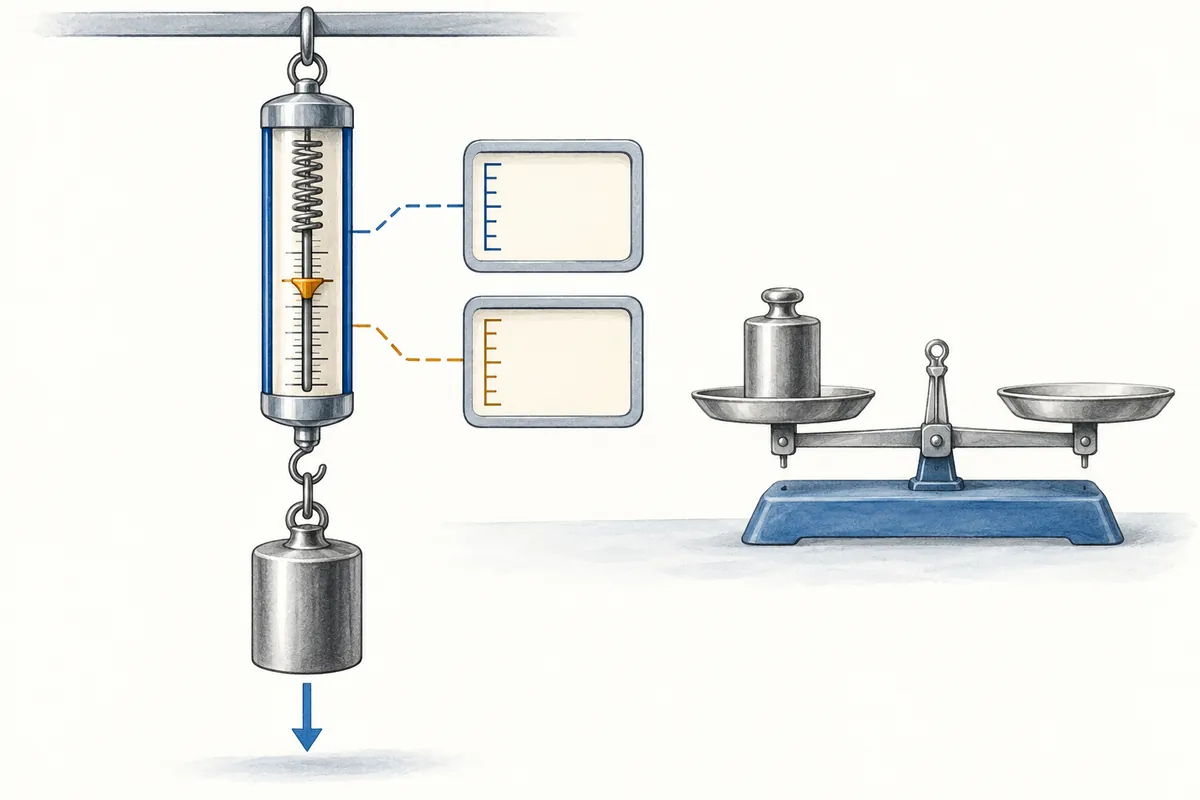
This article explains the relationship between newtons, N, and kilogram-force, kgf, the direction of conversion, and calculations involving area. The numbers are hypothetical educational examples, not actual test results or allowable equipment loads. Check the applicable standards and manufacturer guidance separately for real structures or test equipment operation.
1. kg is mass; N and kgf are force
kg is the SI unit of mass. N is the SI unit of force and can be expressed as 1 N = 1 kg·m/s². kgf means kilogram-force, defined as the force on a mass of 1 kg under standard gravitational acceleration of 9.80665 m/s². Therefore, 1 kgf = 9.80665 N. Reading kgf as the same mass unit as kg makes force equations inconsistent.
Standard gravitational acceleration is the value used in the conversion's definition; it does not mean actual gravitational acceleration is exactly the same everywhere. NIST's material on gravity and force distinguishes standard gravity used in unit definitions from local gravity. Treat calculating actual weight from mass and converting kgf to N as separate problems.
If a source says only “load 100 kg,” check whether the author means mass or is conventionally referring to force. Do not arbitrarily change it to kgf. If equipment instructions explicitly state kgf or N, use that unit; for old drawings or ambiguous notation, check the original and the issuing organization.
| Notation | Physical quantity | Relationship or check |
| kg | Mass | Acceleration or other conditions are needed to express it as force |
| N | Force | 1 N = 1 kg·m/s² |
| kgf | Force | 1 kgf = 9.80665 N |
| kN | Force | 1 kN = 1,000 N |
| Load stated only in kg | Meaning may be ambiguous | Check whether it means mass or is conventional notation for kgf |
2. From kgf to N: multiply by 9.80665
To convert kgf to N, multiply by 9.80665. A hypothetical 50 kgf gives 50 × 9.80665 = 490.3325 N. Rounded for display, this can be written as approximately 490 N. If the original value's accuracy is unknown, do not assume the calculator's number of displayed digits represents measurement accuracy.
Writing units alongside the calculation makes the direction easier to check. In 50 kgf × (9.80665 N / 1 kgf), kgf cancels and N remains. If you divided instead, examine which units remain. Checking cancellation rather than merely memorizing the conversion helps identify errors even when unfamiliar units appear.
You can remember that 10 kgf is approximately 98 N as a reference. If converting 100 kgf gives something very small such as approximately 10 N, check whether multiplication and division were reversed. This rough magnitude check does not replace an accurate calculation, but it helps spot incorrect decimal entries and conversion directions.
3. From N to kgf: divide by 9.80665
To convert N to kgf, divide by 9.80665. A hypothetical force of 1,000 N gives 1,000 / 9.80665 ≈ 101.97 kgf. You can display approximately 102 kgf, but this does not mean a mass of 102 kg was directly measured. It is the same force expressed in another force unit.
If kN appears, convert it to N first. 2.5 kN = 2,500 N, which divided by 9.80665 gives approximately 254.93 kgf. Ignoring the k in kN and dividing only 2.5 makes the result 1,000 times too small. When a data table mixes kN and N, standardize the unit column before calculating.
A round-trip conversion can check your calculation. Converting 1,000 N to kgf and multiplying that value by 9.80665 should return 1,000 N within rounding error. Rounding the intermediate value too early may enlarge the difference, so retain needed precision during calculation and round at the final display stage.
| Hypothetical input | Calculation | Converted result |
| 1 kgf | 1 × 9.80665 | 9.80665 N |
| 50 kgf | 50 × 9.80665 | 490.3325 N |
| 1,000 N | 1,000 / 9.80665 | Approximately 101.97 kgf |
| 2.5 kN | 2,500 / 9.80665 | Approximately 254.93 kgf |
4. Check area units when reading force and stress together
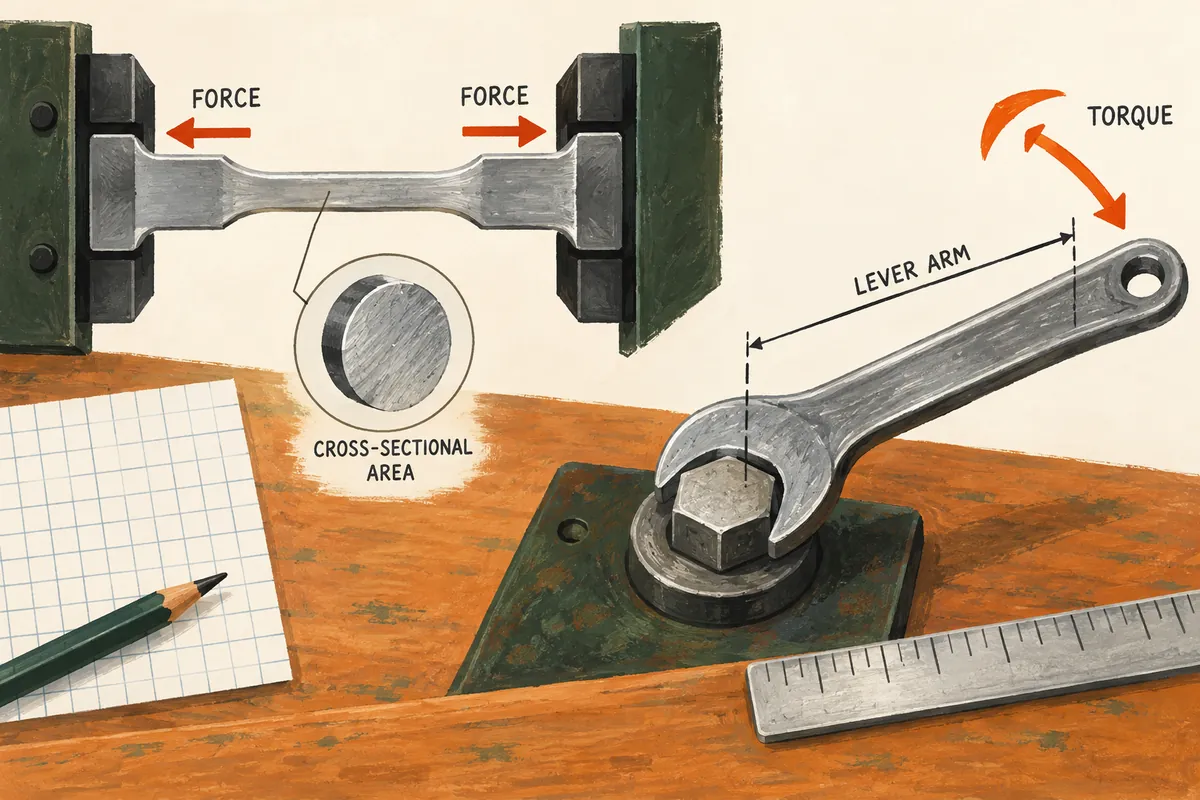
In materials testing, average stress is sometimes calculated by dividing force by cross-sectional area. Matching force units while overlooking area units gives an incorrect result. 1 N/mm² equals 1 MPa. This follows from 1 MPa = 1,000,000 N/m² and 1 mm² = 0.000001 m². The equation dividing force by area includes squared length units.
With a hypothetical tensile load of 500 N and original cross-sectional area of 10 mm², average nominal stress is 50 N/mm² = 50 MPa. If the load is 500 kgf, first convert it to 4,903.325 N and divide by the same cross-sectional area, giving approximately 490.33 MPa. Even when the input number is 500 in both cases, the force unit changes the calculation substantially. These values do not report the strength of an actual material.
Apply the same relationship to convert kgf/mm² to MPa: 1 kgf/mm² = 9.80665 MPa. If the area is in cm², convert it separately because cm² differs from mm² by a factor of 100. For example, 1 cm² = 100 mm². Check both force and area conversions so that the correct stress unit remains.
5. kgf·cm and kgf/cm² are different quantities
Check the symbols after kgf. A multiplied unit such as kgf·cm can describe torque and other quantities involving force times length, while a divided unit such as kgf/cm² describes force divided by area. Similar words do not mean the same physical quantity, so do not enter just their numbers into the same conversion table. The middle dot, division symbol, and squared notation are essential information.
To convert a hypothetical torque of 10 kgf·cm to N·m, convert force and length separately: 10 × 9.80665 × 0.01 = 0.980665 N·m. Converting force without converting cm to m creates a factor-of-100 difference. This example explains multiplied units; it is not an actual bolt-tightening specification.
In sources with small print or image-based units, a ² or dot may appear missing. Compare OCR-extracted text with the original table heading and check the physical quantity reported by the table. If symbols disappear in a value such as “kgf cm,” check the original rather than establishing its meaning from context alone. If units are unclear, the calculation result cannot be confirmed either.
6. Record conversion directions in an Excel worksheet
Keep input values and input units in separate columns, and calculate standardized values in the next column. Column names with units such as “Force_kgf,” “Force_N,” “Area_mm2,” and “Stress_MPa” help other people read the formulas. If you delete the original values and retain only converted results, locating an incorrect unit conversion later becomes difficult.
The formula converting the kgf input column to N is input value × 9.80665; from N to kgf, it is input value / 9.80665. For stress calculated using N and mm², use Force_N / Area_mm2. If area is blank or 0, stop calculation and flag the input for checking. Do not create results by treating missing values as actual zeros.
In an illustrative worksheet, also name the constant used for conversion. A note such as “kgf conversion based on the definition of standard gravitational acceleration” distinguishes it from a calculation using local gravity. If actual metrology or precise testing requires local gravity, check the relevant measurement procedure separately. One unit conversion equation does not complete every measurement correction.
7. Conditions to include when communicating converted results
Record the original value and unit, conversion relationship, final unit, and rounding method. “Converting a hypothetical force of 1,000 N gives approximately 101.97 kgf” is easier to verify than “about 102.” Identify the input used instead of presenting a converted value as an actual measurement or allowable limit.
During the final check, confirm that you distinguished kg from kgf, applied the factor of 1,000 for kN, chose the correct multiplication or division direction, and converted area or length units as well. Plausible-looking numbers and correct units are separate issues. Keeping units beside every number and reverse-calculating helps find mistakes.
When organizing older test tables into current units, retain the original units as well. Comparing with other sources requires matching test conditions and specimen geometry or clearly identifying their differences. Standardizing units alone does not make results from different tests directly comparable. Conversion is the starting point for comparison, followed by checking conditions.
Official sources and scope of verification
- NIST: Gravity Measurements and Standards Laboratory
- NIST Guide to SI: Weight and Mass
- BIPM: International System of Units
Sources checked: October 5, 2026. Written by AI after reviewing official materials. Hypothetical cases and calculation examples in the text are not actual user records or experimental results. Service conditions, menus, and published materials can change; check the necessary conditions in current official guidance.
Original illustrations created to help explain this article.
Original on Tistory ↗