What Is pH? The pH Scale Explained and Why 1 Unit Is a 10× Change
pH is a number that tells you how acidic or alkaline a water-based solution is. It is the negative base-10 logarithm of the hydrogen-ion concentration, pH = −log10[H+]. On the familiar 0–14 scale, 7 is neutral at 25 °C, values below 7 are acidic and values above 7 are alkaline (basic). Because the scale is logarithmic, each one-unit step is a tenfold change, so a solution at pH 3 has 100 times as many hydrogen ions as one at pH 5.
What pH actually measures
Every water-based solution contains some hydrogen ions (H+; in water they actually exist as hydronium, H3O+). The more there are, the more acidic the solution. Their concentrations are tiny and span many powers of ten, so chemists compress them with a logarithm:
- pH = −log10[H+], with [H+] in moles per liter (mol/L).
- [H+] = 10−pH goes the other way: pH 3 means 0.001 mol/L, and pH 7 means 0.0000001 mol/L.
- The minus sign is why a lower pH means more hydrogen ions.
Strictly, pH is defined with hydrogen-ion activity, an "effective" concentration that accounts for interactions between ions. The simple concentration formula is accurate for dilute solutions, but the two drift apart in concentrated or salty ones, and a pH electrode actually responds to activity. pH has no unit, and it only applies to water-based solutions: pure vegetable oil or pure alcohol has no pH.
Why one pH unit means a 10× change
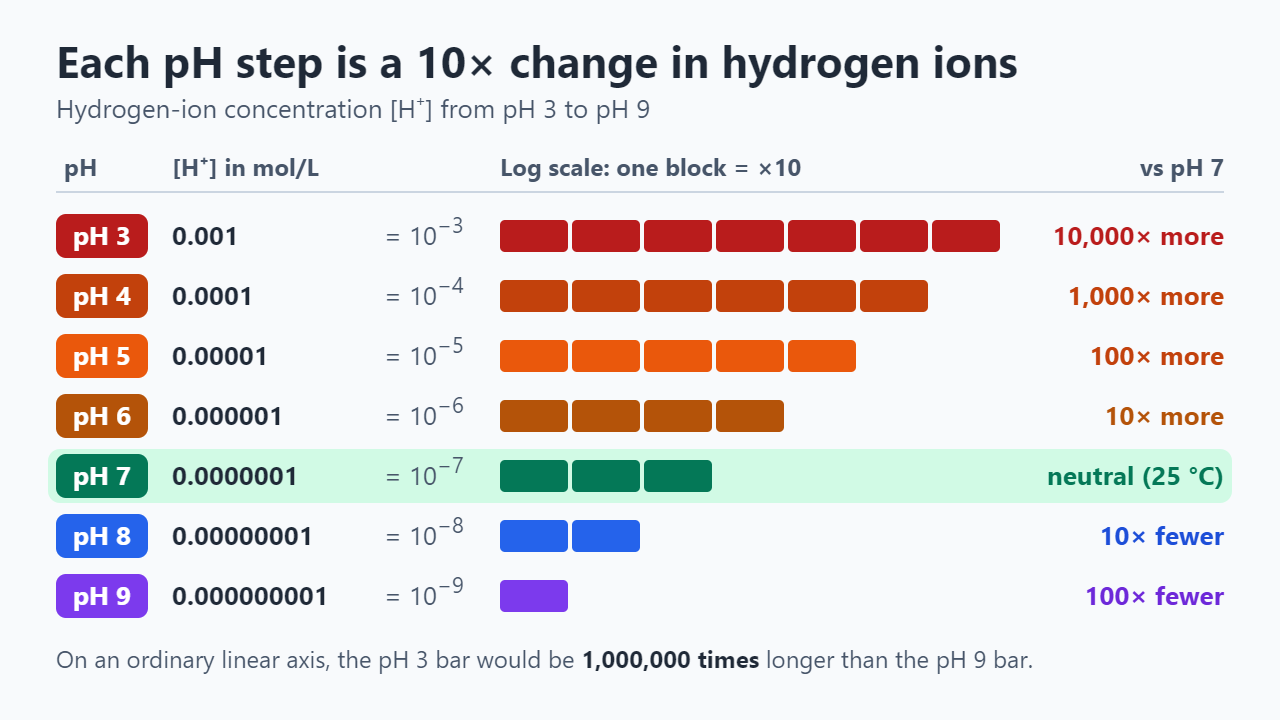
Because pH is an exponent, the gap between two pH values describes a ratio, not an amount. A difference of 1 means 10 times, 2 means 100 times and 3 means 1,000 times. The table shows how quickly the numbers move.
| pH | [H+] (mol/L) | Compared with pH 7 |
|---|---|---|
| 3 | 0.001 (10−3) | 10,000× more |
| 4 | 0.0001 (10−4) | 1,000× more |
| 5 | 0.00001 (10−5) | 100× more |
| 6 | 0.000001 (10−6) | 10× more |
| 7 | 0.0000001 (10−7) | Neutral at 25 °C |
| 8 | 0.00000001 (10−8) | 10× fewer |
| 9 | 0.000000001 (10−9) | 100× fewer |
Going from pH 3 to pH 9 is only six steps along the scale, yet the hydrogen-ion concentration changes a millionfold. That is why a "small" pH change can be a large chemical change.
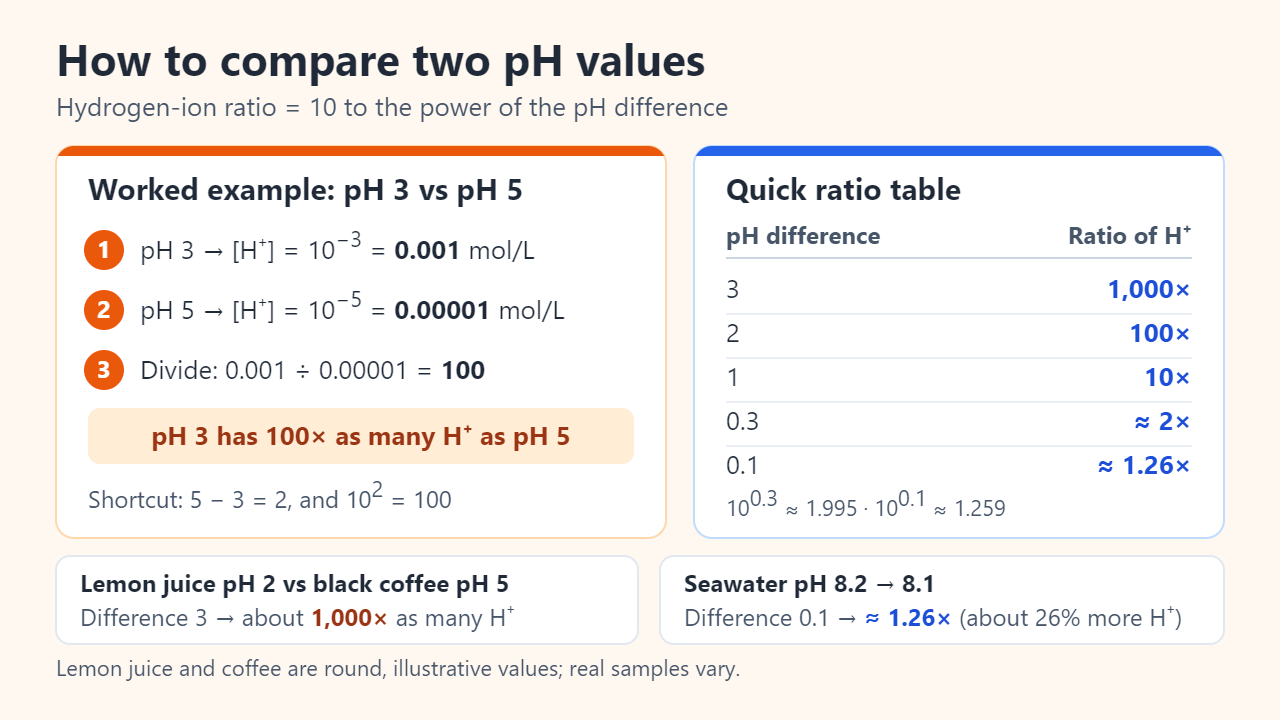
Worked example: pH 3 vs pH 5
- Convert pH 3: [H+] = 10−3 = 0.001 mol/L.
- Convert pH 5: [H+] = 10−5 = 0.00001 mol/L.
- Divide: 0.001 ÷ 0.00001 = 100. The pH 3 solution has 100 times as many hydrogen ions.
The shortcut is ratio = 10difference, and it works for decimals too: a difference of 0.3 is about 2× (100.3 ≈ 2.0), and 0.1 is about 1.26×. NOAA reports that the average pH of the surface ocean has fallen by 0.1 units since the industrial revolution began, to about 8.1, and calls that approximately a 30 percent increase in acidity (a drop of exactly 0.1 works out to 26 percent). Seawater is still alkaline; it has simply become less so.
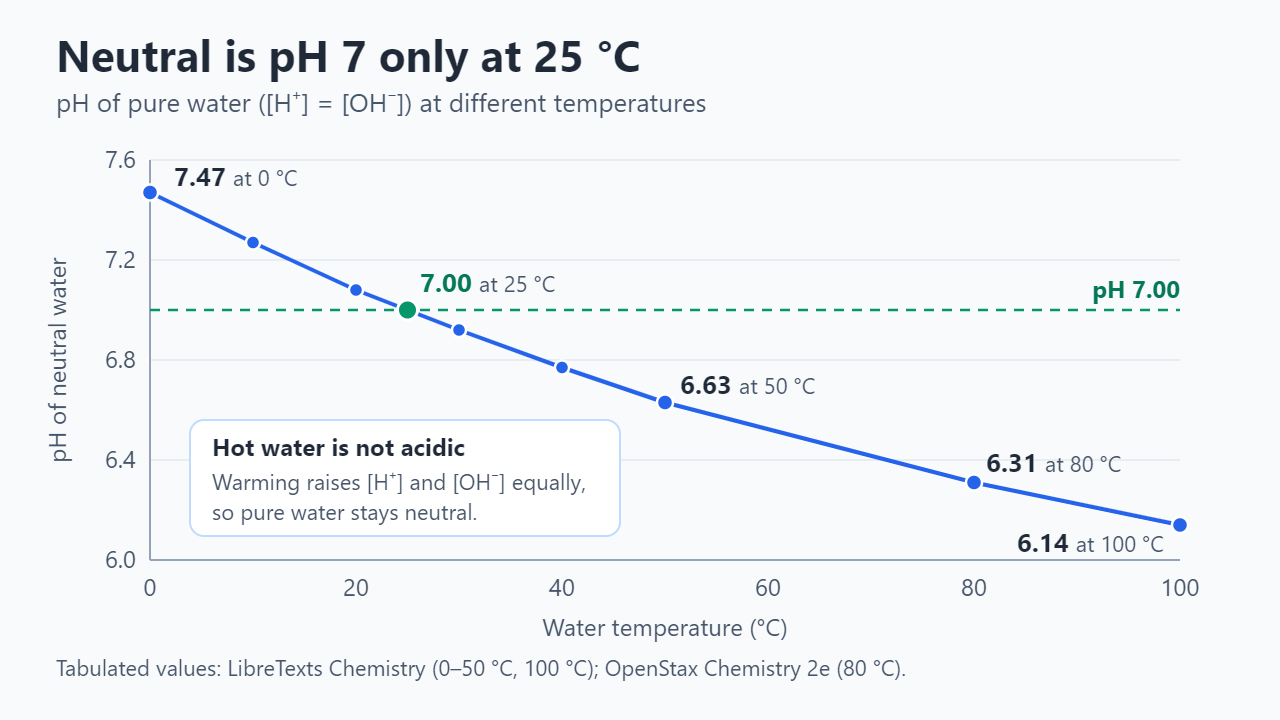
Why pH 7 is neutral, and only at 25 °C
Water ionizes itself very slightly: a tiny fraction of molecules pass a hydrogen ion to a neighbor, forming H3O+ and OH−. The product of the two concentrations is a constant, Kw. At 25 °C, Kw = 1.0 × 10⁻¹⁴. Pure water has equal amounts of both ions, so each is 10−7 mol/L and the pH is 7. The same constant links pH to pOH, its hydroxide counterpart: at 25 °C, pH + pOH = 14.
So "neutral" really means [H+] = [OH−], not "pH 7". Kw grows as water warms, so neutral pure water reads about 7.47 at 0 °C, 6.63 at 50 °C and 6.14 at 100 °C. Boiling water at pH 6.14 is not acidic: both ions increased together, so it is still neutral. That is why a pH reading should come with its temperature, and why textbook values usually assume 25 °C.
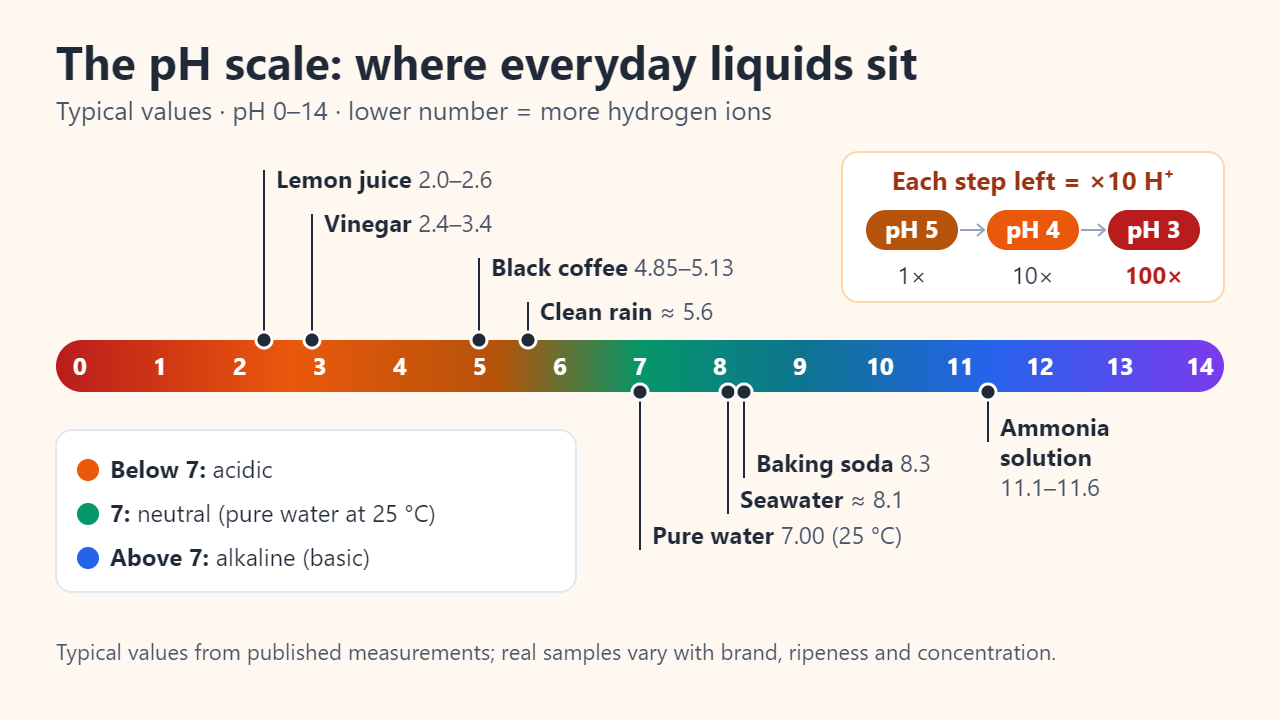
Typical pH of everyday substances
These ranges come from published measurements; ripeness, brand, brewing method and concentration all shift them, so treat them as typical rather than exact.
| Substance | Typical pH | Character |
|---|---|---|
| Lemon juice | 2.0–2.6 | Acidic |
| Vinegar | 2.4–3.4 | Acidic |
| Black coffee | 4.85–5.13 | Mildly acidic |
| Clean rain | About 5.6 | Mildly acidic |
| Pure water at 25 °C | 7.00 | Neutral |
| Seawater (surface average) | About 8.1 | Mildly alkaline |
| Baking soda solution (0.1 mol/L) | 8.3 | Mildly alkaline |
| Ammonia solution (0.1–1 mol/L) | 11.1–11.6 | Alkaline |
Clean rain is slightly acidic because carbon dioxide from the air dissolves in it and forms weak carbonic acid. Acid rain is lower still, usually around pH 4.2 to 4.4, which means roughly 16 to 25 times as many hydrogen ions as clean rain.
How to measure pH: indicators, strips and meters
- Litmus paper turns red in acid and blue in base. It tells you which side of neutral a sample is on, but not how far.
- Universal indicator and pH strips contain a mix of dyes that change color across the scale; you match the color against a chart. They are quick and cheap but much less precise than a meter.
- A pH meter uses a glass electrode whose voltage changes by about 59 mV per pH unit at 25 °C, and converts that voltage to pH. OpenStax describes a typical portable meter as reading to 0.01 units with an accuracy of about ±0.2, while research-grade meters reach about ±0.002.
A meter is only as good as its calibration. The usual routine is to standardize the electrode in two buffer solutions of known pH: one near pH 7 and a second that is more acidic or more basic, matching the range you expect the sample to fall in. The 59 mV figure holds only at 25 °C, because the electrode's response scales with temperature, so many meters also measure the sample's temperature and correct for it. Indicator paper, by contrast, gives only a rough estimate.
Common pH misconceptions
- "pH 6 is only slightly more acidic than pH 7." It has 10 times as many hydrogen ions, and pH 4 has 1,000 times as many.
- "The scale stops at 0 and 14." Those are practical limits for everyday solutions, not hard walls. Concentrated strong acids go below 0 and concentrated strong bases above 14; U.S. Geological Survey scientists measured a pH as low as −3.6 in mine water at Iron Mountain, California.
- "A lower pH always means a stronger acid." pH depends on concentration as well as acid strength. A 0.001 mol/L solution of hydrochloric acid, a strong acid, has pH 3, while vinegar, a far more concentrated solution of a weak acid, can sit as low as 2.4.
- "Dilute an acid enough and it turns alkaline." Adding water moves the pH toward neutral but never past it, because water itself supplies equal amounts of H+ and OH−.
- "pH tells you whether something is good for you." pH describes hydrogen-ion activity and nothing else; it is not a nutrition or health rating.
FAQ
Why is pH 7 neutral?
At 25 °C, pure water contains equal concentrations of H+ and OH−, 10−7 mol/L each, and −log10(10−7) = 7. At other temperatures the neutral point shifts, for example to 6.14 at 100 °C.
How much more acidic is pH 4 than pH 6?
They are 2 units apart, so pH 4 has 102 = 100 times as many hydrogen ions.
Can pH be negative?
Yes. A strong acid with more than 1 mol/L of hydrogen ions has a pH below 0; OpenStax works an example in which pH −1.07 corresponds to about 12 mol/L of hydronium ions. At such high concentrations activity and concentration diverge, so these values are approximate.
Is "alkaline" the same as "basic"?
For pH purposes, yes. An alkaline (basic) solution contains more OH− than H+, which at 25 °C means a pH above 7.
Sources: U.S. Geological Survey: pH and Water; OpenStax Chemistry 2e, 14.2 pH and pOH; LibreTexts Chemistry: Temperature dependence of the pH of pure water; NOAA: Ocean acidification
Related reading
Original illustrations created to help explain this article.