How to Calculate Time Differences: Why 15° of Longitude Is One Hour
Relative to the Sun, Earth makes one full turn every 24 hours on average, so the Sun appears to move 360° ÷ 24 = 15° of longitude per hour, and each degree is worth 4 minutes. That is why an ideal time zone is 15° wide. Real clocks, though, follow UTC offsets chosen by each country, so to calculate a time difference you compare offsets: Seoul (UTC+9) is 9 hours ahead of London (UTC+0) in winter, and 8 hours ahead while Britain is on summer time (UTC+1).
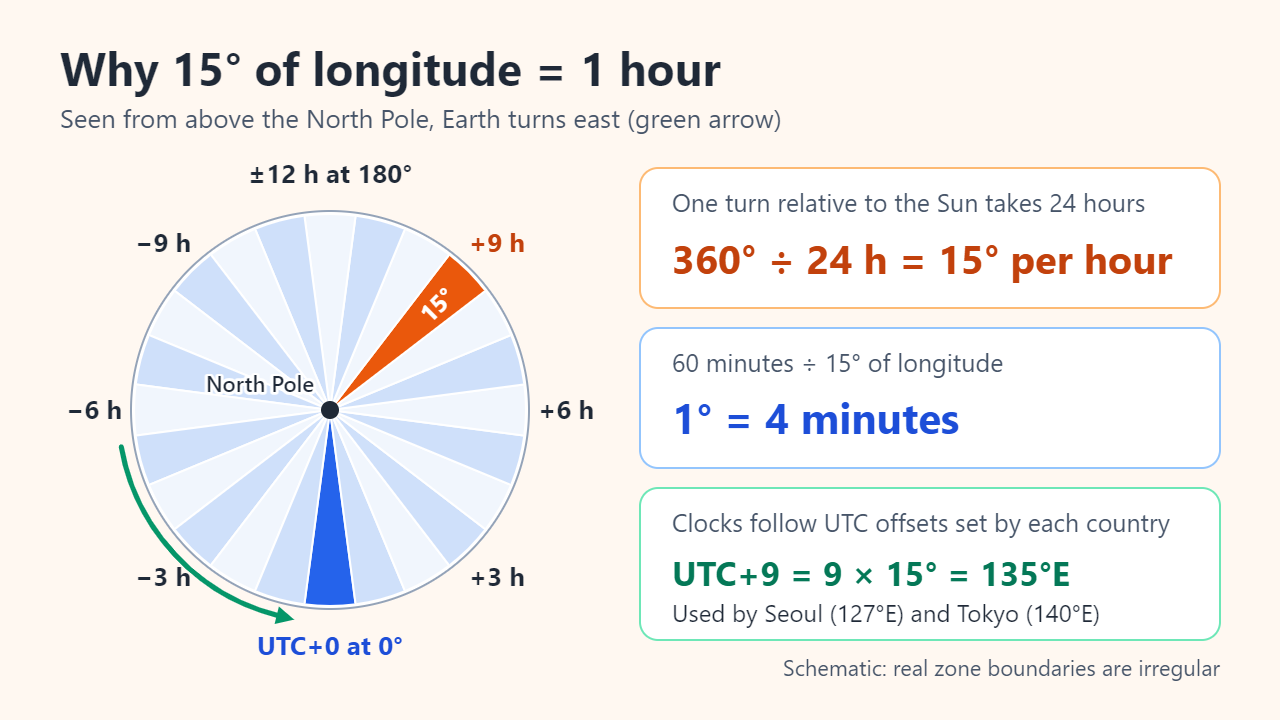
Why 15° of longitude equals one hour
Clock time is tied to the Sun. A solar day, from one noon to the next, averages 24 hours, and during that time the Sun appears to sweep across all 360° of longitude. So:
- 360° ÷ 24 h = 15° per hour, so the world divides neatly into 24 ideal zones.
- 60 min ÷ 15° = 4 minutes per degree of longitude.
- Places to the east see noon earlier, so their clocks run ahead; places to the west run behind.
You can still see the 4-minute rule in the IANA time zone database, which records each city's old local mean time. Seoul's is UTC+8:27:52, or about 507.9 minutes ahead of UTC; divide by 4 and you get 126.97°E, which is Seoul's longitude. Korea's clocks now use UTC+9, the time of the 135°E meridian, so on average the Sun is highest over Seoul at about 12:32, not 12:00.
What UTC is and how offsets work
UTC (Coordinated Universal Time) is the world's reference time scale. The International Bureau of Weights and Measures (BIPM) derives it from atomic time and inserts occasional leap seconds to keep it close to Earth's rotation. UTC never switches to summer time. Every local time is stated as an offset from it: UTC+9 means clocks read 9 hours later than UTC, and UTC−5 means 5 hours earlier.
| Place | Standard offset | Summer time |
|---|---|---|
| Seoul | UTC+9 (KST) | None |
| Tokyo | UTC+9 (JST) | None |
| Beijing (all of China) | UTC+8 | None |
| New Delhi (all of India) | UTC+5:30 | None |
| Kathmandu | UTC+5:45 | None |
| London | UTC+0 (GMT) | UTC+1 (BST) |
| New York | UTC−5 (EST) | UTC−4 (EDT) |
| Kiritimati, Kiribati | UTC+14 | None |
Offsets follow national decisions, not geometry. China stretches across roughly 60° of longitude, touching five ideal zones (UTC+5 to UTC+9), yet uses UTC+8 nationwide. Madrid lies about 3.7° west of Greenwich but keeps UTC+1, the same as Paris and Berlin.
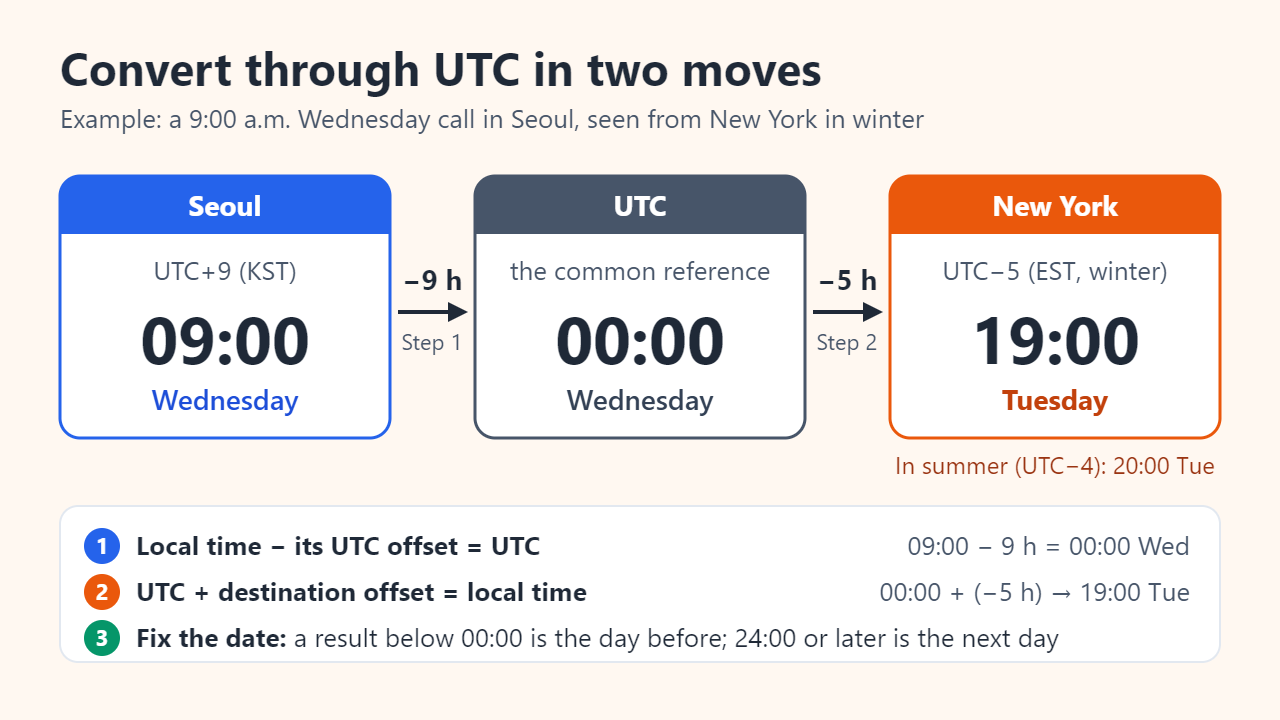
How to calculate a time difference in three steps
- Find both UTC offsets for the actual date, including summer time if either place uses it.
- Convert the starting time to UTC by subtracting its offset: 09:00 at UTC+9 is 00:00 UTC.
- Add the destination's offset: 00:00 + (−5 h) gives 19:00. If the result falls below 00:00, it is the previous day; if it reaches 24:00 or more, it is the next day.
Worked example: a call set for 9:00 a.m. Wednesday in Seoul is 00:00 Wednesday UTC, which is 7:00 p.m. Tuesday in New York in January (UTC−5) or 8:00 p.m. Tuesday in July (UTC−4). Fractional offsets work the same way: 3:00 p.m. in Beijing (UTC+8) is 07:00 UTC, which is 12:30 p.m. in New Delhi (UTC+5:30) and 12:45 p.m. in Kathmandu (UTC+5:45).
Shortcut: the difference is offset B minus offset A. New York minus Seoul is −5 − 9 = −14 hours in winter.
The International Date Line: where the calendar changes
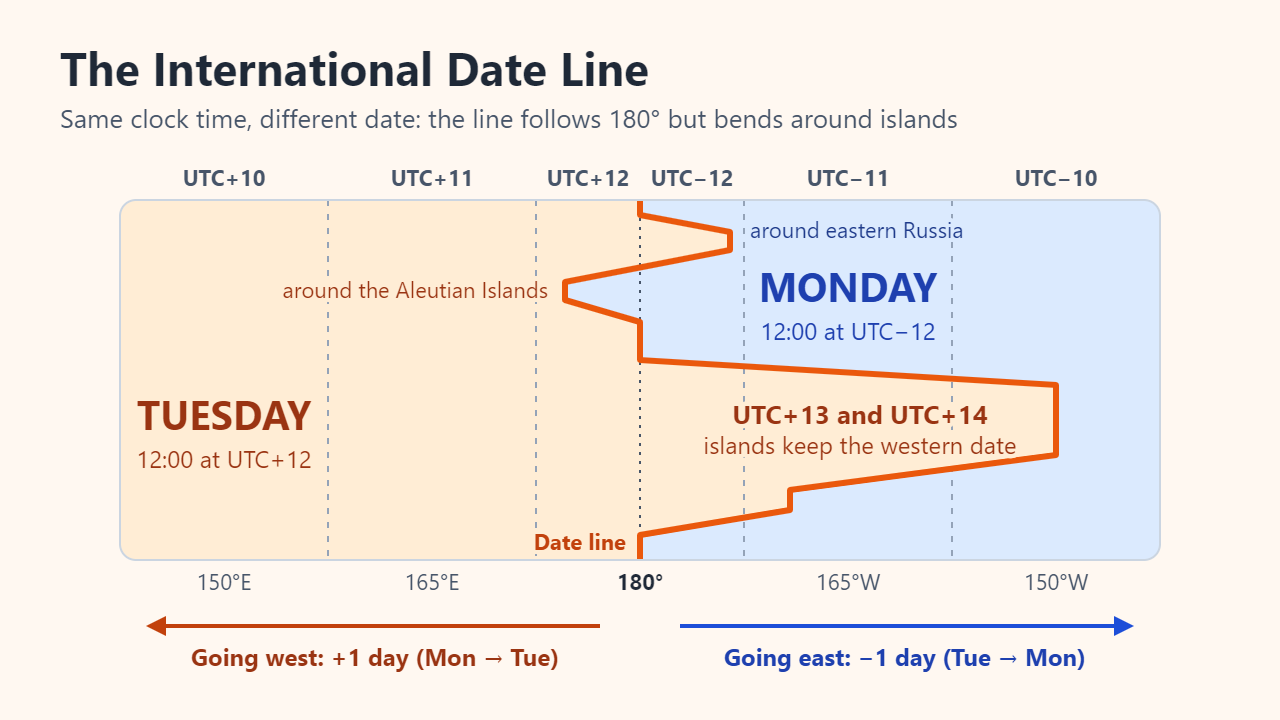
Travel east and you set your watch forward an hour per zone; go all the way around and you would gain a whole day. The International Date Line fixes the calendar. According to NOAA, it runs from pole to pole through the mid-Pacific, roughly along 180° longitude, and separates two consecutive dates.
- Crossing westward (from the Americas toward Asia), the date moves forward one day.
- Crossing eastward (from Asia toward the Americas), the date moves back one day.
Take an illustrative 10-hour flight that leaves Tokyo at 5:00 p.m. Monday (08:00 UTC). It lands at 18:00 UTC, which is 11:00 a.m. Monday in Los Angeles in summer (UTC−7): earlier on the clock than when you took off.
The line zigzags because it has no legal international status. Each country chooses its own date, and the line bends so that a nation is not split between two days: around eastern Russia, around Alaska's Aleutian Islands, and far east around Pacific island nations. Kiribati's eastern Line Islands moved from UTC−10 to UTC+14 at the start of 1995 so the whole country shares one date, and Samoa moved from UTC−11 to UTC+13 at the end of 29 December 2011, skipping 30 December entirely. Samoa (UTC+13) and nearby American Samoa (UTC−11) now show the same clock time on different dates.
Odd offsets: +5:30, +5:45 and +14
Not every offset is a whole number of hours. Besides India (UTC+5:30) and Nepal (UTC+5:45), examples include Iran (UTC+3:30), Myanmar (UTC+6:30), Newfoundland in Canada (UTC−3:30) and New Zealand's Chatham Islands (UTC+12:45).
The extremes are 26 hours apart. Kiribati's Line Islands, at UTC+14, are the first inhabited places to start each new day. UTC−12, just east of the date line, has no permanent residents. It is the nominal time of the uninhabited Baker and Howland Islands and the basis of "Anywhere on Earth" (AoE) deadlines, which have not passed until the date has ended everywhere. Because of the 26-hour spread, three calendar dates are in use at once every day between 10:00 and 12:00 UTC.
Daylight saving time changes the gap
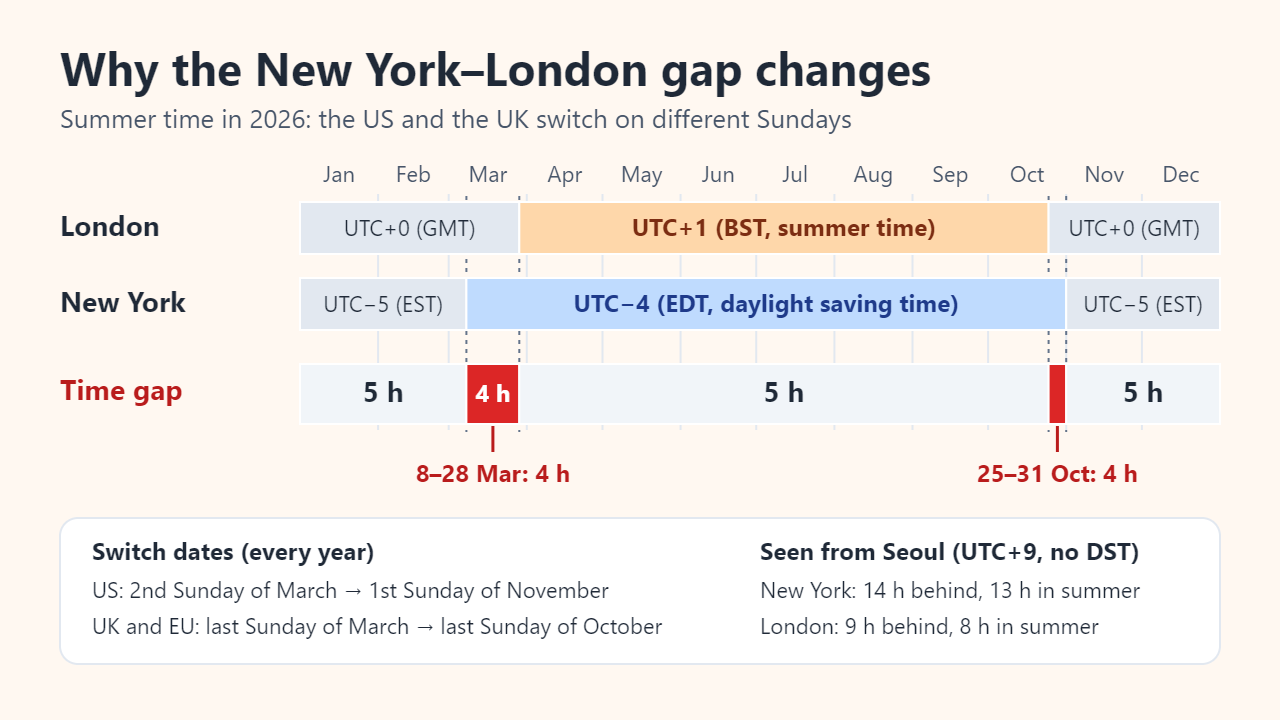
Daylight saving time (summer time) moves clocks forward one hour for part of the year, so the gap between two places can change during the year.
- United States: 2:00 a.m. local time on the second Sunday of March until 2:00 a.m. on the first Sunday of November (8 March to 1 November in 2026).
- UK and EU: 01:00 UTC on the last Sunday of March until 01:00 UTC on the last Sunday of October (29 March to 25 October in 2026).
- South Korea, Japan, China and India: no daylight saving time.
So New York is usually 5 hours behind London, but only 4 hours behind from 8 to 28 March and from 25 to 31 October 2026. Seoul is 14 hours ahead of New York in winter and 13 in summer.
Common mistakes to avoid
- Using the 15° rule for real clocks. Longitude gives solar time; law sets clock time.
- Getting the sign backwards. From UTC+9 you subtract 9 hours to reach UTC; from UTC−5 you add 5.
- Forgetting the date. A result of −3:00 means 21:00 on the previous day.
- Trusting abbreviations. CST can mean China Standard Time (UTC+8) or US Central Standard Time (UTC−6), and IST is used in India, Ireland and Israel. Use numeric offsets instead.
- Misreading "Etc/GMT-9". In the IANA database these POSIX-style names flip the sign, so Etc/GMT-9 means UTC+9. Pick a city zone such as Asia/Seoul instead.
FAQ
Is GMT the same as UTC?
For setting clocks, yes: both mean UTC+0. Strictly, UTC is the atomic time scale maintained by the BIPM, while GMT is now mainly the name of Britain's winter time; in summer London uses BST (UTC+1).
Doesn't Earth rotate in 23 hours 56 minutes?
That is the sidereal day, measured against the stars. Because Earth also moves along its orbit, it must turn slightly more than 360° before the Sun returns to the same place in the sky, which takes 24 hours on average. Clocks follow the Sun, so 24 hours is the right figure.
Why are there more than 24 time zones?
Offsets run from UTC−12 to UTC+14, and some are half or quarter hours, so many more than 24 distinct local times are in use.
Sources: NOAA: the International Date Line; IANA Time Zone Database; BIPM: UTC and time metrology; NASA Space Place: how long is one day?.
Related reading
Original illustrations created to help explain this article.