Why Does Ice Float? Water's Density Peak at 4°C Explained
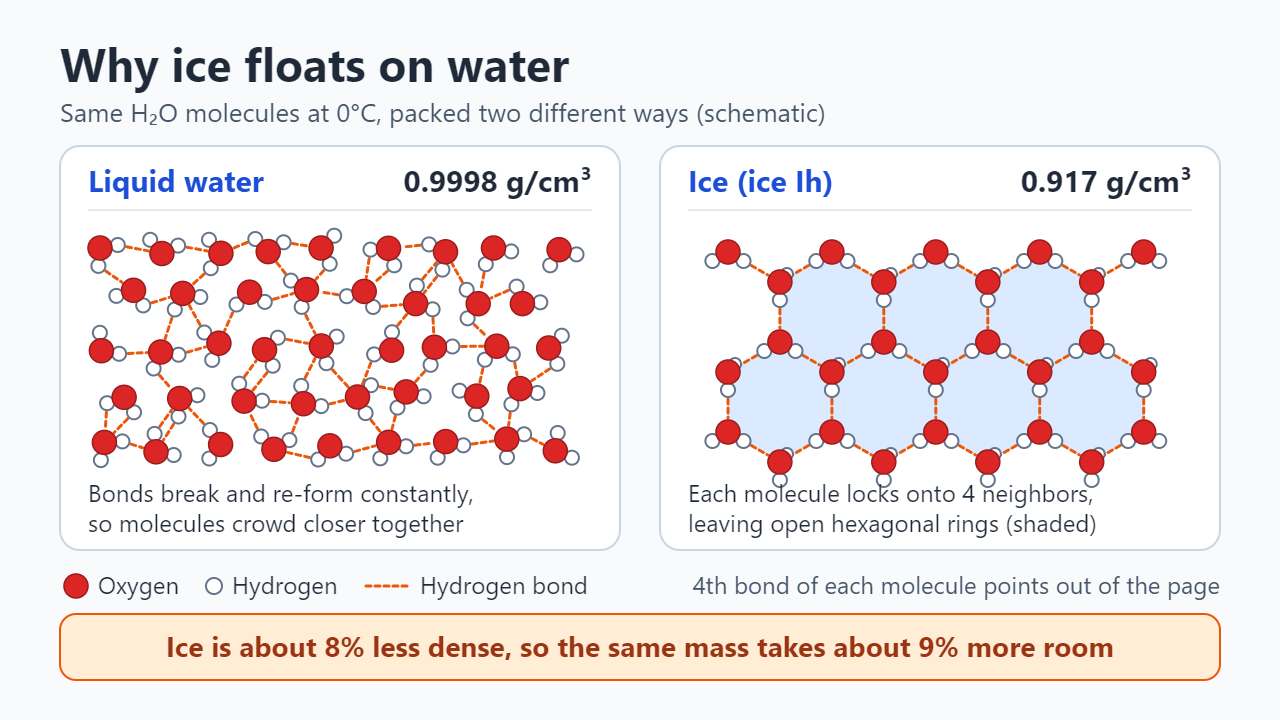
Ice floats because it is about 8% less dense than liquid water: 0.917 g/cm³ for ice at 0°C versus 0.9998 g/cm³ for water at the same temperature. When water freezes, hydrogen bonds lock every molecule to four neighbors in an open hexagonal lattice, so the same mass takes up about 9% more space. Liquid water has a second quirk: it is densest at about 4°C (3.98°C), which is why lakes freeze from the top down while their deepest water stays near 4°C.
Density decides what floats
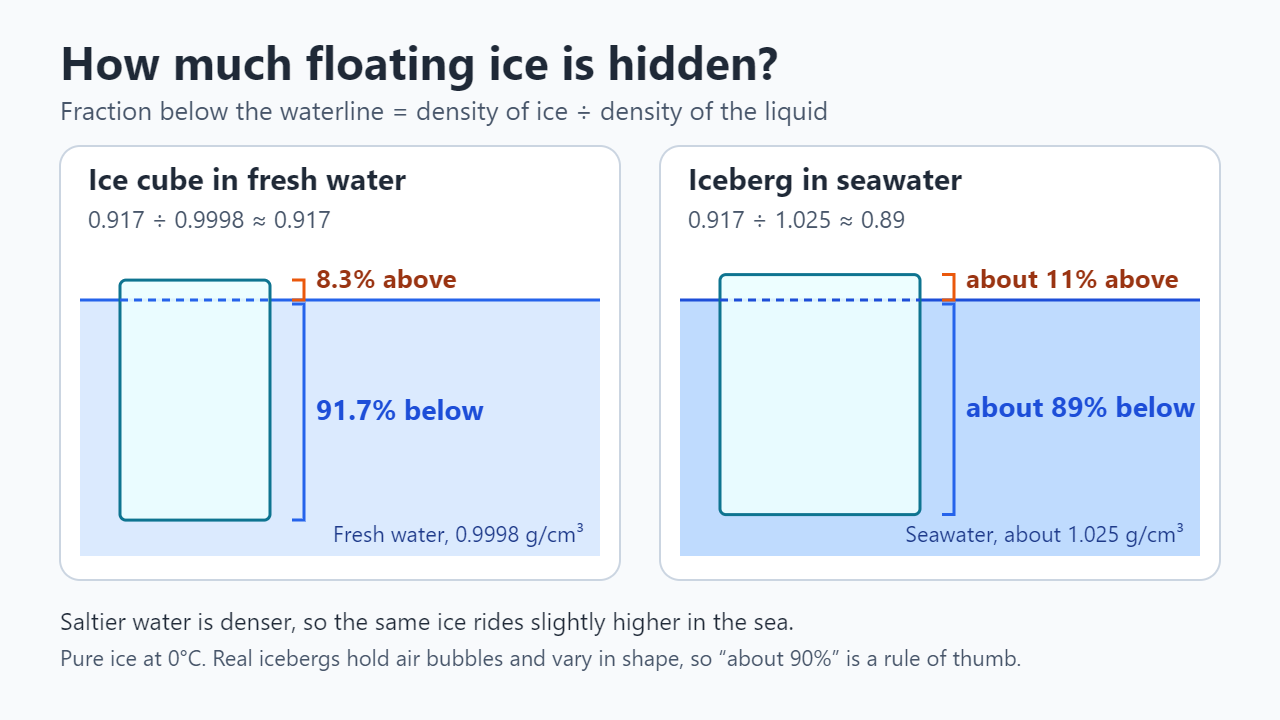
Density is mass divided by volume. An object floats when its average density is lower than that of the liquid around it, and it settles at the depth where it displaces its own weight of liquid (Archimedes' principle). That gives a handy rule: the fraction below the surface equals the object's density divided by the liquid's density.
For most substances, the solid is denser than the liquid. Cooling slows the molecules so they pack more tightly, and freezing locks them into an even tighter arrangement, which is why a lump of solid candle wax sinks in melted wax. Water breaks this pattern. An ice cube in a glass of water floats with 0.917 ÷ 0.9998 ≈ 91.7% of its volume below the surface and about 8% showing above it.
Hydrogen bonds build an open hexagonal lattice
A water molecule (H2O) is bent. Its oxygen atom carries a slight negative charge and its two hydrogen atoms a slight positive charge, so the hydrogen of one molecule is attracted to the oxygen of a neighbor. That attraction is a hydrogen bond. In liquid water these bonds constantly break and re-form, letting molecules slip into gaps and crowd fairly close together.
In ordinary ice, called ice Ih (hexagonal ice), the bonds stop shuffling. Each molecule is held by four neighbors at fixed, nearly tetrahedral angles: two bonds run through its own hydrogens and two come from neighboring hydrogens. These angles join the molecules into puckered six-membered rings with open channels through the middle. The structure wastes space, which makes ice lighter than the liquid it came from. The same hexagonal geometry gives snowflakes their six-fold symmetry.
| Substance | Temperature | Density (g/cm³) | Note |
|---|---|---|---|
| Liquid water | 10°C | 0.99970 | Normal liquid behavior above 4°C |
| Liquid water | 3.98°C | 0.99997 | Maximum density of pure water |
| Liquid water | 0°C | 0.99984 | Slightly lighter than 4°C water |
| Ice Ih | 0°C | 0.9167 | About 8.3% lighter than water at 0°C |
| Seawater (typical) | Surface | about 1.025 | Dissolved salt adds mass |
Two percentages describe the same change, and both are correct. Ice is about 8% less dense than water (0.9167 ÷ 0.99984 = 0.917), while a given mass of water grows by about 9% in volume when it freezes (0.99984 ÷ 0.9167 = 1.091). They simply use different baselines.
Why liquid water is densest at 4°C
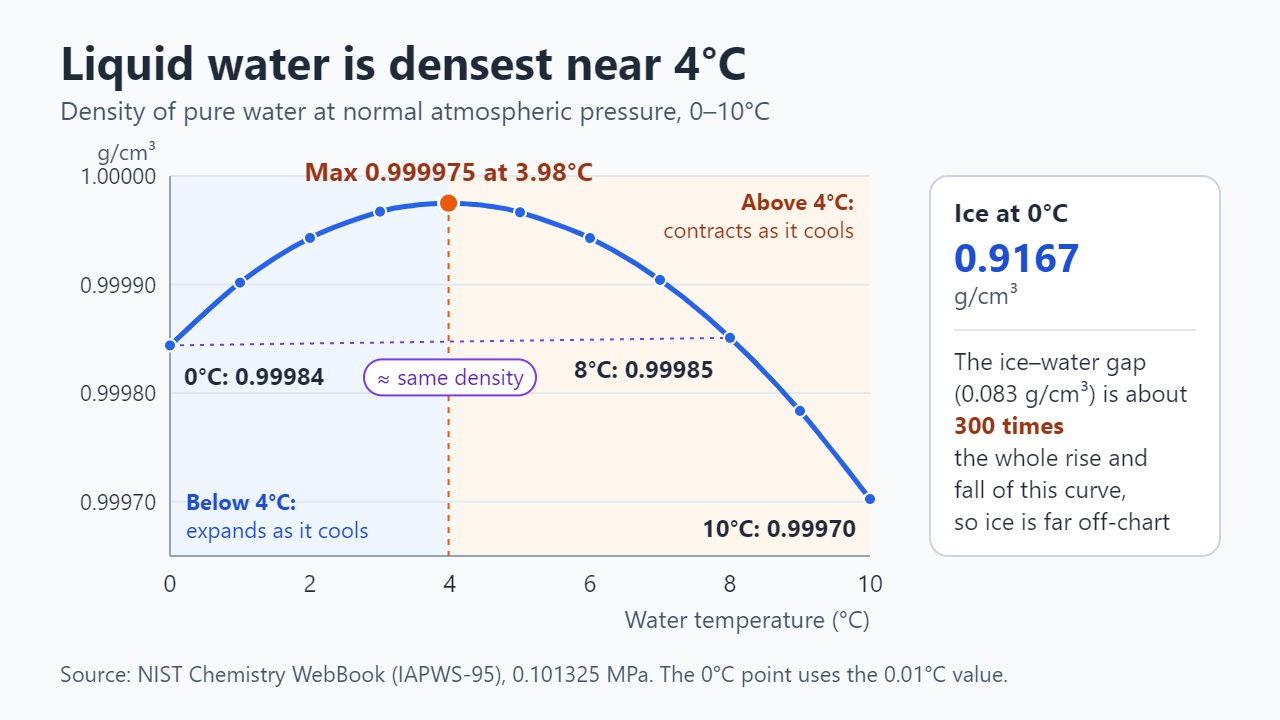
Cooling water sets off two opposing effects. Slower molecules pack more closely, which makes any liquid denser. At the same time, more short-lived, ice-like clusters of hydrogen-bonded molecules form, and their open structure pushes molecules apart. Above about 4°C the first effect wins, so water contracts as it cools. Below 4°C the second effect wins, so water expands slightly even before it freezes.
Reference data based on the IAPWS-95 standard put the peak at 0.999975 g/cm³ at 3.98°C under normal atmospheric pressure. The effect is subtle: water at 0°C is only about 0.013% less dense than water at 4°C, and water at 0°C and at 8°C is almost equally dense (0.99984 and 0.99985 g/cm³). Small as it is, this difference shapes how lakes behave every winter.
Why lakes freeze from the top down
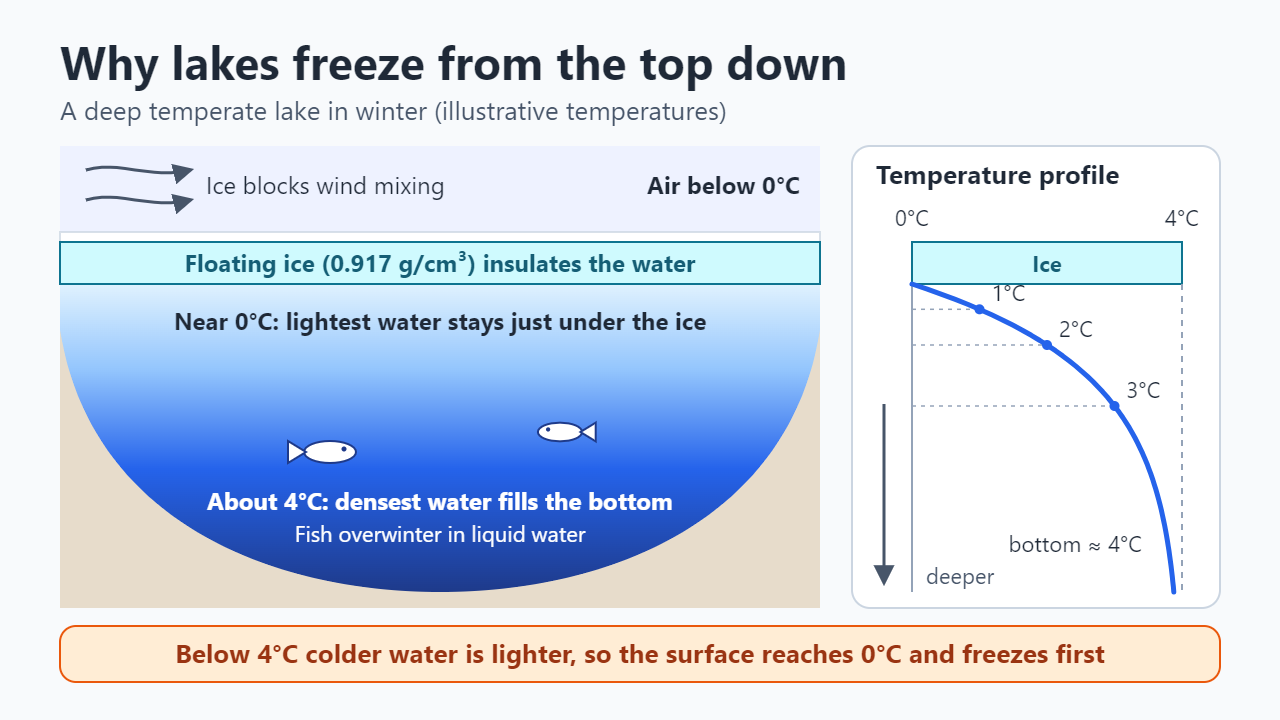
In a deep temperate lake, cooling follows a predictable sequence:
- Autumn mixing. Surface water cools, becomes denser and sinks, and wind mixes the lake (fall turnover) until the whole water column approaches 4°C.
- Crossing 4°C. Once the surface cools below 4°C, it becomes lighter than the water beneath it and stops sinking. Cooling is now confined to a thin top layer.
- Surface freezing. The top layer reaches 0°C and freezes. The ice floats, insulates the water and blocks wind mixing, so it thickens only slowly from below.
- Winter layering. Water just under the ice is near 0°C, and temperature rises with depth to about 4°C near the bottom. This is called inverse stratification.
- Spring turnover. After the ice melts and the surface warms to about 4°C, the whole lake has nearly the same density, and wind can mix it from top to bottom again.
The density gap between 0°C and 4°C water is only about 0.00013 g/cm³, roughly 1/600 of the gap between water and ice, so winter layering is weak, but the ice lid holds it in place. Fish and other organisms spend the winter in the liquid water below, although shallow ponds can still freeze nearly solid in severe cold.
Icebergs: why about 90% stays under water
The same rule that sets how high an ice cube rides applies to icebergs, but the liquid is now seawater at about 1.025 g/cm³. Dividing the densities gives 0.917 ÷ 1.025 ≈ 0.89, so roughly 89% of a berg of pure ice sits below the waterline and about 11% shows above it. Real icebergs contain trapped air bubbles and have irregular shapes, so the familiar "about 90%" is a rule of thumb rather than an exact figure.
Burst pipes, cracked rocks and other side effects
A 9% expansion is small, but it becomes powerful when the water has nowhere to go:
- Burst pipes. Once an ice plug forms in a pipe, further freezing pushes the trapped water toward a closed tap. Liquid water barely compresses, so the pressure in that section climbs until the pipe splits, often where there is little ice. A dripping tap gives that pressure an escape route.
- Bottles in the freezer. A full, sealed glass bottle can crack because its contents need about 9% more room once frozen.
- Frost wedging. Water seeps into cracks in rock, freezes and pries them wider, and each thaw lets more water in. Repeated freeze-thaw cycles break up rock on mountainsides and damage concrete and road surfaces.
FAQ
Does a melting ice cube make a full glass overflow?
No. A floating ice cube already displaces its own weight of water. When it melts, it becomes just enough water to fill the space its submerged part was taking up, so the level stays essentially the same.
Is water the only substance whose solid floats in its own liquid?
No, but it is the most familiar one. A few others, including silicon, gallium and bismuth, also expand when they solidify. Most substances, from metals to wax, shrink as they freeze.
Is there 4°C water at the bottom of the ocean too?
Not for the same reason. Salt lowers both the freezing point and the temperature of maximum density, and above a salinity of 24.7 (open-ocean water is typically saltier) seawater keeps getting denser all the way down to its freezing point of about −2°C. Deep ocean water is cold, generally below 4°C, because cold, dense water sinks.
Sources: NIST Chemistry WebBook: isobaric properties of water (IAPWS-95); IAPWS R10-06: Revised Release on the Equation of State 2006 for H2O Ice Ih; Water on the Web: lake density stratification; AMS Introduction to Ocean Sciences: Ice Formation.
Related reading
Original illustrations created to help explain this article.