Ductility Versus Brittleness: Meaning, Material Examples, and Stress–Strain Curves
This article was translated from its source language with AI assistance. Please check technical terms and equations against the original.
Ductility and brittleness differ in the amount of plastic deformation before fracture. Ductile materials undergo relatively large permanent deformation before breaking; brittle materials may break with little plastic deformation. On stress–strain curves, examine yielding and the plastic region up to fracture together.
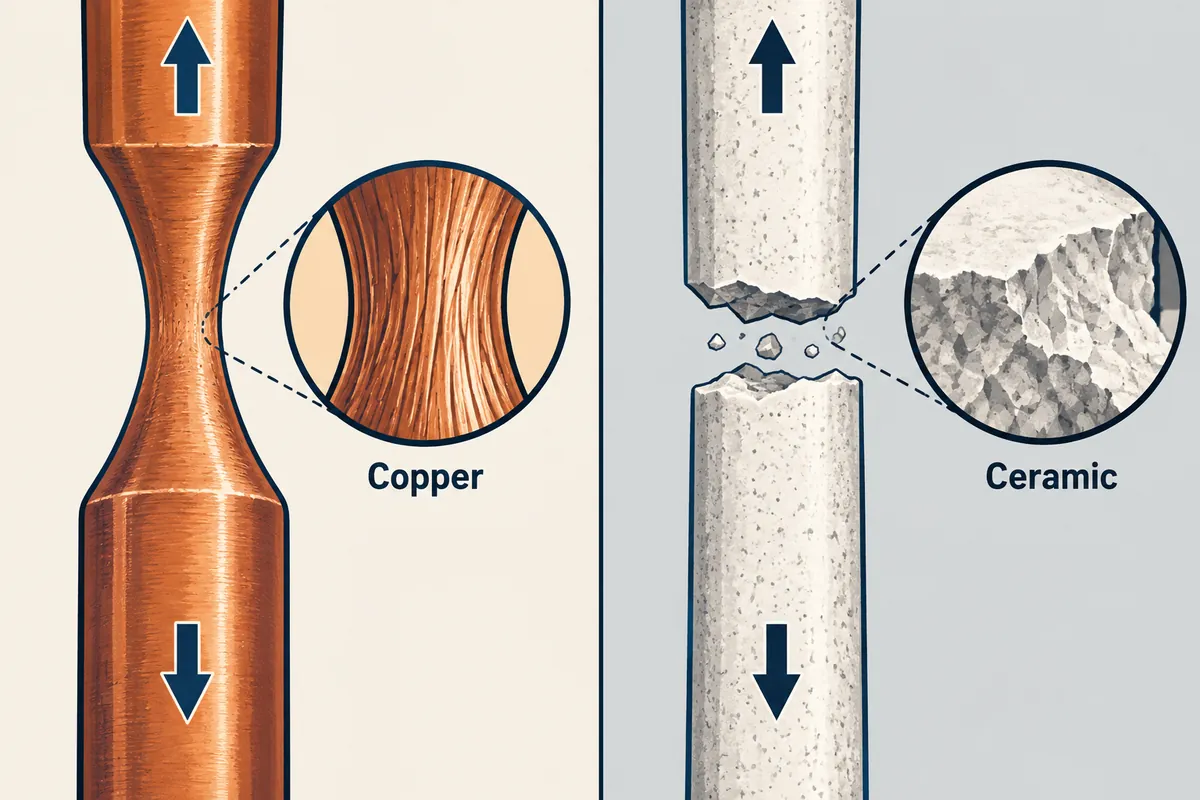
Ductility and Brittleness at a Glance
| Category | Ductility | Brittleness |
| Before fracture | Relatively large plastic deformation | Little plastic deformation |
| Tensile-test indicators | Assessed by elongation and reduction of area | Inspect small fracture strain and fracture surfaces |
| Representative examples | Copper and low-carbon steel at room temperature | Glass and ceramics |
| Precaution | Good stretching does not necessarily mean high strength | Does not mean absence of elastic deformation |
This table compares concepts. Actual behavior depends on temperature, strain rate, defects, composition, heat treatment, and test conditions.
What Is Ductility? Permanent Deformation Before Fracture
Ductility is the ability of a tensile-loaded material to deform plastically before fracture. It matters in wire drawing and bending metal bars. Tensile tests evaluate it using post-fracture elongation and reduction of area.
Room-temperature copper and low-carbon steel commonly illustrate ductile behavior. Names alone do not establish ductility: even the same steel's behavior varies with composition, heat treatment, temperature, and loading rate.
What Is Brittleness? Fracture with Little Plastic Deformation
Brittleness means little plastic deformation before fracture. Glass and ceramics are representative, while some cast irons and metals show it under specific conditions. Brittle materials can still deform elastically before fracture.
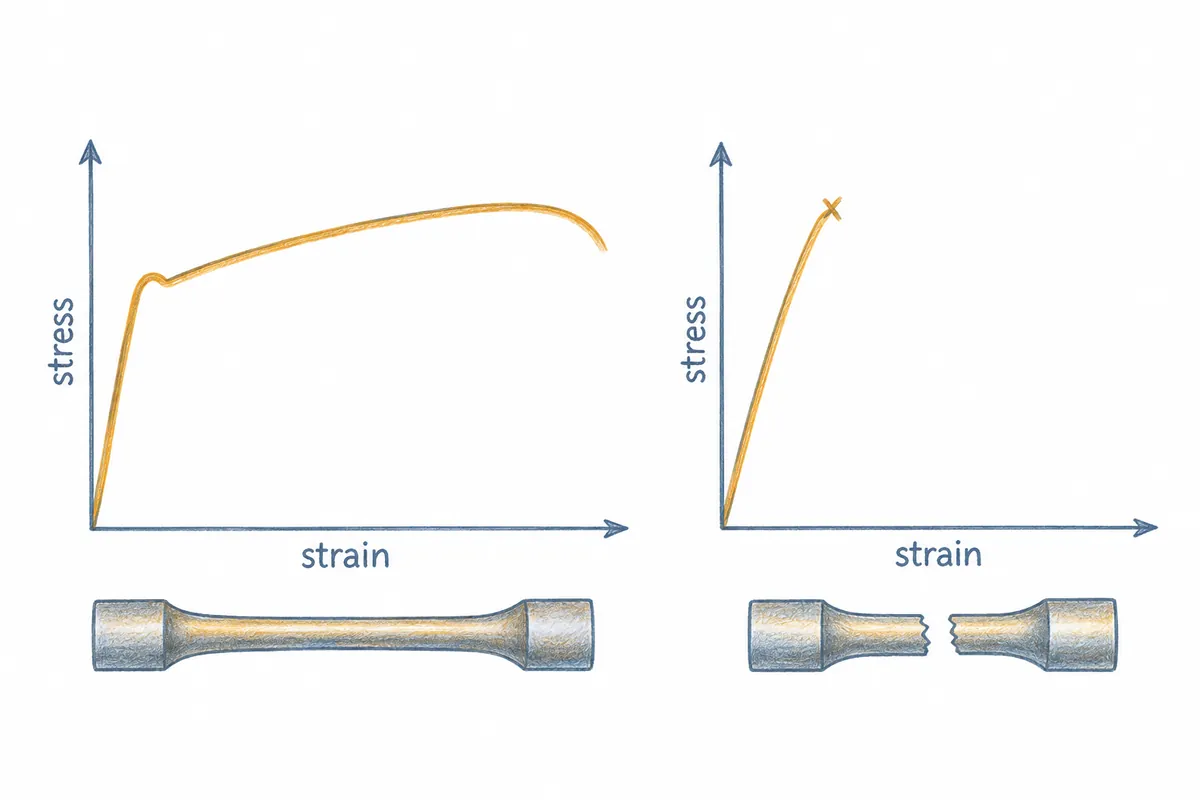
Do not equate brittleness with low strength. Materials sustaining high stresses can be brittle if pre-fracture plastic deformation is small. Defects, geometry, and test conditions strongly affect strength; do not design from unsourced representative values.
Distinguishing Them on Stress–Strain Curves
Ductile materials show a relatively long plastic region between yielding and fracture. Brittle materials may fracture without clear yielding or a long plastic region. Inspect deformation before fracture rather than declaring every material breaking just after yield brittle.
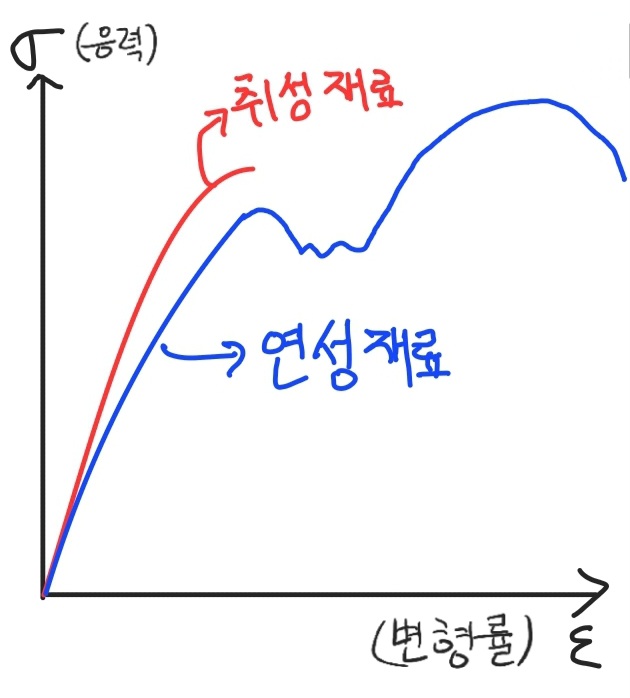
The existing comparison figure illustrates concepts. Do not interpret it as actual test values or a universal curve for all materials.
How Do Ductility, Elasticity, and Toughness Differ?
- Ductility: Plastic-deformation capacity before fracture.
- Elasticity: Recovery after unloading. A rubber band returning to original length illustrates elasticity.
- Toughness: Ability to absorb energy until fracture. Strength and ductility both contribute.
Related Articles
- Elasticity versus plasticity and residual strain after unloading
- Stress–strain curves: Reading yield and tensile strength
- Toughness versus brittleness and Charpy impact tests
Supporting Material
MIT OpenCourseWare: Mechanical properties, ductility, and brittleness lecture
Original illustrations created to help explain this article.
Original on Tistory ↗