Earthquake Magnitude vs Intensity: Why 1 Magnitude Means ~32× Energy
Magnitude measures how big an earthquake is at its source, so each quake gets a single number, such as M6.5. Intensity measures how strongly the ground shook at a particular place, so one quake produces many intensity values that usually fall with distance. Magnitude is logarithmic: one step up means 10 times the wave amplitude on a seismogram and about 32 times more energy, so two steps mean roughly 1,000 times the energy.
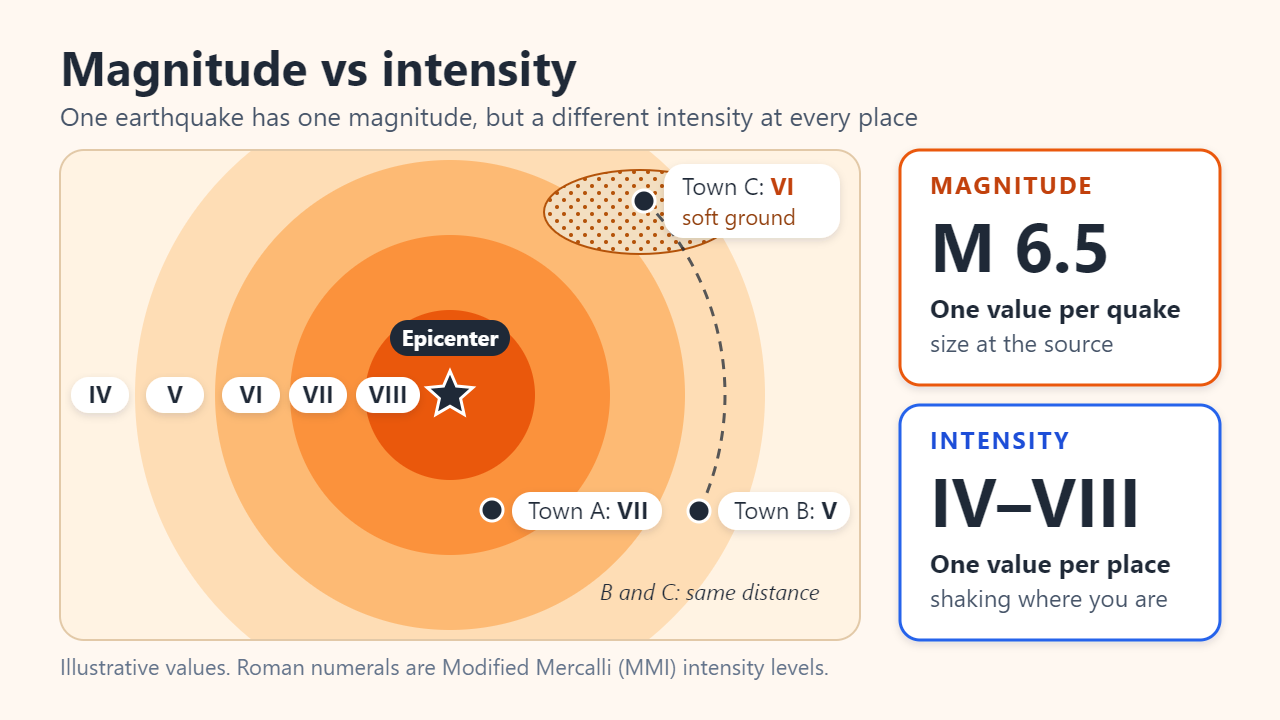
Magnitude: one number for the whole earthquake
Magnitude describes the earthquake itself, not what anyone felt. In 1935 Charles Richter, a seismologist at Caltech, defined the first magnitude scale, now called local magnitude (ML). It was based on the largest wave amplitude recorded by one type of seismograph, corrected for distance, and it originally applied only to California earthquakes within 600 km of that instrument.
Amplitude-based scales misbehave for very large quakes: some overestimate and some underestimate the true size. For anything beyond small local events, agencies such as the USGS now report moment magnitude (Mw). It starts from the seismic moment, a physical quantity: rock rigidity × fault area that slipped × slip distance. The USGS converts it with Mw = 2/3 × (log10 M0 − 9.1), with M0 in newton-metres, and the scale was designed to roughly match Richter values where the two overlap. So when news reports mention the “Richter scale” for a major quake, the number is very likely a moment magnitude.
How much bigger is each magnitude step?
Because the scale is logarithmic, adding 1 to the magnitude multiplies rather than adds. According to the USGS, each whole-number step means a tenfold increase in the amplitude measured on a seismogram and about 32 times more energy released. The factor comes from the 1.5 in the magnitude formulas. Rearranging the Mw equation gives log10 M0 = 1.5 Mw + 9.1, so seismic moment grows by 101.5 ≈ 31.6 per step, and the standard energy–magnitude relation uses the same 1.5 slope. Two steps give 31.6 × 31.6 = 103 = 1,000.
| Magnitude | Wave amplitude (vs M5) | Energy released (vs M5) |
|---|---|---|
| M5 | 1× | 1× |
| M6 | 10× | about 32× |
| M7 | 100× | 1,000× |
| M8 | 1,000× | about 31,600× |
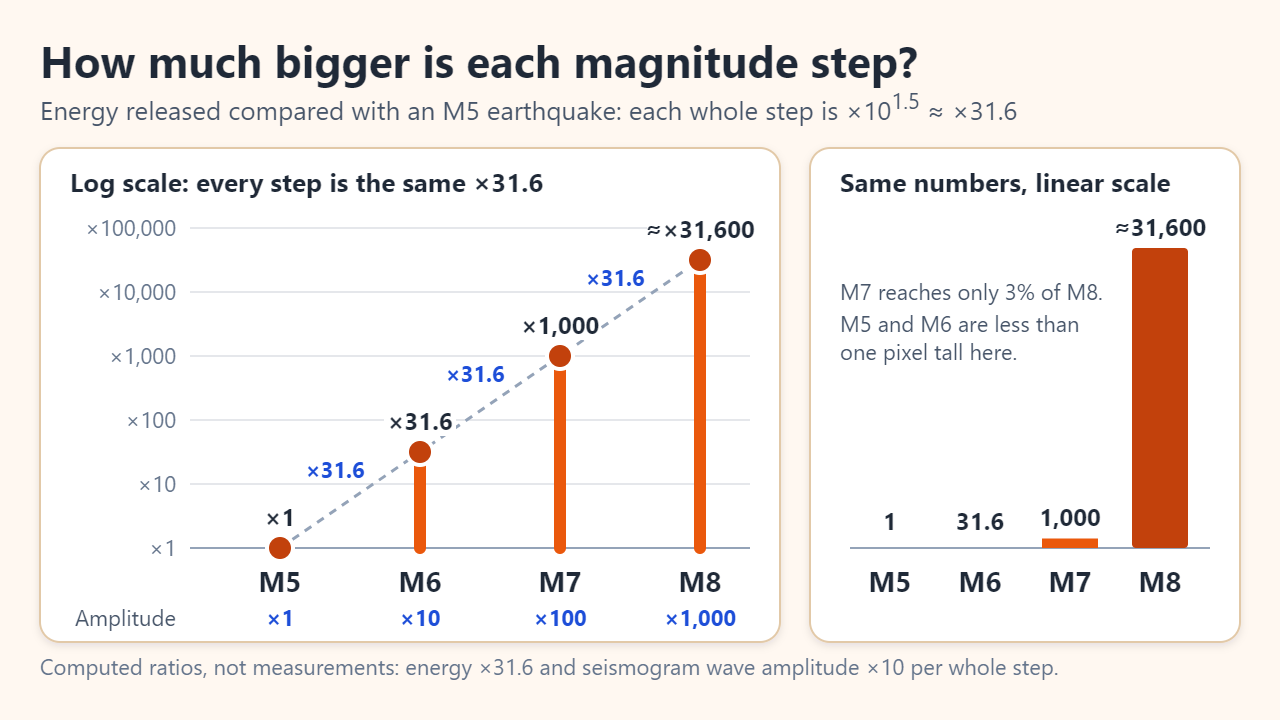
Worked example: how much bigger is an M8.7 than an M5.8? The difference is 2.9 units. Amplitude: 102.9 ≈ 794 times. Energy: 101.5 × 2.9 = 104.35 ≈ 22,400 times. Decimals matter too: a 0.1 step is 100.15 ≈ 1.41, about 41% more energy, and a half step is 100.75 ≈ 5.6 times. This is also why a string of moderate quakes releases far less energy than a single great one.
Intensity: how hard the ground shook where you were
Intensity is a local measurement. It ranks the shaking at one site by its effects (who felt it, what fell off shelves, which walls cracked) or, increasingly, from instruments that record ground motion. Many scales write intensity in Roman numerals, which helps keep it apart from magnitude; Japan’s scale is the notable exception, using ordinary numerals.
In the United States the standard is the Modified Mercalli Intensity (MMI) scale, published by Harry Wood and Frank Neumann in 1931. It runs from I (not felt except by a very few) to XII (near-total damage). The lower levels describe how people perceived the shaking; the higher levels are judged from damage to buildings. The USGS stresses that it has no mathematical basis: it is a ranking of observed effects.
Intensity scales differ by country
There is no single world intensity scale. These are the ones you are most likely to meet in East Asian and American news:
| Scale | Where used | Levels | How it is assigned |
|---|---|---|---|
| Modified Mercalli (MMI) | United States | 12 (I–XII) | Observed effects; instrument-based estimates |
| JMA seismic intensity (shindo) | Japan | 10 (0, 1, 2, 3, 4, 5 Lower, 5 Upper, 6 Lower, 6 Upper, 7) | Seismic intensity meters (instrumental since April 1996) |
| KMA intensity | South Korea | 12 (I–XII), based on MMI | Thresholds of peak ground acceleration and velocity |
| Chinese seismic intensity scale (GB/T 17742-2020) | China | 12 (I–XII) | Damage surveys, with an instrumental method in the standard |
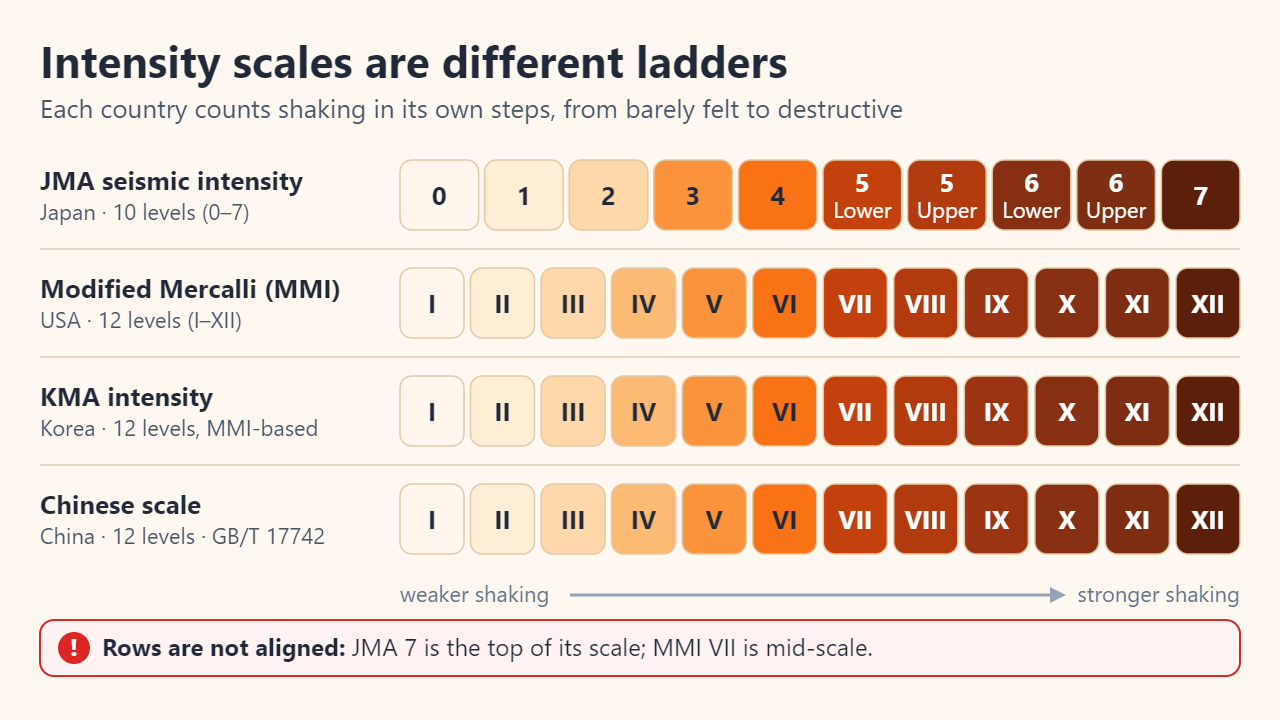
The trap is that the numbers do not translate one-for-one. JMA 7 is the top of Japan’s scale, while MMI VII is mid-scale. When comparing reports from different countries, compare the described effects, such as people being unable to stand or furniture toppling, rather than the numbers.
Why one earthquake produces many intensities
Distance from the fault rupture is the main factor, but not the only one. The USGS and Korea’s KMA both note that local conditions can make a distant site shake harder than a closer one.
- Distance: shaking weakens as waves spread out. In the 1976 Tangshan earthquake (magnitude 7.8), the epicentral area reached intensity XI on China’s scale, urban Tianjin VIII and most of Beijing VI.
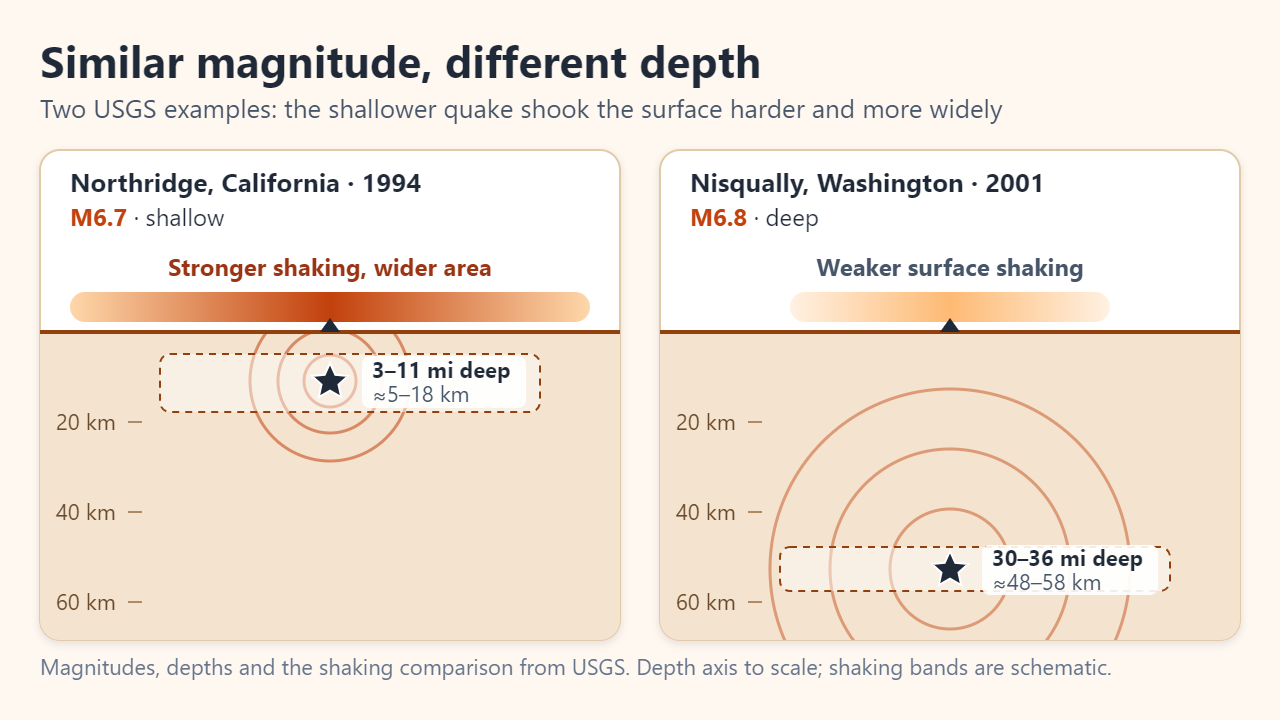
- Depth: the M6.7 Northridge, California quake of 1994 began 3–11 miles (about 5–18 km) down and shook harder, over a wider area, than the slightly larger M6.8 Nisqually, Washington quake, which began 30–36 miles (about 48–58 km) down.
- Local ground: during the M6.9 Loma Prieta earthquake of 1989, three stations at about the same distance recorded very different motion: bedrock shook least, soft mud most.
- Rupture direction and buildings: shaking can be stronger in the direction the rupture travels, and JMA notes that upper floors may shake considerably more than the ground.
How to read an earthquake report
- Find the magnitude and its type. “M6.5” or “Mw 6.5” describes the source and is the same for everyone.
- Check the depth. At similar magnitude, a shallow quake usually shakes the surface harder than a deep one.
- Look up the intensity for your area, not just the maximum. Headlines often quote the strongest intensity observed anywhere.
- Note which intensity scale is used before comparing with another country’s report.
- Expect early numbers to change. First estimates are computed within minutes (JMA aims for about three minutes) and may be revised as more data arrive.
FAQ
Is the Richter scale still used?
Rarely. The USGS uses local (Richter) magnitude mainly for small earthquakes recorded nearby and moment magnitude for everything else, because Mw is a more accurate measure of size, especially for large events.
Is a magnitude 7 twice as strong as a magnitude 3.5?
No. The difference is 3.5 units, so the energy ratio is 101.5 × 3.5 = 105.25, about 178,000 times.
Can intensity be higher farther from the epicenter?
Yes. KMA notes that intensity generally decreases with distance but is sometimes measured higher at distant sites because of differences in ground structure, such as soft sediments.
Sources: USGS: Earthquake magnitude, energy release, and shaking intensity; Japan Meteorological Agency: Tables explaining the JMA Seismic Intensity Scale; Korea Meteorological Administration: earthquake information service help (MMI scale); Xinjiang Earthquake Agency: seismic intensity versus magnitude (Tangshan example, in Chinese).
Related reading
How to read a logarithmic chart: equal distances mean equal ratios
Original illustrations created to help explain this article.