What Causes Tides? Why There Are Two High Tides a Day
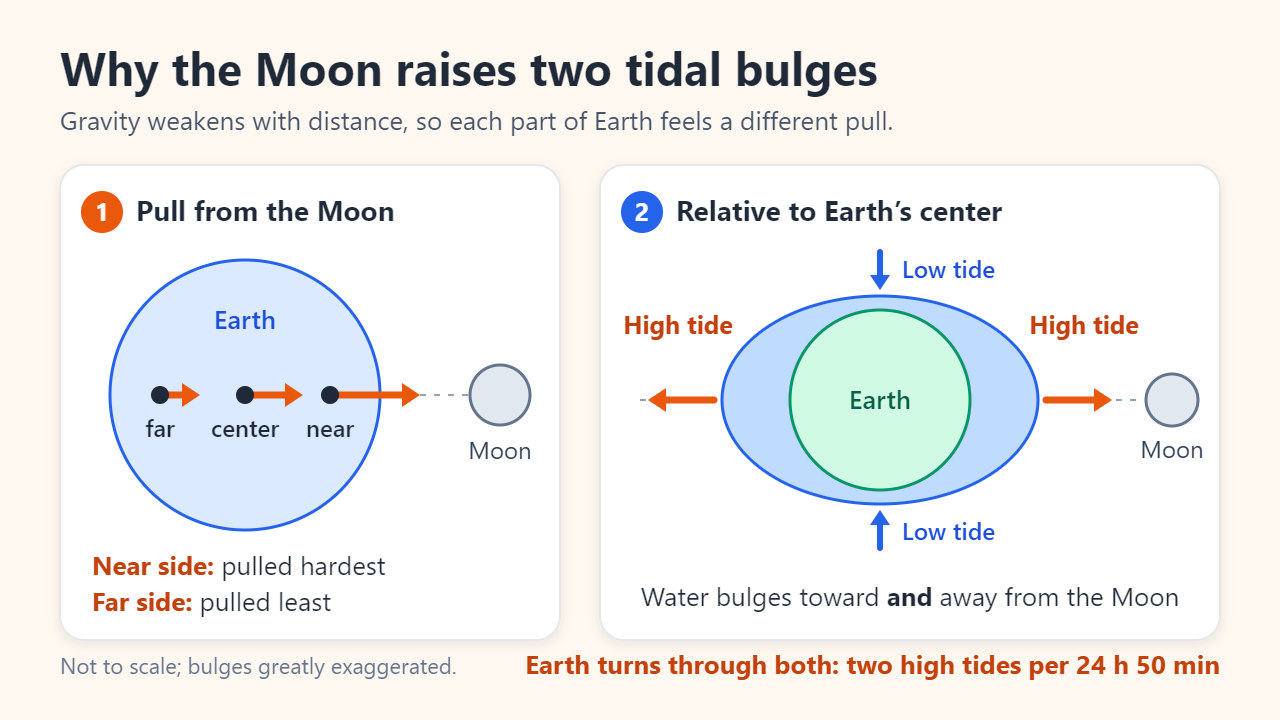
Tides are caused mainly by the Moon’s gravity, or more precisely by the difference in its pull across Earth. The Moon pulls the side of Earth facing it harder than Earth’s center, and the center harder than the far side, so the oceans are stretched into two bulges: one under the Moon and one on the opposite side. As Earth turns through both bulges, most coasts get two high tides every 24 hours 50 minutes, about 12 hours 25 minutes apart.
The real cause: a difference in pull, not the pull itself
If the Moon tugged on every part of Earth equally, the oceans and the solid planet would move together and nothing would pile up. Tides exist because gravity weakens with distance, and Earth is about 12,700 km across. That is enough for the Moon’s pull to differ noticeably from one side of the planet to the other:
- Near side: the water is pulled toward the Moon more strongly than Earth’s center is, so it heaps up into a bulge facing the Moon.
- Far side: the water is pulled less strongly than Earth’s center. The planet is effectively drawn away from it, so this water is left behind as a second bulge.
- In between: water drains toward the two bulges, so places a quarter of the way around the globe have low tide.
NOAA describes the same result as a balance between gravity and inertia: gravity wins on the near side, inertia on the far side. Either way, the Moon is not “pushing” water away, and real bulges are far gentler than any diagram shows.
Why the Moon matters more than the Sun
Ordinary gravity weakens with the square of distance, but the tide-raising effect, which is the difference in pull across Earth, weakens with the cube of distance. That rule settles the contest between the Moon and the Sun.
| Quantity | Moon | Sun |
|---|---|---|
| Mass | 7.35 × 10²² kg | 1.99 × 1030 kg (about 27 million Moons) |
| Mean distance from Earth | 384,400 km | 149.6 million km (about 389 times farther) |
| Overall pull on Earth (Moon = 1) | 1 | about 179 |
| Tide-raising force (Moon = 1) | 1 | about 0.46 |
The arithmetic is short: the Sun’s mass advantage (about 27 million) divided by its distance ratio cubed (3893 ≈ 59 million) gives about 0.46. So the Sun pulls on Earth as a whole roughly 179 times harder than the Moon does, yet its tides are only about 46% as strong, or “about half,” as NOAA puts it.
Why there are two high tides a day, 50 minutes later each day
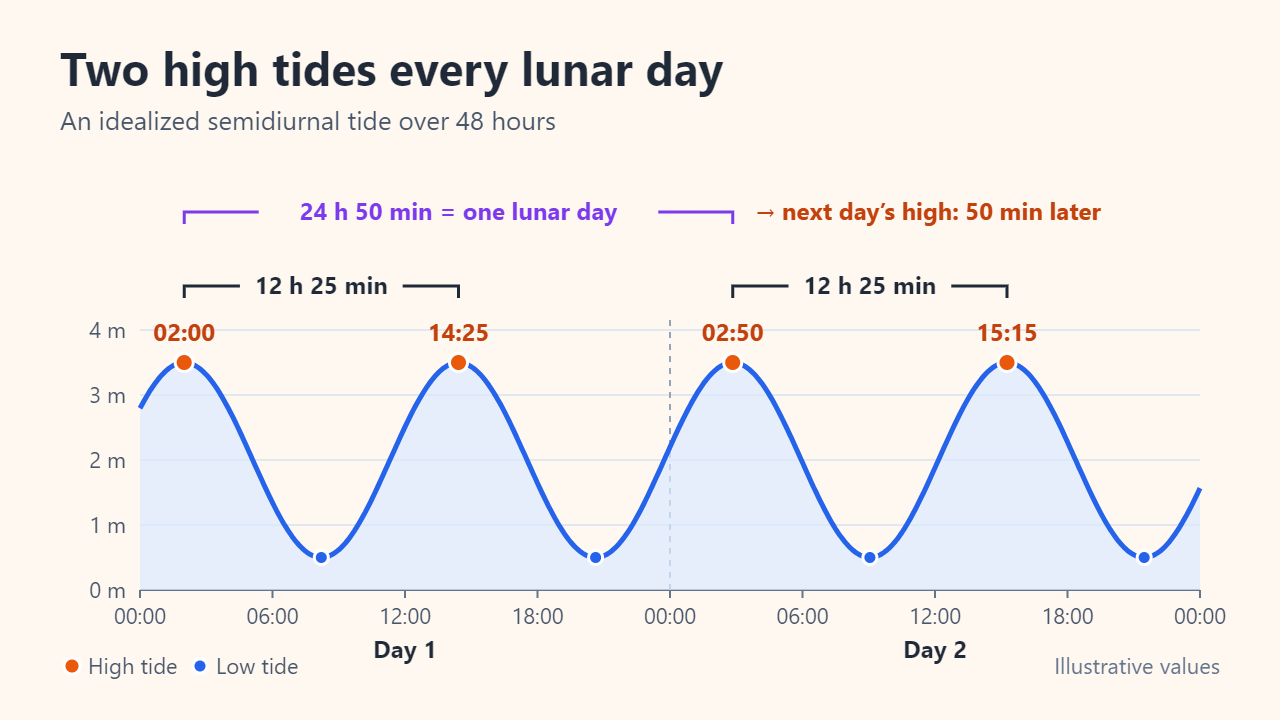
Earth spins beneath the two bulges, so a shore passes through one bulge, a trough, the other bulge and a second trough. The Moon also moves along its orbit in the direction Earth turns, so each spot needs extra time to catch up:
- One lunar day, the time for a spot on Earth to come back under the Moon, lasts 24 hours 50 minutes.
- Two bulges per lunar day put high tides about 12 hours 25 minutes apart.
- Going from high to low water, or low to high, takes about 6 hours 12.5 minutes.
- Each calendar day, the same tide arrives about 50 minutes later than the day before.
You can check the 50 minutes yourself. The Moon takes 29.53 days to come back to the same position relative to the Sun (one cycle of phases), so the lunar day is 24 h × 29.53 ÷ 28.53 ≈ 24.84 h, or 24 hours 50 minutes.
Spring tides and neap tides
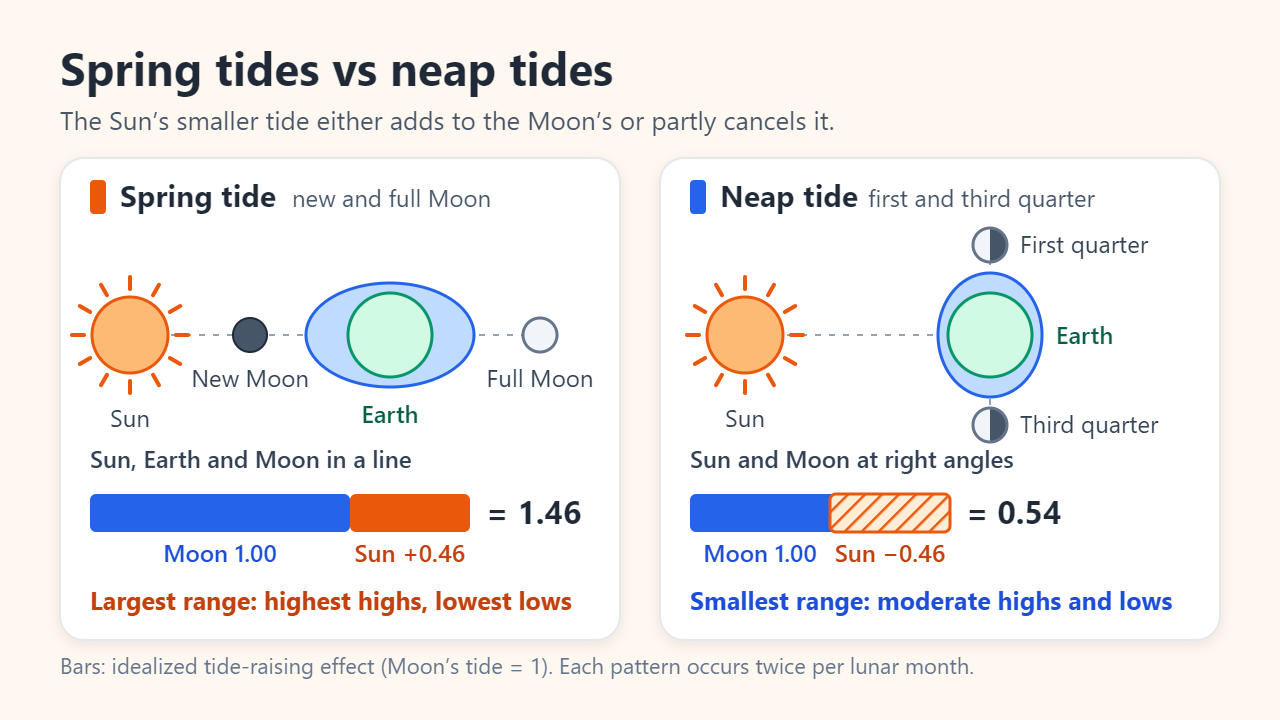
The Sun raises its own, smaller pair of bulges. How they combine with the Moon’s depends on the Moon’s phase, which is why tidal range swells and shrinks over about two weeks.
| Spring tide | Neap tide | |
|---|---|---|
| Moon phase | New and full Moon | First and third quarter |
| Geometry | Sun, Earth and Moon in a line | Sun and Moon at right angles |
| Solar tide | Adds to the lunar tide | Partly cancels it |
| Result | Highest highs, lowest lows | Moderate highs and lows |
| Idealized strength (Moon = 1) | 1 + 0.46 = 1.46 | 1 − 0.46 = 0.54 |
Both new and full Moon give spring tides because each body stretches the ocean toward and away from itself, so the Moon’s side of Earth does not matter. The name has nothing to do with the season; it comes from the tide “springing forth,” and spring tides occur twice a month all year, with neap tides about seven days after each. In the simple model the spring effect is about 2.7 times the neap effect (1.46 ÷ 0.54), though real coasts amplify or damp this in their own way. Tides also run larger when the Moon is near perigee, its closest point to Earth; “king tide” is a popular, non-scientific name for such exceptionally high tides.
Why tidal range differs so much between coasts
The two-bulge picture assumes a planet covered by deep, even water. Real continents block the bulges as Earth rotates, so the tide moves around each ocean basin as a very long wave, and every basin develops its own pattern. That is why the tidal range, the height difference between high and low water, varies so much from place to place.
- Resonance: in Canada’s Bay of Fundy, the Bay of Fundy–Gulf of Maine system sloshes back and forth with a natural period close to that of the main lunar tide. In its Minas Basin the range can reach 16 m when the contributing factors line up.
- Coastline shape: NOAA lists average ranges of about 30 feet (roughly 9 m) near Anchorage, Alaska, but 5–8 feet from Cape Cod to the Florida Keys.
- The Moon’s orbit: ranges grow near perigee and shrink near apogee.
- Weather: wind and air pressure can hold the water above or below the predicted level.
Diurnal and mixed tides: when there is only one high tide
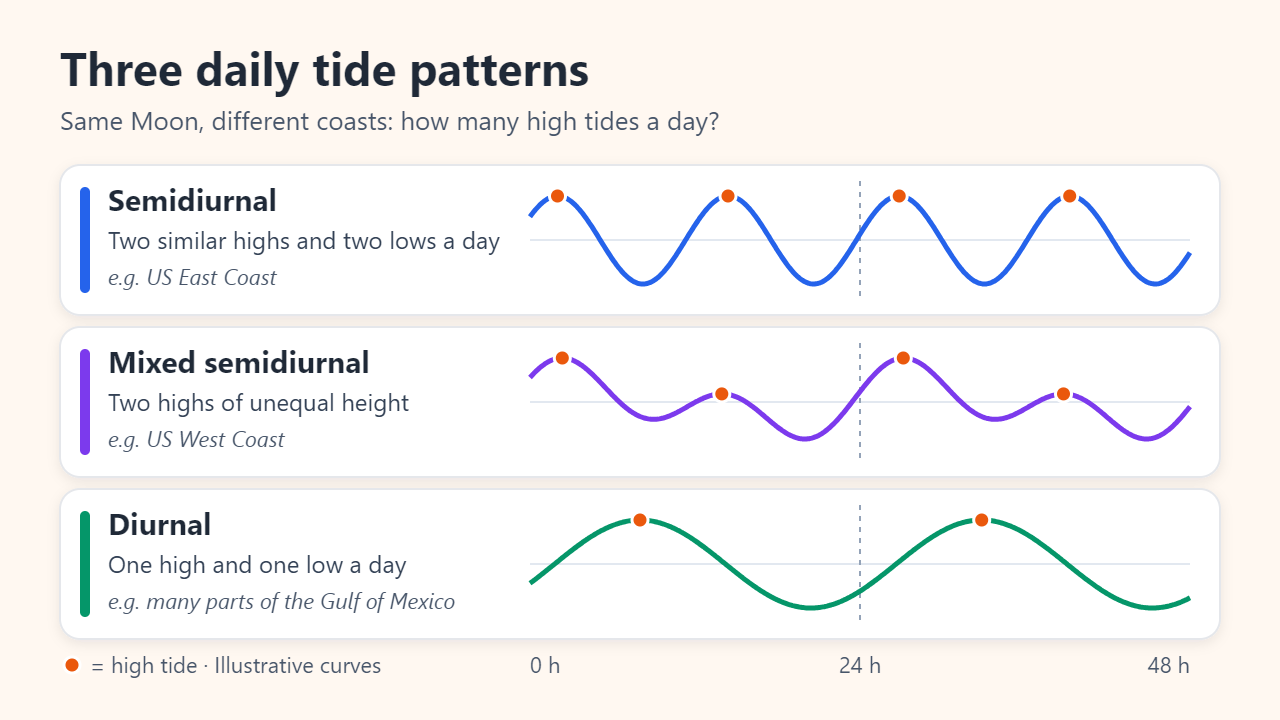
Not every coast follows the twice-a-day rhythm. As the Moon moves north or south of the equator over its monthly orbit, the bulges tilt relative to Earth’s axis, so a coast can pass through the thick part of one bulge and only the edge of the other. NOAA calls the resulting height difference between the day’s two tides the diurnal inequality. Combined with each basin’s response, it produces three broad patterns:
- Semidiurnal: two highs and two lows of about the same height each lunar day, typical of the US East Coast.
- Mixed semidiurnal: two highs and two lows of clearly different heights, common on the US West Coast.
- Diurnal: one high and one low per day, found in many parts of the Gulf of Mexico.
Official tide tables include all of these effects, so before fishing or walking on tidal flats, check the nearest station’s prediction rather than guessing from the Moon’s phase.
FAQ
Does the Sun cause tides too?
Yes. The solar tide is about 46% as strong as the lunar tide. On its own it would produce highs every 12 hours; combined with the Moon’s tide, it creates the two-week cycle of spring and neap tides.
Do lakes have tides?
Technically, yes, but they are tiny. NOAA puts the spring tide in the Great Lakes at less than 5 centimeters, hidden by much larger changes caused by wind and air pressure.
Why doesn’t high tide happen when the Moon is overhead?
Because the tide travels as a wave around each ocean basin, steered by coastlines and the seafloor, local high tide often comes hours before or after the Moon is highest in the sky.
Sources: NOAA Ocean Service: What causes tides?; NOAA Ocean Service: The lunar day and tide timing; NOAA Ocean Service: Types and causes of tidal cycles; NASA JPL: Bay of Fundy
Related reading
Original illustrations created to help explain this article.