Torque vs Horsepower: The Difference, the Formula and Why 5,252 rpm
Torque is the twisting force an engine puts on its crankshaft; horsepower, or power, is how fast that twisting does work. Engine speed links them: power = torque × angular speed, which works out to kW = N·m × rpm ÷ 9,549, or hp = lb-ft × rpm ÷ 5,252. An engine making 300 N·m at 4,000 rpm is therefore producing about 125.7 kW (171 PS, 169 hp) at that moment.
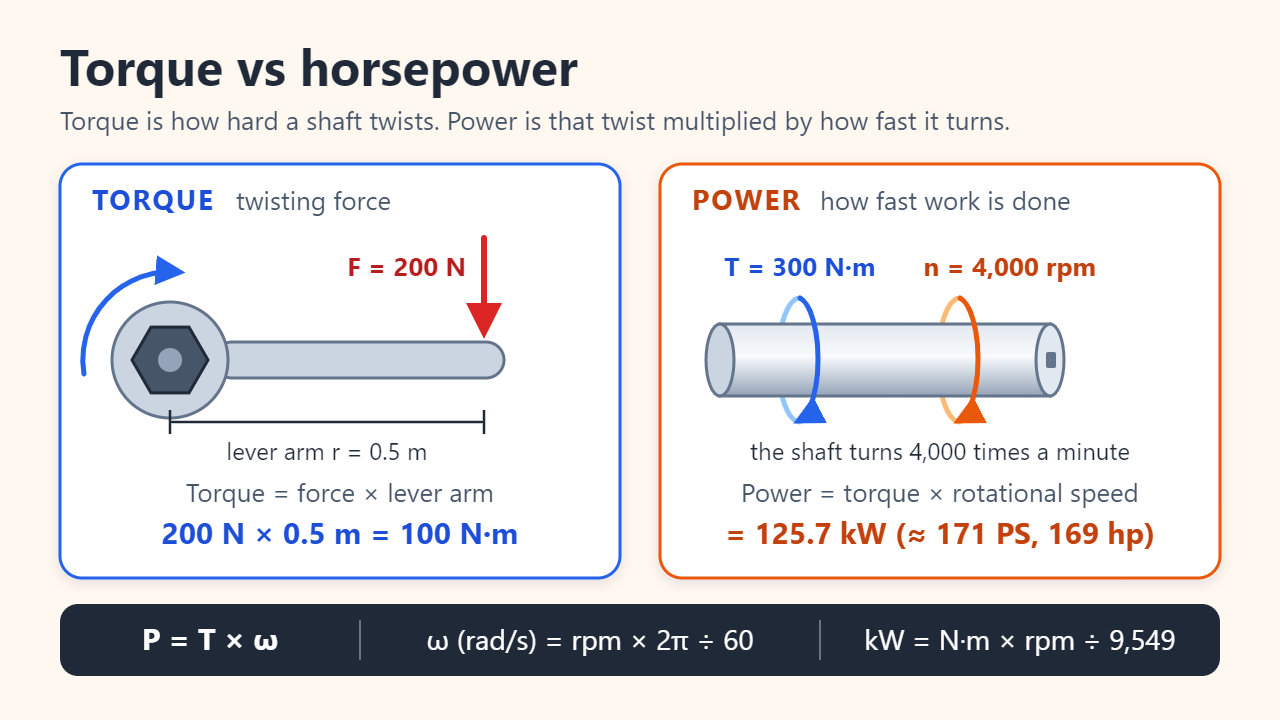
What torque and power actually measure
Torque is a force multiplied by its perpendicular distance from the axis of rotation, the lever arm. Push down with 200 N on a wrench 0.5 m long and the bolt receives 200 × 0.5 = 100 N·m. Nothing has to move: a seized bolt still feels the full 100 N·m. That is why torque alone says nothing about how much work gets done.
Power is the rate of doing work, measured in watts (1 W = 1 J/s). When a steady torque turns a shaft, the work equals torque × angle turned in radians, so power equals torque × angular velocity: P = T × ω, the rotational twin of P = F × v. NIST specifies that torque is written in newton meters, not joules, even though both reduce to the same base units, because torque and energy are different quantities.
The formula: from torque and rpm to kW or hp
Spec sheets give engine speed in revolutions per minute, but P = T × ω needs radians per second. One revolution is 2π radians and a minute is 60 seconds, so:
- Convert rpm to rad/s: ω = 4,000 × 2π ÷ 60 ≈ 418.9 rad/s.
- Multiply by torque: P = 300 N·m × 418.9 rad/s ≈ 125,664 W.
- Convert to the unit you need: ÷ 1,000 = 125.7 kW; ÷ 735.5 = 170.9 PS; ÷ 745.7 = 168.5 hp.
Folding the constants together gives the shortcuts. Because 60,000 ÷ 2π ≈ 9,549, kW = N·m × rpm ÷ 9,549. One mechanical horsepower is 550 ft·lbf per second, or 33,000 ft·lbf per minute, and 33,000 ÷ 2π ≈ 5,252, so hp = lb-ft × rpm ÷ 5,252. The formula also runs backward: an engine making 150 kW at 6,000 rpm is delivering 9,549 × 150 ÷ 6,000 ≈ 238.7 N·m at that speed.
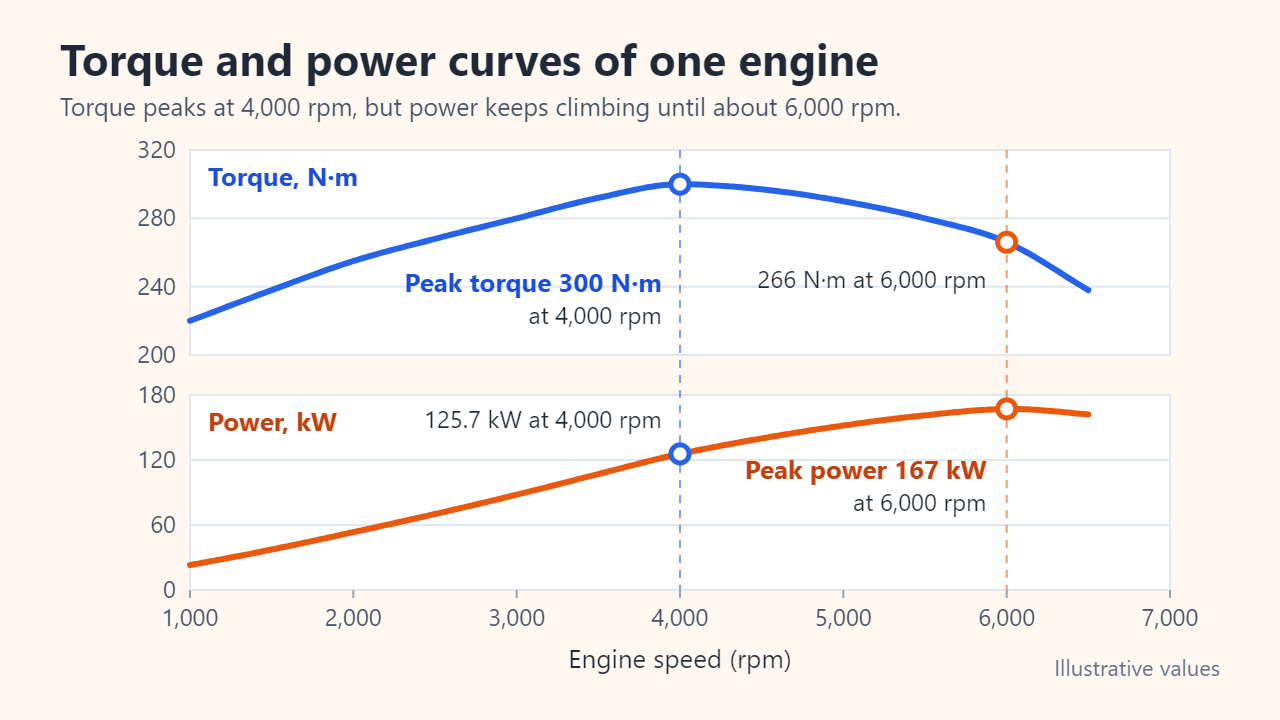
One trap: peak torque and peak power rarely occur at the same rpm, so multiplying a brochure's peak torque by its peak-power rpm gives a number the engine never produces.
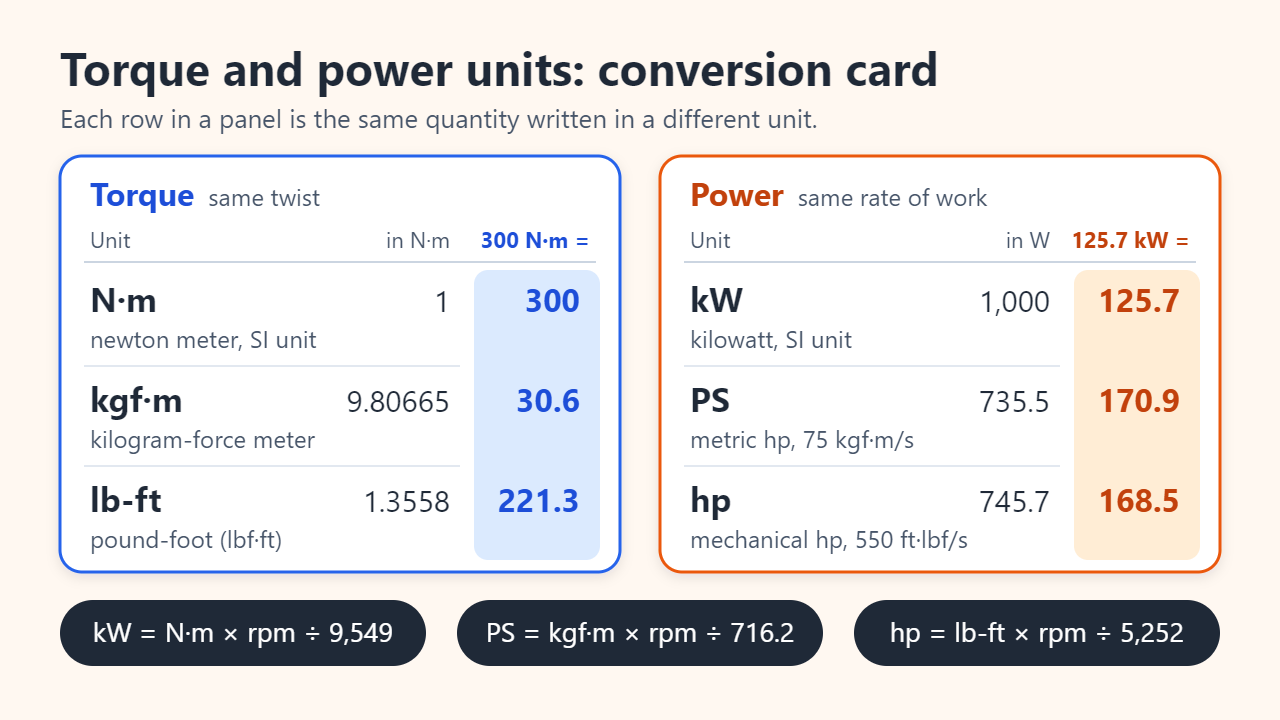
Torque and power units on spec sheets
Depending on the market and the age of the brochure, the same engine may be described in three families of units. Korean spec sheets, for example, usually list ps and kgf·m, while American ones use hp and lb-ft.
| Unit | Measures | Value in SI | Where you see it |
|---|---|---|---|
| N·m (newton meter) | Torque | SI unit | Most spec sheets |
| kgf·m (kilogram-force meter) | Torque | 9.80665 N·m (exact) | Older brochures, South Korea |
| lb-ft (pound-force foot) | Torque | 1.355818 N·m | United States |
| kW (kilowatt) | Power | 1,000 W | Most spec sheets |
| PS (metric horsepower) | Power | 735.49875 W (75 kgf·m/s) | Europe and Asia |
| hp (mechanical horsepower) | Power | 745.6999 W (550 ft·lbf/s) | United States, UK |
Useful ratios: 1 kW = 1.360 PS = 1.341 hp, and 1 PS = 0.986 hp, so a figure in PS is about 1.4% larger than the same power in hp. For torque, 1 kgf·m ≈ 7.23 lb-ft, which makes 300 N·m equal to 30.6 kgf·m or 221.3 lb-ft.
How to read torque and power curves
An engine dynamometer measures torque and speed across the rev range, and the power curve is calculated from them with P = T × ω. Figure 3 shows an illustrative engine whose torque peaks at 300 N·m at 4,000 rpm. Beyond that point torque falls slowly, but rpm rises faster than torque drops, so power keeps climbing to about 167 kW near 6,000 rpm. Only when torque falls off steeply does power turn down.
- Peak torque and its rpm: strong torque low in the rev range means brisk response without downshifting. Turbocharged engines often quote peak torque as a range, such as 1,500–4,500 rpm, because their curve is flat.
- Peak power and its rpm: the most the engine can deliver. Holding the engine near that speed with the gearbox gives the hardest acceleration.
- Width of the power curve: a broad curve pulls well over a wide speed range, which matters more in daily driving than one peak number.
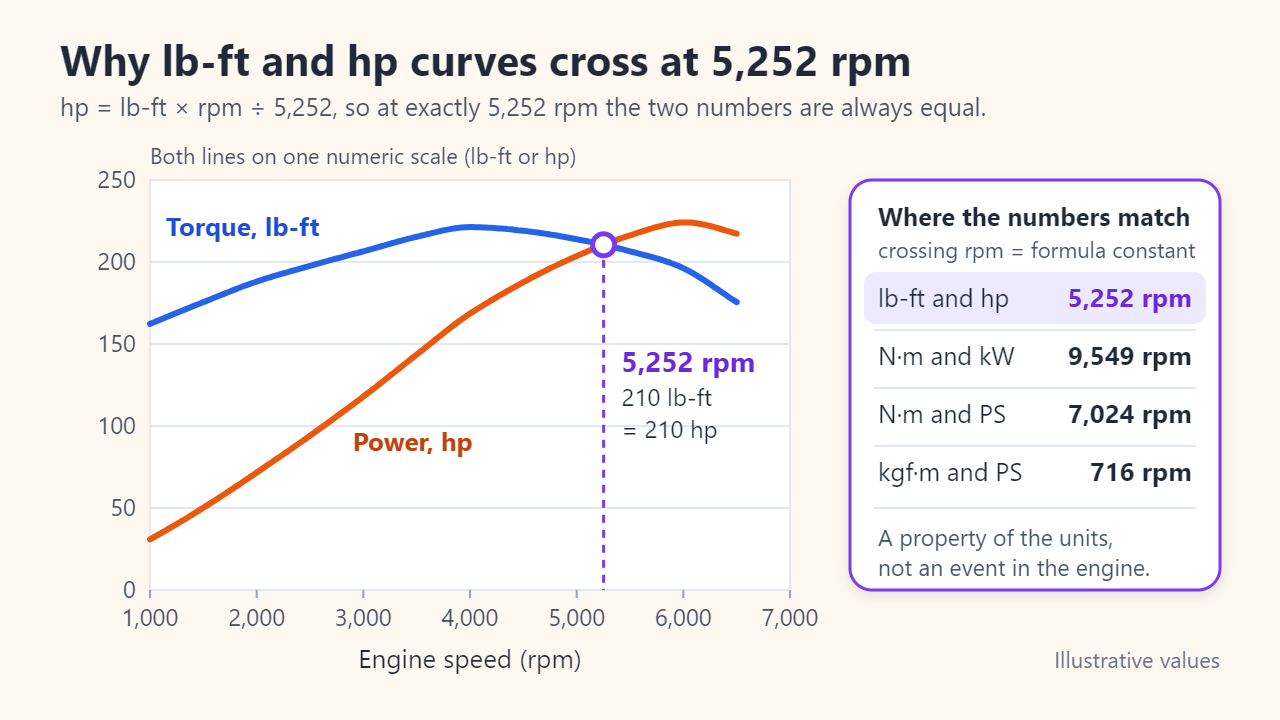
Why the curves cross at 5,252 rpm
On American dyno charts the torque (lb-ft) and horsepower lines always cross at 5,252 rpm. Nothing special happens inside the engine there. Because hp = lb-ft × rpm ÷ 5,252, the two numbers must be equal when rpm equals 5,252; below that speed the torque number is larger, and above it the horsepower number is. The illustrative engine shows about 210 lb-ft and 210 hp at that point.
Change the units and the crossing moves: N·m and kW would meet at 9,549 rpm, N·m and PS at about 7,024 rpm, and kgf·m and PS at about 716 rpm. An engine that stops revving before 5,252 rpm never shows the crossing at all.
Gearing: why wheel torque exceeds engine torque
A gearbox trades speed for torque. Each reduction multiplies torque and divides rpm by the same ratio, so power passes through unchanged apart from friction losses. With illustrative ratios of 3.5:1 in first gear and 4.0:1 in the final drive (14:1 overall), 300 N·m at 4,000 rpm becomes up to 4,200 N·m at the wheels, turning at about 286 rpm: still 125.7 kW before losses.
That is why power, not engine torque, limits acceleration at a given road speed. Driving force equals power ÷ speed, so at 100 km/h (27.8 m/s) 125.7 kW can push the car with at most about 4.5 kN, whichever gear is selected.
FAQ
Is torque or horsepower more important?
Neither alone. Power sets how much acceleration is possible at a given speed; the shape of the torque curve shows how easily the engine delivers that power without a gear change. Compare whole curves, not just the peaks.
Why do diesel engines have high torque but modest horsepower?
Diesels typically make their torque at low rpm and stop revving earlier than gasoline engines. Since power is torque × rpm, the lower speed range caps the power figure even when the torque figure is large.
Can I convert N·m to hp without the rpm?
No. Torque and power are different quantities, so you need the engine speed: hp = N·m × rpm ÷ 7,121, or convert to lb-ft first and divide by 5,252.
Are hp, bhp and PS the same?
Not quite. Brake horsepower (bhp) traditionally means power measured at the crankshaft on a dynamometer, in mechanical horsepower of 745.7 W. Metric horsepower (PS, also cv or ch) is 735.5 W, so 200 PS is about 197 hp.
Sources: NIST Guide to the SI (SP 811), Appendix B.9: conversion factors; NIST Guide to the SI (SP 811), Chapter 4: SI units; OpenStax University Physics Volume 1, 10.8 Work and Power for Rotational Motion.
Related reading
Original illustrations created to help explain this article.