How Far Is a Light-Year? Meaning, Kilometers and Star Distances
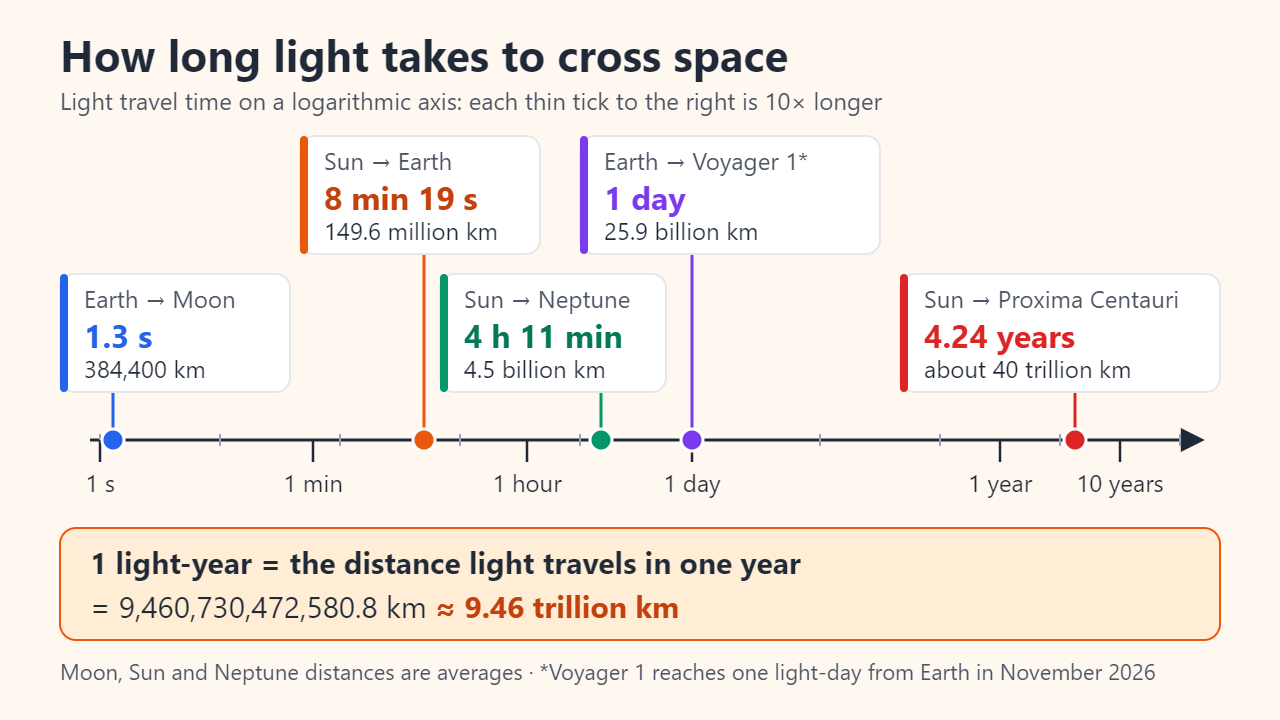
A light-year is a unit of distance, not time: it is how far light travels in a vacuum in one Julian year of 365.25 days. That works out to exactly 9,460,730,472,580.8 km, or about 9.46 trillion kilometers (5.88 trillion miles). Astronomers use it because star distances in kilometers quickly become unreadable: Proxima Centauri, the nearest star beyond the Sun, is about 4.24 light-years away, roughly 40 trillion km.
What a light-year means (and what it doesn't)
The "year" in light-year tells you how the distance is measured, not how long anything takes. The speed of light in a vacuum is a fixed constant, so "how far light gets in a set time" makes a dependable ruler. The same idea gives smaller units: a light-second is about 300,000 km, a light-minute about 18 million km, and a light-day about 25.9 billion km.
The usual symbol is ly. A star 10 ly away is therefore about 94.6 trillion km from us, and the light we see from it set out about 10 years ago. That double meaning, a distance that is also a travel time, is what makes the unit so handy.
How to calculate a light-year in kilometers
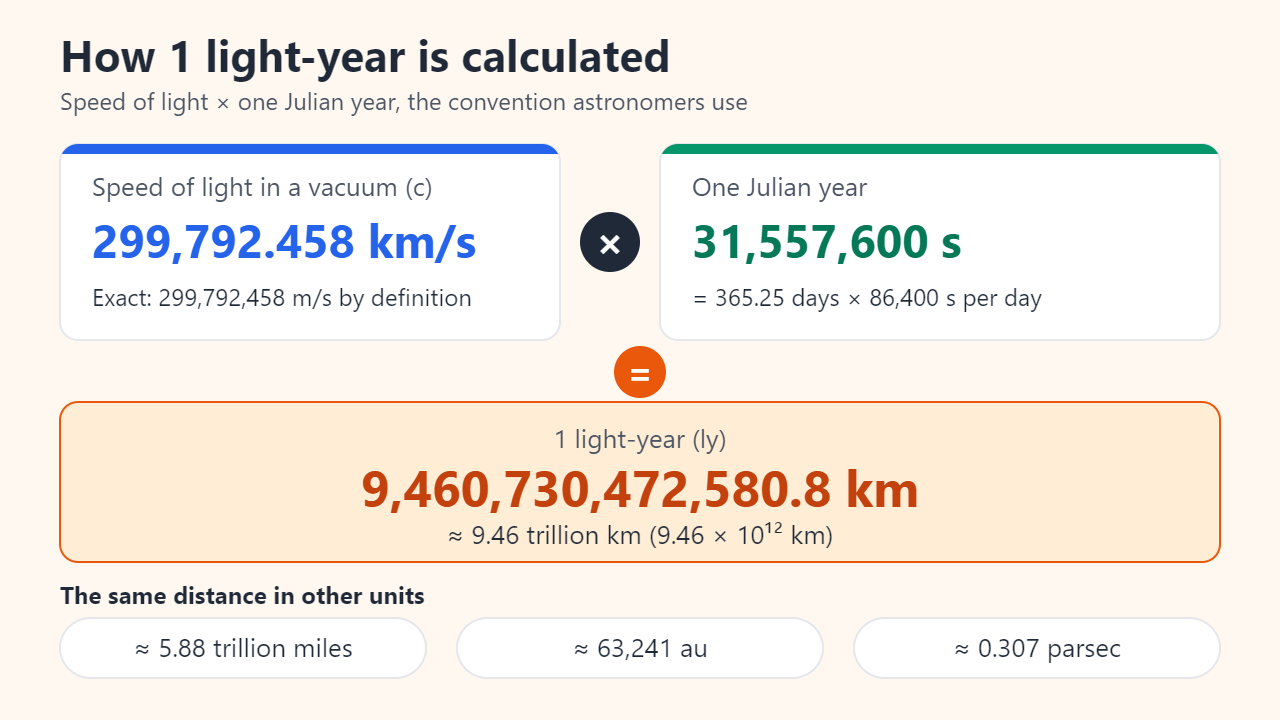
The International Astronomical Union (IAU) builds the light-year from two fixed numbers, so you can reproduce it with a calculator:
- Speed of light: c = 299,792,458 m/s, exact by definition, because the meter itself is defined from it. That is 299,792.458 km every second.
- Length of the year: a Julian year is 365.25 days × 86,400 seconds = 31,557,600 s.
- Multiply: 299,792.458 km/s × 31,557,600 s = 9,460,730,472,580.8 km.
- Round for everyday use: about 9.46 × 10¹² km, that is 9.46 trillion km, or about 63,241 astronomical units.
Why 365.25 days? The Julian year is a simple, fixed convention that astronomers use for long time spans. If you plug in the 365.2425-day Gregorian calendar year instead, the result is about 194 million km shorter. That gap is only 0.002%, irrelevant for star distances, but it explains why online converters sometimes disagree in the last digits. NIST lists the light-year as 9.460 73 × 1015 m, which matches the Julian-year value.
From light-seconds to light-years: a distance ladder
Light travel times turn cosmic distances into something you can picture. The table uses average distances; the Moon and Sun times shift slightly over a month and a year as those distances change.
| Trip | Approximate distance | Light travel time |
|---|---|---|
| Earth to Moon | 384,400 km | 1.3 seconds |
| Sun to Earth | 149.6 million km (1 au) | 8 min 19 s |
| Sun to Neptune | 4.5 billion km | about 4 h 11 min |
| Earth to Voyager 1 (November 2026) | 25.9 billion km | 1 day |
| Sun to Proxima Centauri | about 40 trillion km | about 4.24 years |
| Milky Way to Andromeda Galaxy | about 2.5 million light-years | about 2.5 million years |
The ladder shows how enormous the jump to the stars is. NASA calculated that Voyager 1, launched in 1977 and the most distant human-made object, would reach one light-day from Earth on November 18, 2026, after almost half a century of flight. A single light-year is 365.25 times farther. For a down-to-earth comparison (illustrative numbers), a jetliner flying nonstop at 900 km/h would need about 1.2 million years to cover one light-year.
Light-years are also a look back in time
Because light needs time to arrive, a distance in light-years doubles as the age of the view. Sunlight reaching your eyes left the Sun a little over 8 minutes earlier. Proxima Centauri appears as it was about 4.24 years ago, and the Andromeda Galaxy, roughly 2.5 million light-years away, appears as it was about 2.5 million years ago. If a nearby star changed today, nobody on Earth could know until its light arrived.
One caveat applies to very distant galaxies. When a news story says a galaxy is "13 billion light-years away," it usually means its light traveled for about 13 billion years. The universe kept expanding during that trip, so the galaxy's present distance is larger than the headline figure.
Light-year vs astronomical unit vs parsec
Astronomers pick the yardstick that fits the scale. Inside the Solar System they use the astronomical unit (au), which the IAU fixed in 2012 at exactly 149,597,870,700 m, close to the average Earth–Sun distance. For stars and galaxies, research papers mostly use the parsec (pc), with kiloparsecs and megaparsecs for larger scales.
The parsec comes from parallax, the tiny shift in a star's position as Earth circles the Sun. A star whose parallax is one arcsecond (1/3,600 of a degree) is 1 pc away, and the distance in parsecs is simply 1 divided by the parallax in arcseconds. Proxima Centauri's parallax is about 0.77 arcseconds, which gives roughly 1.3 pc.
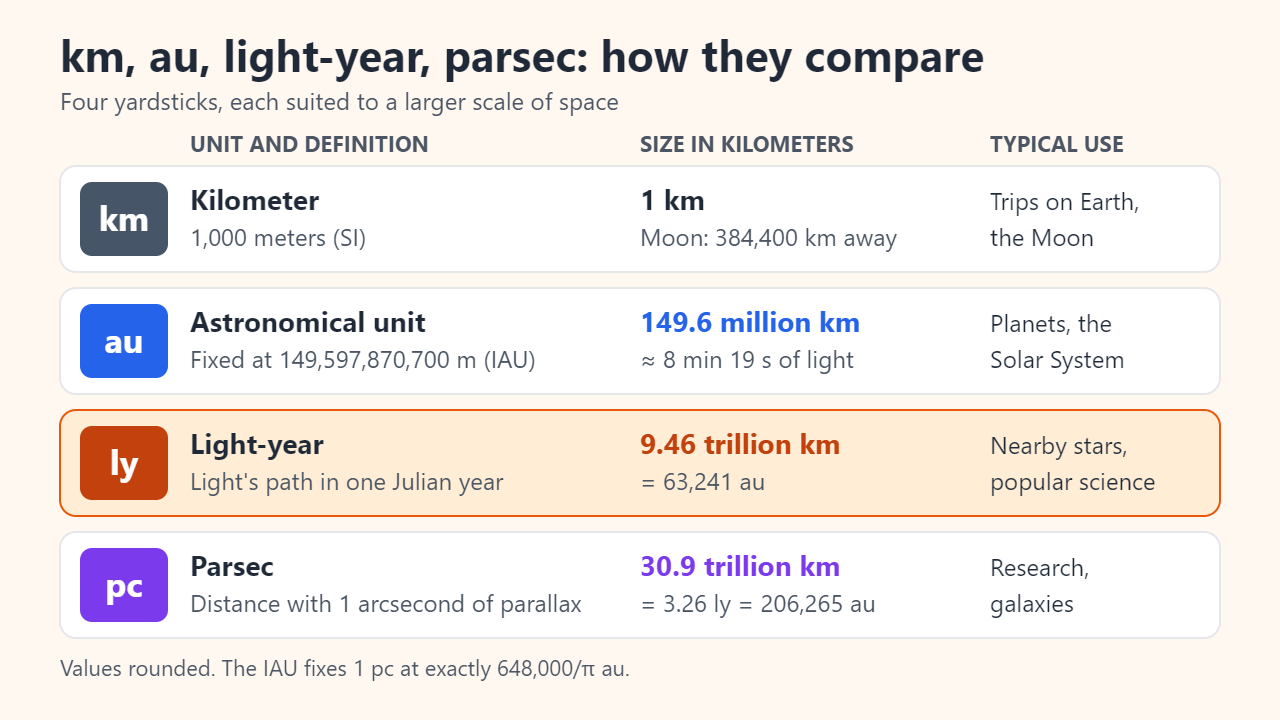
| Unit | Size in km | Equivalent | Typical use |
|---|---|---|---|
| Astronomical unit (au) | 149.6 million | about 8 min 19 s of light travel | Planets, the Solar System |
| Light-year (ly) | 9.46 trillion | 63,241 au | Nearby stars, popular science |
| Parsec (pc) | 30.9 trillion | 3.26 ly = 206,265 au | Research papers, galaxies |
Common mistakes with light-years
- Treating it as a unit of time. "That will take light-years" is a figure of speech; in science, a light-year always measures length.
- Mixing up trillion and billion. 9.46 trillion km is 9.46 × 10¹² km. 9.46 billion km would be a thousand times shorter, only about twice Neptune's distance from the Sun.
- Assuming a parsec is the smaller unit. One parsec is about 3.26 light-years.
- Thinking we see stars "live." Every star appears as it was when its light set out, from a few years to thousands of years ago.
- Expecting every converter to agree to the last digit. Tools that assume 365 or 365.2425 days give slightly different answers from the 365.25-day standard.
FAQ
How many kilometers are in one light-year?
Exactly 9,460,730,472,580.8 km under the Julian-year definition, usually rounded to 9.46 trillion km, or about 5.88 trillion miles.
How long would it take to travel one light-year?
Light takes one year, by definition. Spacecraft are far slower: by NASA's calculation, Voyager 1 needs about 49 years just to reach one light-day from Earth.
Is a parsec bigger than a light-year?
Yes. One parsec is about 3.26 light-years, or roughly 30.9 trillion km.
Why don't astronomers just use kilometers?
They could, but the numbers get hard to read and compare. Proxima Centauri is about 40,000,000,000,000 km away, versus a tidy 4.24 ly or 1.3 pc.
Sources: NIST: speed of light in vacuum (CODATA); NIST Guide to the SI, Appendix B.8: light-year, astronomical unit and parsec in meters; NASA: What is a light-year?; NASA: Voyager 1 and the light-day.
Related reading
Original illustrations created to help explain this article.