Polaris Is Not the Brightest Star: How to Find It and Why It Seems Still
This article was translated from its source language with AI assistance. Please check technical terms and equations against the original.
Choosing the brightest star to find north may lead you to the wrong one. Polaris matters more for its position than its brightness. Consider why stars appear to move during the night alongside the direction of Earth's rotation axis, and it becomes clear why this modest-looking star is a guide. The observing method described here is for the Northern Hemisphere.

1. It lies near the sky's rotation center
Earth's rotation makes stars seem to travel across the sky. Extend its axis toward the northern sky and you reach the north celestial pole; Polaris lies nearby. It therefore traces a much smaller circle than other stars and seems nearly stationary, rather than being perfectly motionless. NASA's Polaris guide explains how star trails relate to the rotation axis.
In a photograph of concentric star trails, first locate the center. Short trails near it and long trails farther out do not indicate that Earth rotates at different rates. They reflect different distances from the rotation center. Draw a center and two points on paper, then imagine turning them through the same angle: small and large circles appear together.
2. Use the two outer stars of the Big Dipper's bowl
Find the Big Dipper's ladle shape in a clear northern sky. Join the two stars at the outer edge of its bowl and extend the line toward the bowl's open side to help locate Polaris. The candidate lies at the end of the Little Dipper's handle, or the tail of Ursa Minor. The dipper's orientation changes with time and season, so check the relationship between the two stars rather than matching a diagram's up and down directions literally.
If a bright building or tree blocks the Big Dipper, try again from a safe location with a clearer view. Check the orientation settings of a phone's star map, too. A nearby name on the screen is not sufficient identification: compare the arrangement of neighboring stars to reduce mistakes.
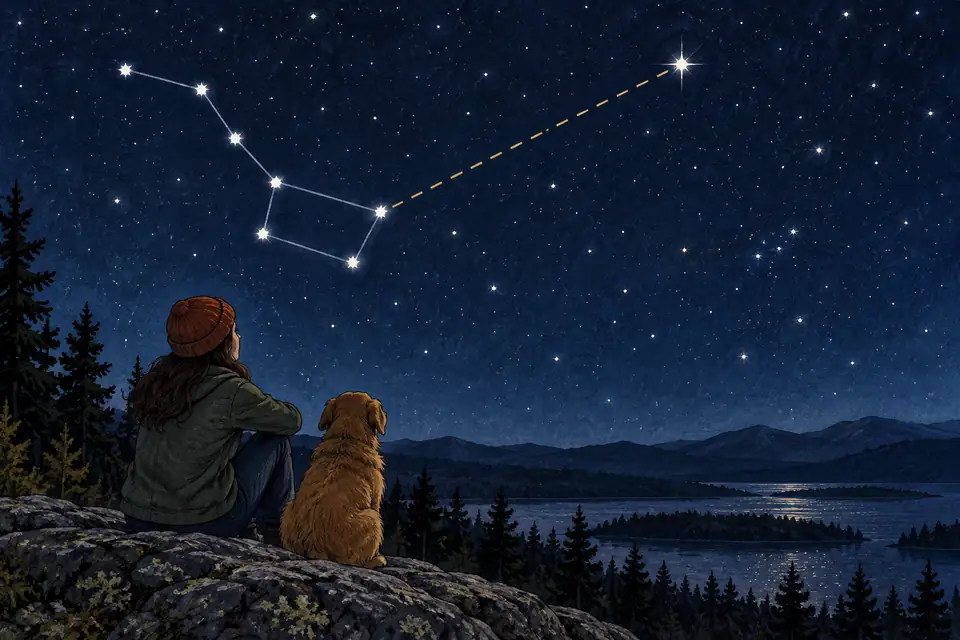
3. Height above the horizon connects to latitude
In the Northern Hemisphere, Polaris's angular height above the horizon is approximately the observer's north latitude. NOAA's explanation of latitude discusses estimating latitude from a star's altitude. Near 37 degrees north, for example, expect Polaris roughly 37 degrees above the northern horizon. This is a geometric approximation, not a precise survey measurement.
Altitude here is an angle between the horizon and your line of sight, not a height in meters. Mistaking a mountain ridge for the horizon or choosing the wrong star spoils the estimate. Sketch Earth's curved surface and the observer's sight line to understand why Polaris rises when you travel north and drops toward the equator. Even for the same star, the orientation of the local horizontal plane changes with location.
4. One star cannot give your entire position
Polaris helps establish north in the Northern Hemisphere, but is generally below the horizon in the Southern Hemisphere, where this method cannot be used. Direction and approximate latitude also do not determine longitude. The fact that many places at the same latitude see it at a similar altitude illustrates this limitation.
In an observing notebook, record your method, time, obstructions, and degree of confidence. “Compared the extension of the bowl's outer stars with the Little Dipper's handle” is more checkable than “found a bright star.” Learning Polaris goes beyond memorizing a name. Explaining where and on what evidence you identified it also makes the wider map of the night sky easier to read.
Original illustrations created to help explain this article.