What Is a Black Hole? Why Light Can't Escape the Event Horizon
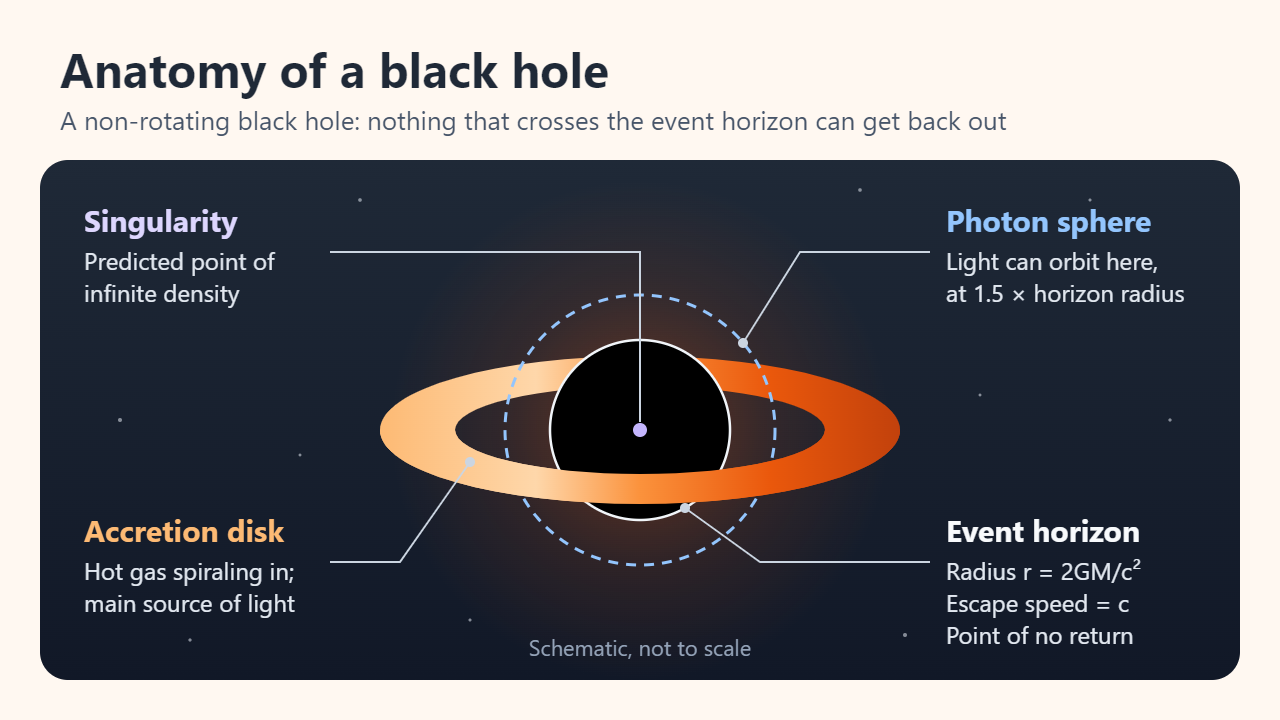
A black hole is a region of space where so much mass is packed into so small a volume that nothing that falls in can get back out, not even light. Its boundary is the event horizon: at that distance from the center, the speed needed to escape equals the speed of light, 299,792 km/s, and inside it every possible path, even a light ray aimed straight outward, leads further in. For a non-rotating black hole the horizon radius is the Schwarzschild radius, rs = 2GM/c², which works out to about 3 km for a black hole with the Sun's mass.
From escape velocity to a black hole
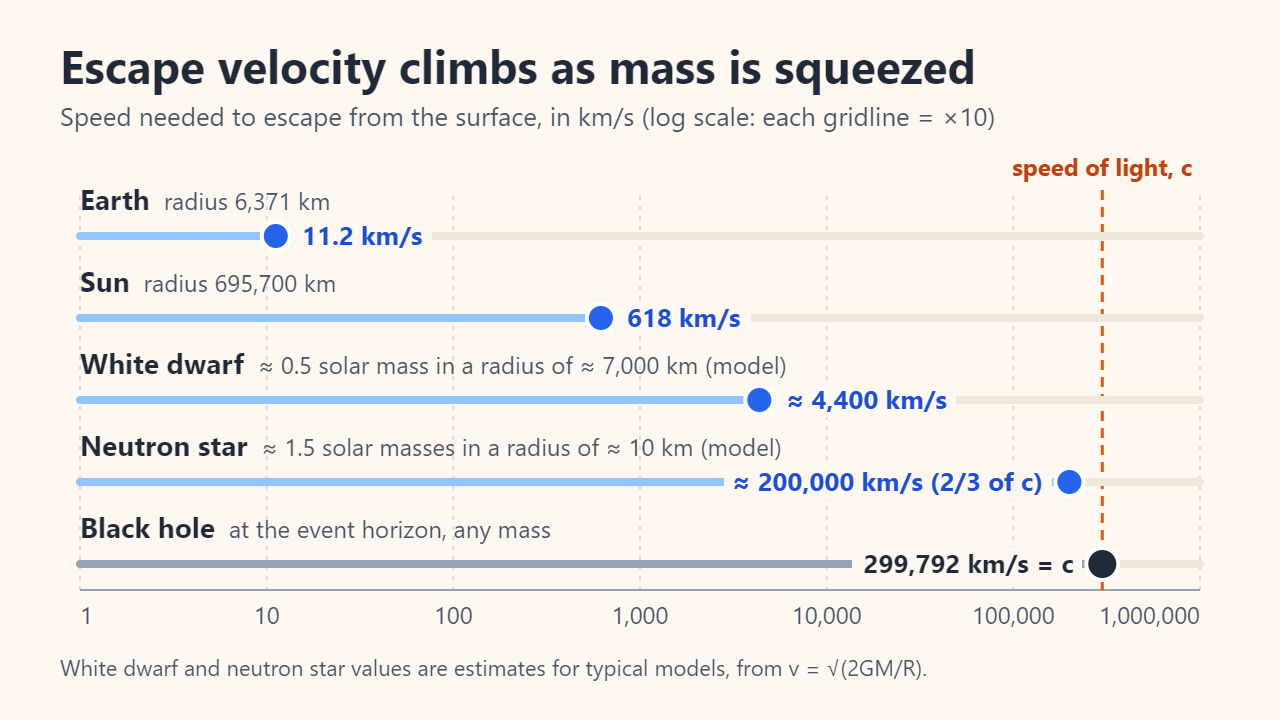
Escape velocity is the launch speed needed to coast away from a body's gravity for good. For a sphere of mass M and radius r it is v = √(2GM/r), where G is the gravitational constant. Squeeze the same mass into a smaller radius and escape velocity rises:
- Earth: 11.2 km/s from the surface.
- Sun: about 618 km/s from its visible surface.
- White dwarf: roughly half the Sun's mass in a ball slightly larger than Earth; for a 7,000 km radius, about 4,400 km/s.
- Neutron star: about 1.5 solar masses in a sphere some 20 km across: roughly 200,000 km/s, two-thirds of light speed.
Shrink an object further and its escape velocity reaches c. Setting √(2GM/r) = c gives r = 2GM/c², named after Karl Schwarzschild, who derived the matching solution of Einstein's equations of general relativity in 1916. Newton's formula happens to land on exactly the horizon radius that relativity gives for a non-rotating black hole.
Why light can't escape the event horizon
The escape-velocity argument is a useful first step, not the full story. Light is not a thrown ball that slows down and falls back; measured locally, it always moves at c. What changes is spacetime itself: in general relativity, mass curves space and time, and near a black hole the curvature becomes extreme.
At the event horizon, a flash of light pointed straight outward can only hover in place. Inside it, every direction you could travel, every path into the future, leads toward the center. Getting out would mean outrunning light, which nothing can do. The horizon is a point of no return, not a wall: there is no solid surface to land on.
Two other features shape what telescopes see. At 1.5 times the Schwarzschild radius lies the photon sphere, where light can circle the black hole, although the slightest nudge sends it inward or away. Farther out, gas in an accretion disk spirals inward, heats up and glows. Because gravity bends passing light, the dark "shadow" in black hole images looks larger than the horizon itself; NASA describes it as roughly twice the size.
Schwarzschild radius: how big is a black hole?
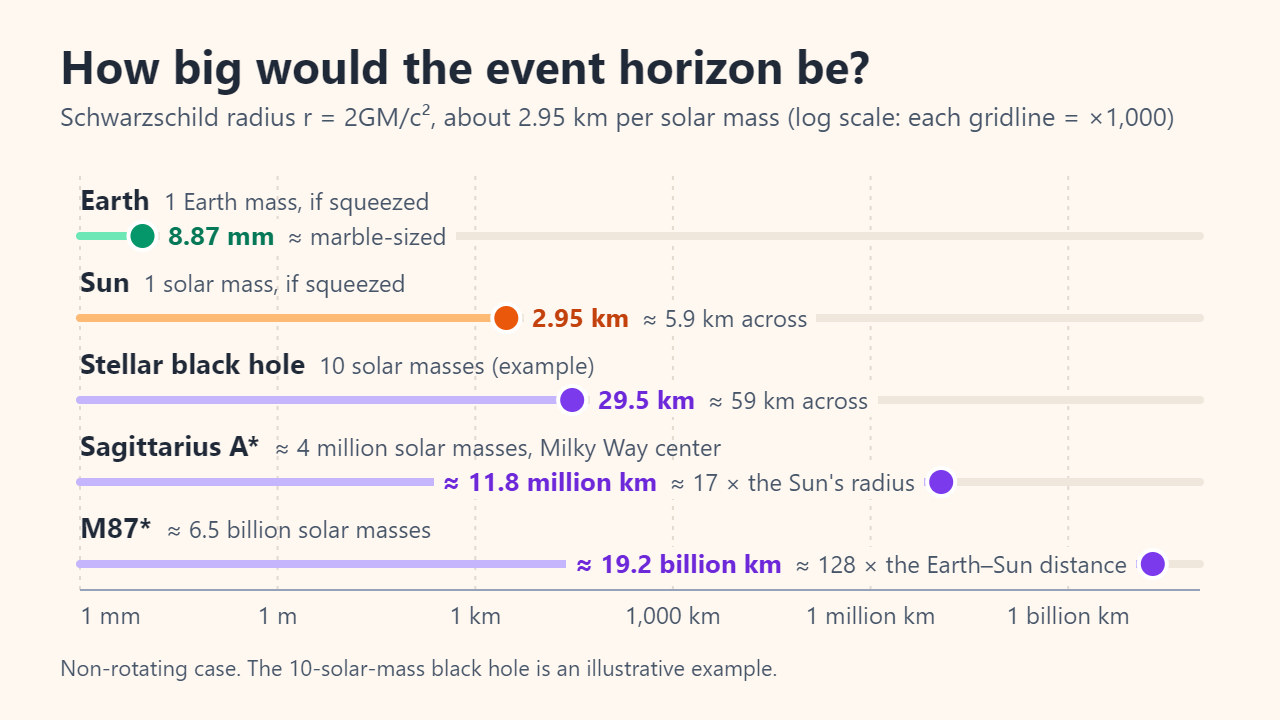
Because rs is directly proportional to mass, a handy rule is about 2.95 km per solar mass. Using NASA's masses and the exact speed of light (non-rotating case):
| Object | Mass | Schwarzschild radius | For scale |
|---|---|---|---|
| Earth (if squeezed) | 5.97 × 1024 kg | 8.87 mm | About 1.8 cm across, marble-sized |
| Sun (if squeezed) | 1 solar mass (1.99 × 1030 kg) | 2.95 km | About 5.9 km across |
| Stellar black hole (illustrative) | 10 solar masses | 29.5 km | About 59 km across |
| Sagittarius A* | About 4 million solar masses | About 11.8 million km | About 17 times the Sun's radius |
| M87* | About 6.5 billion solar masses | About 19.2 billion km | About 128 times the Earth–Sun distance |
From Earth to M87*, the radii span more than 15 powers of ten, hence the logarithmic scale in Figure 3. Spinning black holes have somewhat smaller horizons, but rs remains the standard yardstick.
How do black holes form?
Astronomers sort black holes by mass, and each group has a different origin:
- Stellar-mass black holes, from a few to hundreds of solar masses, are the remains of massive stars. Stars born with more than about 8 times the Sun's mass end in supernova explosions. If the collapsing core holds between about 1 and 3 solar masses it becomes a neutron star; heavier cores keep collapsing into a black hole. According to NASA, stars of around 20 solar masses or more leave black holes behind.
- Supermassive black holes, from hundreds of thousands to billions of solar masses, sit at the centers of almost all large galaxies. How they grew so large is still uncertain; some may have formed within the universe's first billion years.
- Intermediate-mass black holes, roughly a hundred to hundreds of thousands of solar masses, should fill the gap, but candidates have proven hard to confirm.
How do we know black holes exist?
A black hole gives off no light of its own, so astronomers detect its effect on its surroundings. Four independent lines of evidence agree:
- Orbiting stars. Teams led by Reinhard Genzel and Andrea Ghez followed stars near the center of the Milky Way for about 30 years. Their orbits require an invisible, compact object of about 4 million solar masses: Sagittarius A*.
- Glowing gas. Matter falling toward a black hole heats up and radiates across many wavelengths, including X-rays.
- Gravitational waves. On September 14, 2015, LIGO's twin detectors in the United States caught GW150914: ripples in spacetime from two black holes of roughly 30 solar masses each, merging about 1.3 billion light-years away. The discovery was announced on February 11, 2016.
- Direct images. The Event Horizon Telescope links radio observatories around the globe into a virtual Earth-sized telescope. It released the first image of a black hole, M87* (6.5 billion solar masses, 55 million light-years away), on April 10, 2019, and an image of Sagittarius A* (about 27,000 light-years away) on May 12, 2022. Both show a dark shadow surrounded by a bright ring of bent light.
Common myths about black holes
"Black holes suck in everything nearby." At a distance, a black hole pulls like any other object of the same mass. If the Sun were replaced by a black hole of equal mass, the planets would keep their orbits; the solar system would just get much colder.
"The Sun will one day become a black hole." It cannot: NASA notes it would need about 20 times more mass. About 5 billion years from now it will begin swelling into a red giant, and it will end as a white dwarf.
"The singularity is a known object." General relativity predicts infinite density at the center, but nobody knows whether that is physical or a sign that the theory breaks down.
FAQ
Can anything escape from a black hole?
Nothing that has crossed the event horizon. Matter still outside can: some infalling gas is redirected into jets that move at close to the speed of light.
What would happen if you fell into one?
It depends on the mass. At the horizon of a 30-solar-mass black hole, the tidal stretch between head and feet would be about a million times Earth's gravity. Above roughly 30,000 solar masses it drops below one g, so you could cross a supermassive black hole's horizon without noticing anything at that moment.
Is the black hole at the center of our galaxy dangerous to Earth?
No. Sagittarius A* is about 27,000 light-years away, far too distant to pose any danger.
Sources: NASA Science, Black Hole Types; NASA Science, Black Hole Anatomy; ESO, first image of the black hole at the heart of our galaxy; LIGO Scientific Collaboration, GW150914.
Related reading
Original illustrations created to help explain this article.