Mechanics of Materials: Conditions Limiting the Use of the Standard Stress Formula
This article was translated from its source language with AI assistance. Please check technical terms and equations against the original.
Hello. Today, I would like to discuss limitations concerning stress acting on materials. This is one of the problems engineers frequently encounter in practice, and understanding it is very important for solving engineering problems.
Before reading this post, however, you should have some understanding of the basic concept of stress. If the concept is not yet clear, you may want to read the post below first!
https://tiheatanium.tistory.com/m/21
Mechanics of Materials: What Is Stress?
Today's post will examine stress, one of the important concepts in engineering and mechanical mechanisms. When a force acts on an object, stress exists and can be calculated. It is that important.
tiheatanium.tistory.com
Let us begin.
Consider a condition in which stress is distributed uniformly along the entire length of a steel bar. This is a familiar condition that can easily be calculated using the formula s = P/A.
Here, s denotes stress, P is the axial force, and A is the cross-sectional area of the bar.
This condition is achieved when the axial force P acts through the centroid of the cross-sectional area.
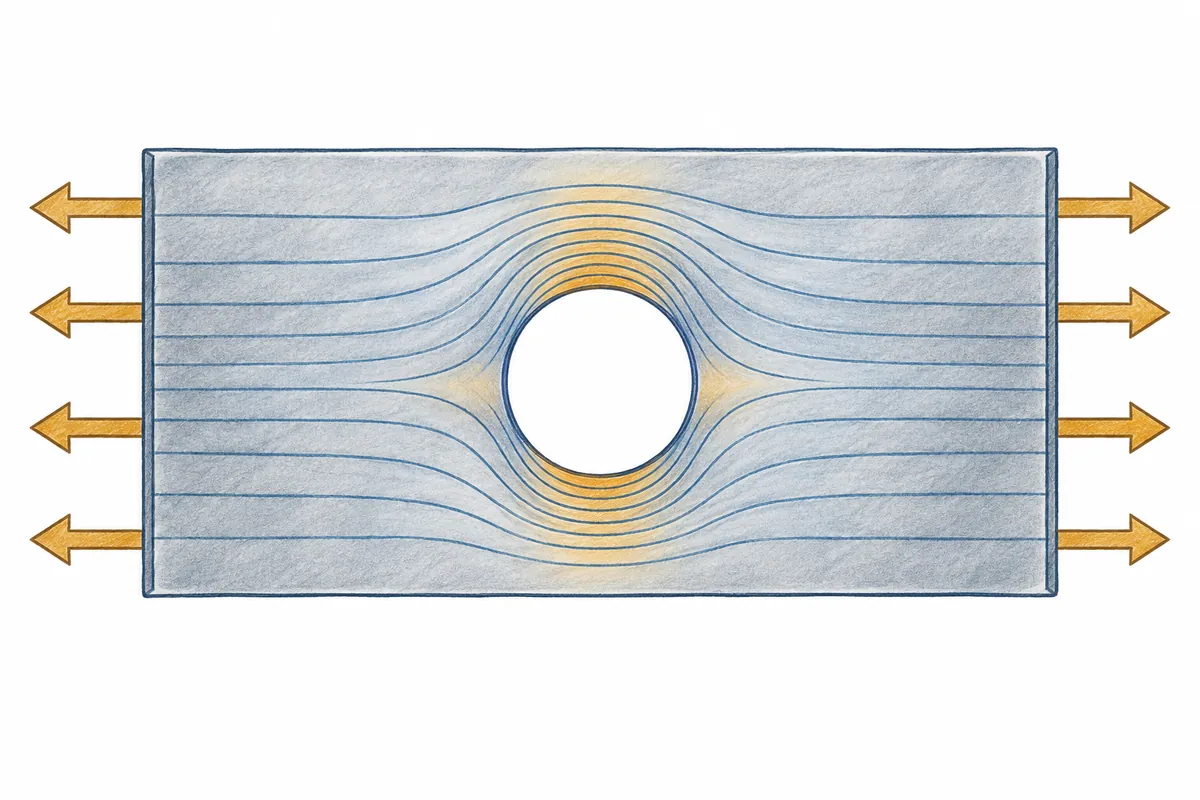
These conditions are not always satisfied. The stress distribution can differ at the ends of a bar, depending on how the load P is transmitted to it. If the load is distributed uniformly at the end, the stress pattern is the same as elsewhere in the bar.
In practice, however, loads are often transmitted through pins or bolts, producing high local stresses known as stress concentrations.
For example, in the eyebar shown below, the load P is transmitted through a pin passing through the hole, or eye, at the end of the bar. The forces shown in the illustration therefore result from the bearing pressure between the pin and the eyebar. In this case, the stress distribution around the hole is very complex.
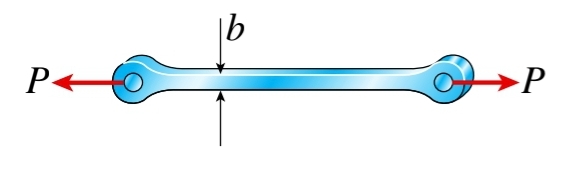
As we move from the end toward the middle of the bar, however, the stress distribution gradually approaches a uniform state. In fact, at locations separated from the stress concentration by a distance equal to the largest cross-sectional dimension of the bar, the formula s = P/A can be used accurately.
Ultimately, even when stress is not uniformly distributed, the formula s = P/A can be useful because it provides the average normal stress. When the cross-sectional area is nonuniform in this way, engineers therefore need to check whether using such a formula makes a significant difference in practice.
Today, we have examined the limitations of the standard stress equation.
Thank you.
Source: [1] Mechanics of Materials, J. M. Gere, B. J. Goodno et al. — 2012 — Cengage Learning
Original illustrations created to help explain this article.
Original on Tistory ↗