Mechanics of Materials: What Is Stress?
This article was translated from its source language with AI assistance. Please check technical terms and equations against the original.
Today's post examines stress, one of the important concepts in engineering and mechanical mechanisms. When a force acts on an object, stress exists and can be calculated. In this sense, nearly every object in daily life experiences stress.
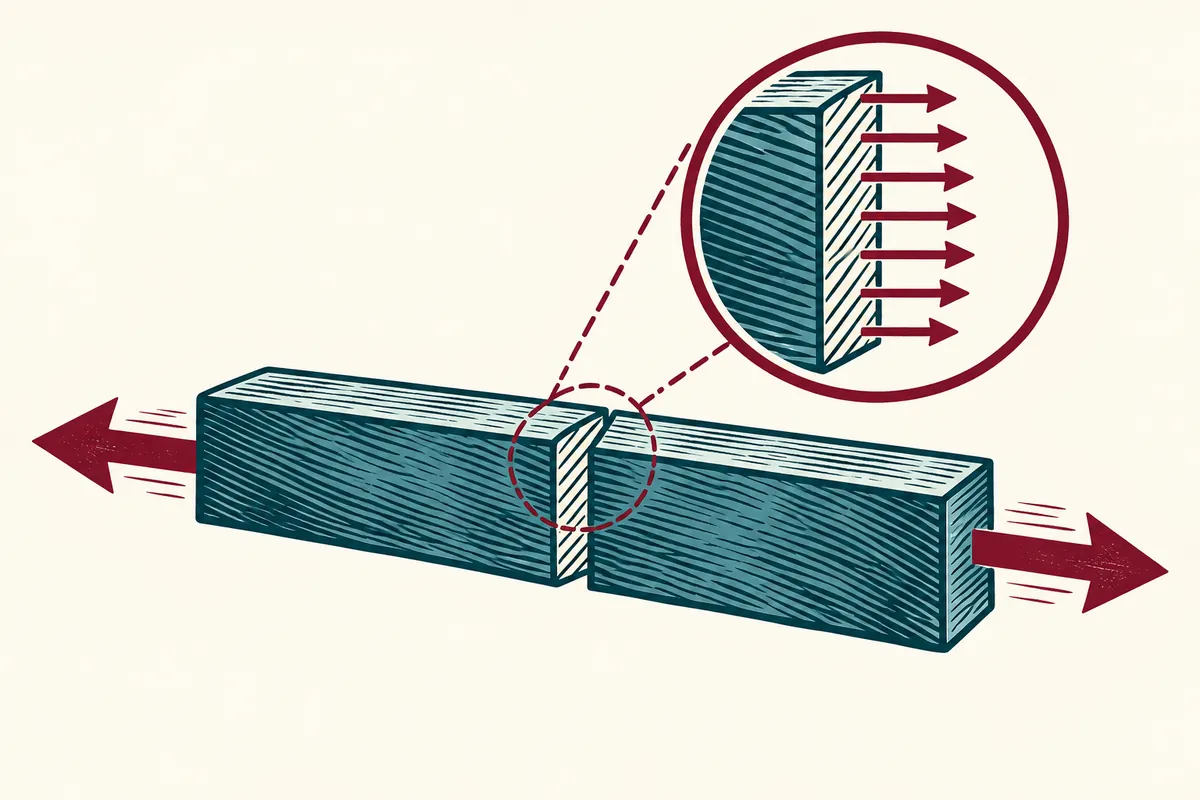
Then What Is Stress?
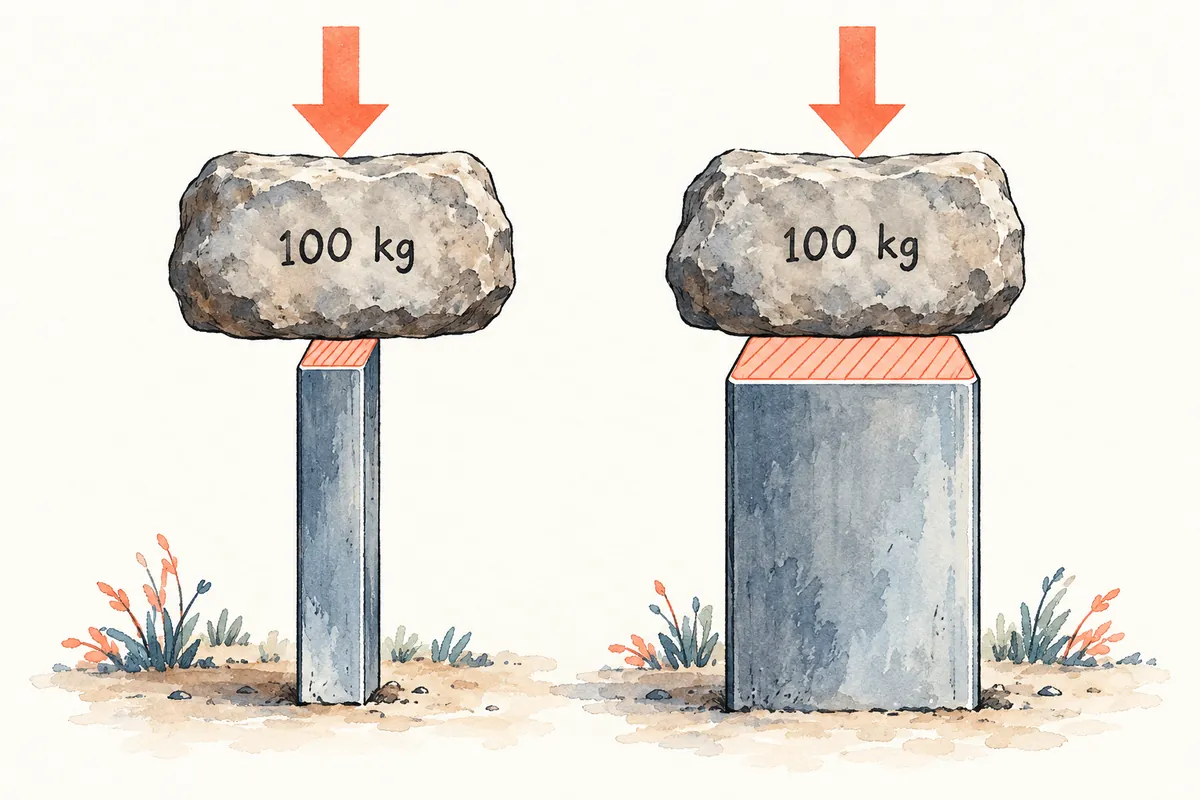
Let us start with its definition. Stress is defined as the force (P) acting per unit area (A). It is represented by the Greek letter sigma, σ. Stress may be uniformly distributed, or its intensity may vary from point to point.
We can therefore express stress with the following equation.
σ = P/A
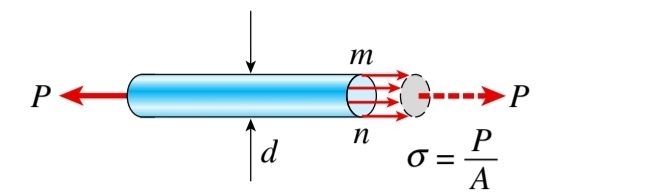
Let us use the illustration above (Figure 1) as an example. Suppose the stress acting on cross section mn is uniformly distributed across the entire area. The resultant of these stresses will then equal the magnitude of the stress multiplied by the bar's cross-sectional area A. Expressed mathematically as explained earlier, P/A = σ.
This formula gives the magnitude of uniform stress in an axially loaded bar with an arbitrary cross-sectional shape.
Types of Stress:
Tensile Stress and Compressive Stress
If a force P stretches a bar, tensile stress acts in the bar.
If the force reverses direction and the bar is compressed, this is compressive stress. Normal stress acts perpendicular to the cut section,
whereas shear stress acts parallel to the surface.
Tensile stress is generally defined as positive,
and compressive stress as negative.
Since normal stress σ is the axial force divided by the cross-sectional area, its units are units of force divided by units of area.
Stress is commonly expressed in pounds per square inch (psi) or kilopounds per square inch (ksi).
Unit Conversion:
When using SI units,
force is expressed in newtons (N),
and area in square meters (m²).
Consequently, stress has units of newtons per square meter (N/m²), equivalent to pascals (Pa).
However, the pascal is a very small unit, so larger multiples such as megapascals (MPa) are usually used.
For reference, the prefix K, kilo, means multiplication by 1,000, and M, mega, means multiplication by 1,000 × 1,000. For example, when discussing storage capacity, you mention a certain number of kilobytes or megabytes, right? That comes from these prefixes!
If the stress in a bar is 1.91 ksi, converting to SI units gives approximately 13.2 MPa, or 13.2 x 10^6 Pa. (10^6 means multiplying 10 by itself six times.)
Although not recommended in SI, stress is sometimes expressed in newtons per square millimeter (N/mm²), equivalent to megapascals (MPa).
Today, we have discussed the basic concept of stress and its unit conversions. This fundamental knowledge can be applied in many fields beyond materials science and architecture.
See you in the next post!
Source: [1] Mechanics of Materials, J. M. Gere, B. J. Goodno et al. — 2012 — Cengage Learning
Original illustrations created to help explain this article.
Original on Tistory ↗