How to Do the Pomodoro Technique: 25/5 Cycles and When to Adjust Them
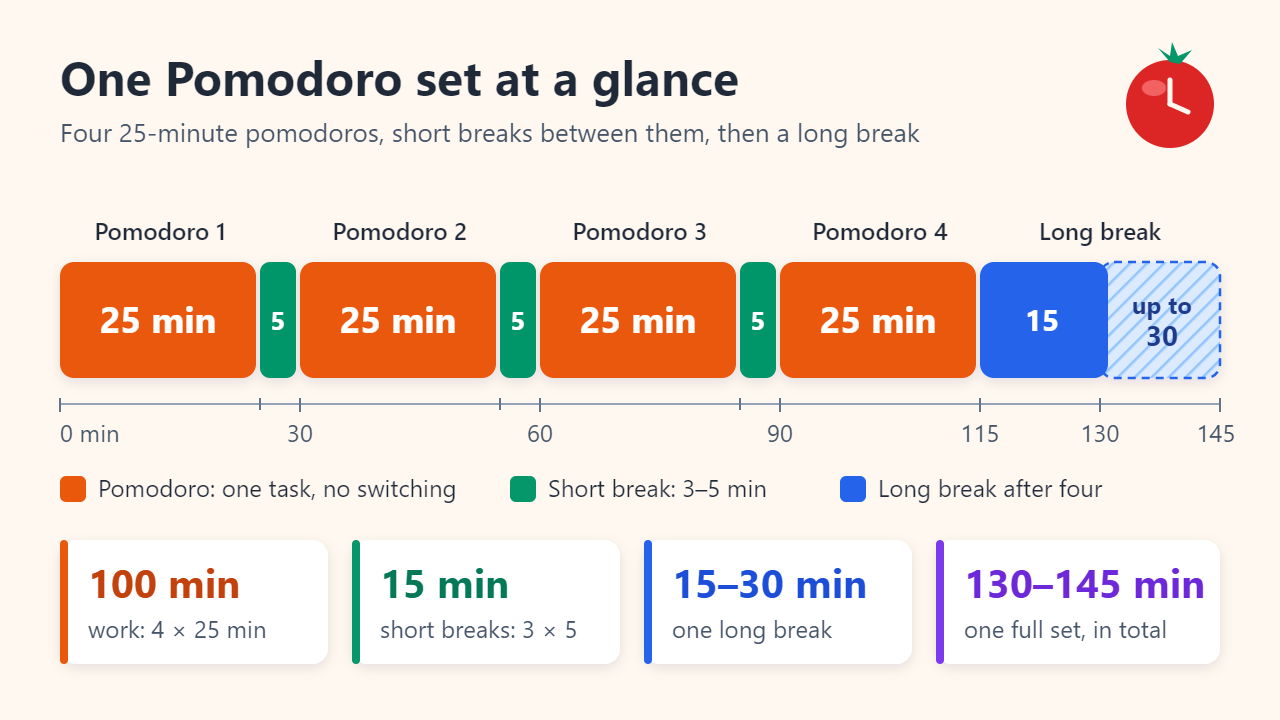
The Pomodoro Technique is a time-management method in which you work on one task for 25 minutes, take a 5-minute break, and after four of these rounds take a longer break of 15–30 minutes. Francesco Cirillo devised it in the late 1980s as a university student, timing himself with a tomato-shaped kitchen timer (pomodoro is Italian for tomato). One full set lasts about 130–145 minutes. You can adjust the lengths to suit your work, but the research behind the method is still small and mixed.
Where the tomato timer came from
Cirillo was struggling with distractions at university when he set himself a modest bet: could he really study for just 10 minutes? To keep himself honest he used a kitchen timer shaped like a tomato, and the experiment slowly grew into a method he later taught to individuals and teams. His official site describes three parts: plan the day’s work, focus on one activity at a time while handling interruptions, and reflect by comparing your estimates with what actually happened. The tools are deliberately simple: a timer, a pencil and paper.
Each 25-minute block is called a pomodoro. In Cirillo’s rules a pomodoro is indivisible: there is no half pomodoro, and one you abandon partway through does not count, so you start a fresh one. If the task finishes before the timer rings, you spend the remaining minutes reviewing or polishing what you just did instead of jumping to something new.
How to do the Pomodoro Technique, step by step
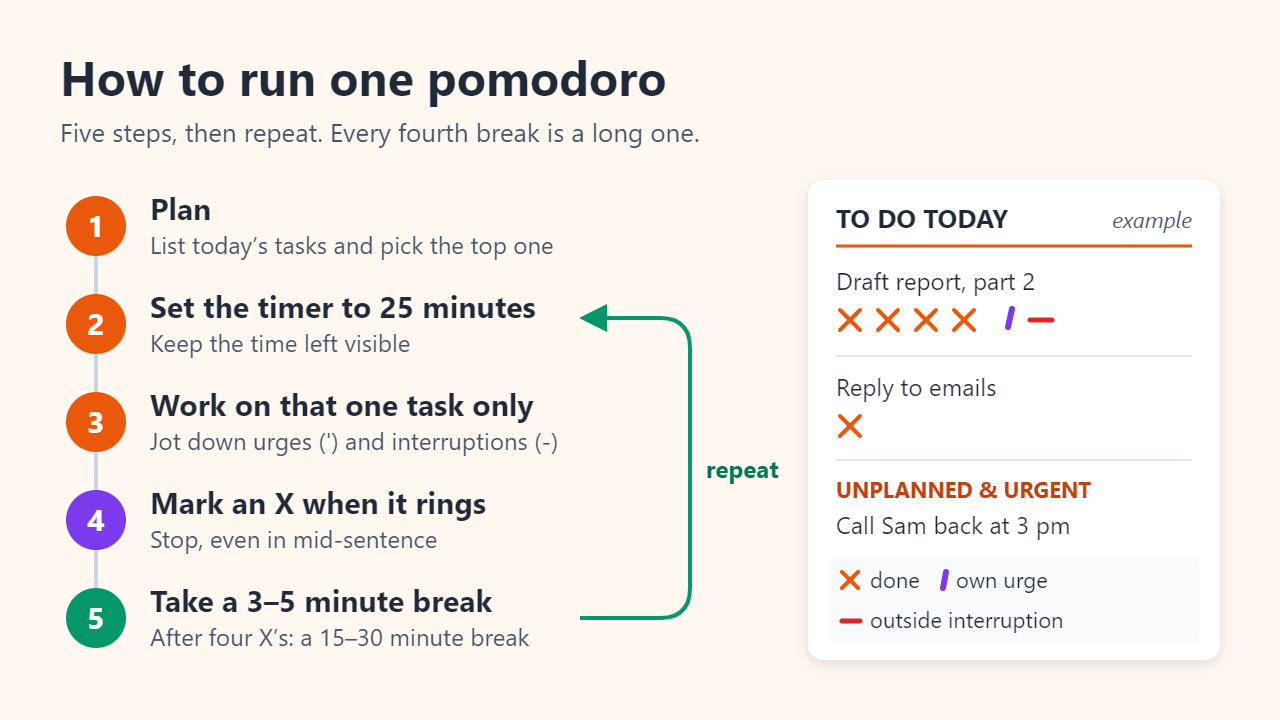
- Plan the day. Write today’s tasks in priority order. Split anything that would take more than five to seven pomodoros, and bundle tiny jobs, such as a quick email and a booking, into a single pomodoro.
- Set the timer for 25 minutes. A kitchen timer works, and so does any app that shows the time left.
- Work on that one task only. If an unrelated urge pops up, jot it down for later and carry on. Cirillo’s original guide marks these internal interruptions with an apostrophe (') and outside ones, such as a colleague’s question, with a dash (-), so you can count them at the end of the day.
- Mark an X when it rings. Stop even if you are mid-sentence. The X is your record of completed effort.
- Take a short break of 3–5 minutes. Stand up, drink water, stretch. Skip work talk and important messages.
- After four pomodoros, rest longer. Take 15–30 minutes, then start a new set.
For outside interruptions, the original guide suggests a short routine: tell the person you are in the middle of something, agree on when you will get back to them, and then actually call back. Cirillo’s point is that most requests can wait 25 minutes.
Why it can help, and what research shows
The appeal is easy to see. A 25-minute block makes a dreaded task feel small enough to start, the timer takes the decision about when to stop out of your head, and the tally of pomodoros and interruptions gives you data for better estimates. Planned breaks also keep you from grinding on for hours until you are drained.
Controlled evidence, however, comes from only a few small studies of university students:
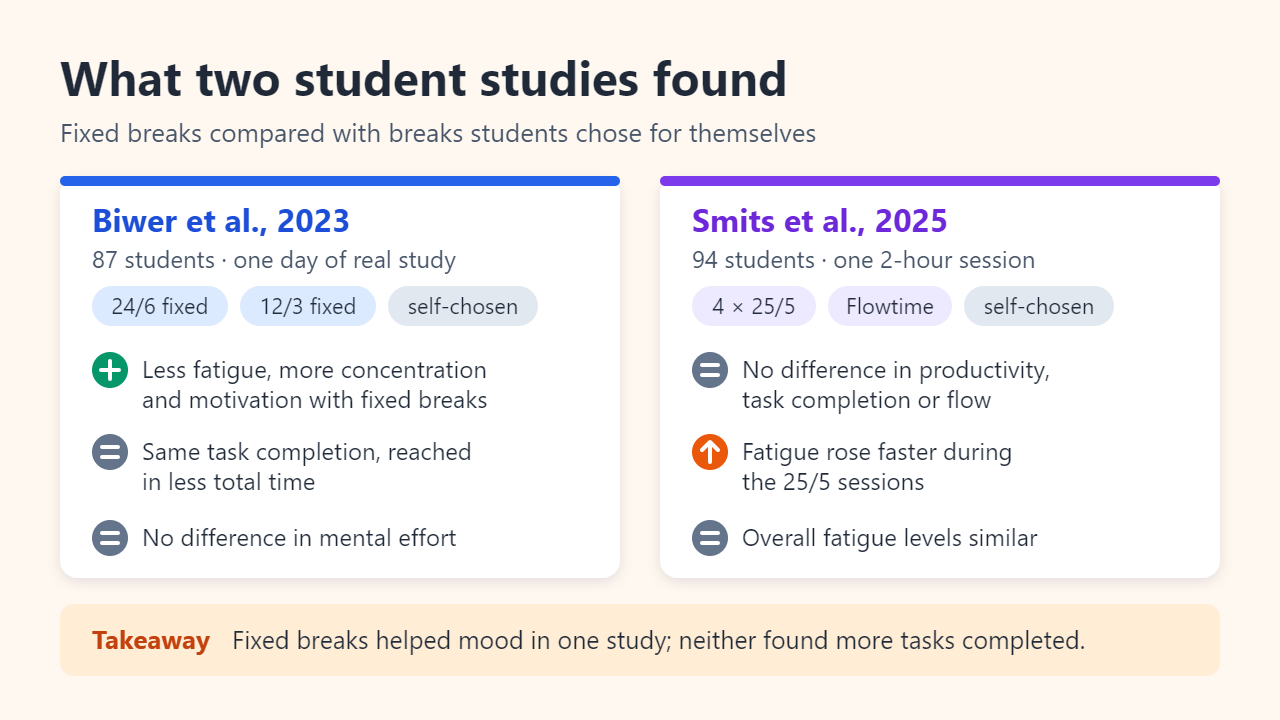
- Biwer and colleagues (2023) followed 87 students through a day of real study. Students given fixed breaks (24 minutes of work then 6 minutes off, or 12 then 3) reported less fatigue and more concentration and motivation than those who chose their own breaks. All three groups completed a similar amount of work, but the fixed-break groups needed less total time. Invested mental effort did not differ.
- Smits and colleagues (2025) randomly assigned 94 students to a two-hour session with self-chosen breaks, four 25/5 pomodoros, or Flowtime breaks (study while focused, then rest for 5, 8 or 10 minutes depending on the block’s length). They found no differences in productivity, task completion or flow. Fatigue rose faster during the pomodoro sessions, although overall fatigue levels did not differ.
Taken together, fixed breaks may make studying feel more manageable, but there is no solid evidence that the 25/5 cycle itself raises output or grades. Treat it as a structure worth testing, not a proven productivity booster.
How to adjust the 25/5 cycle
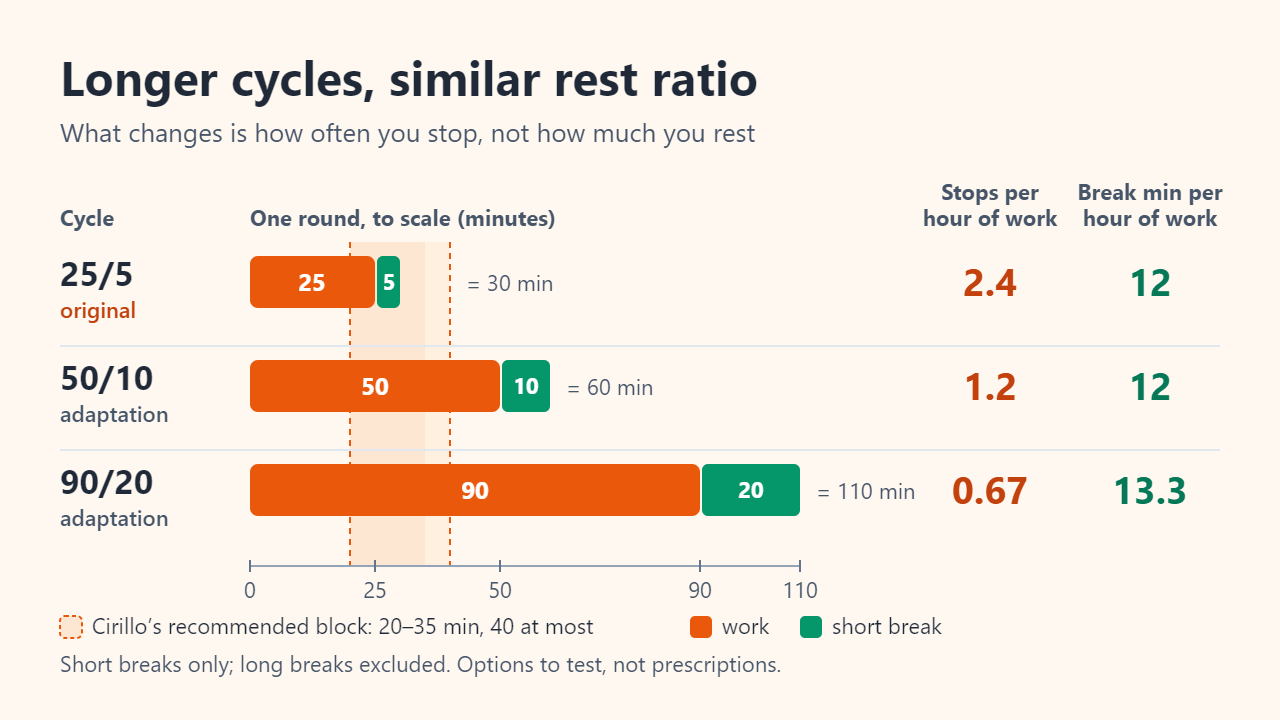
Cirillo himself was not rigid about 25 minutes. His original guide puts the ideal pomodoro at 20–35 minutes, 40 at most, and lets short breaks stretch to about 10 minutes when you are especially tired. Longer cycles such as 50/10 or 90/20 are popular adaptations beyond that range, so think of them as related time-blocking habits rather than the original method. They keep almost the same rest ratio; what changes is how often you stop.
| Cycle (work/break, minutes) | Status | Stops per hour of work | Break minutes per hour of work | Worth testing when… |
|---|---|---|---|---|
| 25/5, long break after four | Cirillo’s standard | 2.4 | 12 | Starting a dreaded task, revision, admin, frequent interruptions |
| 50/10 | Common adaptation | 1.2 | 12 | Writing, coding or problem sets that need a longer warm-up |
| 90/20 | Common adaptation | 0.67 | 13.3 | Long, absorbing work when you can reliably protect the time |
| Flowtime | Self-paced variant | Varies | Varies | A fixed alarm keeps cutting into your concentration |
The table counts short breaks only. Change one variable at a time, keep it for several days, and log completed pomodoros and interruptions as before. If the alarm keeps cutting into momentum, lengthen the block; if your attention fades by minute 15, shorten it.
When the Pomodoro Technique is a poor fit
Fixed timers suit work that can be cut into chunks. They fit less well where restarting is costly: untangling a hard bug, running a lab procedure, or writing a difficult passage once you are finally in flow. The authors of the 2025 study note this common criticism, that a strict timer can break absorption in a task. Meetings, classes and on-call duties also wreck the rhythm. In those cases, use the timer only for the stretches you control, or switch to self-paced breaks with one firm rule: stop before you are exhausted.
Common mistakes
- Working through the bell. Skipping breaks feels productive but drains the later rounds. The long break is part of the method, not a reward.
- Scrolling during breaks. Messages and feeds are not much of a rest. Move, look away from screens, get water.
- Vague targets. “Work on thesis” invites drift; “draft section 2.1” gives the 25 minutes a clear target.
- Counting time instead of learning from it. The tally is for estimating and improving, not for proving how busy you were.
- Quitting after one messy day. Interruptions you could not control do not mean the method failed. Note them and adjust.
FAQ
Can I study for 50 minutes instead of 25?
Yes, if it suits your work, but it is an adaptation. Cirillo recommended blocks of 20–35 minutes, 40 at most. Try any change for several days before judging it.
What should I do during a 5-minute break?
Something physical and undemanding: stand, stretch, refill your water, look out of a window. Cirillo advised against work conversations or important emails during short breaks.
Do I need a special Pomodoro timer?
No. Any timer that shows the remaining time will do, including a kitchen timer or your phone’s built-in timer. The original method needs only a timer, a pencil and paper.
Sources: The Pomodoro Technique official site (Francesco Cirillo); Duke University Academic Resource Center: Pomodoro Technique; Biwer et al. (2023), Comparing Pomodoro breaks and self-regulated breaks; Smits et al. (2025), Self-regulated, Pomodoro and Flowtime breaks among students.
Related reading
Original illustrations created to help explain this article.