Conduction vs Convection vs Radiation: 3 Types of Heat Transfer Explained
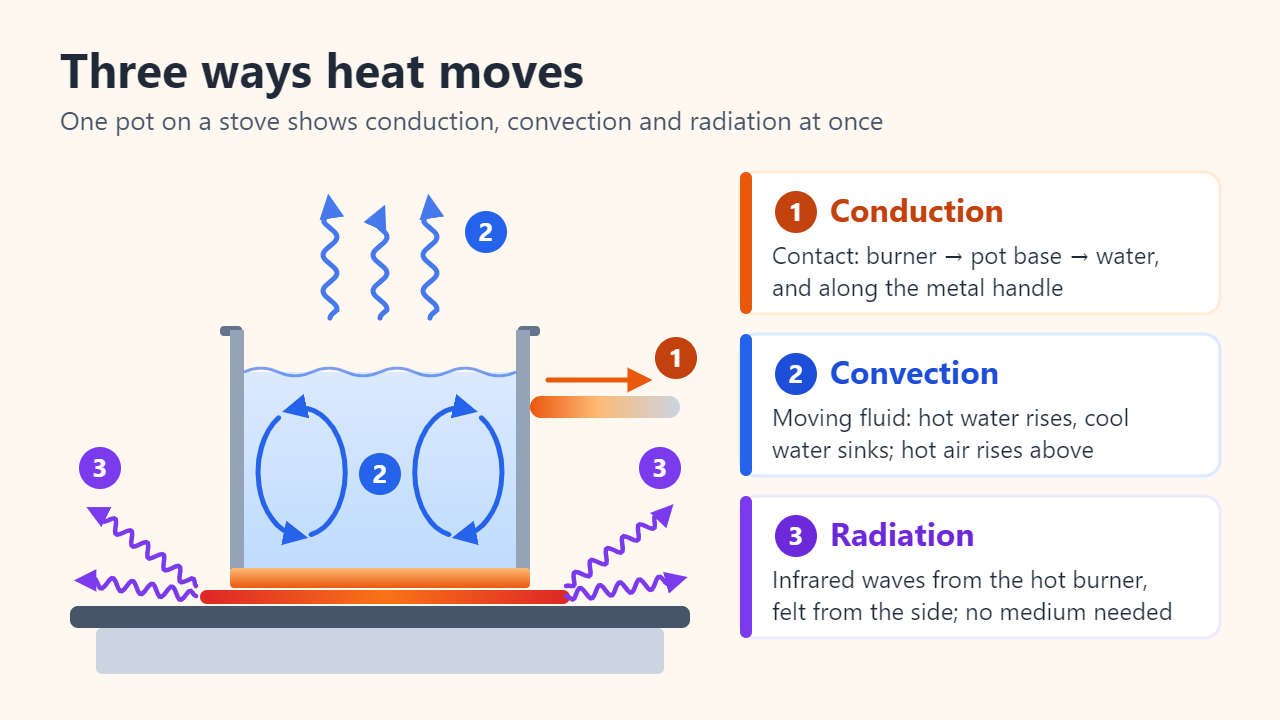
Heat moves in three ways. Conduction passes energy through direct contact, particle to particle, inside a solid or a still fluid. Convection carries energy along with a moving liquid or gas. Radiation sends it as electromagnetic waves, mostly infrared, which need no medium and can cross the vacuum of space. A metal spoon warming in hot soup is conduction, the rolling water in a boiling pot is convection, and the warmth of sunlight on your face is radiation.
Conduction: heat passed along by contact
In conduction, fast-vibrating particles in the hot region jostle their slower neighbors and hand over energy, so heat creeps through a material while the material itself stays put. Metals conduct well because their many free electrons also carry thermal energy. Air conducts poorly because its molecules are far apart. Heat always flows from hot to cold, and the rate follows Fourier's law. For a flat slab it becomes:
P = kAΔT / L
Here P is the heat flow in watts, k is the material's thermal conductivity in W/m·K, A is the area, ΔT is the temperature difference across the slab and L is its thickness. Double the area or the temperature difference and the heat flow doubles; double the thickness and it halves. In an illustrative example, a 1 m² pane of glass 4 mm thick with a 1 °C difference between its faces conducts 1.0 × 1 × 1 ÷ 0.004 = 250 W. A 4 mm layer of perfectly still air would pass only 6.5 W.
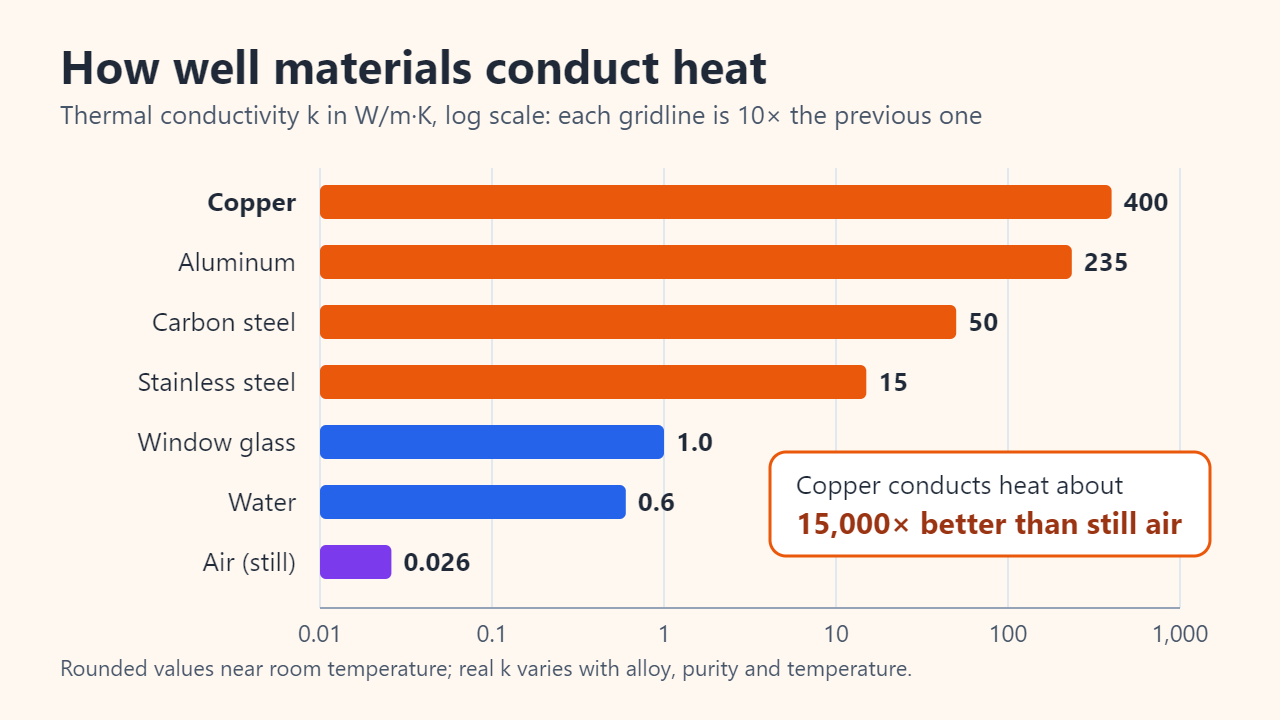
| Material | k, approx. (W/m·K) | Conducts vs still air (same size and ΔT) |
|---|---|---|
| Copper | 400 | about 15,000× |
| Aluminum | 235 | about 9,000× |
| Carbon steel | 50 | about 1,900× |
| Stainless steel | 15 | about 580× |
| Window glass | 1.0 | about 38× |
| Water | 0.6 | about 23× |
| Air (still) | 0.026 | 1× |
Values are rounded and vary with alloy, purity and temperature, but the spread is what matters. Foam, down and wool insulate by trapping air in spaces too small for it to circulate, so heat has to crawl through a poor conductor. Double glazing likewise relies on a sealed layer of air or gas between the panes.
Convection: heat carried by a moving fluid
Convection happens in liquids and gases. Fluid touching a hot surface warms by conduction, then physically carries that energy away as it flows. There are two kinds:
- Natural (free) convection: buoyancy alone drives the flow. Warm fluid rises and cooler fluid sinks to replace it, as in a pot of heating water, the shimmer above a hot road or a growing cumulus cloud.
- Forced convection: a fan, pump, wind or stirring spoon pushes the fluid. Convection ovens, a car's cooling system and blowing on hot soup all rely on it.
Engineers estimate convective heat flow with Newton's law of cooling, q = hAΔT, where ΔT is the difference between the surface and the bulk fluid, and the heat transfer coefficient h (W/m²·K) sums up everything about the flow. h is small for still air, larger for moving air and liquids, and can reach tens of thousands for boiling water. With illustrative numbers, a 0.05 m² surface at 60 °C in 20 °C room air with h = 10 W/m²·K loses 10 × 0.05 × 40 = 20 W. A fan that raises h to 40 W/m²·K quadruples the loss to 80 W.
Radiation: heat carried by electromagnetic waves
Every object above absolute zero emits electromagnetic radiation. At everyday temperatures it is mostly invisible infrared; a stove element hot enough to glow is also giving off visible light. Because these waves need no medium, radiation is the only way heat crosses empty space. Sunlight travels about 150 million km of near-vacuum and reaches Earth in a little over eight minutes.
The power radiated follows the Stefan–Boltzmann law, P = εσAT⁴. σ is the Stefan–Boltzmann constant, about 5.670 × 10⁻⁸ W/m²·K⁴ (the CODATA value listed by NIST, 5.670 374 419… × 10⁻⁸, is exact). ε is the surface's emissivity, from 0 for a perfect reflector to 1 for an ideal black body, and T is the absolute temperature in kelvins. Plugging in degrees Celsius is the most common mistake with this formula.
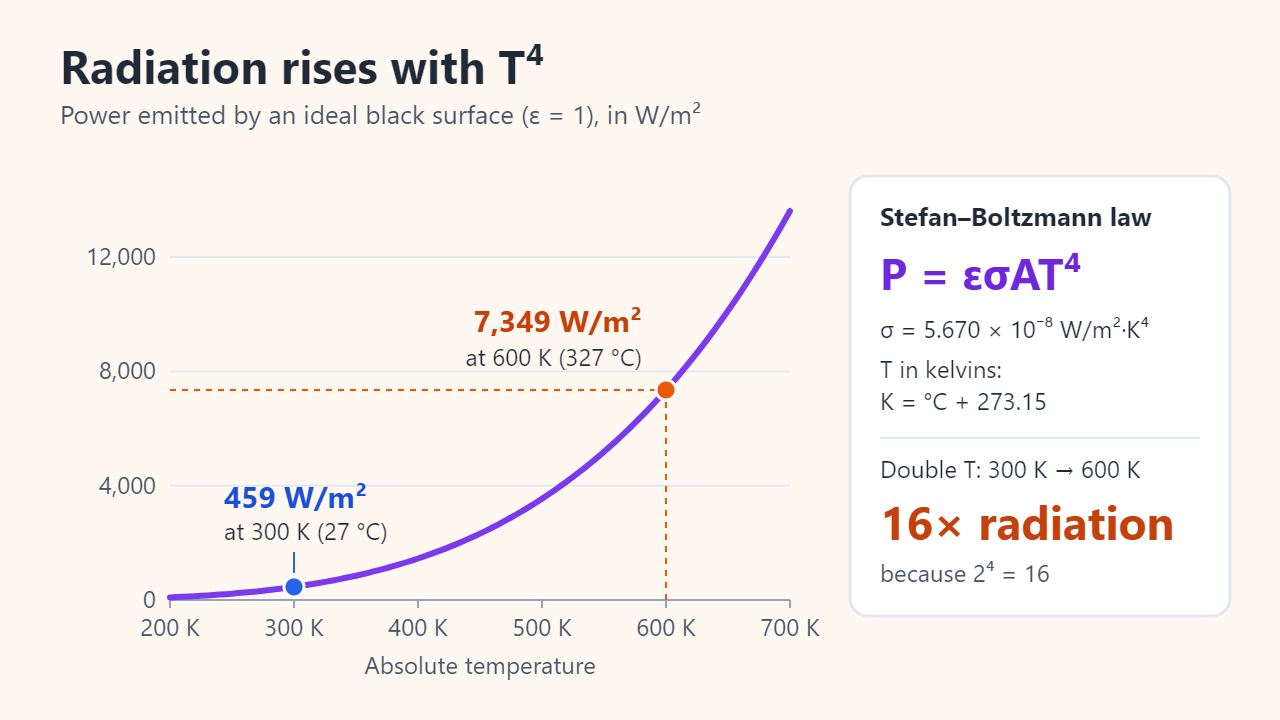
The fourth power makes radiation climb steeply. An ideal black surface at 300 K (27 °C) emits about 459 W/m²; at 600 K (327 °C) it emits about 7,349 W/m², 16 times more for twice the absolute temperature. Objects also absorb radiation from their surroundings, so the net exchange depends on both temperatures. Surface finish matters too: dark, dull surfaces absorb and emit strongly, while shiny metal reflects most of the infrared that hits it.
Conduction vs convection vs radiation at a glance
| Mode | What carries the heat | Needs a medium? | Basic rate law | Everyday example |
|---|---|---|---|---|
| Conduction | Particle collisions and free electrons inside a material | Yes: any solid, liquid or gas | P = kAΔT / L | A spoon handle heating up in hot soup |
| Convection | Bulk flow of a liquid or gas | Yes: a fluid that can move | q = hAΔT | Water circulating in a boiling pot |
| Radiation | Electromagnetic waves, mostly infrared | No: works even through a vacuum | P = εσAT⁴ | Sunlight, or the warmth on the side of you facing a campfire |
In practice the three modes usually act together; the useful question is which one dominates and which one you can block.
Everyday examples: pan, radiator and vacuum flask
A pan on the stove
- The burner heats the pan bottom by direct contact on an electric coil or ceramic top, by hot combustion gases over a gas flame, and by radiation from anything glowing.
- Conduction carries heat through the base and slowly up the handle, which is why handles are often wood, plastic or stainless steel, a metal with relatively low k.
- Convection currents rise from the hot bottom and circulate the water.
- Radiation from the burner warms a hand held beside it, even though the air there is not rising past the hand.
A radiator
Despite its name, a hot-water or steam radiator heats a room by both radiation and convection. Air warmed against the metal rises toward the ceiling, spreads out, cools and sinks, setting up a slow loop that carries a large share of the heat around the room.
A vacuum flask
The vacuum flask, first built by James Dewar in 1892, attacks all three modes at once. The near-vacuum between its double walls leaves almost no molecules to conduct or convect heat across the gap. The walls facing the gap are silvered or polished, so they reflect infrared instead of absorbing and emitting it. The stopper blocks convection and evaporation at the top.
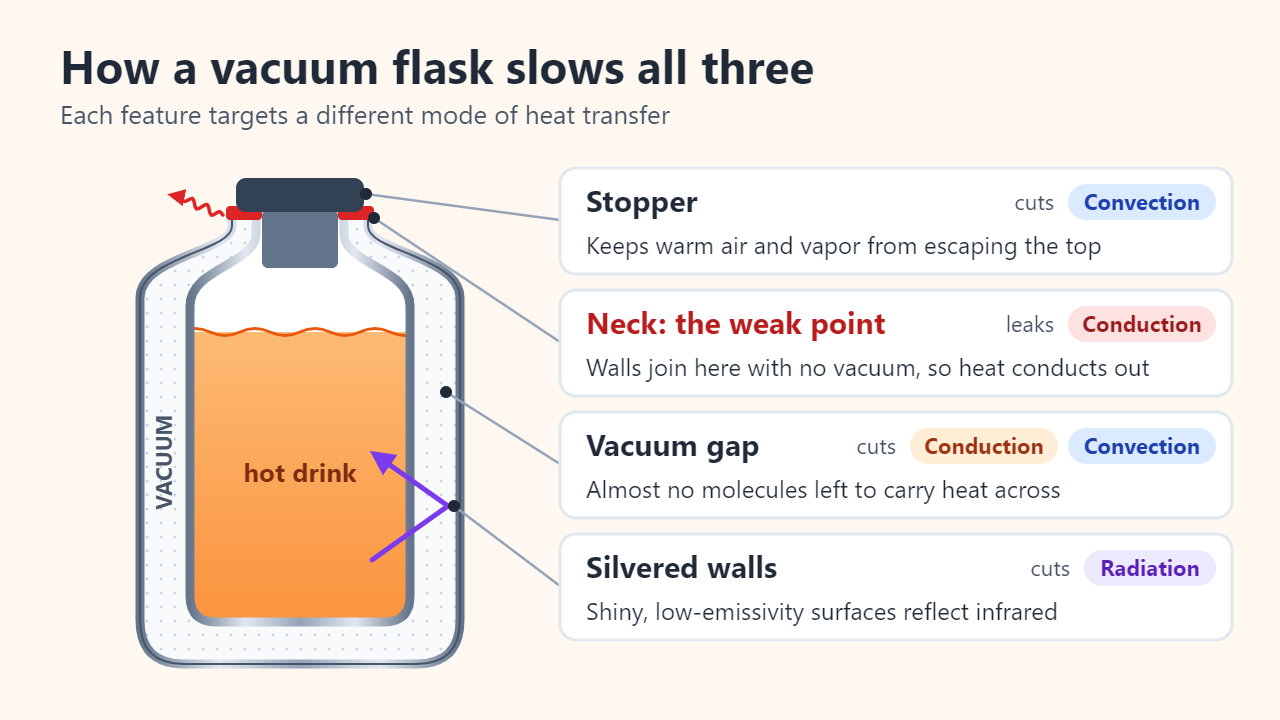
What still leaks escapes mostly through the neck and stopper, where there is no vacuum and heat can conduct. That is why a flask keeps coffee hot for hours rather than forever.
FAQ
What is the main difference between conduction and convection?
In conduction, energy moves while the material stays put. In convection, the material itself moves and carries the energy with it. Heat crosses an opaque solid only by conduction; liquids and gases can do both.
Can heat travel through a vacuum?
Only by radiation. Conduction and convection both need particles, which is why space blocks them almost completely but lets sunlight through.
Is boiling water conduction or convection?
Both. Heat conducts through the pot's base into the bottom layer of water, and convection then mixes it through the pot.
Why does a tile floor feel colder than a rug at the same temperature?
Tile conducts heat away from your skin much faster than the air-filled fibers of a rug. Your skin senses that rate of heat loss, not the floor's actual temperature.
Sources: NOAA JetStream: transfer of heat energy; OpenStax University Physics: Mechanisms of Heat Transfer; NIST CODATA value of the Stefan–Boltzmann constant; Engineering ToolBox: thermal conductivity of common materials.
Related reading
Original illustrations created to help explain this article.