The Second Law of Thermodynamics: The Inevitable Increase of Entropy
This article was translated from its source language with AI assistance. Please check technical terms and equations against the original.
Today, I would like to explain in detail the second law of thermodynamics, the increase of entropy. This topic can also be described as a fundamental tool for interpreting the world around us.
The second law of thermodynamics concerns entropy, or the disorder of a system, and is closely related to the distribution of energy within that system.
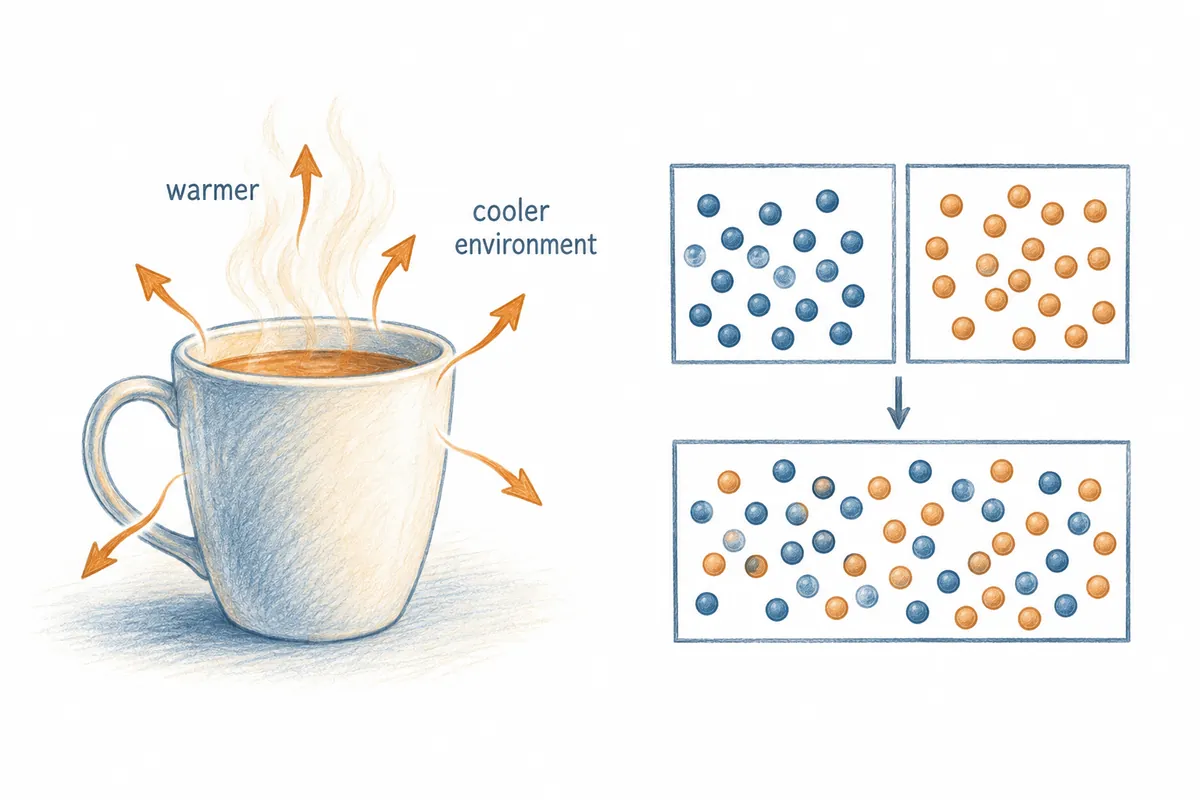
Overview of the Second Law of Thermodynamics
Whereas the first law of thermodynamics concerns conservation of energy, the second concerns its conversion and dispersal. Simply put, the second law says that when energy changes from one form to another, it spreads and disperses, and entropy increases in the process.
The Natural Flow of Entropy
In general, systems naturally move toward a high-entropy state, or a disordered state. For example, when cooled coffee and hot milk are mixed, the components are initially distinguishable. Over time, however, they mix and acquire a uniform temperature and properties. This is an example of increasing entropy.
Once the two components are completely mixed, returning them to their original state is practically impossible.
The Thermodynamic Arrow and the Arrow of Time
One important aspect of this law is the thermodynamic arrow, or Time's Arrow. This expresses in physics the concept that time flows in only one direction. As entropy increases, a system changes as time progresses, matching the sequence of time we experience.
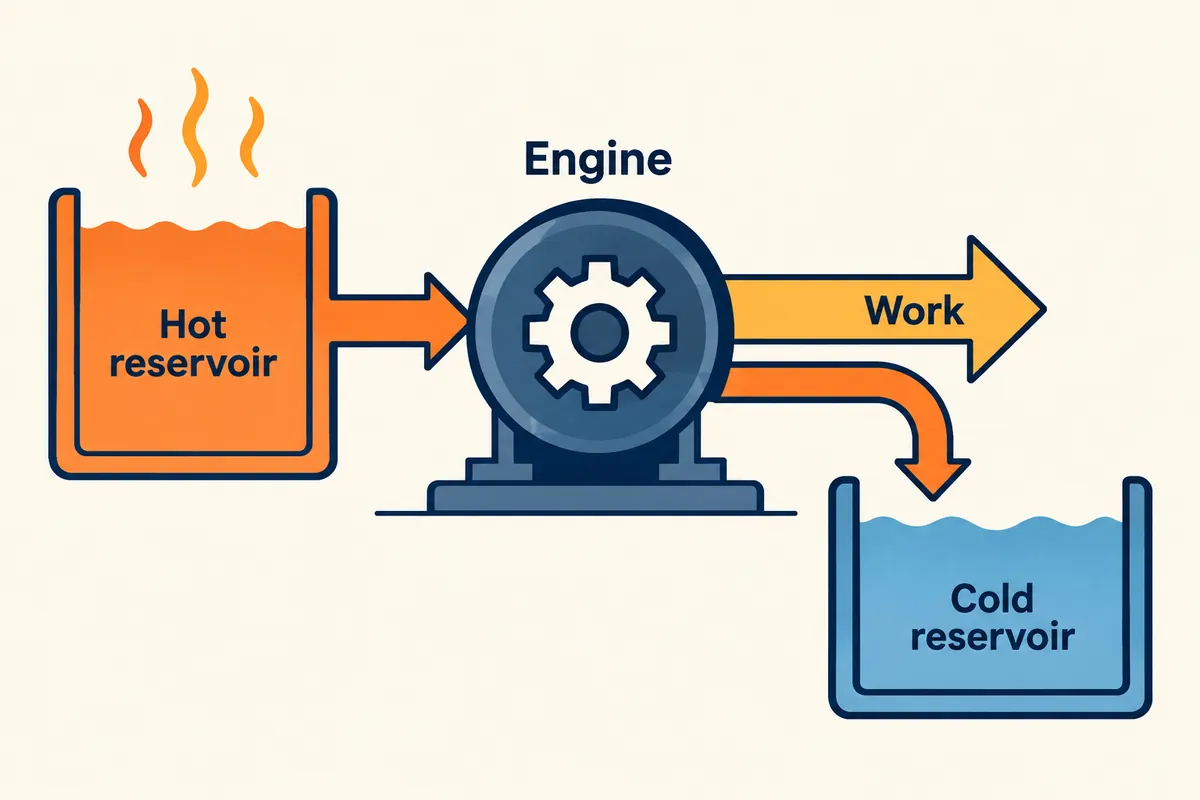
Energy Efficiency and the Second Law
The second law is also closely related to energy efficiency. Some energy disperses whenever energy is converted, explaining why a system's energy efficiency cannot always be 100%. For example, a heat engine producing a given amount of heat also disperses heat into its surroundings and cannot achieve perfect energy conversion.
Increasing Entropy and the Future
Increasing entropy means that more and more energy is converted into lower-grade forms and ultimately becomes unavailable for use. This could lead to a state called heat death: a final stage in which all energy is distributed uniformly and no further work can occur. However, this concerns an extremely long-term perspective and is not an immediate issue we need to worry about today.
Today, through the second law of thermodynamics, we have examined why entropy increases and examples of it in our everyday lives.
Thank you for reading.
Original illustrations created to help explain this article.
Original on Tistory ↗