The First Law of Thermodynamics: The Principle of Energy Conservation
This article was translated from its source language with AI assistance. Please check technical terms and equations against the original.
Today, we will learn about the first law of thermodynamics.

First, What Is the First Law of Thermodynamics?
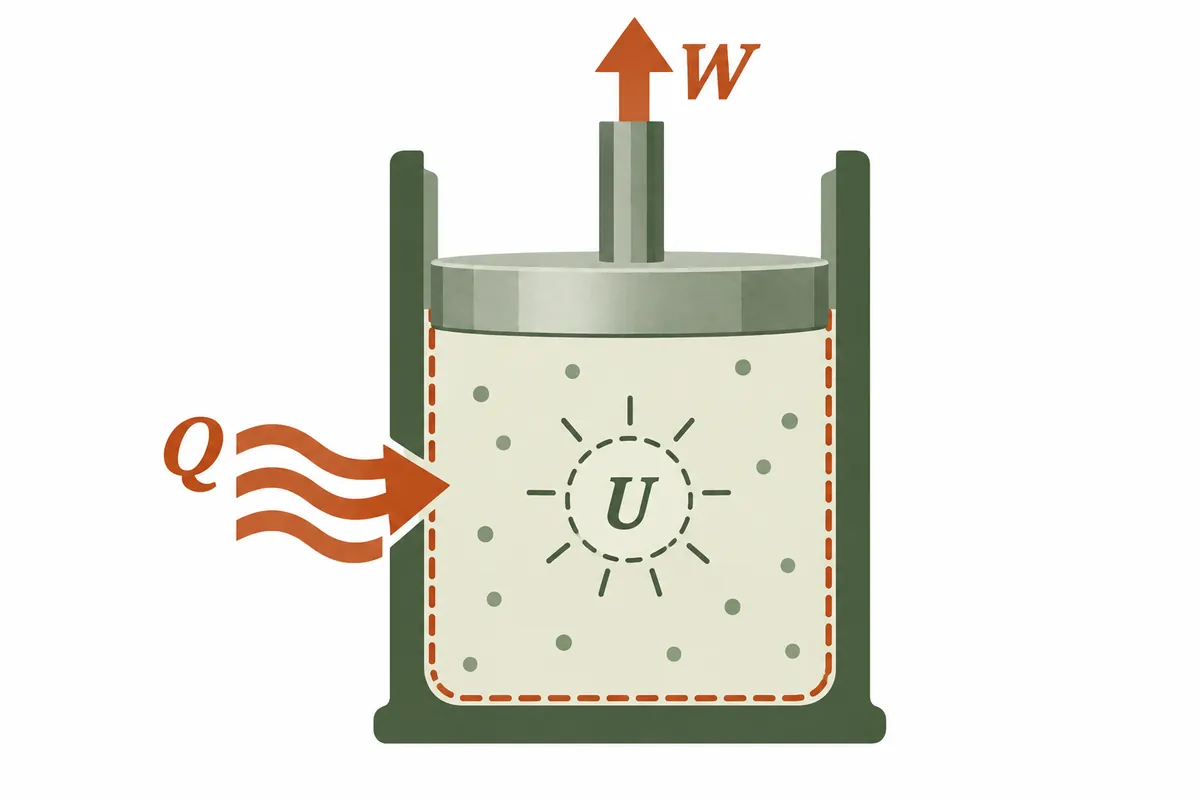
One of the fundamental principles of thermodynamics is the first law, the law of conservation of energy. It is based on energy conservation, one of the most important concepts in physics. Simply put, energy cannot be created or destroyed; it can only be converted from one form to another. Mathematically, this can be expressed as follows:
Etotal = KEsystem + PEsystem + Usystem
Here,
Etotal is the total energy of the system,
KEsystem is the kinetic energy of the system,
PEsystem is the potential energy of the system,
and Usystem is the internal energy of the system. Work is the process of transferring energy to a system through macroscopic mechanical forces acting between the system and its surroundings.
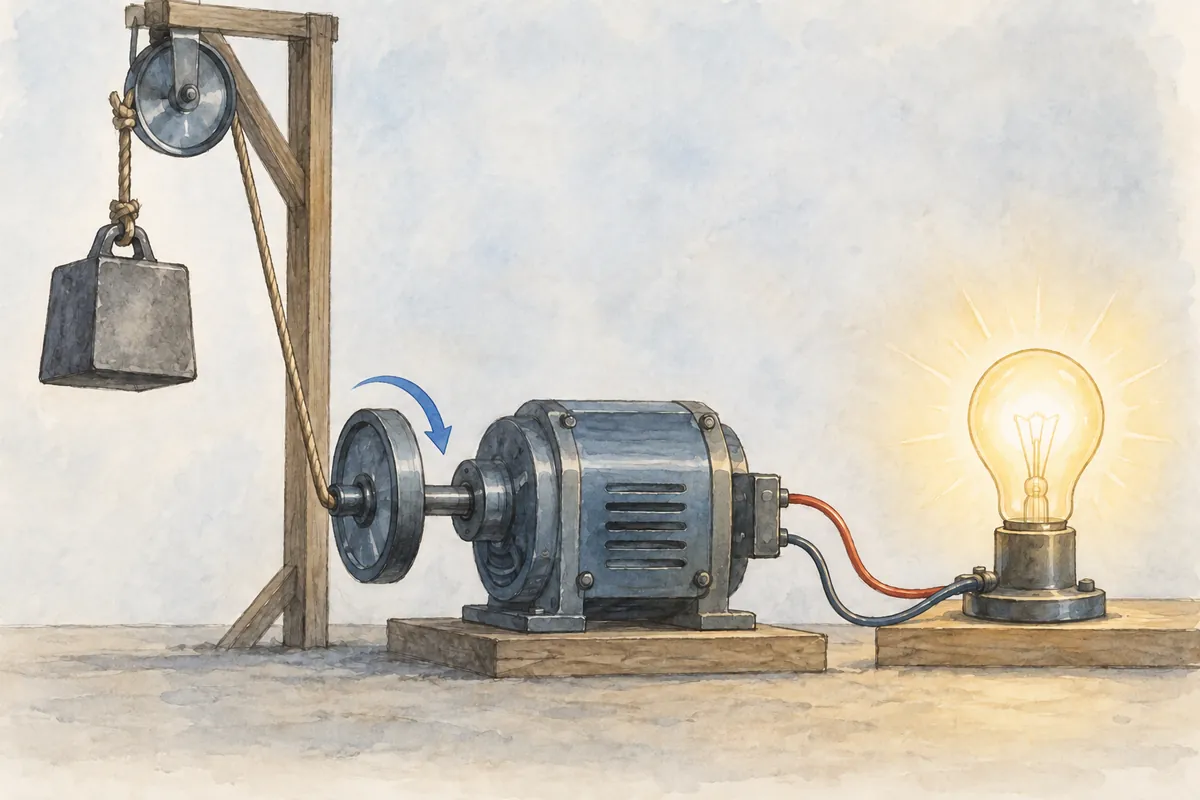
For example, when a machine lifts a system upward, energy is transferred from the machine to the system. The system's energy increases, and this increase appears as an increase in gravitational potential energy. Work added to the system increases its potential energy.
When matter is transferred into a system, its associated internal and potential energy are also transferred into the newly combined system:
(uΔM)in = ΔUsystem
Here,
u is the internal energy per unit mass measured in the surroundings,
and ΔM is the amount of mass transferred.
The flow of heat is a form of energy transfer. Heat transfer is the natural process of moving energy into or out of a system, excluding work or the transfer of matter. In an adiabatic system, internal energy can be changed only through energy transfer as heat (that is, it is not affected by external heat):
ΔUsystem = Q
Combining these principles leads to the following traditional statement of the first law of thermodynamics:
A machine cannot continue operating forever without a corresponding input of energy. More simply, a perpetual motion machine of the first kind cannot be created.
The first law of thermodynamics is essential for understanding countless phenomena in our lives and is used in various scientific and engineering fields.
That concludes this introduction to the first law of thermodynamics.
Thank you!
Original illustrations created to help explain this article.
Original on Tistory ↗