College Physics (Engineering Physics) #004: Instantaneous Velocity and Acceleration
This article was translated from its source language with AI assistance. Please check technical terms and equations against the original.
What Is Instantaneous Velocity??
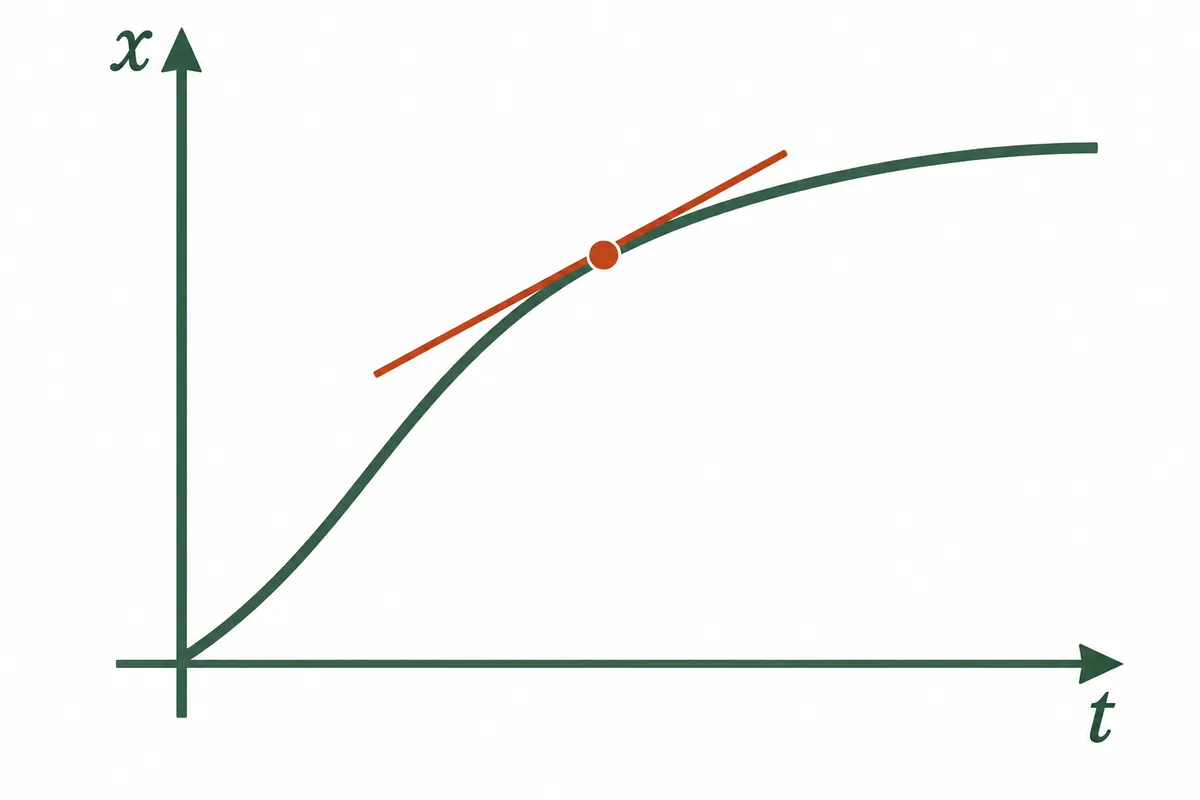
'Instantaneous velocity' indicates an object's velocity at a particular instant.. It describes how fast the object moves at one moment, and is calculated as displacement divided by an infinitesimal time interval.. On a position–-time graph, it is the tangent slope at a particular point.. Also,, in physics it is calculated using 'derivatives(derivative)'..
Instantaneous-Velocity Formula
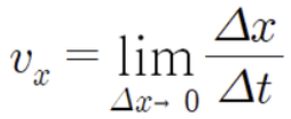
Here Δx is the displacement difference and Δt the time difference. This equation can be represented by the following graph.
Why Instantaneous Velocity Matters
It is needed for precise understanding of dynamic states,, and matters greatly in everyday life, science, and engineering.. It is used when vehicles must stop urgently, in calculating acceleration at rocket launch,, in analyzing complex machinery, and in analyzing communication-signal transmission speeds..
Example of Instantaneous Velocity
Think about driving.. The speedometer always shows instantaneous speed.. For example,, if you drive on a highway at 100km/h,, your car at that moment is moving at 100km per hour.. If the speedometer indicates 80km/h,, its current speed has changed to 80km per hour..
What Is Acceleration??
Acceleration is velocity change per unit time.. It is expressed in terms of velocity change and time;, positive acceleration indicates increasing velocity,, while negative acceleration indicates decreasing velocity.. In the International System of Units,(SI)the acceleration unit is 'meters per second squared'(m/s²)..

Acceleration Formula
Like velocity, acceleration has average and instantaneous forms. The following gives average acceleration.

Here Δv is velocity difference and Δt time difference.
The instantaneous-acceleration equation follows.

Velocity is position differentiated with respect to time, and acceleration is velocity differentiated with respect to time. Thus acceleration is the second time derivative of position.
Why Acceleration Matters
From everyday life to science, and engineering, acceleration is important in many fields.. It applies when buses start or stop,, sports cars accelerate,, and spacecraft launch,, playing a crucial role in better design and safer operation..
Example of Acceleration
Consider a car starting from a traffic light.. As it begins moving,, its speed gradually increases.. In this case,, the car has positive acceleration.. If it accelerates at 2m/s per second,, its speed increases by 2m/s each second.. Thus,, a car initially at rest 1after this many seconds moves at 2m/s,, 2and after this many seconds 4m/smoves at the stated speed..
Conversely,, when the driver brakes to reduce speed,, the car has negative acceleration,(or deceleration).. Here,, the amount of speed reduction determines acceleration.. For example,, if the car decelerates at -3m/s per second,, its speed decreases by 3m/s each second..
Original illustrations created to help explain this article.
Original on Tistory ↗