College Physics (Engineering Physics) #003: Vectors and Scalars, Position, Distance and Displacement, Average Velocity and Speed
This article was translated from its source language with AI assistance. Please check technical terms and equations against the original.
Vectors(Vector)and Scalars:(Scalar)The Concepts
When expressing physical quantities,, distinguish vectors from scalars.. Vectors possess magnitude(magnitude)and direction(direction),, while scalars have magnitude alone without direction.. For example,, displacement is a vector and requires direction,, while distance is a scalar expressed by a numerical value without direction..

1Dimensional Motion and Vector Direction
This chapter deals with 1dimensional motion,, meaning an object moves along a straight path.. In this case, vector direction can use positive(+)and negative(-)signs.. For example,, if rightward horizontal motion is positive,, objects moving right have positive displacement(Δx >= 0),, and objects moving left have negative displacement(Δx <= 0)..
Position, Distance, and Displacement
Position(Position)
Position tells where a particle exists in space at a particular time.. For convenience,, choose a reference point and describe position by relative distance from it.. For example,, if a car is 30 meters from a road sign,, its position can be expressed as 'x = 30m'..
Displacement(Displacement): Understanding Changes in Position
Displacement means a change in position.. In other words,, it is a vector expressing how an object moves over time.. Mathematically it is defined as ‘final position(xf) - initial position(xi)’.. This important quantity describes how far and in which direction an object moves during a period..
Distance(Distance)
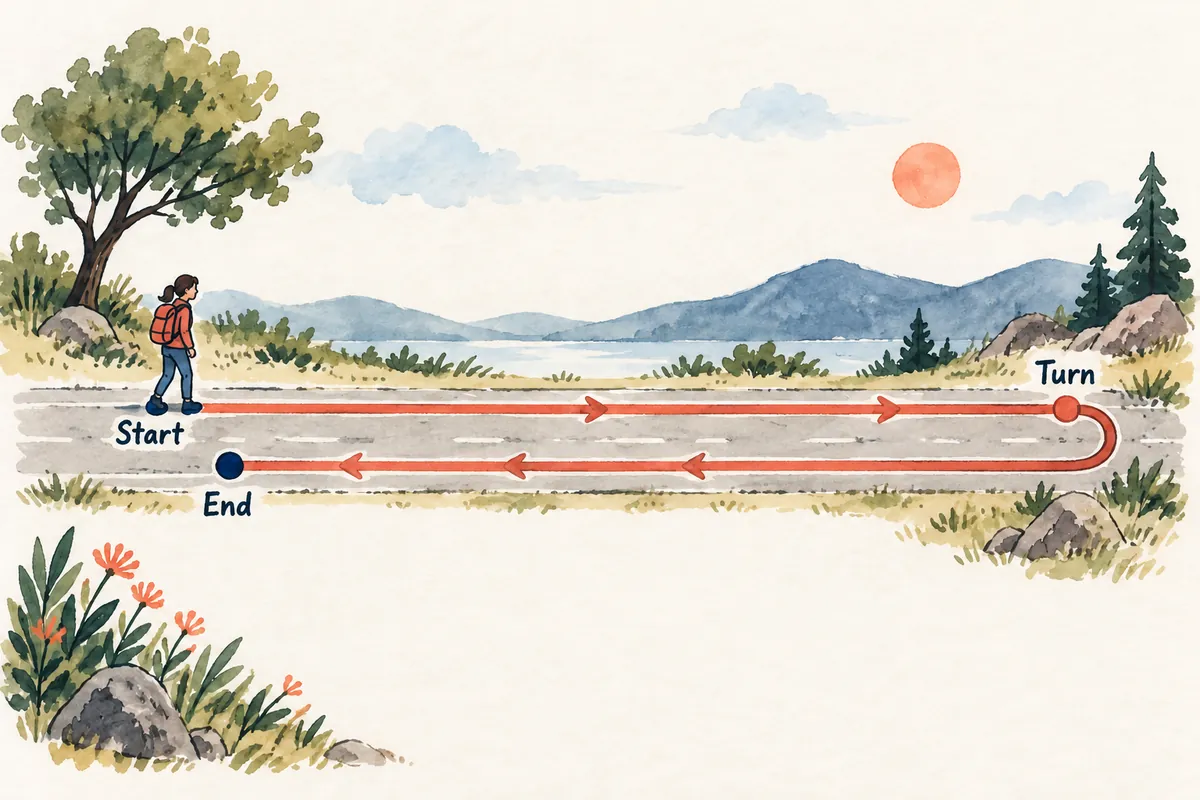
Distance means the total length of the actual traveled path.. It is a scalar,, possessing magnitude without direction,, and expresses the actual ‘length’traveled.. For example,, if a basketball player completes one lap of the court,, displacement may be 0,, while actual traveled distance is the court's perimeter..
Distinguishing Displacement and Distance: What Differs??
These are easily confused,, but must be distinguished for accurate physical understanding.. Displacement includes direction,, whereas distance considers only traveled length.. In other words,, distance measures the path traveled,, while displacement gives the straight-line separation of start and end..
Displacement Includes Direction
Displacement represents straight-line separation of final and initial positions,, but can be positive or negative depending on direction.. For example,, if a player moving from their basket to the opposite basket has positive displacement(+ 21m),, motion in reverse has negative displacement(- 21m)..
Distance Is Always Positive
Distance, by contrast, expresses only path length,, and is always positive.. Thus the player's full round-trip distance is 42m.. This reflects a scalar always having a positive value regardless of travel direction..
Average Velocity and Average Speed
What Is Average Velocity in Physics??
In physics, 'average velocity(average velocity)'is position change during a given time,(or displacement,)divided by time.. SI Its unit in the unit system is 'meters/per second(m/s)',, and it is expressed as follows.:
Vavg=Δx/Δt
Here, Δx is displacement and Δt the time interval.
Understanding Average Velocity Through Graphs
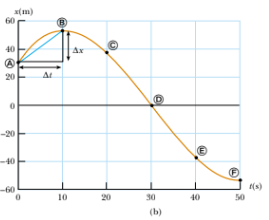
Position–time graphs created with Excel or other analysis programs make average velocity intuitive. The slope of a straight line connecting two graph points represents their interval's average velocity.
For example, the slope between position x1 at t1 and position x2 at t2 gives average velocity vavg for that period.
Direction of Average Velocity
Average velocity has the object's motion direction. Positive displacement, such as moving right from the initial position, gives positive average velocity. Negative displacement, such as moving left, gives negative average velocity.
Interpreting an Average-Velocity Example
Understand it from a position–time graph. Average velocity over an interval is the slope of the straight line joining its endpoints, representing the shortest path. This is displacement Δx divided by time interval Δt. For motion from A to B in Figure 1, it is:
vavg=Δx/Δt=(x2-x1)/(t2-t1)=(50m-30m)/(10s-0s)=2m/s
In this case,, the vehicle moves in the positive direction and its velocity value is positive..
Distinguishing Velocity and Speed
Everyday language uses 'velocity'and 'speed'similarly,, but physics distinguishes them greatly.. 'Velocity(velocity)'is a vector with direction,, 'while speed(speed)'is a scalar without direction.. This lets us consider direction as well as traveled distance..
For example,, if a marathon runner travels 40 kmand returns to the start,, total displacement is 0and average velocity is also 0.. Average speed, however, is total distance divided by total time,, indicating how 'fast' the runner traveled..
Velocity Versus Speed: Example
Imagine walking along a long airport corridor toward your gate.. 45For this many seconds, 100myou walk the stated distance, then realize you missed the restroom and return 25mover the stated distance 10in the stated time.. Total traveled distance is 125m, and total elapsed time is 55seconds.. Average velocity and speed follow.:

Average velocity accounts for direction,, whereas average speed reflects distance and time alone..
Original illustrations created to help explain this article.
Original on Tistory ↗