2026 Nobel Prize Announcement Schedule: Physics, Chemistry, and Economic Sciences in Korean Time and Checking Official Results
This article was translated from its source language with AI assistance. Please check technical terms and equations against the original.
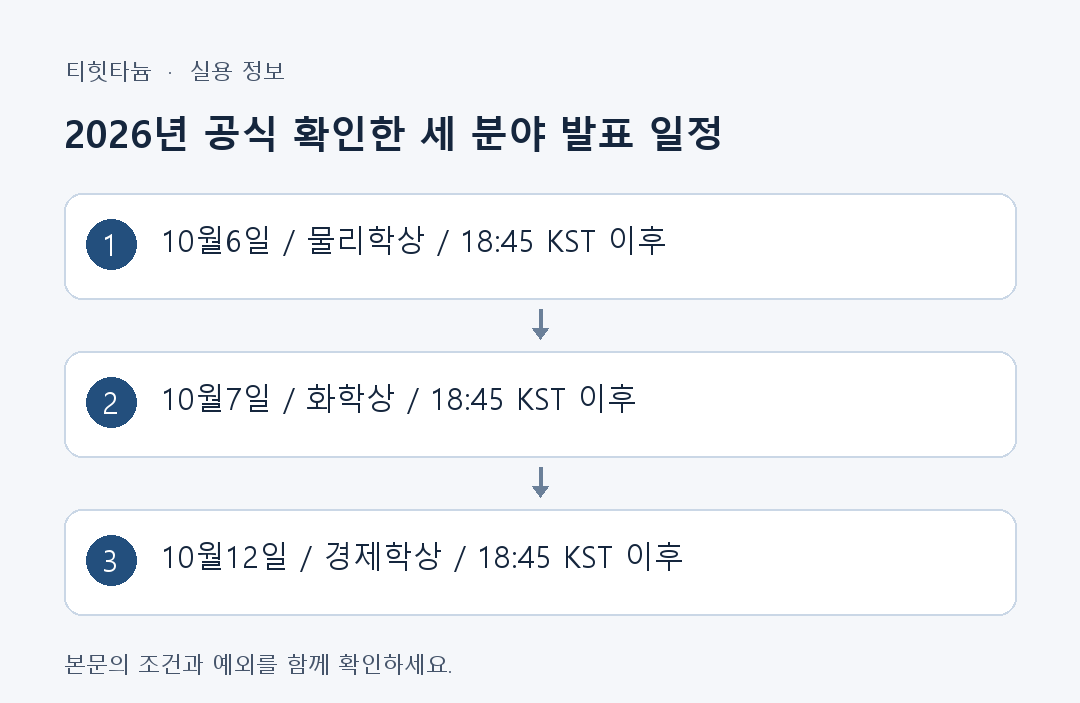
When reading 2026 Nobel Prize news, first distinguish predictions from official announcements. As of October 3, laureates' names cannot be determined in advance. This article converts the Royal Swedish Academy of Sciences' officially announced Physics, Chemistry, and Economic Sciences schedules to Korean time and explains how to verify names and award citations after announcements.
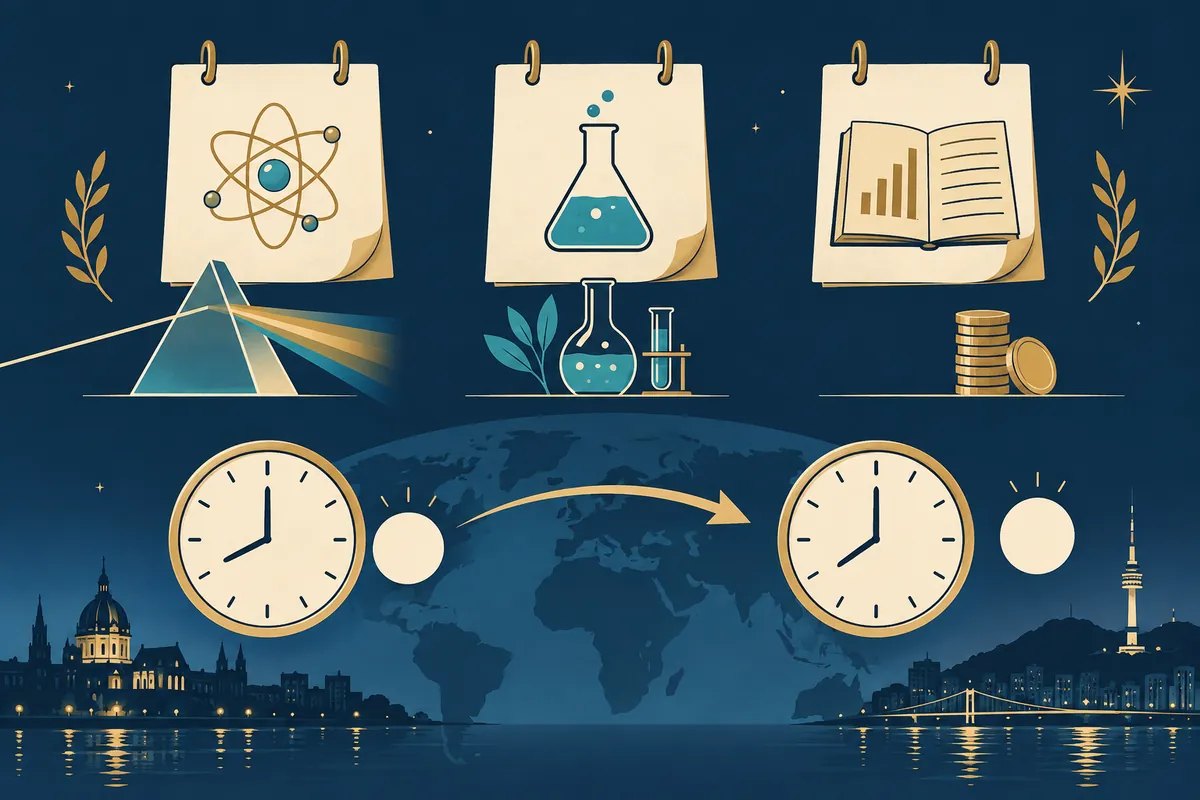
Schedules for these three fields were checked in the official notice below. Physiology or Medicine, Literature, and Peace have separate announcing institutions, so their times were not guessed from these. Check other fields through the official Nobel Prize website and latest institutional notices. Times here are the earliest scheduled announcement times, not guaranteed livestream starts or actual announcement completion times.
1. Three officially checked 2026 schedules
The Academy's February 2, 2026 notice lists Physics on Tuesday, October 6, Chemistry on Wednesday, October 7, and Economic Sciences on Monday, October 12. Each announcement is listed as no earlier than 11:45 local CEST. Do not reinterpret “earliest” as a guarantee of announcement at that exact minute. Actual timing can vary with proceedings and decisions.
CEST is UTC+2 and Korean Standard Time, KST, is UTC+9, a seven-hour difference. Thus 11:45 CEST in this notice corresponds to 6:45 p.m. Korean time on the same date. European time notation can change seasonally between CET and CEST; when converting events on other dates, check the stated zone rather than reusing this difference.
| Field | 2026 announcement date | Official local time | Converted Korean time |
| Physics | Tuesday, October 6 | No earlier than 11:45 CEST | No earlier than October 6, 18:45 KST |
| Chemistry | Wednesday, October 7 | No earlier than 11:45 CEST | No earlier than October 7, 18:45 KST |
| Economic Sciences | Monday, October 12 | No earlier than 11:45 CEST | No earlier than October 12, 18:45 KST |
Korean times in the table are arithmetic conversions of the zone in the official notice. If a subsequent change notice appears, the latest guidance takes precedence. Source:Academy's 2026 announcement schedule notice.
2. What to record in a phone calendar
If adding the schedule, include the year and field in a title such as “Check official 2026 Physics announcement.” Note that 6:45 p.m. is converted Korean time and retain the original no-earlier-than-11:45 CEST time and official link. This reduces confusion when checking changes or sharing times with people overseas.
Setting an alert shortly before the scheduled time is a personal preparation method. An alert does not establish confirmed results; wait if the official page has not updated. If a livestream shows a waiting screen or earlier video, check title, year, and posting date to establish whether it is the current event.
Imagine a hypothetical Korean reader opening the page at 6:30 p.m. If the screen shows 2025 laureates, it may be displaying last year's material. Do not copy it as 2026 results; check that “2026,” the field, and announcement date match. A familiar name does not establish the current laureate.
3. On announcement day, start with the official original rather than search results
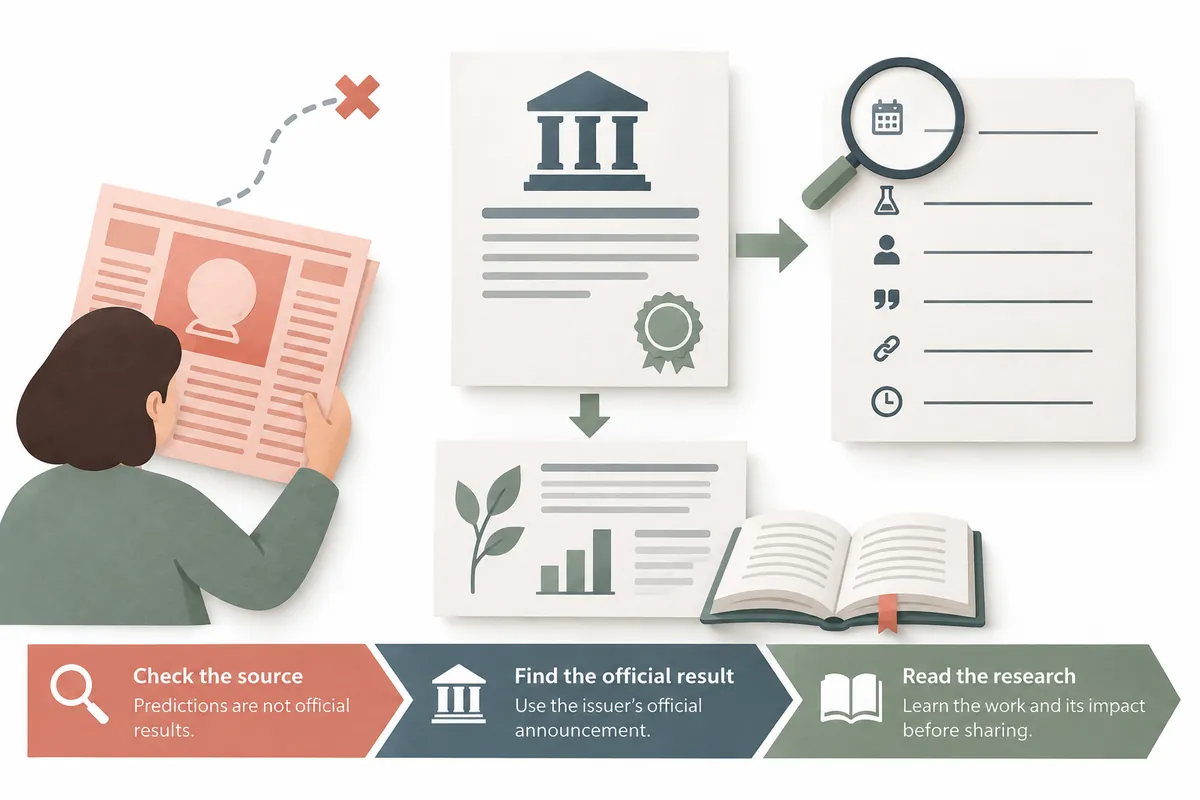
The Academy says announcements can be checked on its website and the official Nobel Prize site. Open the institution's official press release and verify field, year, names in their original spelling, and award citation. Search headlines or social screenshots can mix predictions, old material, and typos. Clicking the link and reading the body is a necessary step.
If Korean name spellings vary across outlets, retaining original spelling helps identification. State affiliations within the announcement's scope, remembering current affiliations may differ from those during the principal research. Begin with officially checked essentials rather than adding unverified education or career details.
When translating an award citation, summarize concisely while preserving technical scope. An award for a new measurement method does not immediately mean improved performance in every industry. Theoretical discovery, experimental observation, device implementation, and practical application are related but different stages. Look up unfamiliar terms in official popular explanations.
| Item to verify | First source | Common mistake |
| Award status | Official press release for the year and field | Presenting a prediction list as confirmed laureates |
| Laureate names | Original spelling and official biographies | Treating namesakes or transliteration differences as different people |
| Award citation | Official announcement and popular explanation | Expanding a research contribution into product efficacy |
| Research content | References and original papers linked in official explanations | Claiming detailed experiments were checked after reading only a press release |
| Event time | Zone and no-earlier-than condition in the latest notice | Reading CEST as CET or presenting an exact guaranteed time |
4. An accessible reading sequence for prize-winning research
After reading the announcement, summarize it in three sentences: the question the research sought to answer, how it differed from previous approaches, and confirmed results plus remaining limits. This helps explain importance more than memorizing laureates' names. With many unfamiliar concepts, start with terms directly in the citation rather than explaining everything at once.
The Academy also provides Nobel research posters. Understand the overview through popular materials before moving to detailed explanations and references. In diagrams, check what objects and processes are represented and whether arrows indicate sequence or causation. Explanatory illustrations and actual observational images differ, so read captions too.
Words such as “groundbreaking” and “revolutionary” in science articles do not answer what changes in your life. Basic discoveries may require additional research, manufacturing, validation, and economic viability before applications. This article does not invent product release dates or profit forecasts absent from announcements. Understanding concepts and making investment decisions are different tasks.
5. Notes distinguishing predictions from confirmed announcements
Assign states to materials such as “schedule notice,” “award prediction,” “official award announcement,” and “research explanation.” Schedules tell you when announcements are planned; prediction articles describe likely candidates. Only the official award announcement directly confirms that year's field results. Commentary helps understanding but does not replace the original confirmed record.
Before announcements, you can read about a particular researcher and field as an introduction to their research. State that award status is unconfirmed and consult papers and institutional profiles. Research explanations can remain valuable even if results differ from predictions. Avoid prematurely using the definitive term “laureate” in titles or text.
Keep change history for articles needing updates, for example “October 3: schedule checked” and “After announcement: laureates added following official verification.” Do not mark the second step complete before an announcement exists. Check times help readers distinguish old predictions from latest results.
6. A short format for sharing news accurately
Include year and field, original laureate names, summary of the official citation, source link, and check time. Leave unverified items blank or marked unverified. Rather than transcribing everything in lengthy prose, link readers to key evidence. Check usage conditions before copying original photographs and explanations verbatim.
A hypothetical sharing sentence could say, “I checked the 2026 [field] results in the institution's official announcement. The citation recognizes a contribution to [research]. Detailed explanations are available in official popular materials.” This illustrates structure, not an announcement with actual laureates or research filled in. Replace placeholders only after a verified announcement.
While waiting, save the schedule and original links; afterward, check original names and citations first. Accurate news consumption begins with recording which announcement you checked and when, more than being the first to share a name. These methods remain useful for next year's announcements or other science awards.
Official sources and scope of verification
- Royal Swedish Academy of Sciences: 2026 announcement schedule
- Royal Swedish Academy of Sciences: Physics and Chemistry prize introductions
- Royal Swedish Academy of Sciences: Nobel Posters
Sources checked: October 3, 2026. An informational guide written by AI after reviewing official materials. Hypothetical cases and calculation examples are not actual user records or experimental results. Screens, service conditions, and announcements can change.
Original illustrations created to help explain this article.
Original on Tistory ↗