Before Drawing Conclusions from a Paper Title and Abstract: Checking Methods, Figures, and Limitations
This article was translated from its source language with AI assistance. Please check technical terms and equations against the original.
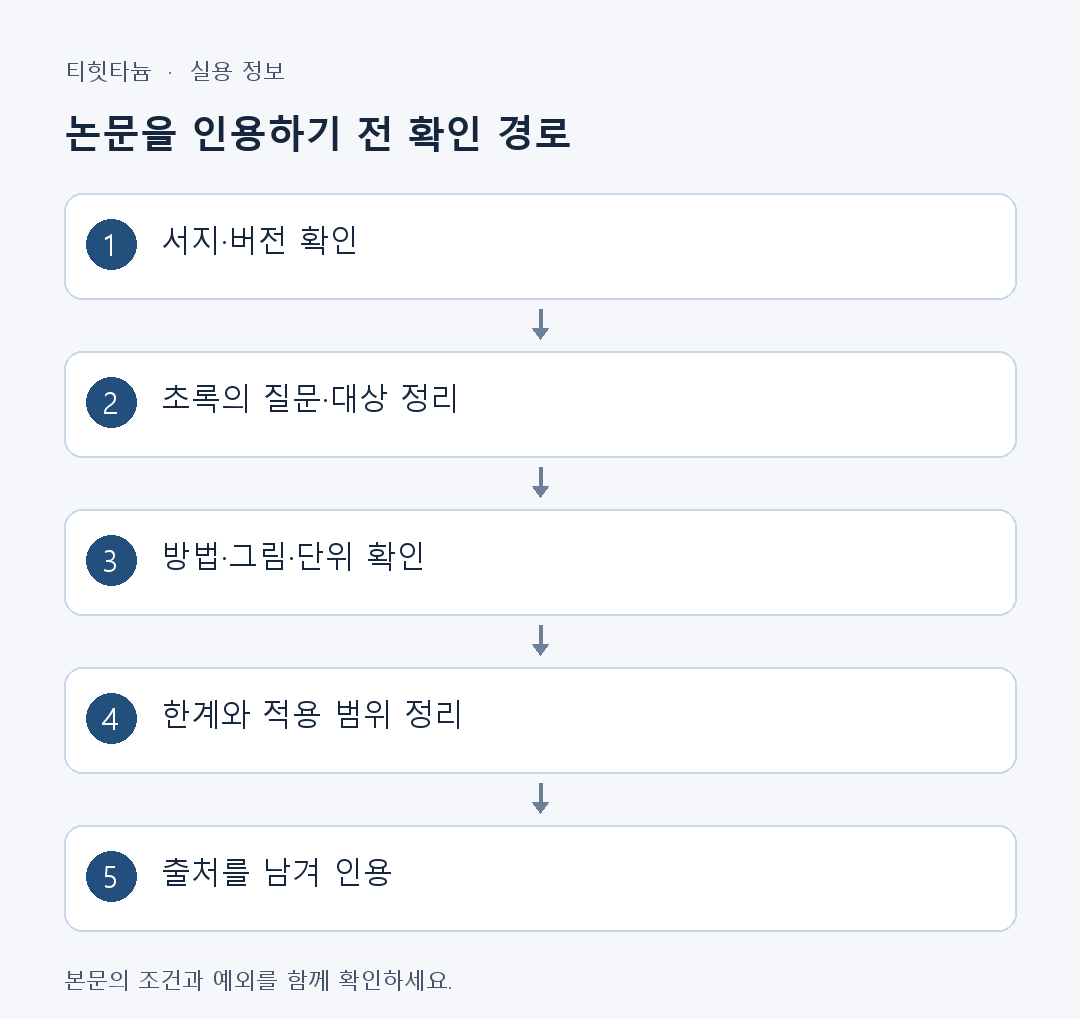
A title saying “improved effectiveness” can make readers expect the same effect in their own situation. But titles and abstracts are entry points for choosing research; actual applicability is determined by methods, results, and limitations. When citing papers in reports or blogs, include what was tested, under which conditions, and against what comparison rather than copying only conclusions.
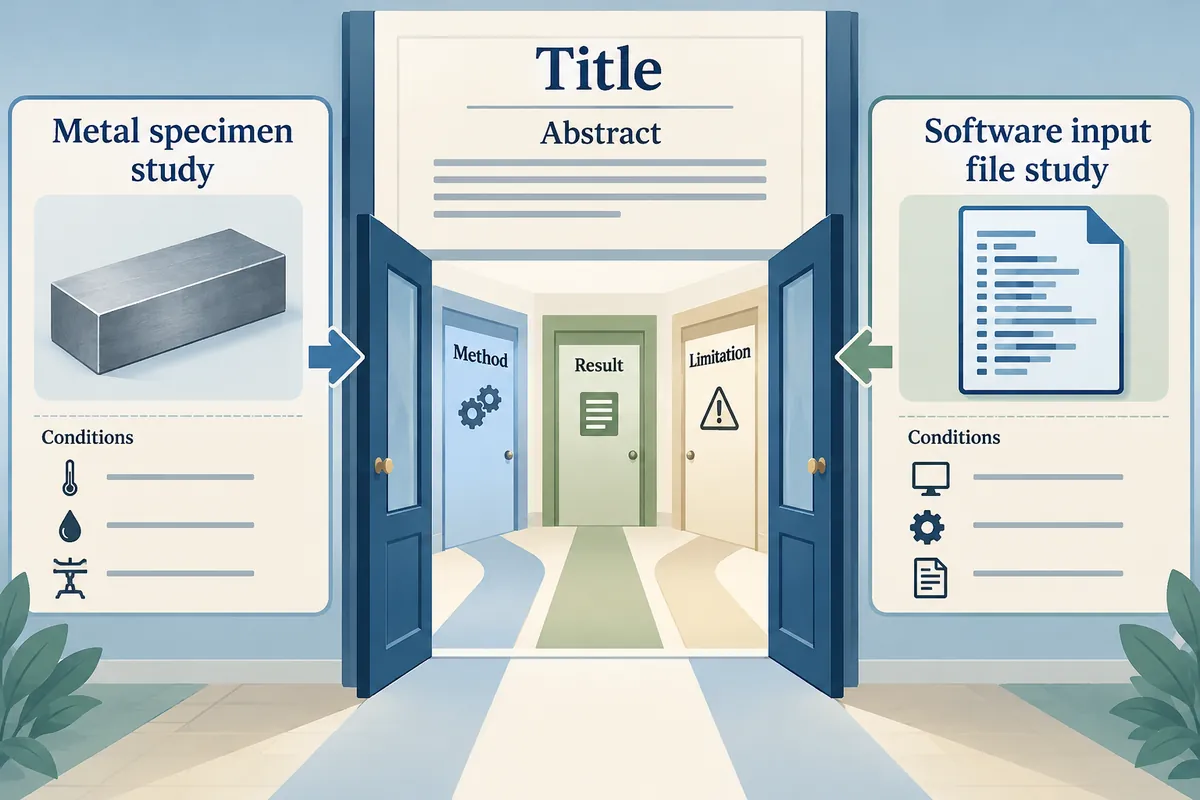
This article does not determine the validity of a particular paper. It provides a reading procedure to classify unfamiliar research quickly and avoid claims beyond the scope read, with hypothetical cases and record templates usable for materials experiments, software comparisons, and educational surveys.
1. Record the paper's identity first
Note title, authors, publication year, journal or repository, and DOI. Online PDF names and search titles may differ from the document title. Where possible, compare title, authors, and publication information on the publisher page linked by the DOI. Crossref search can help locate papers and check bibliography. A DOI alone does not make results correct.
Repeated search entries with the same title are not necessarily separate papers: they may be preprints, final versions, or revisions. Record which version you are reading and whether supplementary material exists. Check later corrections or retraction notices on the publisher page before deciding to cite.
State your reading purpose in one sentence. “Check A versus B for document conversion I frequently perform” is more focused than “Is laptop A faster for every task?” This provides criteria for distinguishing experiments directly addressing your task from figures taken from other tasks.
2. The title is a search cue; the abstract is a research map
NCCIH's reading guidance advises checking purpose, methods, results, and interpretation in the abstract. Write each on a separate line. Distinguishing what was investigated, what was done to which targets, observed results, and the authors' explanation reveals the conclusion's scope.
Consider the hypothetical title “Improved strength of metal specimens after heat treatment.” It does not yet reveal metal type, temperature, duration, or strength test method. You cannot conclude that every metal gains the same effect. Preserve any specified alloy and conditions in the abstract and seek detailed procedures in Methods.
Mark terms such as “significant difference,” “improvement,” and “potential” separately. Statistical distinction is not the same as a major practical benefit. Costs, speed, failure rates, effect size, and uncertainty help determine relevance to your purpose. If absent from the abstract, leave blanks and look in the text.
| Reading location | Question to check | Example note |
| Title and bibliography | Is this my topic, and which version is it? | Specific heat treatment of alloy A, final published version |
| Abstract | What targets, comparison, and measurements? | Tensile tests comparing treated and reference groups |
| Methods | Is there information to repeat the same conditions? | Specimen count, direction, temperature, equipment, and procedure |
| Results | Actual measurements and uncertainty? | Check axes, error bars, and table units |
| Discussion and limitations | How far can results apply? | Other alloys and long-term use remain unverified |
3. Read methods to assess distance from your situation
Find target selection, comparison group, replication count, and measurement procedure. Whether a “sample” means people, objects, or repeated measurements of the same data matters. Confusing repeated readings of one specimen with independent specimen count can exaggerate evidence. Define unfamiliar terms and leave unresolved parts pending judgment.
In materials experiments, composition, manufacturing, specimen geometry, test temperature, loading rate, and measurement direction can affect comparisons. For software, hardware, versions, inputs, network, caching, and execution count serve similar roles. Do not invent missing conditions; write “not reported.” Missing information itself limits interpretation.
Record study conditions and your intended conditions in two columns. They need not all match for a paper to be valuable. If differences are substantial, however, use it to understand concepts or hypotheses rather than as a direct guarantee. Purchases or important practical decisions may require additional evidence for your conditions.
4. Common omissions when reading figures and tables first
Read axes and legends before figure titles. Check whether horizontal change represents time or temperature and whether the vertical axis is an absolute value or change rate. A nonzero axis origin can make small differences look large, so read numbers directly. Read captions for colors and symbols, sample size, and meanings of error bars.
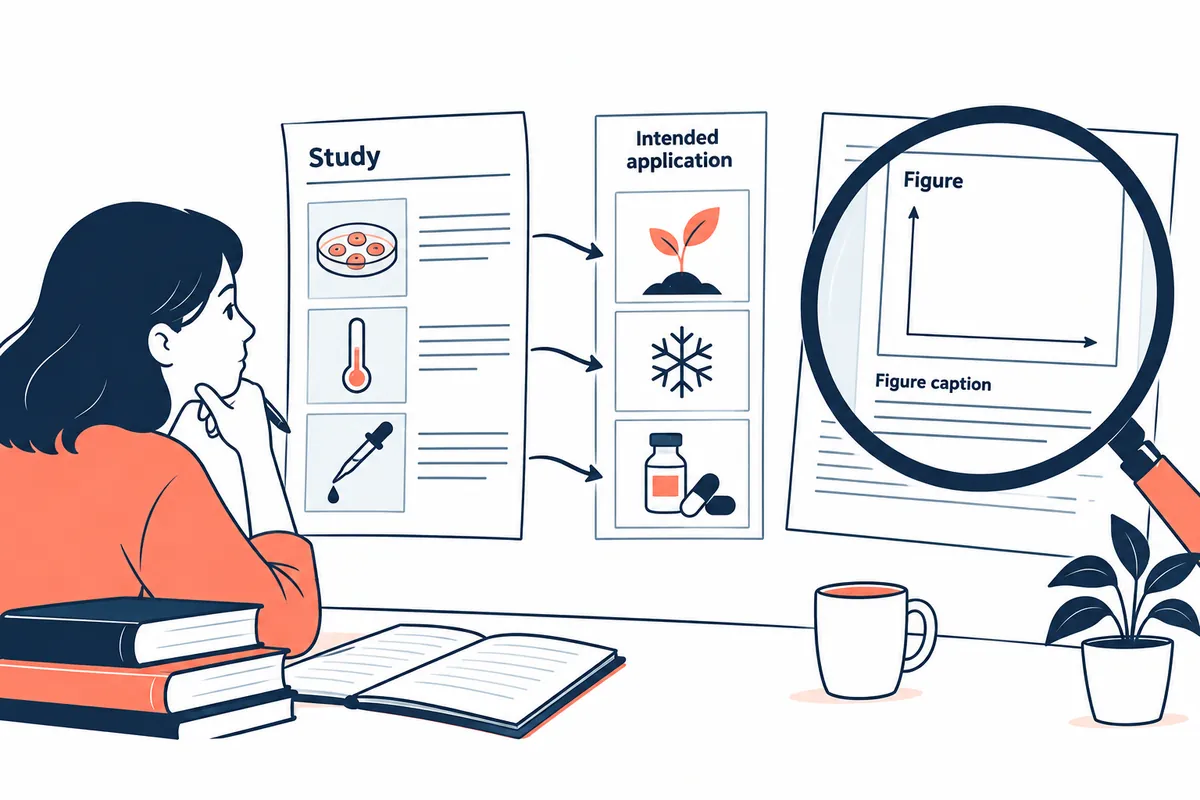
If units appear only in table headings, carry them over when copying cells. In “mean ± value,” the latter means different things if it is standard deviation, standard error, or a confidence interval. Do not call it standard deviation without explanation. When merging tables across papers, note differing conditions to show direct-comparison limits.
Suppose hypothetical processing times are 10 and 8 seconds. These alone do not establish that the second program is always 20% faster. Check inputs, whether failed runs were excluded, and variability. If completion time falls but output accuracy worsens, reconsider whether this improves the original purpose.
5. Record results and authors' interpretations in separate sentences
Result notes describe observations, such as “In an illustrative hypothetical experiment, mean processing time under A was shorter than B.” Interpretation notes record why the authors explain the difference. Separating them avoids presenting explanation as directly proven fact. Check competing explanations in Discussion and references.
Look for limitations in sample scope, duration, insufficient comparisons, measurement error, and selection bias. Authors' stated limitations may not be exhaustive; add missing conditions relevant to your use. Good short-term results may not establish long-term durability, security, or maintenance costs. Separate the paper's questions from questions added by readers.
If you cannot read the entire original, disclose citation scope. “The abstract reported this result” differs from “Methods and supplements were checked.” Without access to Methods, do not imply detailed verification is complete. If needed, use public author manuscripts or lawful library access to read the text.
6. A five-line reading record you can copy
① Question: what you want to establish. ② Targets and conditions: objects, principal settings, and comparison groups. ③ Key results: numbers with units and measurement conditions. ④ Limitations: obstacles to direct application in your situation. ⑤ Source and version: DOI, version read, and check date. This is intended to preserve rechecking locations rather than create a long summary.
An illustrative record is: “Question: Was execution time reduced for a particular conversion? Targets: identical input file sets, versions A and B. Result: B was shorter in the provided time table. Limitations: other file sizes and error outcomes unverified. Source: paper DOI, final version, check date.” If numbers are forgotten, record the table number rather than inventing them.
Finally compare your summary with the original again. Check for expanded target groups, changing association into causation, or generalizing limited conditions to every condition. Reading well is demonstrated by accurately distinguishing what was checked from what remains unknown, rather than declaring complete understanding.
Phrases identifying the scope read
If you did not check the text, write “According to the abstract”; if you checked only a figure, write “Under the conditions in the figure and caption.” This lets readers recheck evidence. Finding original titles and links and preserving unread gaps is more useful over time than reciting another article's summary.
Official sources and scope of verification
Sources checked: October 3, 2026. An informational guide written by AI after reviewing official materials. Hypothetical cases and calculation examples are not actual user records or experimental results. Screens, service conditions, and announcements can change.
Original illustrations created to help explain this article.
Original on Tistory ↗