Materials Engineering Terminology: A Glossary Focused on Original Terms
This article was translated from its source language with AI assistance. Please check technical terms and equations against the original.
Today, I have compiled a glossary focused on terms frequently used in materials engineering.
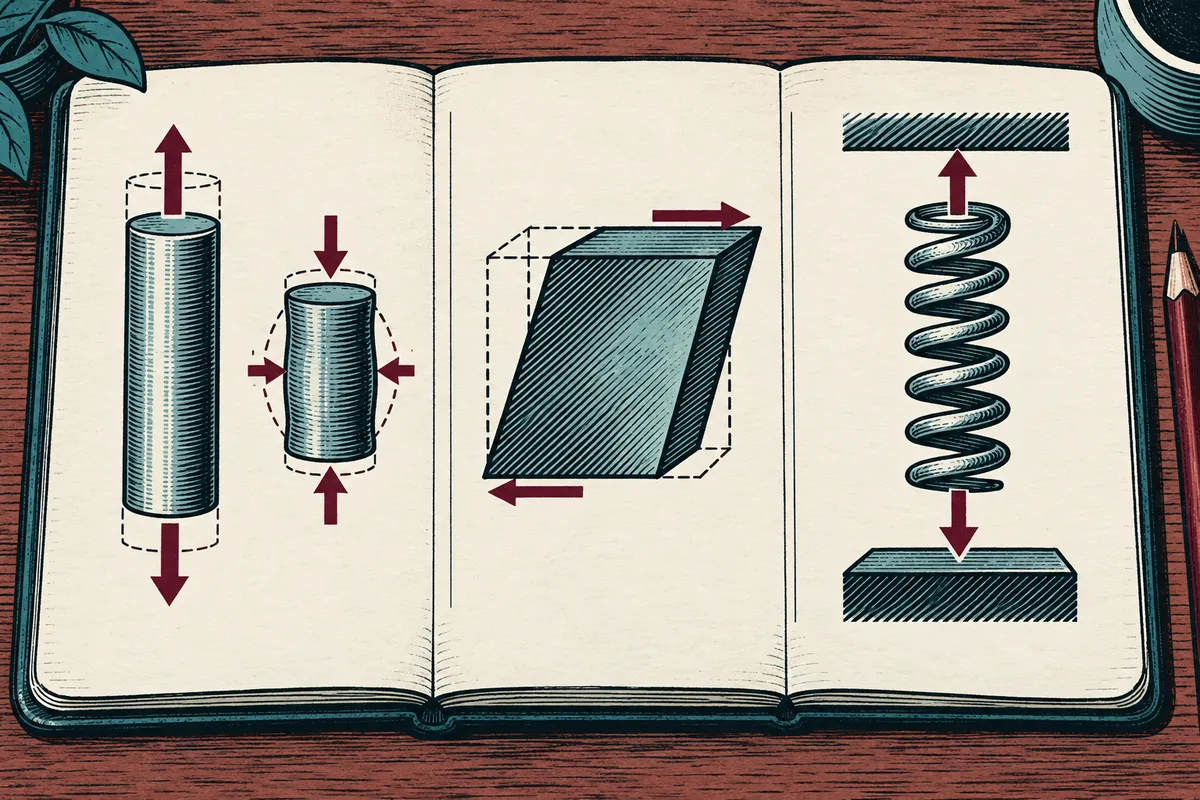
- Poisson's ratio: The ratio of lateral strain to axial strain.. It is dimensionless, and indicates how much a material deforms when subjected to a force..
- Resilience: The ability of a material to absorb energy during elastic deformation.. It represents the combination of material strength and elasticity..
- Shear modulus: The ratio of shear strain to shear stress.. It indicates how much a material deforms under a shear load..
- Shear strength: The maximum shear stress a material can withstand.. It is an important indicator of how much shear loading a material can withstand..
- Slip: The tendency toward plastic deformation through movement within a material.. This commonly occurs in crystals..
- Specific modulus & Specific strength: These refer respectively to modulus per unit volume and strength per unit density.. They are used to evaluate material efficiency..
- Stiffness: The ability to resist deformation under a load,, that is, stiffness.. It is the opposite of flexibility..
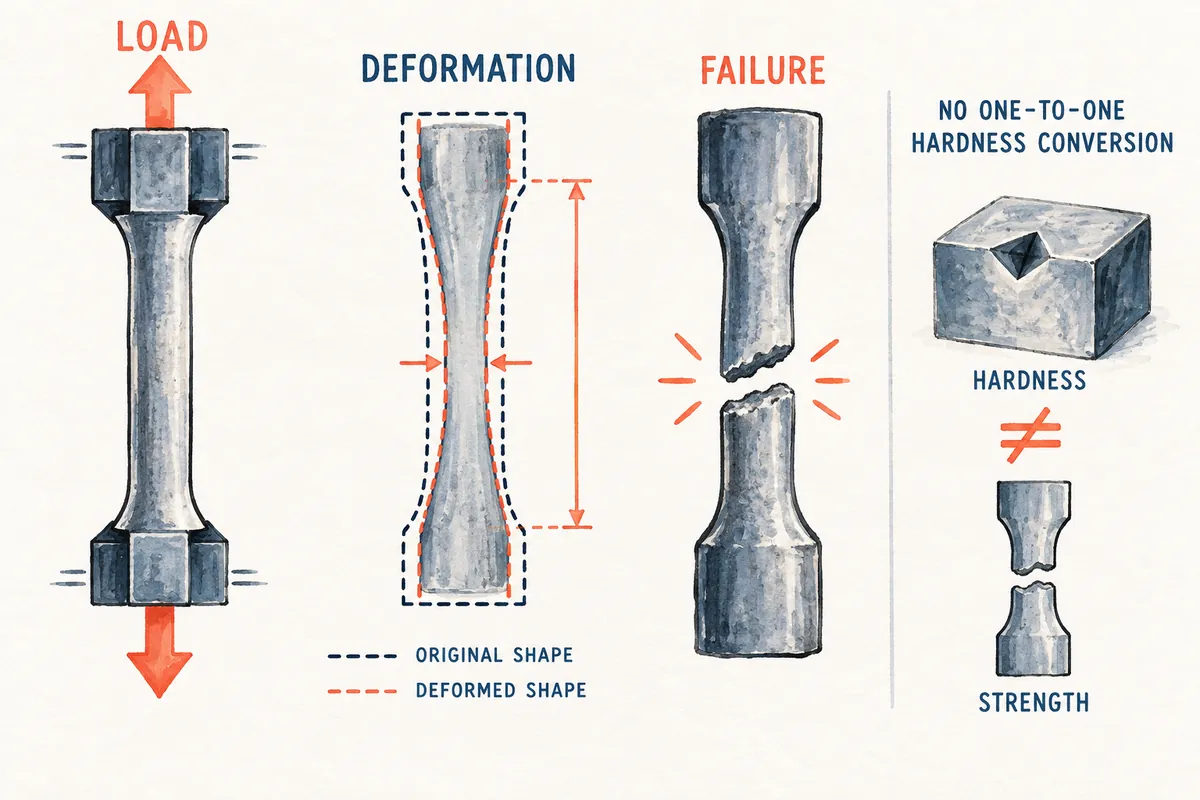
- Tensile strength: The maximum tensile stress a material can withstand before failure.. It is an important indicator of material strength..
- Toughness: The ability of a material to absorb energy, and withstand plastic deformation.. It represents the combination of strength and plasticity..
- Yield strength: The stress at which a material begins to undergo plastic deformation.. It is an important indicator of how much load a material can withstand..
- Anisotropy: The condition in which a material's properties differ with direction.. This is common in materials such as fiber-reinforced composites and wood..
- Elasticity: The ability of a material to return to its original state after deformation..
- Plasticity: The ability of a material to withstand permanent deformation..
- Ductility: The property indicating how much a material can elongate under a tensile load.
- Malleability: The property indicating how much a material can extend under a compressive load.
- Creep: The gradual deformation of a material over time under high temperature or sustained stress.
- Resilience: The ability of a material to recover after elastic deformation.
- Damping: The ability of a material to dissipate vibrational energy.
- Thermal expansion: The property indicating how much a material's volume changes with temperature.
- Mass diffusivity: The property indicating how easily one substance can diffuse within another.
- Coefficient of restitution: The ratio of final to initial relative velocity after two objects collide. It has a value of 1 for a perfectly elastic collision.
- Flexural strength: The property indicating how much stress a material can withstand under a bending load.
- Poisson's ratio: A value expressing the ratio of a material's axial and lateral strains.
- Slip: The tendency toward plastic deformation through movement inside a crystal.
- Resilience: The ability of a material to absorb and recover energy during elastic deformation.
- Specific weight: The property expressing weight per unit volume.
- Stiffness: The ability of a material to resist deformation caused by an external force.
- Viscosity: The property indicating how strongly a fluid resists deformation because of viscosity.
- Surface roughness: The deviation in the direction of the normal vector of an actual surface.
- Bulk Modulus: The ratio of volumetric compressive strain to pressure.
- Young's Modulus: The ratio of linear strain to linear stress.
For more detailed information, see
Sources:https://allabouteng.com/mechanical-properties-of-material/
Mechanical Properties of Material - All About Engineering
It is very essential to know the mechanical properties of material. The physical property that a material show on applying of forces is called mechancal properties
allabouteng.com
for further reading.
Original illustrations created to help explain this article.
Original on Tistory ↗