Fact-Checking AI Summaries: Comparing Numbers, Dates, and Exceptions with the Original
This article was translated from its source language with AI assistance. Please check technical terms and equations against the original.
Key takeaway: Fact-checking an AI summary means pairing sentences with their originals rather than deciding it looks generally right. Check units and denominators, date roles, applicability, and causation separately, and record correction reasons. The originals and faulty summaries below are independently created hypothetical cases, not actual institutional notices or AI execution or accuracy tests.
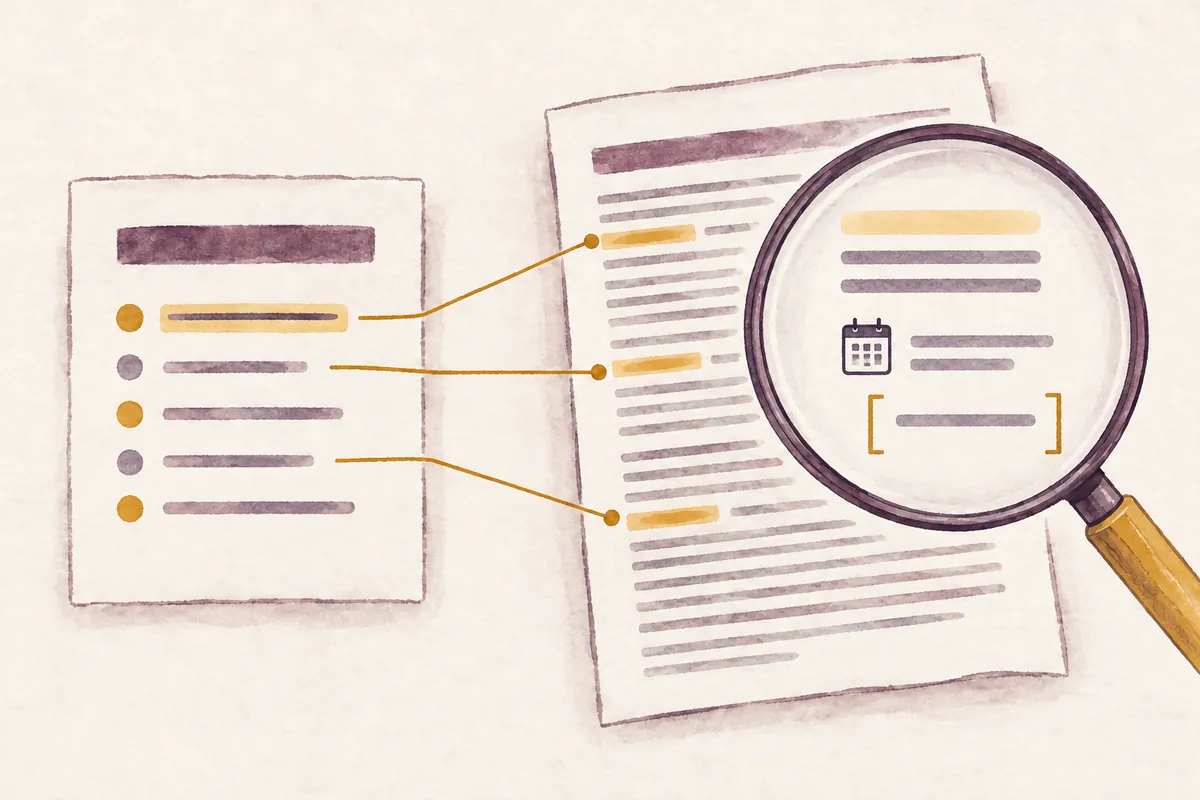
1. Split summaries into verifiable claims
“A new feature launched, so everyone can work faster for free” includes launch status, eligibility, cost, and speed. Divide it into smaller claims to see what was checked and what remains. Reviewing facts and interpretations together can let one correct fact carry the remaining judgments through unchecked.
Anthropic'sofficial help on incorrect responsesexplains that Claude can generate plausible wrong answers and cited web sources may contain context omitted in summaries. Judge what the original says rather than confident tone. This review method applies that direction practically to document work.
| Sentence type | Example | Review question |
| Fact | Applications open on the 15th | Which date in which document? |
| Interpretation | The application period is relatively short | Is a comparison basis given? |
| Suggestion | Prepare documents early | Does it fit verified conditions? |
| Prediction | Users will keep increasing | Is it identified as a forecast with reasons? |
Number summary sentences before review. Mark scope-strengthening words such as “all,” “always,” “must,” “free,” and “proven.” Checking whether originals contain them reveals where brevity becomes exaggeration. Record multiple claims separately.
2. Prioritize by readers' actions
If equal-depth review is difficult, consider what readers will do. Wrong dates can lose an opportunity; wrong save scope can overwrite files. Check application, cost, deletion, and execution decisions before minor background wording.
| Material and purpose | First checks | Action afterward |
| Share an application notice | Eligibility, deadline, required submissions | Restore conditions in guidance |
| Summarize statistical reports | Units, denominator, measurement period | State equation and scope together |
| Explain installation | Supported environment, permissions, execution scope | Share only environment-appropriate steps |
| Organize internal minutes | Decisions versus proposals, owners, deadlines | Mark undecided items separately |
Then open source titles and links and read relevant sections. Check official origin, matching product/version, and regional or account scope. An opening link confirms source existence; a passage supporting the claim confirms evidence correspondence. Distinguishing these avoids stopping at link checks.
3. Numbers: identical values can mean different things
Hypothetical case A: percentages versus percentage points
Hypothetical original: “Response rates measured on the same basis changed from 12% to 18%.”Faulty summary: “The response rate increased 6%.” The difference is 18−12=6 percentage points. Relative increase is (18−12)÷12×100=50%. “6%” alone does not distinguish the meanings.
Corrected summary: “The response rate rose from 12% to 18%, an increase of 6 percentage points. Relative increase was 50%.” A very short summary can retain only the first sentence. If the original reported only the difference, identify relative growth as your calculation rather than a quoted metric. Keep calculated results separate from original reported indicators.
Hypothetical case B: respondents versus all intended participants
Hypothetical original: “There were 200 intended survey participants and 80 respondents; 48 respondents reported satisfaction.”Faulty summary: “60% of all participants were satisfied.” 48÷80=60% describes satisfaction among respondents. The 120 nonrespondents' views are absent.
Corrected summary: “48 of 80 respondents, or 60%, reported satisfaction. This material alone does not establish satisfaction among all 200 intended participants.” 48÷200=24% can also be calculated, but means those reporting satisfaction among all intended participants, not measured overall satisfaction. Being able to calculate a number differs from answering the intended question.
Read value, unit, denominator, period, and comparison together. Check means versus medians and cumulative versus monthly counts. Detached table titles and footnotes can obscure the basis. For calculated summaries, locate original inputs and recompute independently.
4. Units: total quantity versus individual limits
Hypothetical original: “Each attachment must be at most 40MB, with up to three files at a time.”Faulty summary: “One file up to 120MB is allowed.” This replaces the individual limit with the sum for three files. No original passage allows one 120MB file.
Corrected summary: “Each file must be 40MB or smaller; up to three can be uploaded at once.” Check individual limits rather than upload one oversized file. Since no separate total limit is stated, do not add a conclusion that 120MB total is necessarily permitted.
For money, check monthly, annual, per-use, and tax bases; for lengths and time, check mm/cm and seconds/minutes. State conversions when needed. Where conventions differ, such as data capacity, retain original units and inspect their basis. For unitless numbers, start with table headings rather than guesses.
5. Dates: announcement, opening, and deadline are different events
Hypothetical original: “Guidance was announced October 1. Applications run from October 15, 2026 through October 20 at 6 p.m., Korean time.”Faulty summary: “Applications open October 1 and close on the 20th.” It changes announcement into opening and removes time and zone.
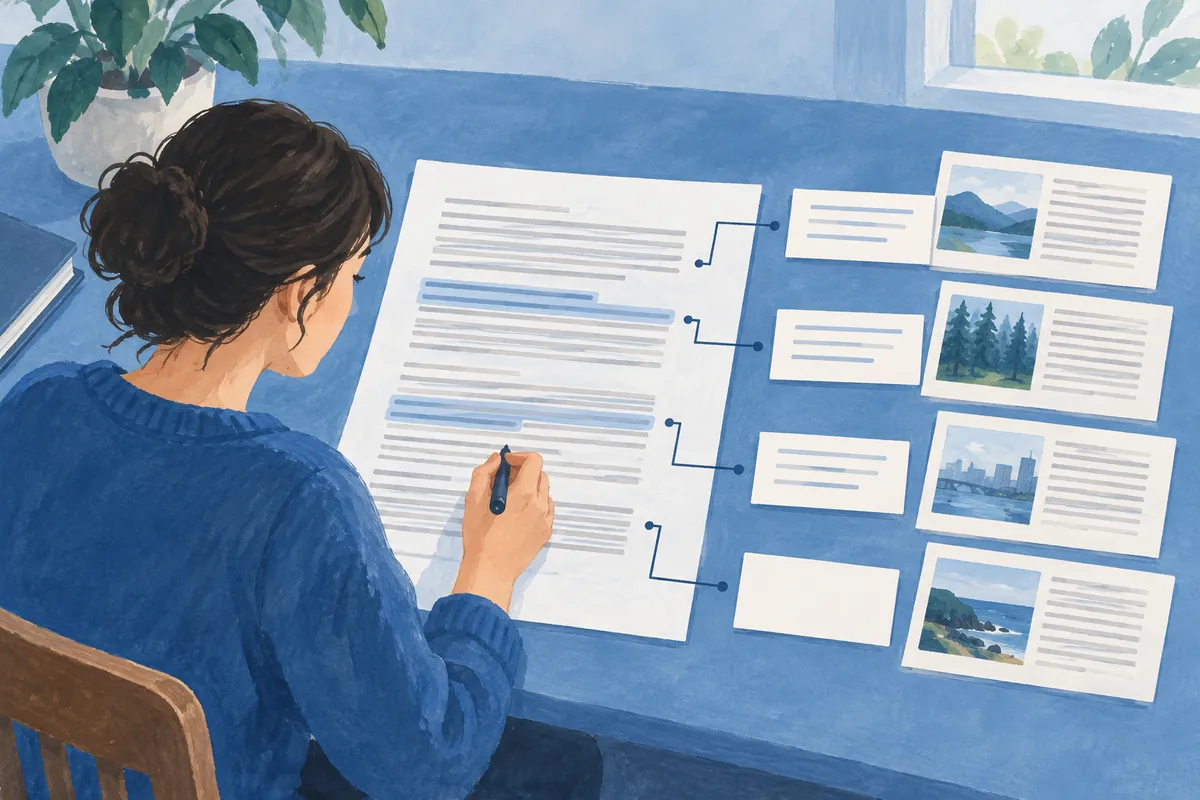
Corrected summary: “Applications run from October 15 through October 20, 2026 at 6 p.m. Korean time. Guidance was announced October 1.” Put actionable dates first to avoid confusion. If opening time is absent, leave it for verification instead of assuming midnight.
“Today,” “next week,” and “soon” depend on writing and reading dates. Use verified absolute dates for sharing, retaining calculation bases if derived. Mark future dates planned or confirmed. For revisions, identify latest title and revision date rather than silently replacing earlier dates.
6. Conditions: check whether summary scope expanded
Hypothetical original: “Only existing organizational accounts permitted by administrators can use the trial feature. Personal accounts are excluded from this trial.”Faulty summary: “Anyone with an account can use the trial.” It omits organizational status, administrator permission, and personal-account exclusion.
Corrected summary: “The trial covers existing organizational accounts permitted by administrators; personal accounts are excluded.” The next step is checking account type and permission. The longer sentence restores access conditions rather than adding decoration.
Read parentheses, footnotes, and clauses after “however” too. Changing “may be possible” to “possible” or “recommended” to “required” changes meaning. Check that minutes' “consider adoption” did not become “decided to adopt.” Separate required source actions from your recommendations.
7. Causation: earlier events alone do not establish causes
Hypothetical original: “Weekly inquiries rose from 20 to 30 after changing the guidance screen. An event also took place, and the cause was not investigated.”Faulty summary: “The screen change caused a 50% increase.” The calculation (30−20)÷20×100=50% is correct, but the causal claim is absent.
Corrected summary: “Inquiries rose from 20 to 30 after the change, but an event also occurred and the cause was not investigated.” A proposal can separately call screen influence a hypothesis needing investigation. Correct numbers do not prevent a new causal claim when “after” becomes “because.”
Also check “a difference occurred” becoming “effect proven.” Even if the original claims effects, retain measurement targets and periods. Do not extend inquiries during a specific period into every user's experience; preserve observed scope.
8. Review record template
Classify findings as verified, correction needed, or unverified and give one-line reasons. Missing evidence differs from original contradiction; record enough to choose the next check. Enter actually read sections or pages in evidence locations, never mark unread documents checked.
문서 이름 / 버전:
요약 작성 목적:
검토 날짜:
문장 번호:
요약의 주장:
유형: 사실 / 해석 / 제안 / 예측
원문 근거: 문서명, 절 제목·쪽 번호, 짧은 관련 구절
확인 항목: 수치 / 단위 / 분모 / 날짜 / 조건 / 인과
판정: 확인됨 / 수정 필요 / 미확인
이유:
수정한 문장:
남은 확인: 필요한 문서 또는 질문
공유 여부와 재확인 시점:
For case A, the judgment is “correction needed” because “6% corrected to 6 percentage points.” For uninvestigated causes, retain “cause unverified.” If sources conflict, record conflict and compare versions and targets rather than average them or choose confident wording.
9. AI review preparation and checks people finish
Anthropic's error-reduction documentationadvises allowing uncertainty, extracting evidence passages, and checking citations claim by claim, while noting these do not eliminate errors. Use AI to list claims for review; fill final judgments from originals you directly read. Agreement among several AIs does not replace source comparison.
아래 [원문]과 [요약]을 비교해 검토 초안을 만들어 줘.
요약을 독립적으로 확인할 수 있는 주장 단위로 나눠 번호를 붙여 줘.
각 주장에 원문의 관련 구절과 위치를 연결해 줘.
숫자·단위·분모·날짜·대상·예외·인과를 별도 열로 확인해 줘.
원문에 없는 내용은 추측하지 말고 미확인으로 표시해 줘.
계산값은 원문 수치와 계산식을 함께 적어 줘.
오류 후보에 수정 문장을 제안하되 근거보다 범위를 넓히지 마.
실제로 수행하지 않은 링크 열기나 재계산을 수행했다고 적지 마.
마지막에 내가 원문으로 다시 확인할 항목을 모아 줘.

[원문]: [문서 이름·날짜·관련 본문·표·각주]
[요약]: [검토할 문장]
Before sharing, check evidence for action-changing sentences, number units and bases, and restored exceptions. Remove unverified essentials or keep their status. Check the title for exaggeration too; if correcting shared material, provide change date and revised sentence so readers can distinguish versions.
Frequently asked questions
Where should I start with a long original? Read sections corresponding to core claims, plus table titles and footnotes. Record partial review scope.
What if the source cannot be opened? A title alone does not establish verification. Retain unverified status until original files or accessible official guidance are obtained.
Can I omit conditions for brevity? Retain conditions changing access or deadlines. Cut surrounding explanation first and preserve target groups, dates, and restrictions.
Is asking for another check enough? AI rechecking finds additional possible errors. Compare important corrections directly and verify calculations separately.
Official sources and check date
Official documents checked: October 3, 2026. Review tables and prompts are practical proposals; every numerical, date, and account-condition example is hypothetical.
Original illustrations created to help explain this article.
Original on Tistory ↗