Evaluating Material Ductility and Brittleness: An In-Depth Look at Tensile and Impact Tests
This article was translated from its source language with AI assistance. Please check technical terms and equations against the original.
1. Introduction
Material ductility and brittleness are important mechanical properties in engineering design and product development. Evaluating deformation under force (ductility) and the possibility of sudden fracture (brittleness) is central to safety and performance. This article examines representative methods, tensile testing and impact testing, including their evaluation criteria and everyday applications.
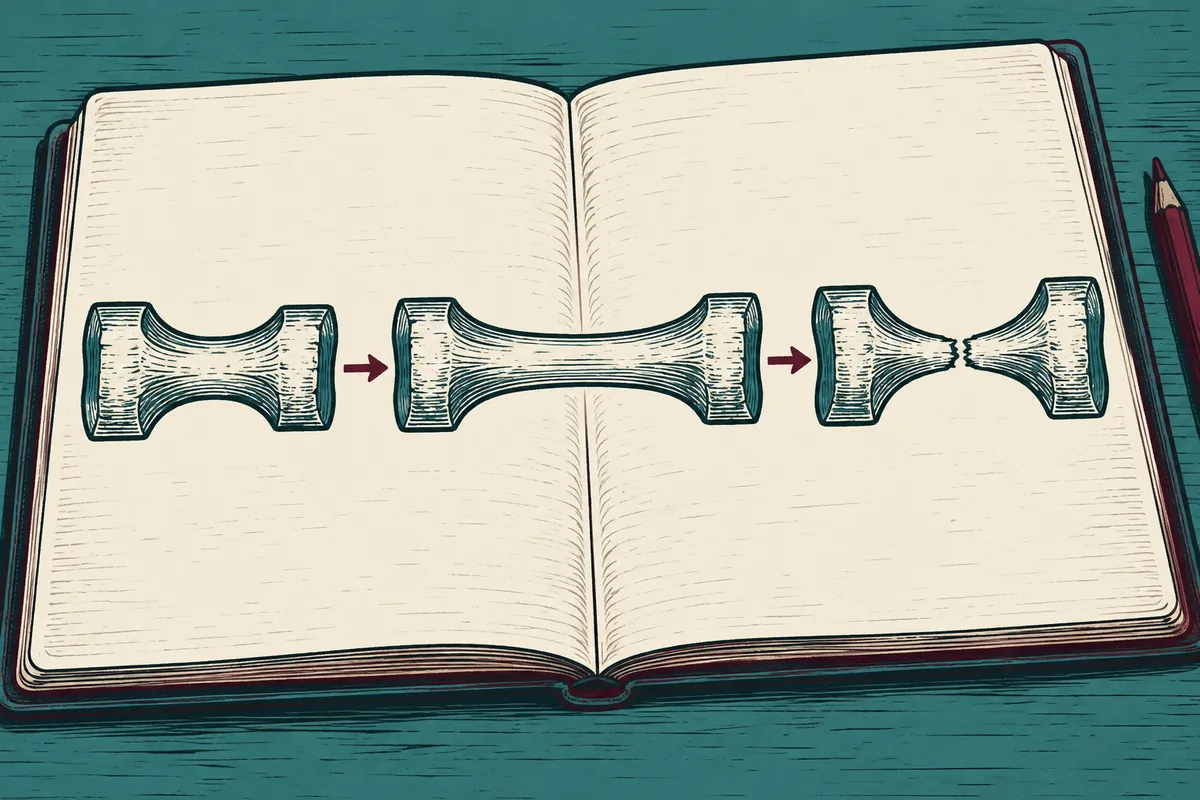
2. Overview of Ductility and Brittleness
- Ductility: Degree of deformation before fracture; highly ductile materials have excellent stretchability and toughness. Examples: Gold and aluminum.
- Brittleness: Sudden fracture after small deformation, characterized by high strength but low ductility. Examples: Glass and ceramics.
3. Tensile Testing
3.1 Overview
Tensile testing is among the most common methods for evaluating mechanical properties, measuring deformation as a sample is pulled at a constant rate.
- Procedure:
- Prepare a standard specimen, usually dog-bone shaped.
- Clamp both ends and apply tensile force.
- Analyze the stress–strain curve.
3.2 Main Metrics
- Yield strength (σy): Stress where plastic deformation begins beyond the elastic limit.
- Ultimate tensile strength (UTS): Ability to withstand maximum loading.
- Elongation (%): Extension relative to original length.
- Reduction in area (%): Evaluates deformation capacity.
3.3 Experimental Applications
- Assessing structural steel in buildings.
- Strength testing of vehicle bodies and components.
- Verifying aircraft-alloy design specifications.
Suggested images:
- Diagram of a tensile-testing machine's operation.
- Stress–strain graph from a tensile test.
4. Impact Testing
4.1 Overview
Impact tests evaluate resistance to high-speed loading and are especially useful for assessing brittle behavior.
- Procedure:
- Add a central notch to induce stress concentration.
- Strike with a hammer released from a specified height.
- Analyze absorbed energy after fracture.
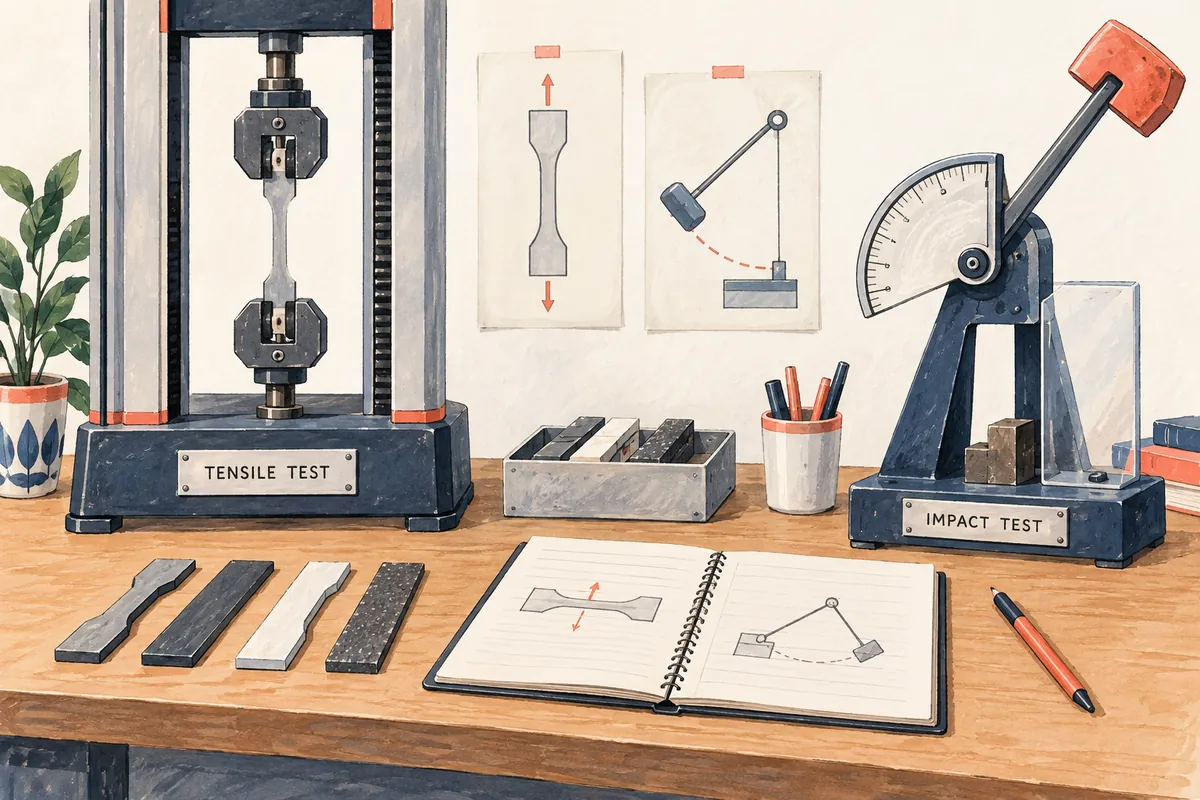
Original illustration of the key points
4.2 Representative Methods
- Charpy impact test:
Strikes a V-notched specimen in a simply supported arrangement. - Izod impact test:
Strikes a vertically clamped specimen to assess brittleness.
4.3 Main Metrics
- Impact energy (J): Energy absorbed by the material.
- Ductile-to-brittle transition temperature: Evaluates changes in brittleness with temperature.
4.4 Experimental Applications
- Material evaluation for crash safety.
- Impact-resistance verification for railway and marine structures.
- Impact testing of protective electronic-device cases.
Suggested images:
- Charpy and Izod apparatus diagrams.
- Photographs of specimen fracture cross-sections.
5. Comparing Ductility and Brittleness Tests
Test category Tensile test Impact test
| Purpose | Evaluate gradual loading | Evaluate sudden-impact resistance |
| Metrics | Yield strength, tensile strength, and elongation | Impact energy and brittle-transition temperature |
| Sample shape | Standard dog-bone | V-notched bar |
| Main applications | Structures, automotive, and aviation | Safety and impact resistance |
6. Conclusions and Everyday Applications
Tensile and impact tests serve different purposes and are essential tools for evaluating ductility and brittleness. They help designers develop safer, more reliable products.
Everyday examples:
- Vehicle manufacturers use tensile tests to check body strength and impact tests to verify occupant protection in collisions.
- Construction evaluates steel-structure ductility to ensure earthquake resistance.
Related references and links:
- ASTM E8 – Tensile testing standard
- ASTM E23 – Impact testing standard
- William D. Callister Jr., David G. Rethwisch, Fundamentals of Materials Science and Engineering
Original illustrations created to help explain this article.
Original on Tistory ↗