Stress Versus Strain: Engineering Concepts Explained Simply
This article was translated from its source language with AI assistance. Please check technical terms and equations against the original.
When studying or working in materials and mechanical engineering, you often hear the terms “stress” and “strain.” Both are essential to designing structures and parts; understanding them helps predict material strength and deformation. This post explains the difference between stress and strain through everyday cases, graph analysis, and experimental applications.
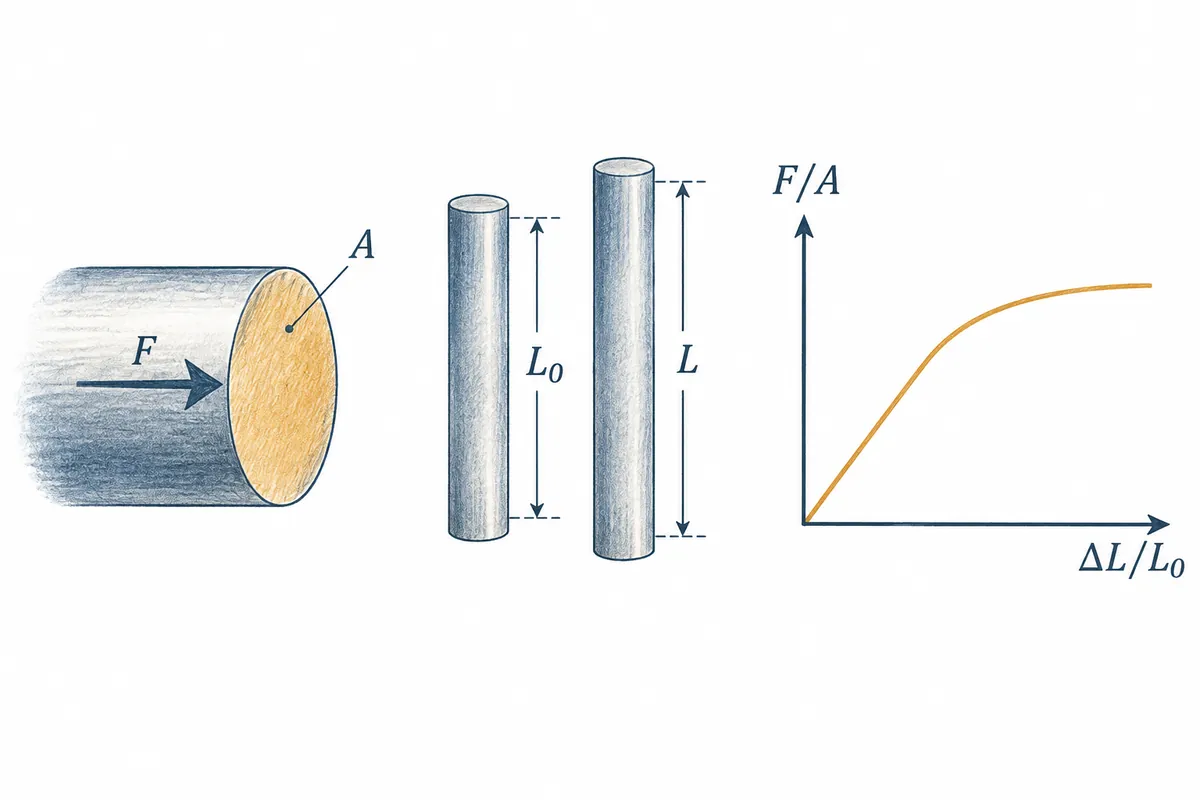
1. What Is Stress?
Stress is force per unit area in a material, expressing internal resistance when external forces act on an object.
Stress formula:
\[
\sigma = \frac{F}{A}
\]
\[
\sigma: \text{Stress (N/m^2 or Pa)}
\]
\[
F: \text{Applied force (N)}
\]
\[
A: \text{Cross-sectional area (m^2)}
\]
Types of stress:
- Tensile stress: Occurs when a material is pulled
- Compressive stress: Occurs when a material is pressed
- Shear stress: Occurs with internal sliding
For details, see Stress Concepts and Applications.
Everyday applications:
- Building columns: How columns support loads above them.
- Car brakes: Pressure when pads grip discs.
- Desk legs: Loads carried when objects are placed on the desk.
2. What Is Strain?
Strain is the ratio describing deformation caused by external force relative to original length.
Strain formula:
\[
\varepsilon = \frac{\Delta L}{L_0}
\]
\[
\varepsilon: \text{Strain (dimensionless)}
\]
\[
\Delta L: \text{Change in length due to deformation (m)}
\]
\[
L_0: \text{Initial length (m)}
\]
Types of strain:
- Elastic strain: Original condition restored when load is removed
- Plastic strain: Permanent deformation remains
For more on strain, see Strain Overview.
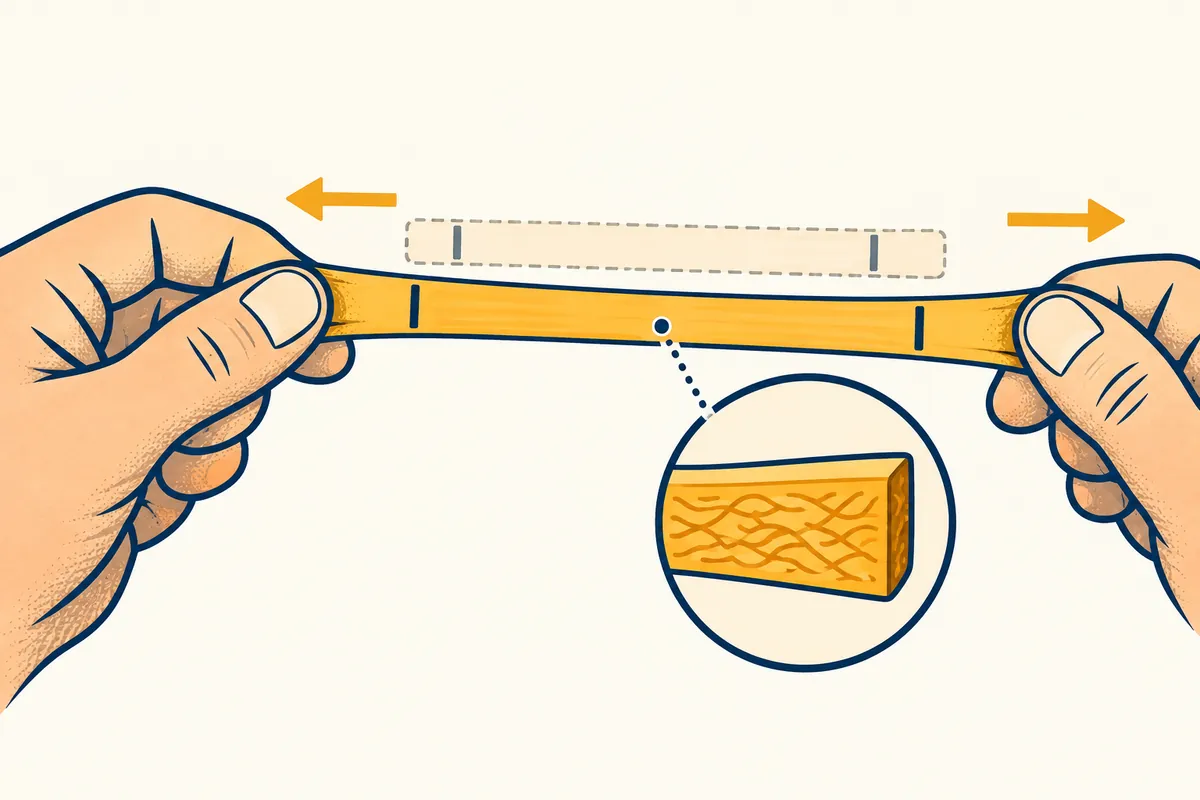
Everyday applications:
- Rubber bands: Amount of stretching when pulled.
- Bridge cables: Extension under load.
- Sneaker materials: Stretching of flexible materials.
3. Differences Between Stress and Strain
Category Stress Strain
| Definition | Force applied per unit area | Deformation ratio relative to original length |
| Unit | Pascal (Pa) | Dimensionless ratio |
| Meaning | Measures material resistance | Evaluates degree of deformation |
| Example | Vehicle-frame strength analysis | Rubber-band extension measurement |
4. Stress–Strain Curve Analysis
The relationship is understood through the **stress–strain curve**. The figure below shows a typical ductile-material curve.
Main regions:
- Elastic region: Original condition restored when load is removed
- Plastic region: Permanent deformation occurs
- Yield point: Transition from elastic to plastic behavior
- Fracture point: Point where the material ultimately breaks
For a detailed explanation of the curve, see this material.
5. Conclusion
Stress and strain are essential for understanding strength and deformation. This post explained their differences through everyday cases and examined deeper aspects through curves and experimental applications.
For more material, visit MIT Mechanics of Materials.
Original illustrations created to help explain this article.
Original on Tistory ↗