The Third Law of Thermodynamics: Absolute Zero
This article was translated from its source language with AI assistance. Please check technical terms and equations against the original.
Today I will discuss the third law of thermodynamics, which concerns absolute zero.

What Is the Third Law?
Simply put, it explains that a system's entropy approaches a constant as its temperature approaches absolute zero.
What is entropy? It measures irregularity or disorder, numerically expressing how many different states a system can have.
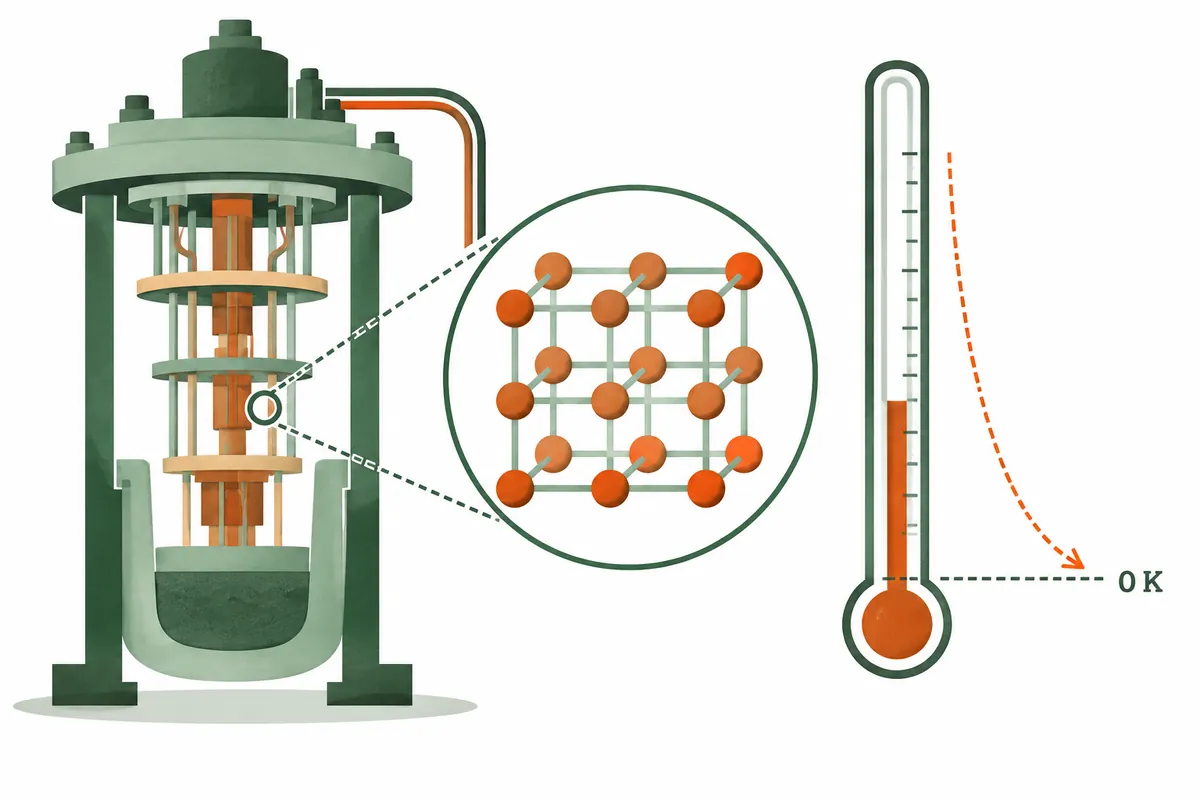
Absolute Zero
Absolute zero is -273.15°C, or 0 K (kelvin), a temperature theoretically unattainable. At this point, atomic motion stops and the system can lose no further thermal energy, reaching its minimum-energy ground state.
Residual Entropy and Microstates
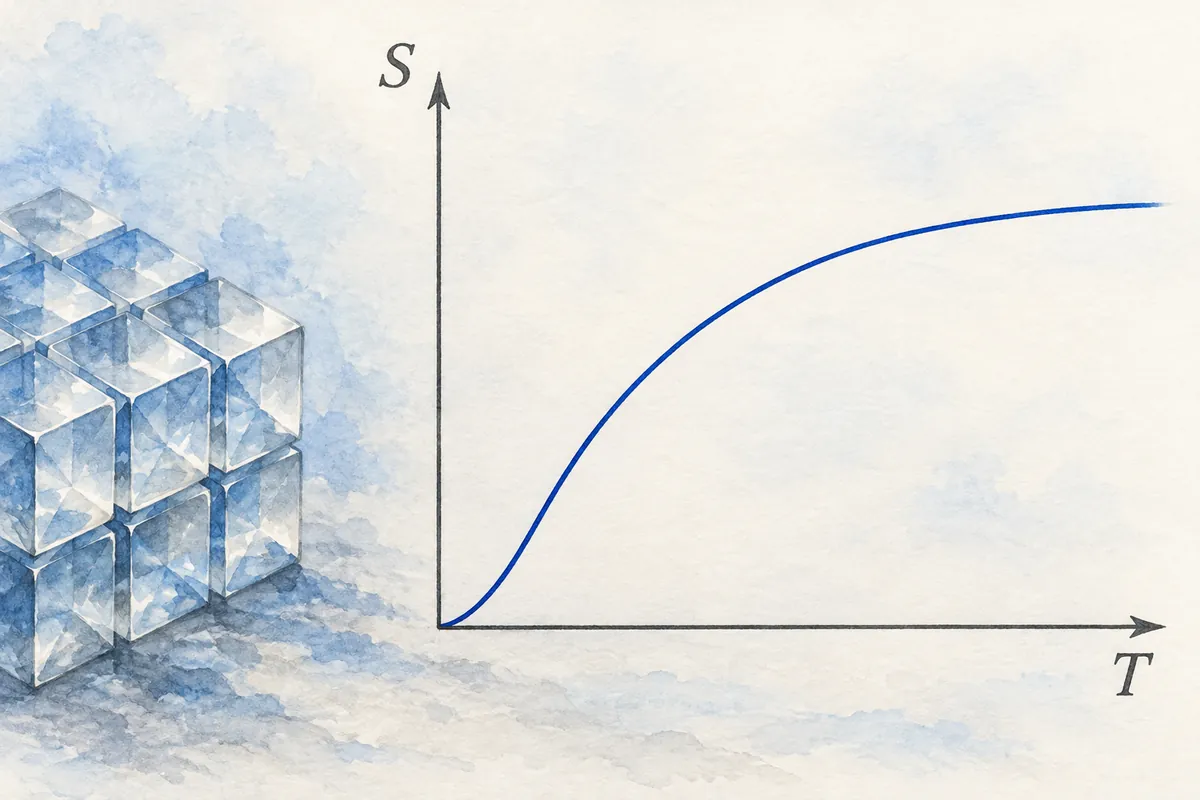
A ground-state system may possess residual entropy. This is generally near zero except in amorphous solids. Interestingly, noncrystalline solids such as glass can theoretically have nonzero residual entropy because they lack a unique ground state.
Microstates indicate the probability of a system occupying a particular state. At absolute zero, only one microstate is possible, meaning all atoms and possible arrangements are identical. Entropy is therefore calculated as Boltzmann's constant k_B times the natural logarithm of the number of possible microstates Ω.
Calculating Entropy
S = (k_B)*(ln(Ω))
If Ω is one, meaning only one microstate, ln(1) = 0 and entropy S becomes zero. This indicates a completely ordered system with no room to increase disorder.
The third law is thus a very important physics concept, greatly contributing to understanding the universe's fundamental workings.
That was today's discussion of the third law. Keep up the good work, everyone!
Original illustrations created to help explain this article.
Original on Tistory ↗