College Physics (Engineering Physics) #002: Dimensional Analysis and Its Uses
This article was translated from its source language with AI assistance. Please check technical terms and equations against the original.
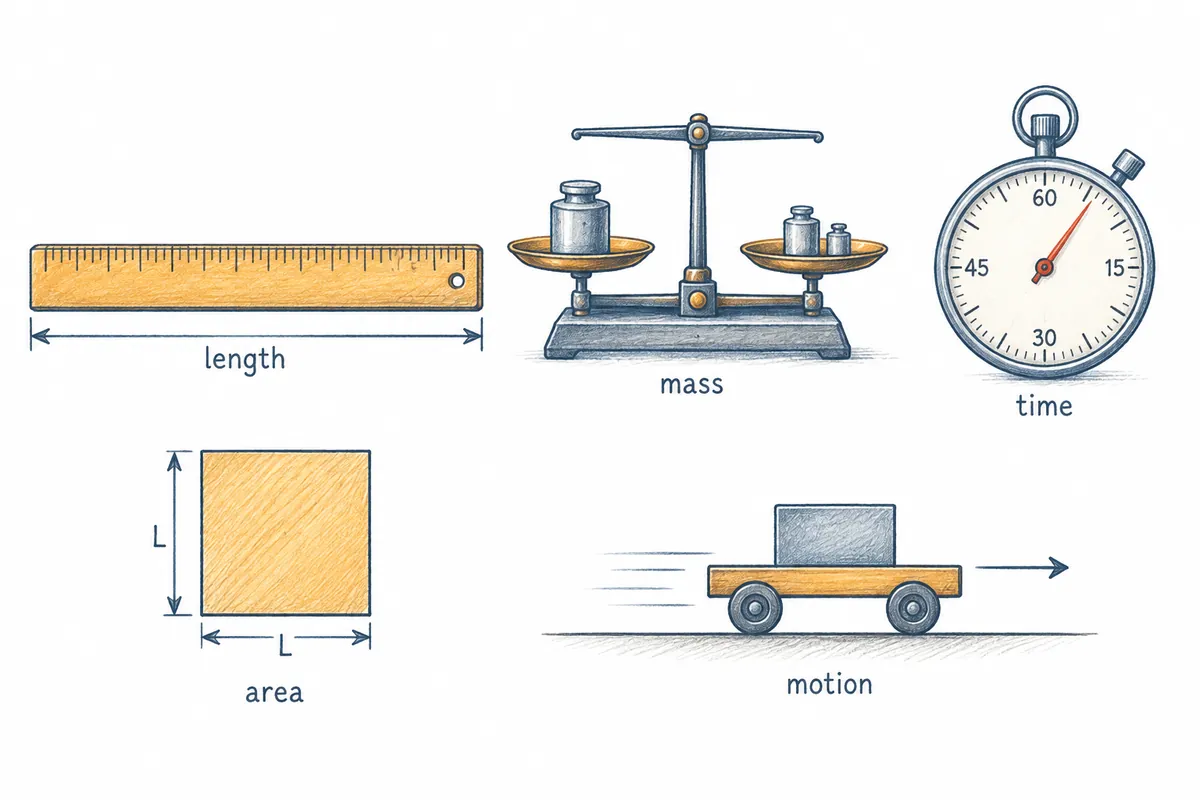
In physics, “dimension” has a special meaning describing a quantity's physical nature. Distance remains distance whether measured in feet, meters, or fathoms; it has the dimension of length.
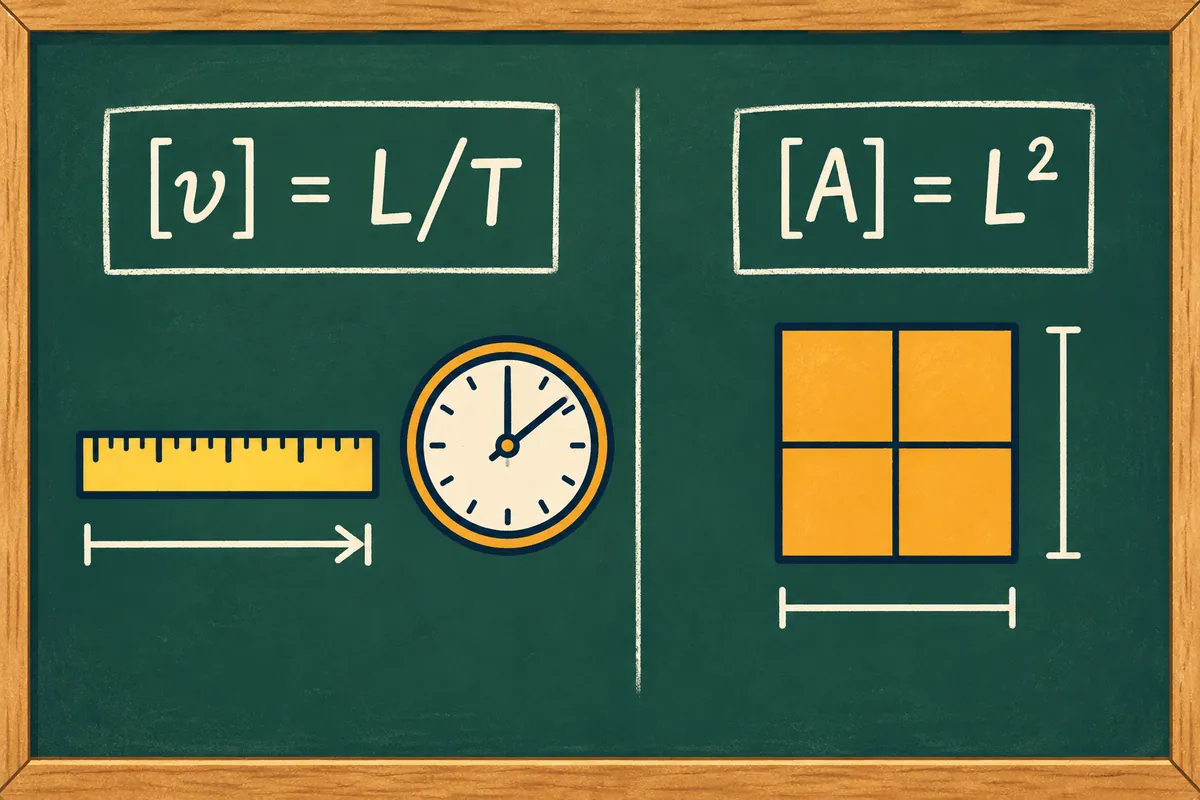
Length, mass, and time dimensions generally use L, M, and T. Square brackets [ ] often denote dimensions of physical quantities.
For example, velocity commonly uses v, with [v] = L/T.
Area A has [A] = L^2.
Many situations require deriving or verifying equations; dimensional analysis can help.
Dimensional analysis uses the fact that dimensions can be treated as algebraic quantities.
Physical quantities can be added or subtracted only when dimensions match. Both sides of an equation must also have identical dimensions. These simple rules help check an expression's form: a relationship can be correct only if both sides match dimensionally.
Suppose we want an equation for position x at time t for a car starting at rest with constant acceleration a.
Check its validity using dimensional analysis.
The left-hand x has length dimensions. The right must also have length for dimensional correctness. Substitute acceleration's L/T^2 and time's T to perform the check.
A more general procedure sets up an expression of the following form.
x ∝ a^n * t^m
Here n and m are exponents to determine, and ∝ means proportionality. The relation is valid only if both sides share dimensions. Since the left is length, the right must be length too. With acceleration L/T^2 and time T, we can write:
(L/T^2)^n * T^m = L^1 * T^0
(L^n)*(T^(m-2n)) = L^1 * T^0
The powers of L and T must respectively match across both sides. For L, n=1 follows immediately. For T, m-2n=0; substituting n gives m=2. Returning to x ∝ a^n * t^m yields x ∝ a*t^2. This agrees with the exact x = 1/2 a*t^2 except for the constant 1/2.
Today we learned what dimensional analysis is and how to use it. Used well, it can even derive units you have forgotten. I will finish here. Thank you.
Original illustrations created to help explain this article.
Original on Tistory ↗