The Difference Between Pressure and Stress
This article was translated from its source language with AI assistance. Please check technical terms and equations against the original.
Hello. Today I would like to discuss two concepts that are easy to confuse.. They are pressure and stress.. These two concepts are very important in physics and engineering, and they appear in fluid mechanics and solid mechanicsin many situations. Some people confuse them because stress and pressure both use the same unit, the pascal (Pa). I wondered about this myself as an undergraduate... haha. Understanding the difference between these two conceptsallows you to distinguish them clearly without confusing them.
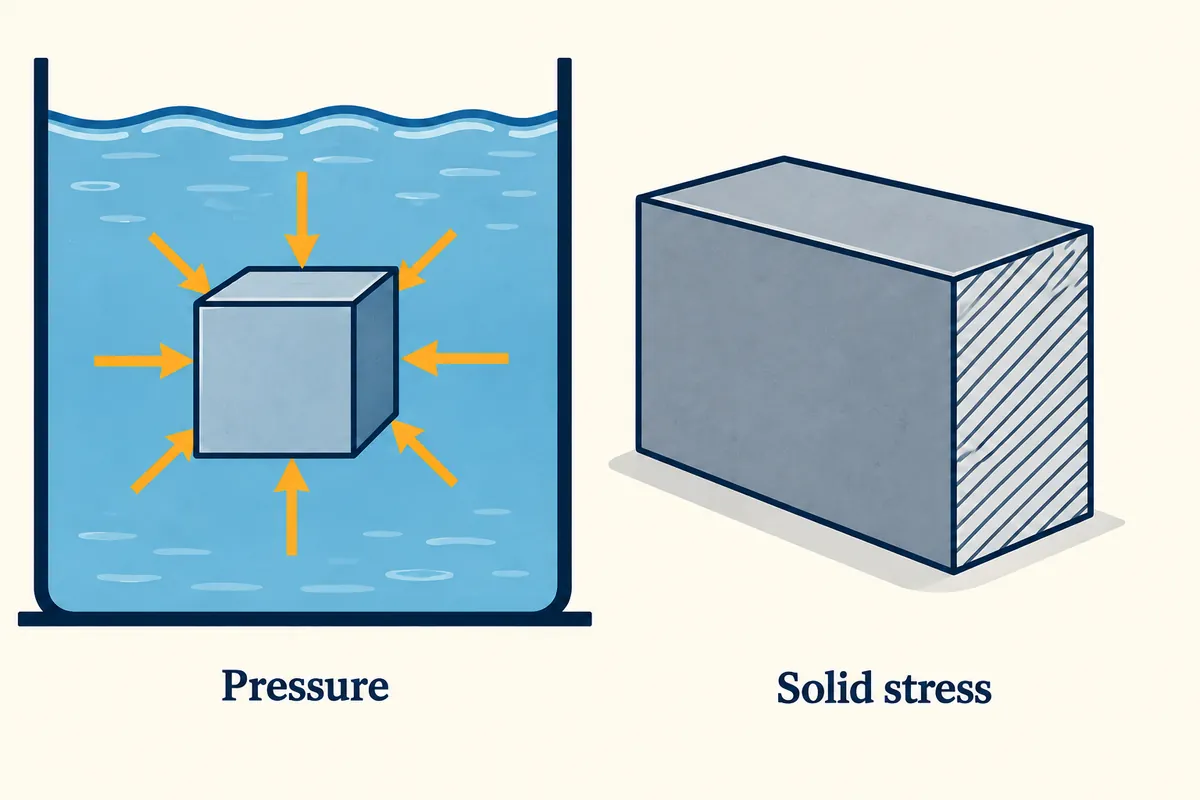
Let us begin the explanation.
Pressure
'Pressure'is the first concept we will examine.. Pressure is a scalar quantity that represents the intensity of an externally applied force.. It is defined as the external force acting per unit area of an object..
For example,, when a ball strikes a wall, the ball exerts pressure on the wall.. Pressure is a thermodynamic property, associated with a vector area element(, a vector normal to a surface,)and the static force acting on it.. Pressure is most often associated withfluids,, and it depends onliquids or gasesand their atoms within a volume,(or molecules confined within that volume,) and the momentum transferred between them.. Pressure can be measured directly using an instrument,, and its magnitude is the same in every direction.. Pressure plays a role in causing an object to deform..
Stress
Next,, 'stress'is the concept we will examine.. Stress is defined as the magnitude per unit area of the internal resisting force an object generates to resist deformation.. It is also known as the intensity of the resisting force generated internally.. Stress can act in a direction normal or parallel to a surface,, and is described using its magnitude,, direction,, and point of application.
Stress in different directions may be equal or different.. Stress helps an object resist deformation..
Stress arises only when an external force acts and attempts to disturb the equilibrium state..
For example,, when someone pulls a spring,, stress develops in the spring,, which attempts to maintain its original position.. When an external force acts,, it attempts to change the original shape of the body, and change the distances between atoms.. However,, the body tends to resist the external force and maintain its original shape.. This tendency generates an opposing force inside the body.. This opposing force per unit area is called stress..
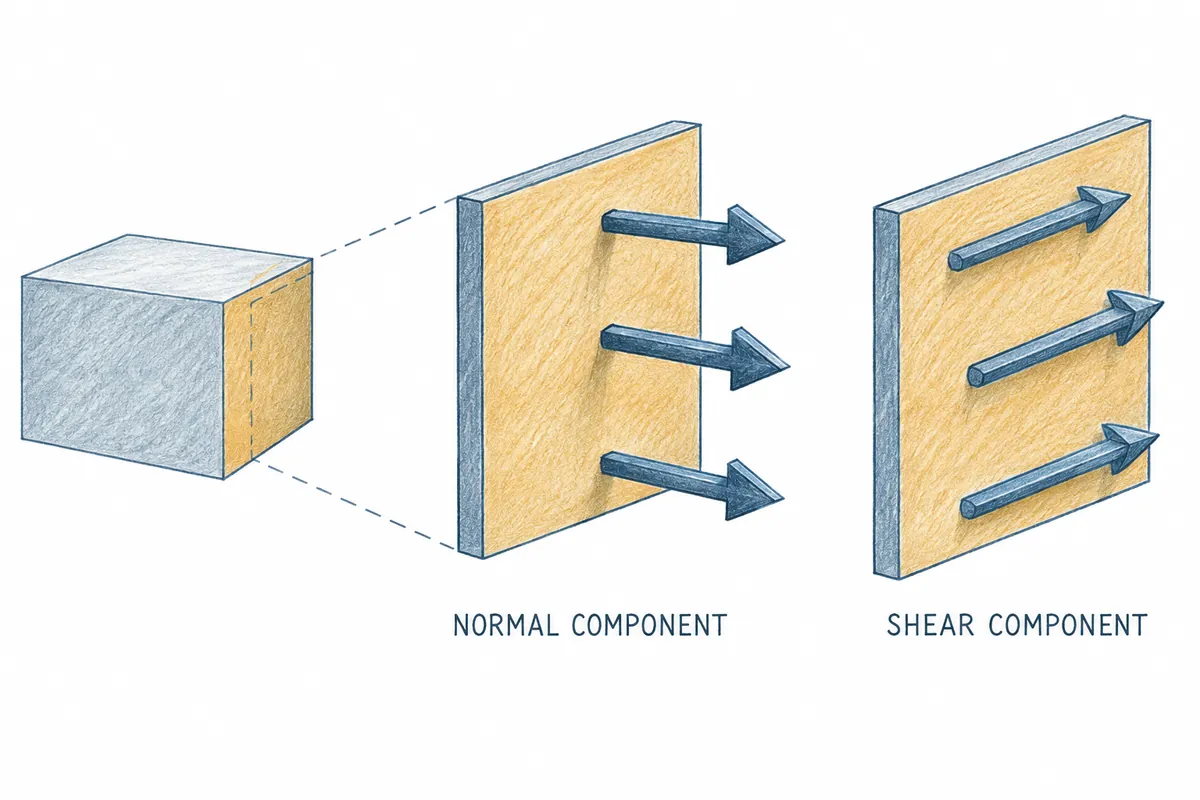
The direction of stress opposes the external force,, and stress has structural properties.. It develops inside the body to resist an external force.. Stress may varyin a solidwith direction..
Pressure vs. Stress
So far, we have defined the two concepts.
Based on these definitions, their differences can be shown in the following table.
| Pressure | Stress |
| Pressure is the external force on an object per unit area that is applied from outside.. | Stress is the internal resisting force against deformation that resists it by being generated per unit area within the object as an internal resisting force. |
| The external force's intensity | The internal resisting force's intensity |
| The surface(receives pressure in various directions)as pressure is applied. | Stress acts in a normal or parallel direction. |
| A scalar | Stress is described using its magnitude,, direction, and point of application to describe the stress . (“second-order tensor”It is also called.) |
| Pressure's magnitude is the same in every direction . | Stress's magnitude may vary depending on the direction.. |
These are the differences.
That concludes the differences between stress and pressure. I hope this has been helpful, and I will see you in the next post.
Original illustrations created to help explain this article.
Original on Tistory ↗