Mechanical Engineering: The Four Major Mechanics Subjects—Solid Mechanics (Mechanics of Materials)
This article was translated from its source language with AI assistance. Please check technical terms and equations against the original.

Hello. Today, we will learn about solid mechanics, or mechanics of materials, one of the important subjects among the four major mechanics disciplines in mechanical engineering.
Mechanics of materials is a branch of applied mechanics concerned with how structures respond to different kinds of loads. It is also known as strength of materials or mechanics of deformable bodies. The structures it addresses include axially loaded bars, shafts under torsion, beams under bending loads, and columns under compressive loads.
Its primary objective is to determine the stresses, strains, and displacements caused by loads acting on structures and their components. Understanding mechanical behavior is essential for the safe design of all kinds of structures, including aircraft, antennas, buildings, bridges, machines, motors, ships, and spacecraft. For this reason, mechanics of materials is a fundamental subject in many engineering fields.
Problems in mechanics of materials begin by examining the external and internal forces acting on stable deformable bodies. First, the loads and support conditions are defined. Then, support reactions and internal forces within components or members are determined using the basic laws of static equilibrium, provided the body is statically determinate.
Mechanics of materials studies the stresses and strains inside real bodies: bodies with finite dimensions that deform under loading. It uses numerous theoretical laws and concepts, as well as physical material properties, to determine stress and strain. It provides additional essential information based on deformation and is necessary for solving statically indeterminate problems, which cannot be solved using the laws of static equilibrium alone.
Both theoretical analysis and experimental results play important roles. Theory is used to derive expressions and equations that predict mechanical behavior, but these expressions can be used in practical design only when the material's physical properties are known. Such properties can be determined only through careful experiments. Moreover, not every practical problem can be solved by theoretical analysis alone; in those cases, physical testing is essential.
The historical development of mechanics of materials combines theoretical and experimental processes.
Famous figures such as Leonardo da Vinci (1452–1519) and Galileo Galilei (1564–1642) conducted experiments to determine the strength of wires, bars, and beams, but did not develop sufficient theory to explain their results.
By contrast, the famous mathematician Leonhard Euler (1707–1783) developed a mathematical theory of columns and calculated their critical load in 1744. At that time, there was no experimental evidence demonstrating the importance of his results. Because suitable tests had not validated his theory, Euler's results remained unused for more than 100 years. Today, however, they form the foundation for the design and analysis of most columns.
Mechanics of materials, or solid mechanics, applies mostly to stationary solids and is still used in many fields. Personally, among the four major mechanics subjects in mechanical engineering, I found this subject the most tangible and realistic.
That concludes this explanation of solid mechanics, or mechanics of materials.
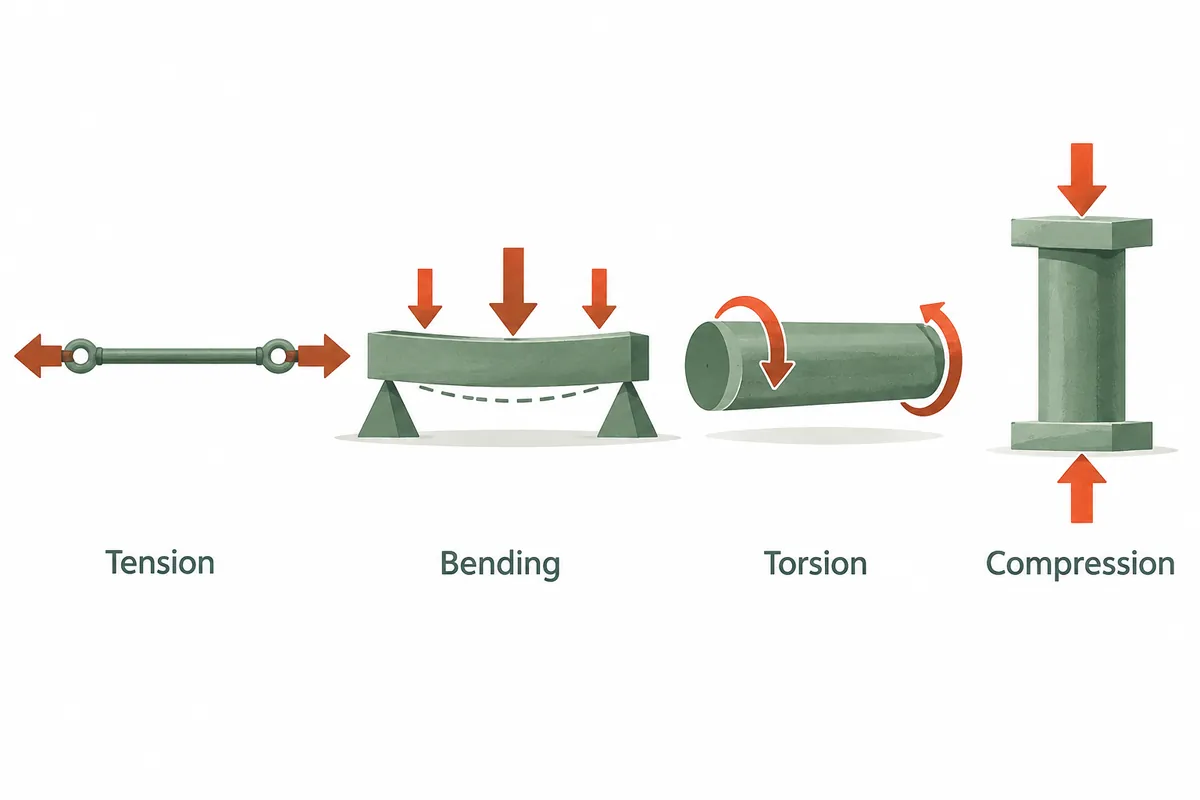
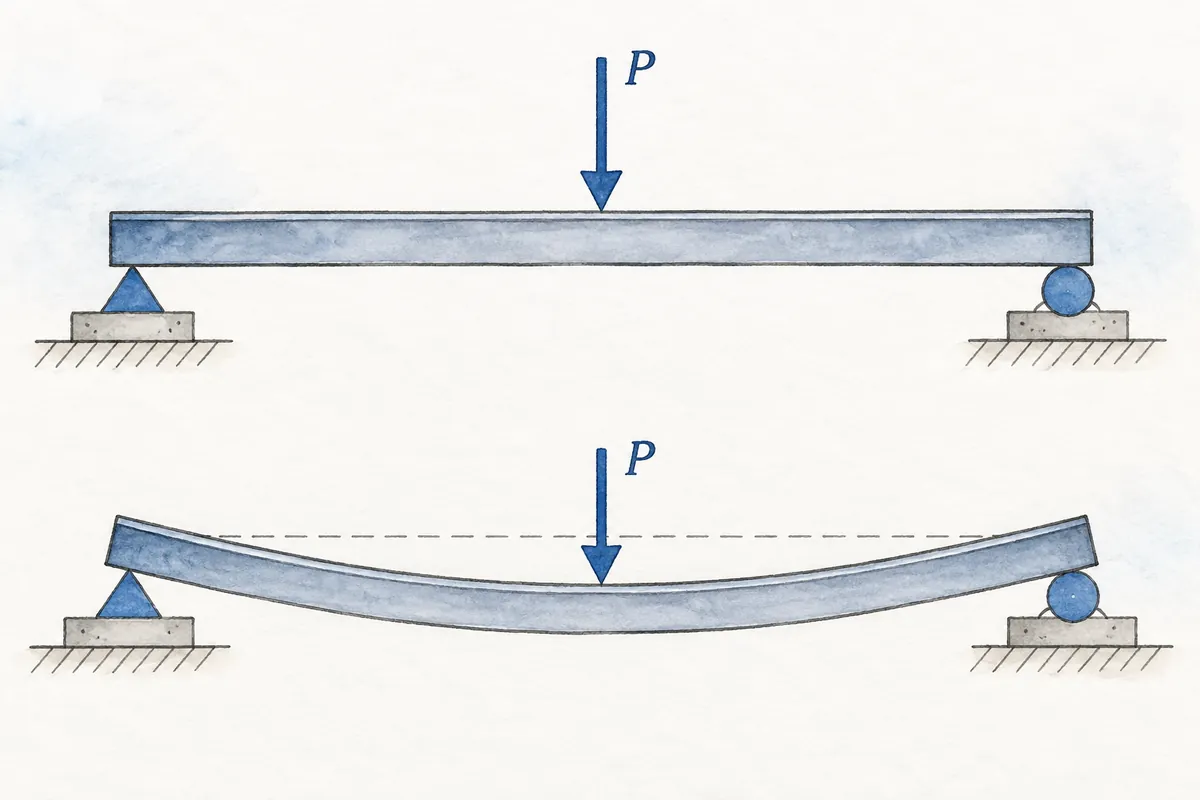
Original illustrations created to help explain this article.
Original on Tistory ↗