Read Stainless Steel 304 and 316 Markings: Check Composition and Usage Environment
This article was translated from its source language with AI assistance. Please check technical terms and equations against the original.
If a product description lists "304 stainless steel" or "316 stainless steel," it is easy to immediately compare which one is unconditionally better. However, the question to consider when selecting materials is not the size of the numbers, but the usage environment. Indoor shelves differ from railings exposed to sea breezes in terms of water, salt, surface contamination, and maintenance conditions. Even within the same steel grade, the nature of problems can vary depending on whether the structure allows water to accumulate in crevices or how the welded joints are finished. This article explains how to interpret markings and conditions; it is not based on actual measurements of specific product composition or lifespan tests.
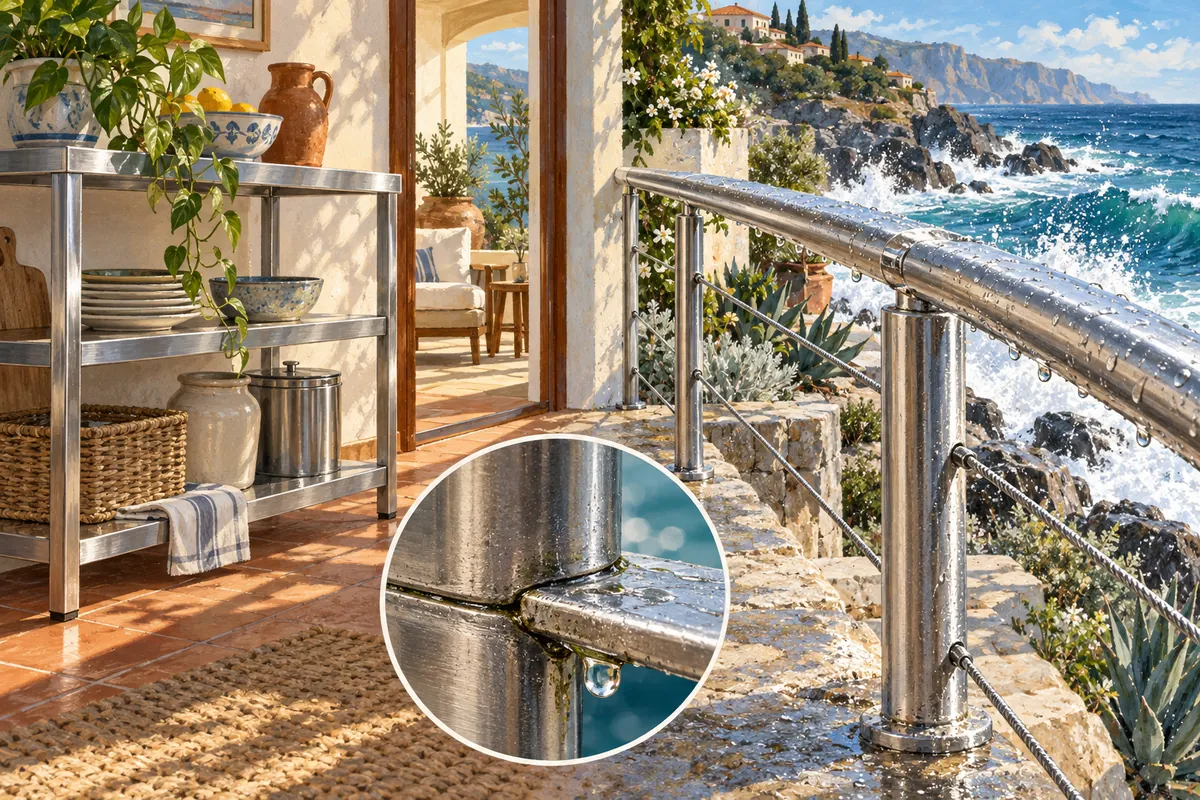
1. 304 and 316 cannot be ranked by their class numbers alone.
304 and 316 are notations for widely used austenitic stainless steel grades. The manufacturer Outokumpu isCore 304is a representative steel grade containing chromium and nickel,Supra 316is described as a steel grade containing chromium, nickel, and molybdenum to account for more demanding corrosive environments. While the molybdenum in 316 contributes to increased specific corrosion resistance, it does not mean that rust or localized corrosion is completely eliminated in all environments.
Numerical notations serve as a starting point for identifying materials, not as a description containing all the performance characteristics of the finished product. Even within the same 304 grade, you must verify whether it is sheet or rod, what the surface finish is, and what treatments were undergone during the manufacturing process. Comparing products with different thicknesses and structures based solely on a single steel grade makes it difficult to evaluate strength, ease of use, and maintenance conditions together. The purpose and shape of the product must be determined first to understand the significance of the material description.
2. Distinguish between the manufacturer's representative ingredients and the limitations of material specifications.
The table below is a summary to help understand the representative chemical composition of a specific product as presented on the manufacturer's webpage. It does not represent fixed values that are identical to all 304 or 316 steels, nor does it represent the upper or lower limits allowed by the specification. To verify the actual delivered materials, you must consult the relevant product specifications and the provided material documentation. Representative values are used to explain the differences between the two steel grades and are not used to certify the composition of a specific product.
| Comparison Items | Core 304/4301 representative value | Supra 316/4401 representative value |
| Chrome Cr | 18.1 Mass% | 17.2 Mass% |
| Nickel Ni | 8.1 Mass% | 10.1 Mass% |
| Molybdenum Mo | No separate values in the corresponding representative ingredient list | 2.1 Mass% |
| Key Points When Reading Tables | Representative Cr-Ni series | Cr-Ni-Mo series including Mo |
| Unknown with this value | The exact ingredients and lifespan of my product | The exact ingredients and lifespan of my product |
304 The absence of a molybdenum value in the composition table does not mean that the element is exactly 0 in all products. An omission in the table and an actual measured value of 0 are different pieces of information. Furthermore, you cannot immediately conclude that a product is forged or an error simply because the manufacturer's representative composition table differs slightly from that of another company. First, verify that you are comparing the same product, the same notation system, and the same types of values. The specification range, representative value, and the measured value of the delivered material each serve different roles.
3. Link different notation systems in the document.
Product descriptions may include multiple identification systems, such as 304, EN numbers, and UNS numbers. For example, a manufacturer's Core 304/4301 page presents both EN 1.4301 and UNS S30400. This correspondence is helpful when reading the product description. However, you should not group all numbers that look similar under the exact same certification conditions without verifying separate notations and standards. You must also check the product form and applicable standards.
When creating orders or comparison tables, record the steel grade name exactly as written by the seller, and list the steel grade name and applicable standard from the provided document side by side. If the notations differ, verify with the supplier the basis for the correspondence. It is advisable not to assume that the actual material described in the supporting document has been verified simply by looking at the word "316" in the page title. Even if notations are simplified for comparison purposes, the original document number and name should be preserved separately.
Expressions like '18-8' can be used to understand the approximate characteristics of chromium and nickel composition, but that single expression does not confirm all conditions of a specific specification. Distinguish the role of easy-to-read sales text from that of material identification information. For products where consumers cannot obtain material proof, leave the unverified parts blank and make judgments based on the intended use and care instructions. Do not fill in the absence of data with arbitrary compositional estimations.
4. Stainless steel also considers environmental and surface conditions.
A thin passivation film associated with chromium is important for the corrosion resistance of stainless steel.Manufacturer's Atmospheric Corrosion Guideexplains that chlorides, moisture, contamination, surface condition, structure, and maintenance affect the results. If salty water remains in crevices for a long time or if contamination accumulates due to a rough surface, problems that are difficult to predict based solely on the steel grade name may arise. One should not assume it is dry simply because it is indoors, nor should one rule out salt simply because it was dropped from the sea.
When recording the usage location, specific questions are more useful than the single word "outdoor." Note whether rain washes the surface, if it is under a cover causing only contamination to accumulate, if there is a direction for water drainage, if moisture remains after washing, and if it comes into contact with salt or specific cleaning agents. These questions are the environmental inspection items suggested in this article. They are not the results of actual measurements of exposure concentrations or corrosion rates, but are intended to organize conditions and serve as a reference for conversation with experts or suppliers.
For example, a hypothetical indoor storage shelf can be configured for conditions where it receives minimal water contact and dries after cleaning. Conversely, exterior parts under a cover near the coast may be in a condition where salt buildup is not directly washed away by rain. Comparing the two cases solely as 'same metal parts' obscures significant differences. Even in environments where 316 is being considered, more severe exposure may necessitate a review of different materials, finishes, structures, or maintenance.
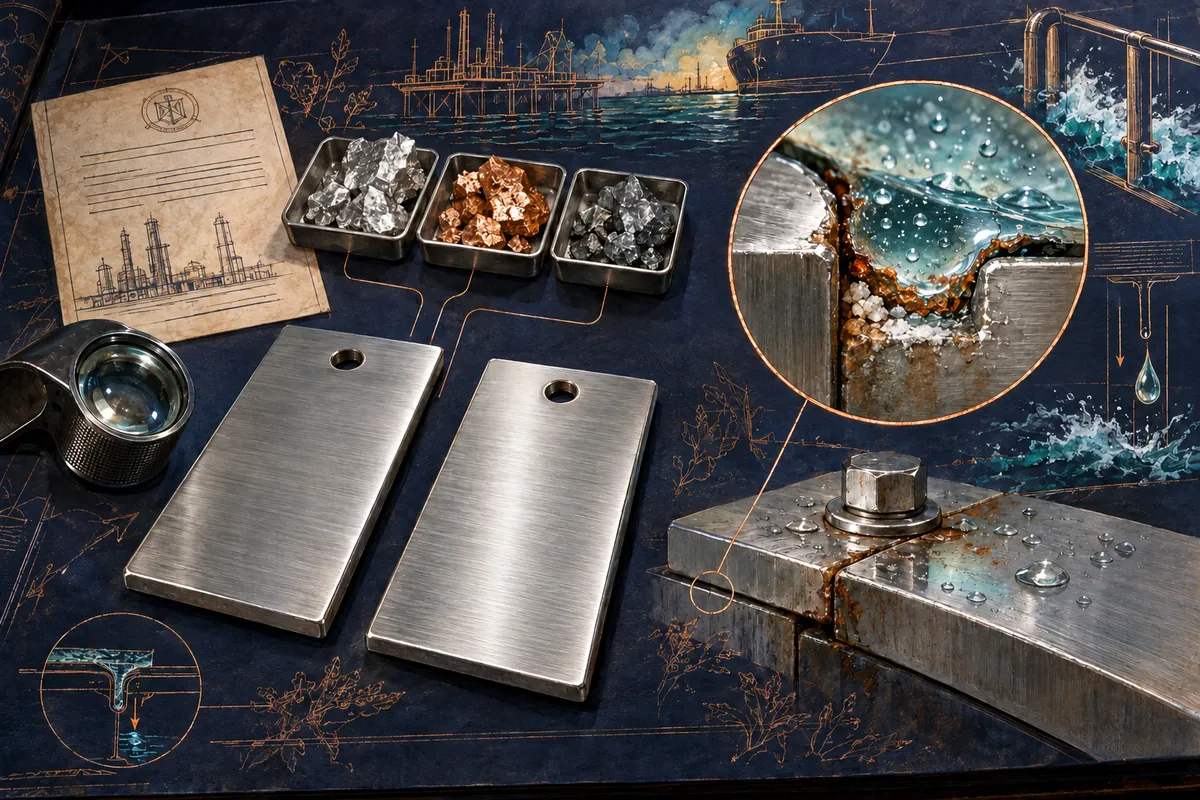
5. Welding and L markings are checked separately.
The 'L' in 304L and 316L is a designation distinguishing types with a low carbon content. Manufacturer data explains that lower carbon is advantageous in reducing the risk of intergranular corrosion associated with carbide precipitation after welding. This should not be broadly interpreted to mean that "if an 'L' is attached, there are no issues with any welding or operating temperature." Welding methods, thermal history, surface treatment, and applicable standards remain separate conditions.
When comparing welded finished products, do not look solely at the main body material; check the finish and maintenance guidelines for the welded areas. On the explanatory checklist, you can record 'steel grade and L marking,' 'presence of welded areas,' 'surface treatment description,' and 'whether there is a water pooling pattern.' Do not confirm specific defects based solely on visible color or marks. If you have any doubts regarding a part in a photo, it is recommended to verify it by correlating it with production records or the supplier's description.
6. Do not confuse corrosion index with life prediction.
In the material introduction, you can find PRE series indices that use chromium, molybdenum, and nitrogen components. Manufacturers' atmospheric corrosion data also includes formulas that compare alloy compositions. These indices serve as clues for comparing specific corrosion resistances, and doubling the number does not mean that the actual service life is doubled. Surface contamination, crevices, temperature, and exposure conditions cannot all be explained by a single alloy composition formula.
If a simple comparison chart on the internet concludes that "304 is X years, and 316 is Y years," please verify the test conditions and basis. Lifespan figures that lack consideration of location, structure, and maintenance are difficult to translate to your own usage conditions. Directly converting specific saltwater test results into actual outdoor lifespans also requires separate justification. This article does not create such conversion values; instead, it suggests a method for interpreting data to understand the specific tests or environments on which comparisons are based.
7. Create a one-page checklist before purchasing or placing an order.
In the first column of the checklist, write the purpose and location of use. Next, write the materials to be in contact with, the potential for water and contaminant retention, the cleaning method, and the required shape and thickness. Finally, link the candidate steel grades with the documents provided by the supplier. If material proof is available, verify that the product name, steel grade, applicable standards, material identification information, and provided composition items in the document correspond to the material intended for purchase. Which items are mandatory may vary depending on the contract and standards.
Explanatory confirmation statements can be written as follows: 'Indoor use, intermittent water contact, planned to be dried after washing, welded areas present, steel grade and surface finish need verification.' This makes it easier to convey the conditions than simply asking the supplier, 'Is 316 better?' For food contact or specific industrial applications, you must verify the conformity required for the finished product in addition to the steel grade name. The designation 304 or 316 alone cannot declare the suitability of the finished product for all intended uses.
8. Final Checklist for Reading Notation
- Are the steel grades in the sales text and material documents linked?
- Did you distinguish between the representative components, specification ranges, and actual measured values?
- Did you compare the product shape, thickness, and surface finish together?
- Have you sorted out the conditions for salt, moisture, contamination, and water stagnation?
- Did you check the weld area and the L marking separately?
- Did you not change the corrosion comparison index to lifespan?
- Have maintenance and cleaning conditions been communicated to the supplier?
- Did you not write unverified parts as if they were confirmed facts?
It is more accurate to understand the difference between 304 and 316 in terms of their connection to composition and environment rather than their numerical ranking. The labeling is the key to finding the material, but the actual selection follows from usage conditions and product information. Instead of simply gathering and comparing steel grade names, placing conditions and supporting documents in the same table makes it clear what you know and what else needs to be verified.
Official Sources and Writing Standards
- Outokumpu Core: 304 Steel Grade and Representative Components
- Outokumpu Supra: 316 Steel Grades and Representative Components
- Outokumpu: Conditions of Stainless Steel and Atmospheric Corrosion
Data Verification Date: 2026-10-10. This explanation was generated by AI based on actual official data. Calculations, codes, and verification examples marked separately are for illustrative purposes only and are not the results of direct testing or actual measurements of the user environment. We will re-verify whether there have been any changes to the functions and data on the publication date.
Original illustrations created to help explain this article.
Original on Tistory ↗