Questions that make AI say what it doesn't know: Separating unverifiable and estimation
This article was translated from its source language with AI assistance. Please check technical terms and equations against the original.
The most difficult response when asking an AI is when it naturally confirms information it does not know. While this may appear helpful, the reader cannot tell to what extent the facts have been verified. Requesting the AI to "say you don't know" can be helpful, but that alone does not eliminate errors. You must collectively decide what evidence to use, what to retain when data is insufficient, and how to indicate estimations. This article focuses on how to distinguish between unverified and estimated statements at the question stage, rather than on general checklists for verifying answers.
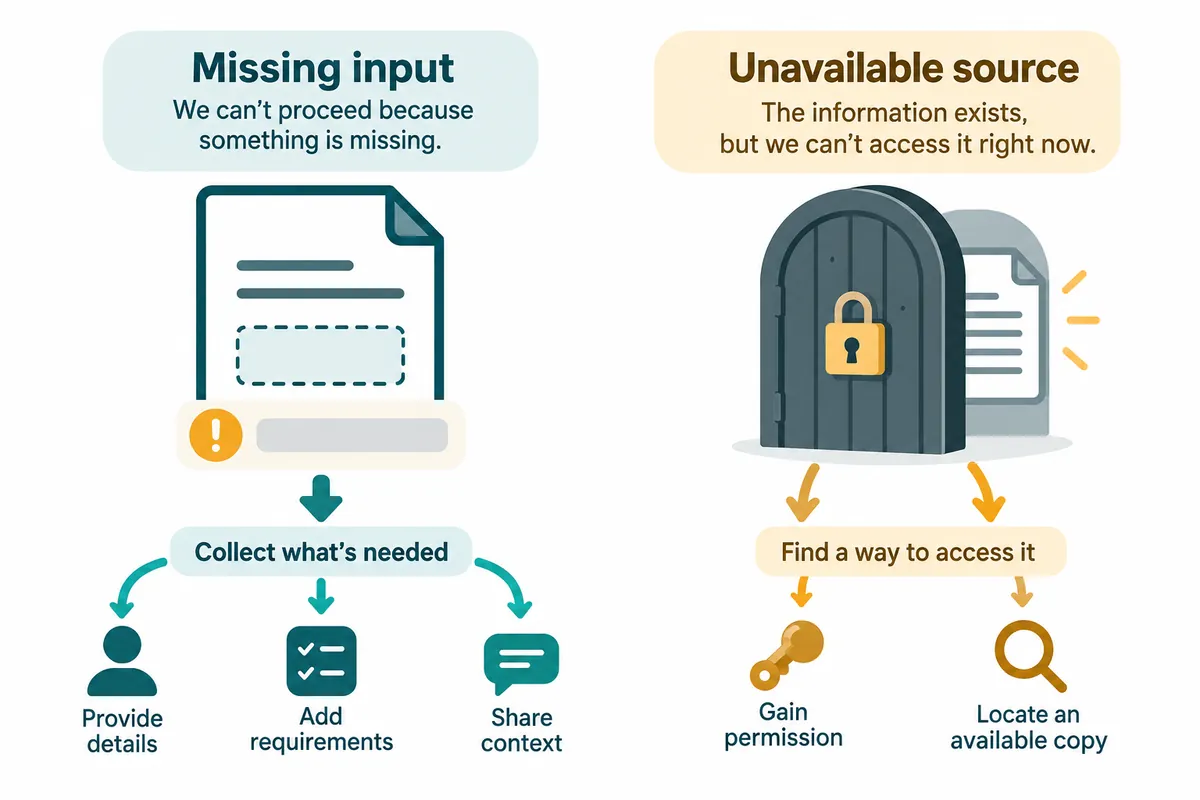
Dividing the reasons for not knowing into two categories
The first case involves missing necessary conditions in the question. If you ask, “Why won’t this file open?” but the file format, the application used, and an error message are missing, it is difficult to determine the cause. In this case, you must define the required conditions before searching for further sources. The second case involves conditions being present, but there is no documentation to verify them. Even if the product name and version are provided, if the official documentation for that version could not be opened, feature support cannot be confirmed. Grouping both situations under the same “Unknown” category makes it difficult to choose the next course of action.
Ask the AI to identify the reasons as well. You can write, “Please explain whether the question conditions were missing or if the official basis could not be verified.” For file error questions, you can receive a list of additional information needed, and for product feature questions, you can organize the official documentation that needs to be found. Expressing uncertainty does not mean ending the response with nothing. It becomes a useful answer only when you connect it to what needs to be verified to make a judgment possible.
Write confirmed facts and estimations in a different sentence
Let’s assume the documentation states that “CSV files can be imported” and contains no information regarding exporting. From this, the fact that can be confirmed is import support. Saying that exporting is also supported is an additional assumption, and saying that exporting is not supported cannot be confirmed based solely on the data. By writing, “Since there is no explanation of export in the documentation, I could not verify whether it is supported,” one can distinguish between facts and a lack of data.
This difference is not merely a matter of phrasing. If you wrongly assume something is unsupported, you may give up on necessary features, and if you wrongly assume it is supported, you may continue searching for menus that do not exist. Try adding to your question: “Please mark items not in the documentation as ‘Unverifiable’ rather than changing them to ‘Unsupported.’” This formats the results to display the actually verified scope and remaining questions, rather than having the AI fill in the blanks to complete the explanation. Virtual document examples do not represent functional information of the actual product.
| Answer Status | Expression Example | Next things to do |
| specified in the original text | The provided document states that import support is available. | Check Version and Coverage |
| Not in original text | Export support cannot be confirmed from this data. | Find official information regarding |
| Insufficient condition | It is difficult to determine the cause as there is no error message. | Collect necessary conditions |
| Data Conflict | The supported versions of the two documents are different. | Compare Publish Date and Revision Status |
| Estimation for explanation | Possible cause examples under this condition | Verify in actual environment |
Read the numbers that look like probabilities carefully
Just because an AI writes "90% certain" does not mean it represents an actual verified probability. Without information on the data and calculations used to derive the figure, the number merely appears to be precise evidence. In fact, it is better to request the status of the evidence in a question rather than asking for an arbitrary percentage of certainty. Check if the official document was opened directly, which sentences connect to the claim, and whether there are any exceptions. High certainty without evidence is different from limited judgment with evidence.
Even when statistical data contains actual probabilities or confidence intervals, you must distinguish between the AI's own confidence and the values in the source data. If figures from a document are cited, you must read the sample and conditions together; if the value is an estimate by the AI, you must verify the basis for the calculation. You can use a request stating, "Do not create a confidence figure for the answer; instead, explain the verified basis and application conditions." The purpose is not to eliminate numbers, but to distinguish between actual data figures and unfounded expressions.
Question format including uncertainty
The following is a hypothetical request to review product documentation: “Please summarize file import and export support based solely on the provided instructions. Please present a table classifying features into those explicitly stated in the original text, those not mentioned, and those with ambiguous wording. Do not assume support is unavailable simply because it is not in the original text. If you need specific versions or conditions, please leave a question. For explanations that require estimation, separate them from factual statements and explain under what assumptions they are possible.”
The purpose of this request is to format the response in a reviewable format rather than to make it short. If the result is too long, you may ask that the facts stated in the original text be presented first, followed by a summary of questions to be verified. If the latest information is required, request that official sources be searched for and actually opened to verify the facts, and that the date of verification be recorded. Providing a link is not considered sufficient proof that the original text has been read. You must be able to directly compare the claims with the content of the relevant page to verify their accuracy.
When estimation is helpful
Even with limited data, explanations comparing possible causes can be useful. For example, regarding a question about a file not opening, you can categorize possibilities such as file corruption, app compatibility, and access permissions. However, such a list is not a diagnostic result. Label it as “Examples of Possible Causes” and link observations verifying each cause. Narrowing the scope through actual comparisons—such as whether different files open in the same app or if the same file can be opened in a supported app—leads the estimation to the next course of action.
Before having the AI select a single cause, you can request it to check in order of lowest verification cost. Write it like this: “Suggest checking for read-only before changing or deleting the file. Write down the results to observe for each cause and the next steps.” This approach creates a flow based on conditions rather than definitively concluding causes that cannot be confirmed with current information. In this case, request that hypothetical steps not be described as having been actually executed, and update the estimate by incorporating the results verified by the user into the next question.
When different sources conflict
If Document A states that a feature is supported while Document B states that there are limitations, request that the AI not draw a conclusion by arbitrarily averaging the two. You must verify if the product version, region, account type, publication date, and revision status differ. The more recent document might be a draft, while the older document represents the currently valid regulation. Requesting to “show conflicting sentences and the scope of application for each document first” is helpful. After reading the differences in the original text, you can determine which conditions apply.
If one of the two materials could not be opened, it does not write that the conflict has been resolved. The brief introduction in the search results may differ from the actual page content. Leave the unread material separately and find an accessible official path. If there is no explanation in the official materials either, you can organize the questions to ask customer support. The role of the AI response is not to generate blank information, but to connect current evidence with necessary verification.

Improve the answer with a follow-up question
If the initial response is overly definitive, you can request, “Show me the original text and verification date that directly support this conclusion. If there is no evidence, please change it to ‘unverifiable.’” Questions that encourage the repetition of the same answer with greater confidence do not aid in verification. Instead of asking “Is that really correct?”, ask specifically what needs to be verified to be correct. Once the evidence is indicated, you must read the actual original text to see if the same content exists.
The answer may change if the user adds conditions. If you initially assumed they were using a Windows app but they were actually opening a document in a browser, the items to be checked will change. Rather than asking them to maintain the previous answer, have them explain how their judgment changes based on the new conditions. Uncertainty is not a phrase that hides weaknesses in the answer, but rather information that reveals how the judgment changes when conditions change. Organizing the purpose of the question and the basis of the evidence together allows for the consistent review of subsequent answers.
When reusing a completed answer
When transferring AI answers to documents or blogs, do not remove the "unverified" label or change them into definitive statements. Even if you revise the language to be easier to read, maintain the status of the evidence. If the phrase “could not be verified in this source” is omitted, readers may assume that the entire fact has been verified. If the verification date and the version applied are important information, write them close to the main text. To avoid reusing old answers as if they were new facts, also include the sources necessary for future review.
The official guidelines and the example questions in this post serve different roles. Official materials serve as the basis for verifying product features and recommendations, whereas the examples are self-constructed to make it easier to review the answers. Using the exact wording of the examples does not automatically guarantee accuracy. The process of reading actual materials and gathering necessary conditions must be carried out alongside this. The core of this approach is to allow for "unknown" while specifically requesting the next steps for verification.
Frequently Asked Questions
If you make them say they don't know, doesn't the answer become useless?Requesting the reason for the inability to verify along with the next items to check actually helps with the judgment. An answer that shows what is lacking, rather than a conclusion based on grounds, leads to the next step of the actual work.
If you tell the AI not to speak with certainty, will the error disappear?Simply changing the wording does not eliminate errors. You must compare the source text, scope of application, and execution results. Uncertainty indicators are a tool to identify points for verification.
Should the estimate always be excluded?Estimates can be helpful when comparing possible causes or understanding explanatory situations. Separate them from facts and attach assumptions and verification methods. If you do not introduce estimations as actual events or verified results, the reader will know what needs to be verified.
Official Data and Writing Standards
This is an informational manuscript created using AI. The official documentation was verified on October 3, 2026, and the examples below are structured for illustrative purposes. They do not represent actual performance results or measured values of personal projects. Please reconfirm updated product information before publication.
Questions that make AI say things it doesn't know
1. Check Question Conditions
→
2. Classification of Basis Status
→
3. Indicate reason for inability to verify
→
4. Specifying the assumptions of the estimate
→
5. Connect the following verification items
This is a custom-made flowchart for illustrative purposes and is not an actual product screen or measurement result.
Original illustrations created to help explain this article.
Original on Tistory ↗