Monty Hall Quiz: Understanding Conditions and Probability for Switching Doors
This article was translated from its source language with AI assistance. Please check technical terms and equations against the original.
Monty Hall Condition Check Quiz
These are self-created learning questions. Think of the answer first, then expand each 'View Answer/Explanation'. Press again to close. Scores and personal information are not stored, and IQ or personality is not evaluated.
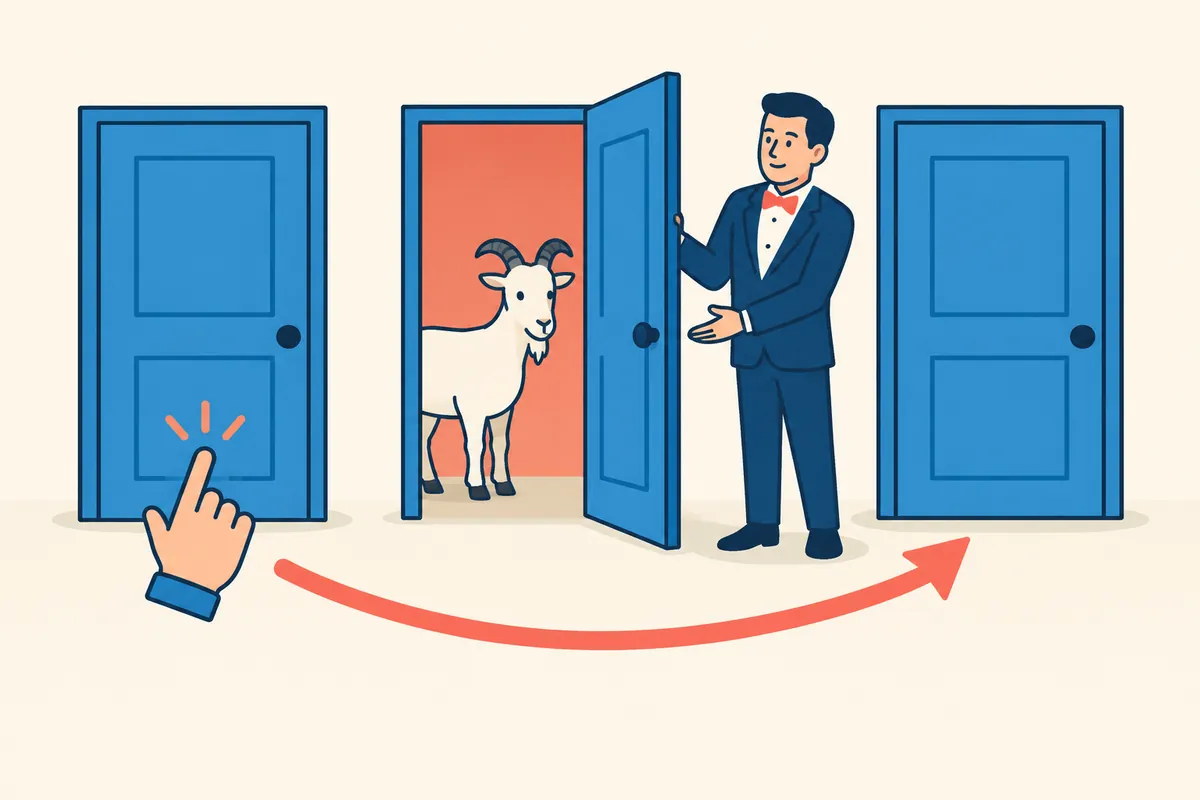
Default condition:Among A, B, and C, the locations of the prizes are evenly distributed and independent of the first choice. The participant chooses A. The host knows the location of the prizes, opens one unchosen empty door each time, and gives the participant a chance to switch to the remaining door each time. If there are two empty doors that can be opened, they are chosen with equal probability.
Problem 1. What is the probability of winning if you always switch under the base conditions?
① 1/3 ② 1/2 ③ 2/3
View Answer/Explanation — Question 1
Answer: ③ 2/3.The probability that the prize is initially in A is 1/3, and if you switch at this point, you lose. The combined probability that it is initially in B or C is 2/3, and since the host opens an empty door, switching moves you to the prize door. The fact that two doors remain does not mean that the probability is equal.
Problem 2. If the product is in B and you choose A?
Explain the results of the host opening and swapping under the basic conditions.
View Answer/Explanation — Question 2
Open C and change it to B to win.Since the participant chose A and there is a prize in B, the host can only open C. This is one instance where switching wins if the initial choice is incorrect. However, this single instance does not guarantee a win in every round.
Problem 3. What if the host opened a door randomly without knowing, and it happened to be empty?
The host does not know the location of the prize. The initial choice A is left as is, and one of B or C is opened randomly and evenly. Only the case where an empty door is opened is included in the observation, and the case where a prize is opened is excluded. What is the conditional probability of winning by switching to the remaining door?
View Answers & Explanations — Question 3
In this variation, 1/2.Out of the 6 equivalent cases created by 3 product locations and 2 door openings, there are 4 cases where the empty door was opened. Of these, there are 2 cases where the first A is the correct answer and 2 cases where the remaining door is the correct answer. With the condition of observing the empty door, the result is 2/4 for each. The basic game and the host's information and action rules have changed. This is the result calculated directly under the specified variation conditions.
Problem 4. If you play the base game 3 times, are you sure to win 2 times with the swap?
Consider the range that a probability of 2/3 speaks of.
View Answer/Explanation — Question 4
It is not necessarily true that you win twice.The expected multiplier for three independent attempts is 3 × 2/3 = 2, but the actual multiplier is one of 0, 1, 2, or 3. For example, if you choose the first answer for all three attempts, you win 0 times by switching. Do not read the expected value as a guarantee of short runs.
Please check the text below and the official training materials for a detailed comparison of calculations and conditions. You can read the problem without clicking on ads or logging in.
Key Summary: Under standard conditions, where the host knows the location of the prize, always opens an empty door, and always provides a chance to swap, the swap rate is 2/3. Variations where the host opens randomly are a different matter, so you must read the rules of conduct first.
Order at a Glance
This is an illustrative diagram. It is not a screen capture or an actual test result.
1.Product Location and First Selection Conditions
2.Checking information known by the host
3.Always check door/replacement rules
4.Divide the three cases into a table
5.Variation conditions are calculated separately.
I don't just watch the scene where two doors remain.
The Monty Hall problem starts with a situation where a prize is in one of three doors and a participant chooses the first door. Then, the host opens an empty door and gives the participant a chance to change their choice. If you judge the probability to be 50/50 based solely on the fact that two doors are closed at the end, you omit the rule by which the host selected the doors.
This article provides four self-created learning quiz questions and case analysis explanations. It does not reproduce scenes from the original broadcast or analyze the results of actual participants. There are no features to save quiz scores or determine IQ or personality traits. You can think of the correct answer first and then expand the answer and explanation viewing area to read the reasoning.
Fixes the default conditions all at once
It is assumed that the location of the prize is determined with equal probability for A, B, and C, and is independent of the participant's initial choice. The participant chooses A. The host knows the location of the prize and opens one empty door that the participant did not choose each time, while giving the participant an opportunity to switch to the remaining door each time. It is specified that if there are two empty doors to open, they are chosen with equal probability.
The educational materials from MIT and Berkeley address the switching probabilities of standard problems while explaining the host's information and behavioral conditions. In this text, the observation that a door was opened is a result of such a rule. If the question is conditioned on opening a specific door, the rule for choosing between the two empty doors can also be influenced, so here it has been fixed to an equal probability choice.
| Basic Conditions | Why is it necessary? | Remaining questions when missing |
| Product Locations A, B, and C: 1/3 each | Basic probability of the initial choice | Is the location probability the same for every door? |
| First selection and product location independent | So that selection information does not already exist | Did the participant know the location hint? |
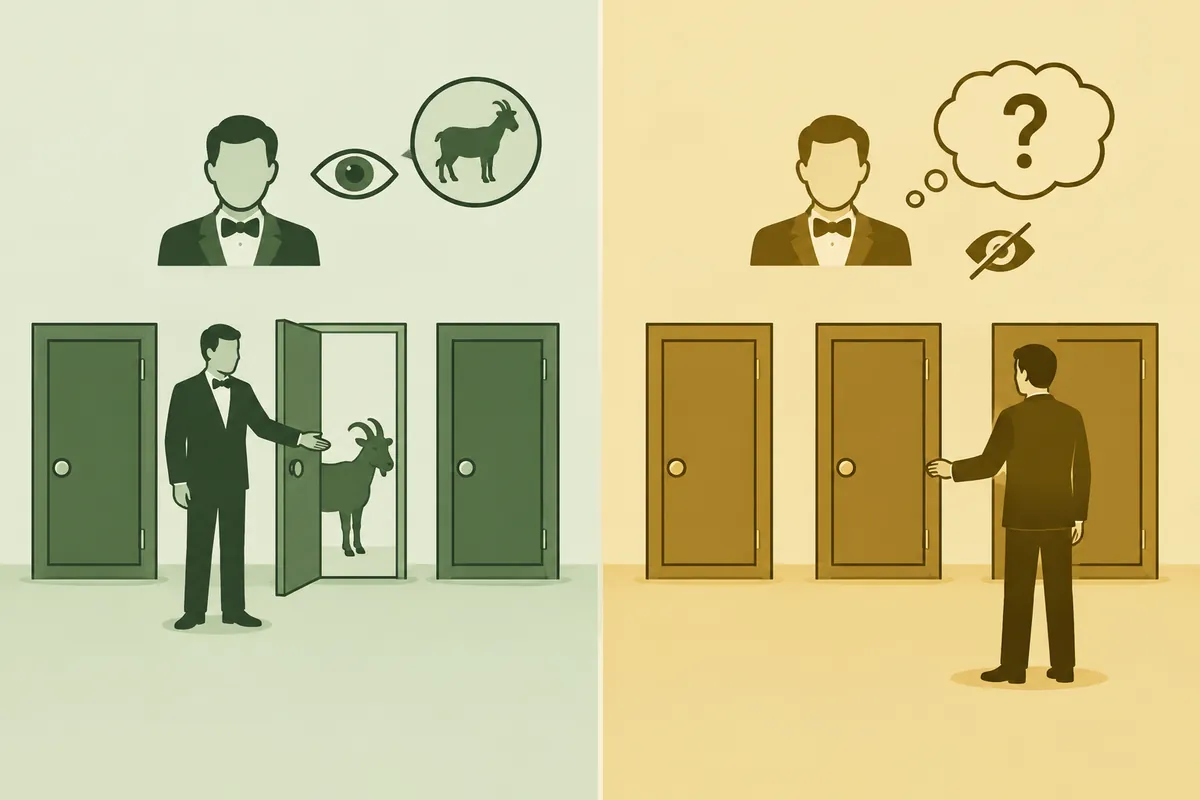
| The host knows the location | Can open by avoiding the product door | Did I accidentally open an empty door without knowing? |
| Always open unselected empty doors | Observation occurs in the facilitator's rule | Does it open in some cases? |
| Always provide replacement opportunities | Prevention of selection bias in the replacement proposal itself | Does it suggest only when it is the first correct answer? |
| If two are empty doors, the probability is equal | Calculation that applies conditions to specific open doors | Is there a preference for the door name? |
| Distinguishes between products and empty doors | Clarification of the definition of victory in results | Are there various items or other rewards? |
Divides the case where the first choice is right or wrong
If the prize is in the first door chosen, A, the initial choice is correct, and the probability is 1/3. The host loses if they open the empty door B or C and switch to the remaining empty door. If the prize is not in A, the initial choice is incorrect, and the probability is 2/3. Since the host must open an empty door among the other two, the prize is in the remaining door, and they win if they switch.
Since the case where the first choice is wrong is linked to the win of the swap, the probability of the swap under standard conditions is 2/3. We do not assume that the probability of A's initial choice randomly changes to 1/2 the moment a door opens. Examine the table to see the procedure by which the revealed information was obtained and how that procedure works in each case.
| Product Location | First selection A | The door opened by the host | maintenance result | Replacement Result |
| A (1/3) | First answer | B or C, each with the same probability | Victory | Defeat |
| B (1/3) | First incorrect answer | Only C is allowed | Defeat | Victory |
| C (1/3) | First incorrect answer | Only B is possible | Defeat | Victory |
| Total | First answer 1/3 | Opens the empty door every time | Win 1/3 | Victory 2/3 |
Connect the explanations for problems 1 and 2.
The first question asks for the probability of winning when switching under the basic conditions, and the answer is 2/3. The second question asks for a single case where the prize is in B and A is initially chosen. Since the host cannot open the selected A or prize door B, C is opened, and if the participant switches to B, they win. One is the probability for all cases, and the other is the result for a specific case.
Do not interpret the explanation that you won in specific cases as a guarantee of a win. Conversely, if you change the example to only the case where the prize is at A, you cannot say that you always lose. Indicating which row in the case table is being described makes it easier to distinguish between probability and individual results. The quiz examples are problems based on assumed prize locations and are not actual game results.
If the host opens it randomly without knowing, the conditions change.
In the third item, it is assumed that the host opens either B or C with equal probability without knowing the location of the prize. Only the case where an empty door is opened is recorded in the observation, while the case where a prize is opened is excluded. In this conditional observation, the winning probability of holding and switching is 1/2 each. This differs from the behavior of the host in the basic problem, who always avoids the prize.
Combining the 3 product positions and 2 door/open positions of the variation creates 6 cases with equal probability. Excluding the 2 cases where the product is opened, 4 cases remain. For the 2 rows where the first A is the correct answer, Maintain wins, and for the remaining 2, Replace wins. This is a calculation derived directly from the conditions of the specified variation.
| No-information host variation | Open Door | Includes empty statement observation | Maintenance / Replacement |
| Product A | B | included | Win / Loss |
| Product A | C | included | Win / Loss |
| Product B | B | Exclude: Product reveal | Excluded from this conditional sample |
| Product B | C | included | Defeat / Win |
| Product C | B | included | Defeat / Win |
| Product C | C | Exclude: Product reveal | Excluded from this conditional sample |
| Remaining 4 cases | All the same original probability | Conditional normalization to 1/4 each | Maintenance 2/4 / Replacement 2/4 |
Re-verify conditional probability as a fraction
In the no-information host variant, the probability of the first A being correct and seeing an empty door is 1/3. The probability of the first A being wrong but seeing an empty door is (2/3) × (1/2) = 1/3. The total probability of seeing an empty door is the sum of the two values, 2/3. Therefore, the probability of winning with the condition of seeing an empty door is (1/3)/(2/3) = 1/2.
It is important to indicate which cases were excluded from this calculation. The reward rules for the game, which include cases where the prize is opened, were not covered here. Do not read the probability conditional on seeing an empty door as the same value as the probability for all runs. When stating the result, include the condition that it applies only when an empty door is opened.
직접 만든 변형 계산 기록
P(initial=A) = 1/3
P(empty | initial=A) = 1
P(empty | initial≠A) = 1/2
P(empty) = (1/3)*1 + (2/3)*(1/2) = 2/3
P(stay wins | empty) = (1/3)/(2/3) = 1/2
P(switch wins | empty) = 1 - 1/2 = 1/2

표준 게임은 진행자가 위치를 알아 항상 빈 문을 엶.
위 변형은 진행자가 위치를 몰라 무작위로 엶.
같은 마지막 장면을 보더라도 정보 생성 절차가 다릅니다.
Expected wins are not a guaranteed number of occurrences
The fourth question asks whether switching guarantees two wins when playing a standard game three times independently. The expected multiplier is 3 × 2/3 = 2, but the actual multiplier can be one of 0, 1, 2, or 3. Since the expected value is a concept that averages possible outcomes and their probabilities, it is not a guarantee that it will be realized exactly as is in a short run.
If you choose the product door first all three times, you lose all times by switching. The probability in this case is (1/3)³ = 1/27 under the assumption of independence. Conversely, if you choose the wrong answer first all three times, you can win all times by switching. If the probability of 2/3 is interpreted as a rule that it must happen twice out of three times, it cannot explain such possible cases.
Expanding the explanation shows the answer and the reasoning together.
The answer and explanation viewing area for each question can be expanded by clicking or using the keyboard. You do not necessarily have to view the answer to another question first even if you open one question. You can close it by pressing it again, allowing you to reconsider the conditions with the answer hidden. This quiz is for learning purposes only and does not involve answer submission, grading, or saving records.
The mere fact that the explanatory text is visible does not constitute verification of the actual blog's expand function. During the writing process, the question and explanation structure and case calculations are checked, and verification of opening and closing with a mouse and keyboard within the saved Tistory body remains during the publishing process. If the function does not work, it must not be marked as "Web Function Verification Complete," even if the calculation explanation is correct.
Six Questions to Ask When Reading Famous Questions
Check if the initial probabilities are equal, if the choice is independent of the prize, if the host knows the location, if an empty door is always opened, if there is always a replacement offer, and what the rule is for selecting the door to open. If any of these differ, you must redefine the cases and conditions before obtaining the base answer. It is not a problem that is numerically identical just because it is called Monty Hall.
It is more accurate to note that conditions are insufficient rather than guessing unspecified conditions to arrive at the correct answer. When sharing actual quizzes, please convey the basic conditions of the question along with the answer; do not send only the answer as 2/3. This article compared the differences between two predetermined models using a self-made table and did not investigate the actual behavior of broadcast hosts or participant statistics.
How to verify my explanation
First, divide all possible product positions without omission and record the doors that can be opened in each case according to the host's rules. Finally, add the probabilities for the Hold/Swap winning rows. When there are multiple possible actions, divide the probabilities by the number of rows and check if the sum is 1. Counting only the number of rows may lead to errors in tables with different weights.
Keeping the tables of standard conditions and information-free variations separate clarifies which answer corresponds to which condition. The case calculations were performed via offline verification and do not constitute a claim of actual simulation or user play. The official training materials serve as the basis for confirming the importance of the standard model and conditions, and the four questions, variation tables, and checklist were created by me.
Official Source and Verification Scope
- Berkeley — Monty Hall Conditions and Probabilities
- MIT OCW — Monty Hall Probability Lecture Transcript
Official data verified on: 2026-10-08. Re-verified publication date items: Host information · Always open · Always replace · Tie action conditions, expected value of independent iterations. Check the opening and closing of the four explanations in the saved text.
AI Authoring Assistance. The examples, figures, and work records in this text are self-created illustrative examples. They are not presented as experiences performed in actual user environments or measurement results.
Original illustrations created to help explain this article.
Original on Tistory ↗