Creating Reading Notes with Claude: Distinguishing Between Quotes and My Interpretation
This article was translated from its source language with AI assistance. Please check technical terms and equations against the original.
Key Summary: When creating reading notes with Claude, separate original text quotations, content summaries, and your interpretation into distinct columns. For quotations, directly compare the location with the original text, and leave any claims not found in the source as unconfirmed.
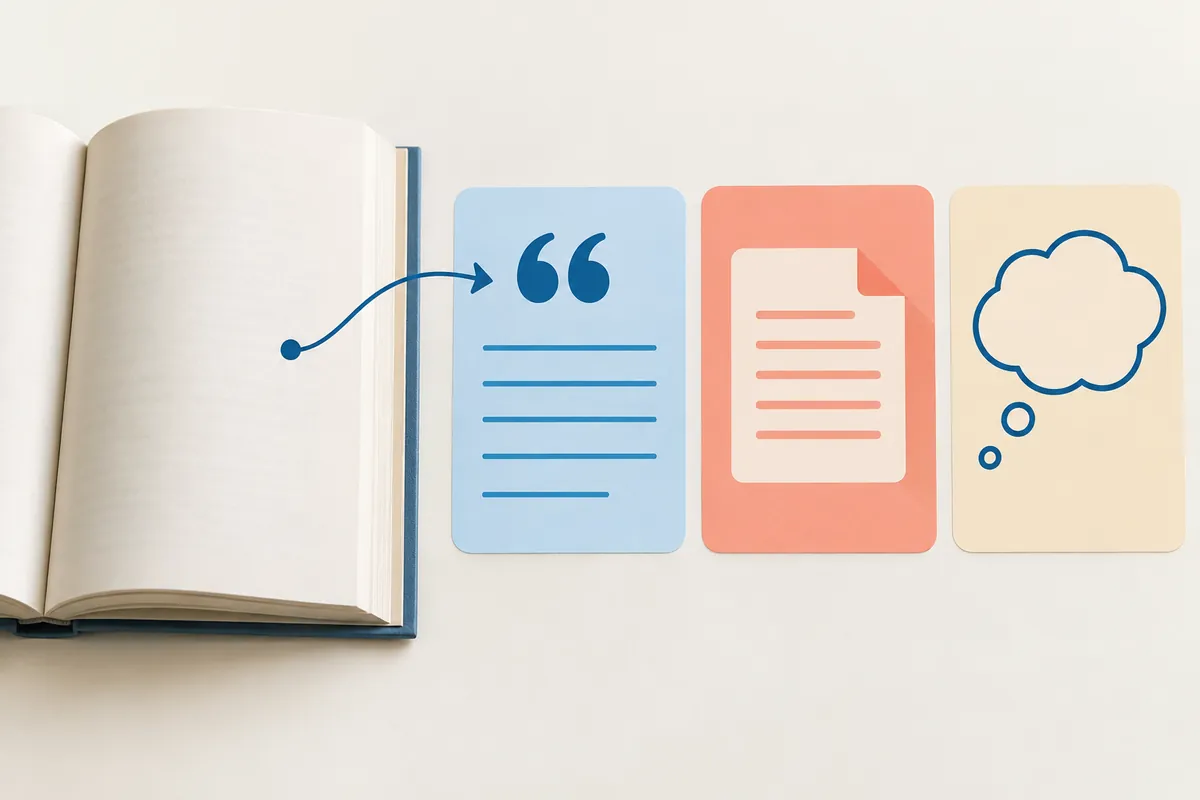
Order at a Glance
This is an illustrative diagram. It is not a screen capture or an actual test result.
1.Specify data and read range
2.Distinction between citation, summary, and personal interpretation
3.Page or paragraph position record
4.Compare AI results with the original text
5.Leave follow-up questions and unanswered questions
First, divide the three sections of the reading notebook.
A short sentence taken directly from the book, a summary of that sentence organized in my own words, and an interpretation I came up with after reading are all different things. If you simply ask Claude to summarize it into a single paragraph, this boundary can become blurred. Dividing the notebook into sections first and marking which content was verified in the original text helps with rereading and verification.
This post is not a review based on reading an actual book on behalf of the author, but rather a proposal for a procedure to organize materials provided by readers. The sentences below are fictional sentences created by the author. I do not fabricate and quote actual author sentences, nor do I present them as if they were summaries of books I have not read. Please do not assume that the AI's response is a verified citation simply because it sounds natural.
| Note Types | writing method | Basis for verification |
| Short quote | Record the original expression exactly as it is within the limited length | Comparison of actual sentences, paragraphs, and pages |
| Content Summary | I will summarize the meaning in my own words | Maintain the subject and condition of the original text |
| My interpretation | Stated as the reader's opinion | Distinction from the author's argument |
| Interpretation proposed by AI | Mark as AI suggestion | Review of Reader Consent and Basis |
| Follow-up question | Questions that have not yet been answered | Do not randomly generate answers not found in the data |
| Application Idea | Assumptions to be used in other situations | Not changed to actual author's application examples |
| Unidentified Location | Page/paragraph not found yet | Do not mark as confirmed |
First, determine the data name and the reading range.
Rather than simply providing the book title and asking for a summary, determine the scope of your reading and the materials to be provided. Indicate chapter, section, page, or paragraph numbers and request that the content be covered only within this range. It is important not to assume that any parts for which materials were not provided have been read. Page locations may differ depending on the edition.
When providing the text, consider the usage permissions and necessary scope; there is no need to start by unconditionally uploading the entire book. You can narrow down your question to just a short direct summary or the parts to check. This post is not a record of reviewing publication usage rights or uploading external files, and the actual scope of material access must be verified within the user environment.
Check the scope of Claude file support.
Claude Official Help provides guidance on how to provide files to individual conversations or projects and the scope of support. In particular, general non-PDF documents involve text extraction and must be distinguished from the scope of interpreting included figures. If the note requires reading tables or figures, first check what information is actually being provided.
The mere fact that a file is attached does not mean that all pages, comments, and figures have been loaded. You can verify this by specifying representative paragraphs and tables, and depending on the model and format, actual support conditions should be read again in the official help. This article has not personally investigated the current account's pricing plans, restrictions, or project feature availability, so the same screen cannot be guaranteed for all readers.
Let's divide virtual statements into three ways.
Assume the self-created sentence “Observation records are the starting point of interpretation, not the conclusion itself” is the first paragraph of hypothetical reading material A. You can write this short sentence exactly as it is in the quotation box and mark the location as A-1. In the summary box, write the meaning that you are distinguishing between the record and the conclusion, and in the my interpretation box, write your personal thoughts on wanting to separate work records from causal judgments.
The three columns are not intended to repeat the same content. Citations serve different roles: they provide the basis for expression and placement, summaries convey the meaning of the original text, and interpretations facilitate new connections for the reader. Even if my interpretation is persuasive, I do not rewrite it simply because the fictional author personally stated that specific work example.
| Self-made material A-1 | Note Content Example | display |
| Quoted from original text | The record of observation is the starting point of interpretation and is not the conclusion itself. | Virtual Sentence / A-1 |
| Summary | Read as meaning that recorded facts should not be treated as final judgments. | Summary written by a reader |
| My interpretation | I want to write error logs and cause hypotheses in separate columns for work | Reader's Application Thoughts |
| AI Proposal | Proposal for a method of dividing notes by observation, hypothesis, and verification results | Structure proposed by AI |
| Follow-up question | What verification method does this material recommend? | The answer cannot be confirmed based solely on the provided sentence . |
| Inappropriate zoom | The author experimented with a log analysis method for a specific program. | Excluded as it is a claim not present in the sentence |
In citations, attach the location as well as the content.
If the page number is clear, write down the edition and page number; if the page number is missing from the provided text, you may use paragraph numbers or identifiers within the material. Do not record page numbers randomly generated by the AI as the actual book locations. If the page number is not visible, it is accurate to indicate that the location is unconfirmed.
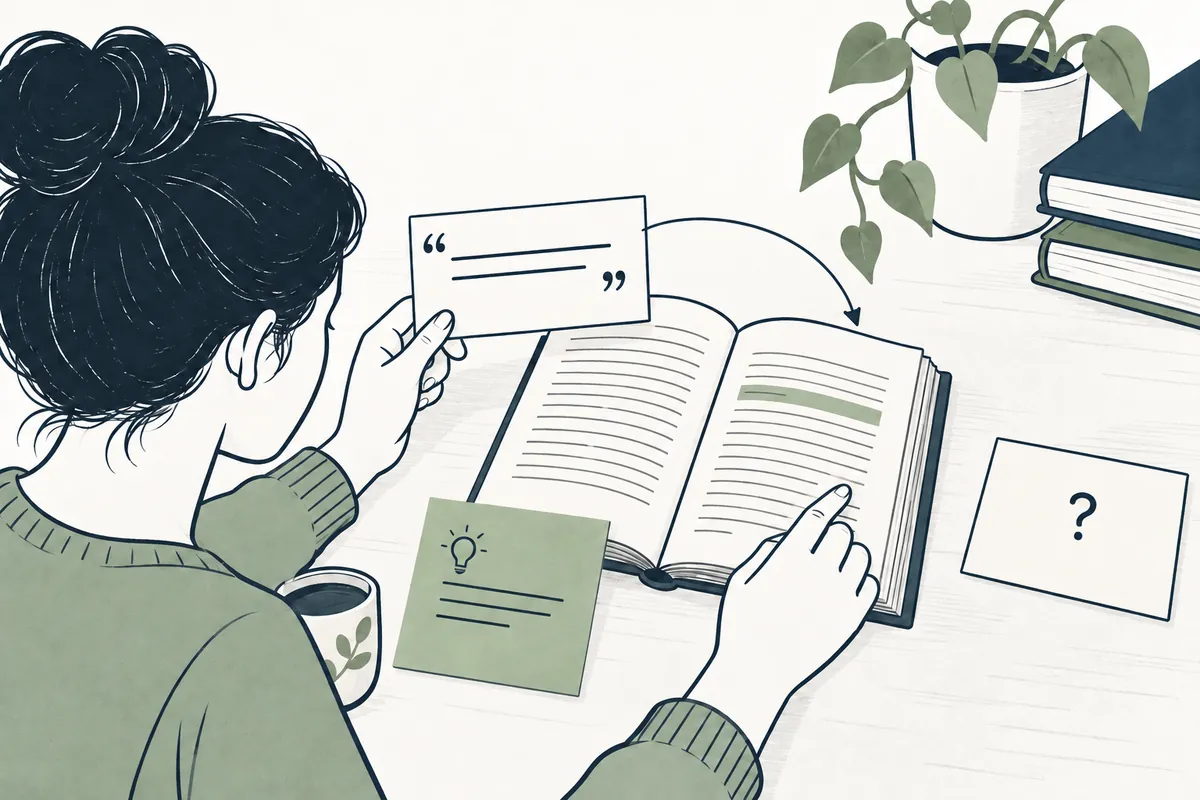
Since the same sentence may appear in multiple locations, check the chapter, section, and surrounding context as well. The fictitious A-1 identifier is a number from the text example, not an actual page in the book. Create a location record sufficient to locate the sentence when reopening the material, but do not convert it into a note that duplicates the entire long original text.
설명용 독서 노트 양식
Document label: reading-example-A
Edition / version: record actual edition
Provided scope: chapter or paragraph range
Read by user: confirmed scope / not confirmed

Note 01
Type: short quote
Source location: paragraph A-1 (fictional example)
Exact text: 관찰 기록은 해석의 출발점이며 결론 그 자체는 아니다.
Verified against original: yes / not yet

Note 02
Type: paraphrase
Summary: 관찰 기록과 최종 판단의 역할을 구분한다.
Source location: A-1
Conditions preserved: check subject and scope

Note 03
Type: personal interpretation
Idea: 로그 사실과 원인 가설을 별도 칸에 적어 보겠다.
Attributed to author: no
Evidence for application: not tested

Note 04
Type: open question
Question: 어떤 검증 절차를 권하는가?
Answer in provided passage: not found
Maintains targets and conditions in the summary
If the original text explains certain situations but the summary expands them to apply principles to all situations, the meaning changes. Please request that the subject, conditions, and exceptions be organized together. For example, to avoid errors such as using a paragraph of advice as the author's entire theory or twisting a question into a conclusion, it is recommended to compare the original text and the summary side by side.
If a summary sentence is long, it can be broken down into units of claims to be verified. It distinguishes between claims in the original text and explanations generated by AI, and translates connecting parts if necessary. Source evidence is not established merely because sentences flow naturally. The scope of what the reader actually read and the scope of verification are also recorded.
My interpretation may elicit both agreement and counterargument.
The interpretation section of the reading notes is not a place to unconditionally praise the original text. You can write down thoughts such as parts you agree with, conditions you want to verify further, or whether there might be counterarguments. Questions suggested by the AI are recorded as questions and are not assumed to have answers already in the original text. Your own application examples are plans or assumptions until you actually try them out.
Even if an interpretation linking a hypothetical sentence to a business log is useful, do not present it as an experimental result in a book. Distinguishing between the reader's thoughts and the author's statements makes it easier to modify the interpretation later while reading other materials. When having the AI suggest multiple interpretations, request that it output them in a separate column from the facts stated in the provided material.
Read the scope of the project's data sharing and conversation.
Claude The official project guide explains how to use the project knowledge to provide materials. If your purpose is to refer to the same material across multiple reading conversations, you can distinguish between the scope of individual conversations and the project knowledge. It is not assumed that the questions and answers in all conversations share the same context simply because the material has been uploaded to one place.
When starting a conversation, reiterate which materials and scope you are targeting. Clearly label the materials, as placing different editions or notes with the same title together can mix up their locations and contents. This post did not create an actual project or upload files. You must verify whether this feature is available on your account through the screen and official guidelines.
설명용 Claude 요청문
제공 자료 A의 지정 범위만 사용해 독서 노트를 정리해줘.
출력은 인용 / 내용 요약 / 내 해석 후보 / 후속 질문으로 나눠줘.
인용은 짧게 쓰고 원문 위치를 붙여줘. 위치를 못 찾으면 미확인이라고 적어줘.
요약은 원문의 대상·조건·예외를 유지하고 없는 주장이나 페이지를 만들지 마.
해석 후보는 저자의 말이 아니라 AI 제안이라고 표시해줘.
내가 제공하지 않은 장이나 그림을 읽었다고 가정하지 마.
자료에 답이 없는 질문은 답을 만들지 말고 추가로 확인할 범위를 알려줘.
마지막에 원문과 직접 대조해야 할 문장을 목록으로 남겨줘.
Find three errors in the completed notes
I check whether the sentences within the quotation marks match the actual expressions, whether the summary has expanded the scope of the original text, and whether my interpretation has been written as the author's argument. These three points are a separate review from sentence length or writing style. One cannot conclude that the fidelity of the citations in the notes has been verified solely on the grounds that the writing has become neater.
For locations and sentences that have not been verified, keep them marked as unverified and locate the necessary source text again. If a citation is incorrect, correct it to a shorter, more accurate expression or convert it to a summary, attaching a "summary" label. Do not write "verification complete" for corrections unless they have actually been compared.
Completion criteria for reading notes
Including the name and scope of the material, the actual location of short citations, and indications of the conditions and personal interpretations of the summary makes it easier to reconstruct the meaning upon rereading. Follow-up questions can be left unresolved, and filling in every question is not a prerequisite for completing the notes. Clearly noting unverified details is also a useful outcome.
Claude Official sources serve as the basis for verifying file provision and the scope of project materials, while virtual sentences, note formats, and requests were written personally. I did not manipulate sentences from actual books or create and insert actual user experiences. While AI can assist with organization, the step of comparing citations with one's own interpretation must be verified separately in the deliverables.
Official Source and Verification Scope
- Claude Help — File provision and format handling scope
- Claude Help — Projects and Knowledge Resources
Official data verified on: 2026-10-08. Items re-verified by publication date: Currently supported formats, figure processing, and project usage conditions. Actual book edition, coverage scope, and citation locations are directly compared with the source text.
AI Authoring Assistance. The examples, figures, and work records in this text are self-created illustrative examples. They are not presented as experiences performed in actual user environments or measurement results.
Original illustrations created to help explain this article.
Original on Tistory ↗