Leave configuration file cleanup to the Codex: Defaults and environment-specific differences
This article was translated from its source language with AI assistance. Please check technical terms and equations against the original.
Key Summary: When entrusting configuration file cleanup to the Codex, first separate common defaults, environment-specific differences, and values overwritten at runtime. Rather than shortening key names, you should verify that the final applied values are preserved and that the code being read is correct.
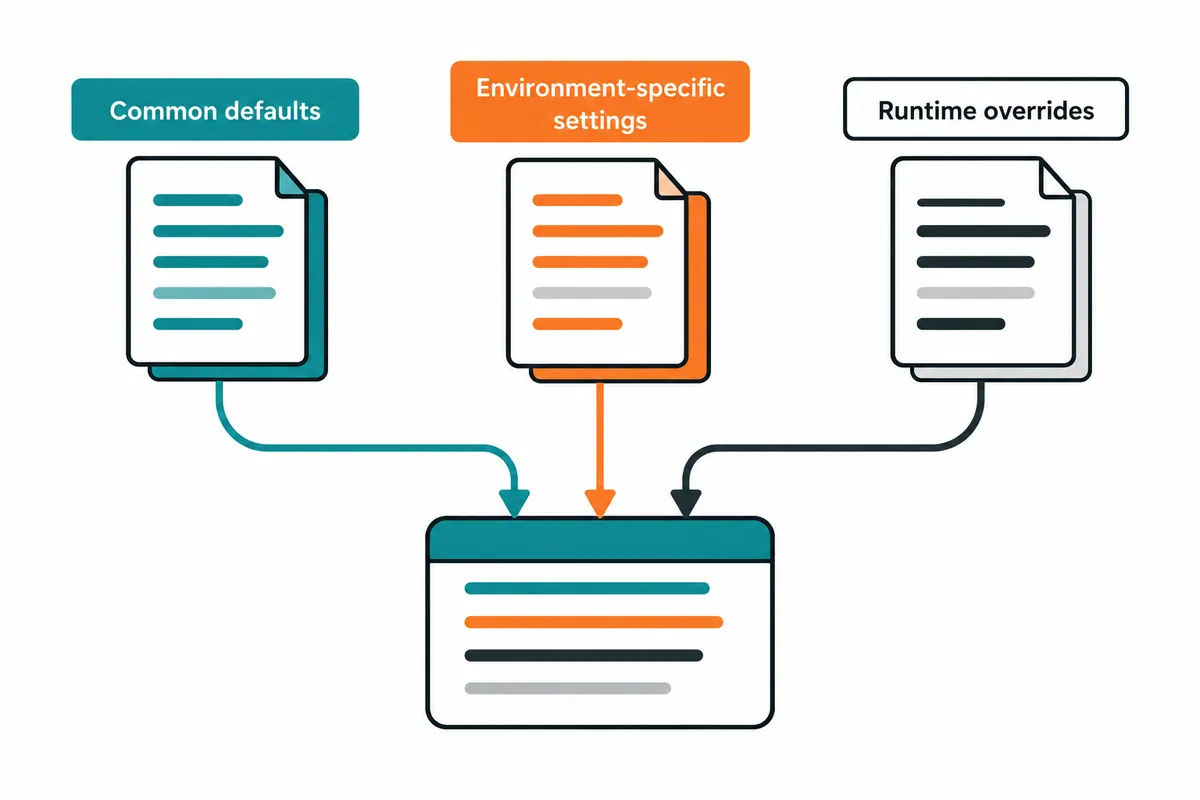
Order at a Glance
This is an illustrative diagram. It is not a screen capture or an actual test result.
1.Find the code and file list to read
2.Default Values · Environment Differences · Secret Separation
3.Create application priority table
4.Review of minor changes and differences
5.Verification of final values in the representative environment
does not immediately delete the same value just because it exists in multiple places.
Development projects may contain values for default settings, development environment settings, run options, and deployment environments. Deleting duplicates simply because they have the same name or value can alter default values or environment-specific behavior if they are omitted. First, verify which code reads which file and what determines the final value.
This post is a work design requesting organization from the Codex. I have not modified or distributed any actual project files. The app-settings example below is a virtual application setting created by me and is not presented as a key supported by the Codex's config.toml. You must distinguish between the Codex's own settings and the settings of the app you are working on.
also distinguishes the scope of the Codex's own settings.
Current official OpenAI documentation explains that personal preferences can be placed in ~/.codex/config.toml, and project-specific .codex/config.toml can be used. There is also a condition that project settings are read from trusted projects. Since there are multiple layers of priority, such as run options, projects, and personal settings, only one file is read to determine the final behavior.
Please propose settings after verifying the actual supported keys and their scopes in the official Configuration Reference. Cleaning up the app's own configuration files does not automatically equate to changing the Codex's security and permission settings. This article has not altered the user's actual Codex settings or access permissions, nor has it arbitrarily fixed Model, Pricing, or Account features.
| cleanup target | Basis to find | Range to decide |
| App common default value | Configuration Loader · Schema · Basic Constants | Operation when all environments are missing |
| Differences by environment | Development, test, and production files and execution methods | Will I really separate only the different values? |
| execution options | CLI arguments or launcher code | Whether it takes precedence over the file |
| environment variable | Variable names to read and basic processing | investigate only the name without printing the secret value |
| Codex Personal Settings | Official config basic documentation | Individual client range |
| Codex Project Settings | Official Key/Trust Conditions | Project Coverage |
| Management Policy | Actual applied organizational requirements | Distinguishing between simple default values and forced conditions |
| Unused candidate | Dynamic access to all references and loaders | Do not delete immediately just because it was not found in search |
Find the code to read and create a table starting from priority.
Request the Codex to locate the file list and configuration loader, and ensure that the paths through which each key is read are organized before modification. If a virtual app reads the default file first, overwrites the environment file, and applies execution options last, you must record that order. Do not generalize this order to other apps.
Keys that do not appear in reference searches may also be available for dynamic access or use by external tools. To remove candidate keys, you must review the code, documentation, and execution paths that read them. By distinguishing between references that have been verified and use cases that have not yet been verified, you can specifically assess the risk of deletion. The mere fact that a setting has been read does not mean that execution in all environments has been tested.
Divides common default values and environment-specific differences into virtual examples.
In the app-settings example below, it is assumed that timeout_seconds is 30 in all environments, while endpoint and log_level vary by environment. You can consider a design where common values are kept in the default file, and only differences are recorded in the environment file. However, you must first verify whether the app actually has a loader that merges missing keys into default values.
Some apps can read a single environment file without merging files. In such apps, deleting common values from the environment file may cause keys to disappear. Do not create files that look concise first before verifying the code. The criterion for completing the cleanup is not whether the file has become shorter, but whether the final settings of the representative environment have been maintained as intended.
가상 앱의 설정 설계 — Codex config.toml 지원 키 예시가 아님

app-settings/base.json
{
  "timeout_seconds": 30,
  "retry_count": 2,
  "log_level": "INFO",
  "endpoint": "https://service.example"
}

app-settings/development.json
{
  "endpoint": "http://localhost:8080",
  "log_level": "DEBUG"
}

app-settings/test.json
{
  "endpoint": "http://localhost:8081",
  "retry_count": 0
}

app-settings/production.json
{
  "endpoint": "https://service.example"
}

가정: 이 앱의 로더가 base → selected environment → explicit CLI 순서로 합침.
가정을 실제 로더에서 확인하지 않았다면 이 구조로 이동하지 않습니다.
비밀값은 파일 예시에 넣지 않고 별도 전달 방식의 변수 이름만 기록합니다.
First, predict the final values for each environment to create verification criteria.
Creating tables of final values for development, testing, and production before and after cleanup makes it easy to read the impact of changes. If the default value is 30 and there is no separate timeout for a specific environment, verify whether using 30 is intended for that environment. No value, a value of 0, and an empty string can be different inputs.
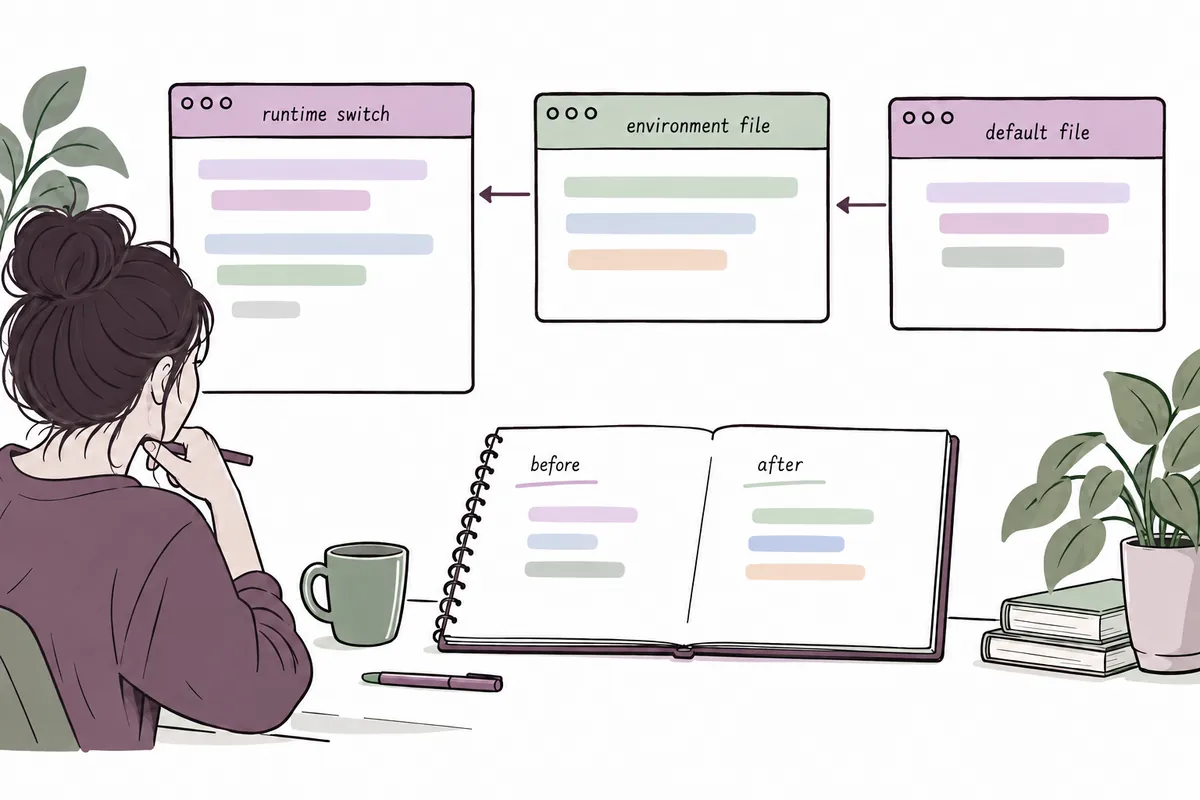
The validation table includes unknown environment names or missing required values in addition to normal environments. If the result is that inputs that are supposed to fail are executed silently using operational defaults automatically, it may not serve the purpose of cleanup. The tables in this article represent hypothetical expectations and are not actual test results. Only the checks performed should be recorded separately.
| Virtual Environment · Input | timeout | retry | log level | for verification purposes |
| development basic execution | 30 | 2 | DEBUG | Merging default values and environment differences |
| test basic execution | 30 | 0 | INFO | Do you not consider 0 as missing? |
| production default execution | 30 | 2 | INFO | Maintain default operation |
| development + timeout override 10 | 10 | 2 | DEBUG | Check explicit option priority |
| Unknown environment name | definition needed | definition needed | definition needed | Determine failure or default processing policy first |
| Missing Required Endpoint | Based on the corresponding schema | Based on the corresponding schema | Based on the corresponding schema | Review whether to use the quiet default |
| timeout="abc" | Validation required | Whether to retain other values | Whether to retain other values | Type conversion failure log |
| retry=0 | 0 | 0 | Environment Standard | whether the conditional statement overwrites 0 with false |
The cleanup request specifies the scope of modification.
If you simply request that the Codex optimize all settings, the scope of investigation, relocation, and key changes may become too broad. First, investigate the loaders and their usage, and request an explanation of the behaviors to be modified and those to be retained. Changes involving moving file names and renaming keys have different impacts, so it is easier to review them if not grouped together.
The request statement below is a self-written example for a virtual project. It clarifies the scope to ensure that candidate deletion or security setting changes are not executed before the actual files are read. The guidelines applicable to the project and the scope of user permissions must be considered together, and the mere fact that it is written in the request statement does not substitute for actual verification.
설명용 Codex 요청문
1. app-settings/와 설정을 읽는 코드를 찾아 파일·키·참조 위치를 정리해줘.
2. 수정 전에 기본값, 환경 파일, 실행 인자의 실제 우선순위를 설명해줘.
3. 비밀값은 출력하지 말고 필요한 변수 이름과 전달 경로만 적어줘.
4. 사용하지 않는 키는 근거와 미확인 사용처를 구분해 후보로만 표시해줘.
5. 개발·시험·운영의 현재 최종값과 변경 후 기대값을 비교해줘.
6. 첫 변경은 공통 기본값 정리로 제한하고 키 이름·파일 이동은 별도 제안해줘.
7. 누락·0·빈 문자열·잘못된 환경 이름 처리를 유지하는 검증을 포함해줘.
8. 실제 실행하지 않은 검사는 미실행으로 표시해줘.
9. 변경 파일과 되돌릴 범위, 남은 확인 항목을 알려줘.
does not duplicate the actual value when cleaning up the location of the secret value.
Even if secret values are discovered during the configuration investigation, there is no need to copy them directly into the body, examples, or logs. What is needed are the variable names, how they are passed in different environments, and how they are handled in case of omission. During the cleanup process, changes to merge the delivery paths for general default values and authentication information into the same file are not automatically suggested.
Issues such as whether sensitive information exists in already tracked files can be addressed in a separate scope, but this article did not investigate the secret values in the actual storage. Virtual app examples use only public description addresses. Expressions claiming that security improvements have been made should be used when there is actual change and verification evidence.
Review the differences, specifically looking at the deleted default values.
In the change list, look at which keys have been moved and which values have been removed, rather than just the number of files. Even for the same key, changing it from a number to a string or removing empty values can affect the loader's processing. Also, check if the comments and documentation explain the actual scope of support.
If the final values and error input handling of the representative environment were maintained, the verification results for that range can be recorded. Environments that could not be executed are left as unverified. Code searching and file structure checks alone are not reported as completion of normal execution in the production environment. The scope of the checks actually performed, as required by project guidelines, is also disclosed.
In the document, write the setting name and scope together.
In the README, rather than simply listing key names, describe the units, default values, environment-specific differences, and behavior when they are missing. For example, you must explain based on the actual loader whether `timeout_seconds` is in seconds and how 0 is interpreted. If the same name has different meanings in different environments, it becomes a separate candidate requiring naming standardization.
When describing Codex settings, we link to official support keys and the scope of the current documentation, and do not mix them with virtual app keys. Since setting priorities can be linked to execution methods or management policies, we leave them as items to re-check the official documentation on the date of publication. We do not confirm the application status of specific accounts until we verify it directly.
Completion is determined by the final applied value and failure behavior.
We record the number of cleaned files, common values to retain, environment-specific differences, and representative verification results. You must also check what failures occur from missing or incorrect inputs to determine if default values are masking errors. Recording the files to revert and the range of changes allows you to use the same criteria when adding the next environment.
The official OpenAI sources are based on the Codex Personal/Project Setup and Support sections, while the virtual app's merge structure, requests, and expected value tables were written by me. I have not presented actual project modification, deployment, or successful execution results. Set the goal of verifying that the app reads values with the same meaning before setting the goal of making files shorter.
Official Source and Verification Scope
Official documentation verified on: 2026-10-08. Items re-verified by publication date: Official Codex configuration hierarchy, supported keys, trust conditions, management requirements. The actual loader, merge, and execution priority of the app example must be verified separately within the project.
AI Authoring Assistance. The examples, figures, and work records in this text are self-created illustrative examples. They are not presented as experiences performed in actual user environments or measurement results.
Original illustrations created to help explain this article.
Original on Tistory ↗